
Hello
we are currently building a new semi-detached house
I am considering installing underfloor heating in the basement.
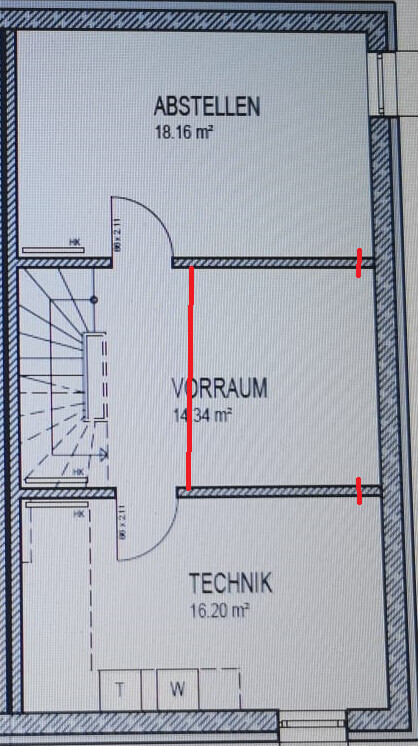
Our basement comes standard with conventional radiators under the stairs in the utility and storage rooms. As a special request, we will (red line) partition off this area as a separate room (of course with a door). The two lines at the back of the room will be ventilation slots to allow airflow since the other two rooms have windows.
The new room is intended as a pantry/storage room, and the storage room might be used as a workout room.
I have a few questions:
1: What do you think about installing underfloor heating throughout the entire basement? What are the advantages and disadvantages? The additional cost is 2700€.
2: In the underfloor heating package, the two rooms in the middle (hallway and newly partitioned room) will share a single heating circuit manifold, meaning the underfloor heating would be controlled by one thermostat and would heat both rooms. The underfloor heating would run beneath the new wall (a sand-lime brick wall).
My option would be, for an additional cost (amount unknown), to give the new room its own heating circuit, or to omit underfloor heating in that room altogether (which would of course reduce the extra cost of 2700€), or to have the hallway and new room share one heating circuit.
What would you recommend?
we are currently building a new semi-detached house
I am considering installing underfloor heating in the basement.
Our basement comes standard with conventional radiators under the stairs in the utility and storage rooms. As a special request, we will (red line) partition off this area as a separate room (of course with a door). The two lines at the back of the room will be ventilation slots to allow airflow since the other two rooms have windows.
The new room is intended as a pantry/storage room, and the storage room might be used as a workout room.
I have a few questions:
1: What do you think about installing underfloor heating throughout the entire basement? What are the advantages and disadvantages? The additional cost is 2700€.
2: In the underfloor heating package, the two rooms in the middle (hallway and newly partitioned room) will share a single heating circuit manifold, meaning the underfloor heating would be controlled by one thermostat and would heat both rooms. The underfloor heating would run beneath the new wall (a sand-lime brick wall).
My option would be, for an additional cost (amount unknown), to give the new room its own heating circuit, or to omit underfloor heating in that room altogether (which would of course reduce the extra cost of 2700€), or to have the hallway and new room share one heating circuit.
What would you recommend?

There was a discussion here last year about heating basements. The conclusion was that you can save a significant amount of money on heating costs by not heating the basement.
This makes sense when you consider that warm air rises and the basement will settle at a lower temperature without heating. The heating circuits on the ground floor then naturally need to run longer to compensate for the missing heat output in the basement.
We heated half of the basement, but with underfloor heating. Definitely do not mix the systems! Although I couldn’t see whether it was a heat pump, district heating, or gas, in all cases the supply temperature needs to be lower because you don’t have to heat the radiators.
This makes sense when you consider that warm air rises and the basement will settle at a lower temperature without heating. The heating circuits on the ground floor then naturally need to run longer to compensate for the missing heat output in the basement.
We heated half of the basement, but with underfloor heating. Definitely do not mix the systems! Although I couldn’t see whether it was a heat pump, district heating, or gas, in all cases the supply temperature needs to be lower because you don’t have to heat the radiators.
D
Deliverer6 Oct 2021 17:40OWLer schrieb:
It makes sense to some extent, considering that warm air rises and in an unheated basement, lower temperatures are established. The heating circuits on the ground floor then naturally require a higher flow rate to compensate for the missing heating output in the basement. Warm air only rises if the air above is colder. Basement 19°C (66°F), ground floor 21°C (70°F) → no rising occurs. And if you need higher flow rates and/or higher temperatures on the upper floor, it is not actually more economical than simply heating the basement as well. The goal of underfloor heating systems is ALWAYS to maximize the heated surface area, so that the temperature requirement is as low as possible.
An unheated basement only works if it is not part of the thermal envelope. But for that, it must be properly insulated from the ground floor. Nowadays, this can no longer be considered a desirable option.
Since radiators require completely different supply temperatures than underfloor heating, you should definitely not combine the two.I don’t see any technical problems with it.
Of course, radiators (multi-layer flat convectors?) would need to be larger to provide the same heating output.
But in the basement, a lower temperature level is usually sufficient.
On the other hand, I expect higher heat losses with underfloor heating in the basement, since very few basement screeds are well insulated underneath.
Also, I have concerns about heated screed in the basement because heavy objects are more likely to be placed roughly on the floor there, which in my opinion increases the risk of cracks in the screed structure.
My impressions are based on problems from family members who had to break up their heated screed twice to repair it.
D
Deliverer6 Oct 2021 18:50If you have enough space to install huge radiators in the basement, where the exact temperatures don’t matter much (so you don’t have to raise the temperature just for the basement), and if the plumber can properly calculate so that the resistance in the radiators is similar to that of an underfloor heating circuit, it can be done. For me, though, that’s a bit extreme, and I wouldn’t want to sacrifice wall space in every "storage room."
Regarding the other topics: nowadays, properly insulating a basement should be a given. In a few years, it will be heat pumps only, and you are building a new house, not a renovation.
And I can’t even imagine what it would take to break up a proper 7cm (3 inches) heated screed, probably tiled in the basement...
Regarding the other topics: nowadays, properly insulating a basement should be a given. In a few years, it will be heat pumps only, and you are building a new house, not a renovation.
And I can’t even imagine what it would take to break up a proper 7cm (3 inches) heated screed, probably tiled in the basement...
Thanks for your help
So, we have district heating and the regular radiators would operate at 60 degrees Celsius (140°F)
According to the builder, the basement floor will be specially insulated for the underfloor heating
How much load can a heated screed typically withstand?
So, we have district heating and the regular radiators would operate at 60 degrees Celsius (140°F)
According to the builder, the basement floor will be specially insulated for the underfloor heating
How much load can a heated screed typically withstand?
D
Deliverer7 Oct 2021 08:50If it is properly installed, a floor can handle anything you subject it to. In my old building, due to the limited construction height and the load-bearing capacity of the ceilings, the screed thickness is only 3.5 to 4.5 cm (about 1.4 to 1.8 inches). That’s much thinner than what is common in new buildings. And even with this, we live completely normally...
Regarding district heating: you should expect that this heat source will eventually run out, as burning fossil fuels will no longer be allowed. At that point, you will be glad to have a heating system that requires no more than about 30°C (86°F) supply temperature. Even now, district heating is usually one of the most expensive ways to heat a house. But you probably don’t have a choice, right?
Regarding district heating: you should expect that this heat source will eventually run out, as burning fossil fuels will no longer be allowed. At that point, you will be glad to have a heating system that requires no more than about 30°C (86°F) supply temperature. Even now, district heating is usually one of the most expensive ways to heat a house. But you probably don’t have a choice, right?
Similar topics