
ᐅ Floor plan of a traditional single-family house on a 700 sqm plot with east-facing access
Created on: 5 Oct 2021 00:20
M
Mitch404
Hey everyone,
many of you probably know this situation: suddenly there are three of you, and you realize that your current apartment will soon be too small. My wife and I have therefore decided to treat ourselves to a single-family home. We are currently working with the architect we chose to develop the floor plan.
Development Plan / Restrictions
Plot size: 700 sqm (7,535 sq ft)
No slope
Site occupancy ratio (building coverage ratio): 0.3
Floor area ratio: 0.6
Number of parking spaces: 2
Number of floors: 2 full stories; with two full stories, a knee wall is not allowed
Roof style: Gable roof
Client Requirements
Style, roof type, building type: The roof style is fixed as a gable roof. The house should also blend in with neighboring buildings, so a more rectangular than square (town villa) footprint is preferred.
Basement, floors: No basement and no sloping ceilings desired; therefore, two full stories
Number of residents, ages: 3 people aged 35, 30, and 0.3 years; space for an additional child desired
Room requirements on ground floor and upper floor: Typical needs of a family with two children and no special hobbies. A sufficiently sized utility room to be able to hang laundry indoors in winter. Kitchen large enough to comfortably bake a cake occasionally (currently only a 6 sqm (65 sq ft) kitchen, which is rather tight). We had also considered a home office on the ground floor to avoid guests needing to enter the upper floor, but overall that made the ground floor feel too large.
Office: The office is for home office use, designed for two workstations (usually not used at the same time) and with the possibility to accommodate occasional overnight guests.
Overnight guests per year: None regularly. If our parents or friends want to stay over, we want to have the option to use the office space for this.
Open or closed architecture: We think open layouts look nice, but in everyday life we want practicality, which includes being able to retreat occasionally. Therefore, a large living/dining area with a kitchen that can be at least partially integrated via a large sliding door, while the rest remains rather closed off.
Conservative or modern construction: Modern construction as far as we like it (for example, an open staircase in the living area is currently trendy but we do not like it, and for the “T” layout solution, we find our bathroom too small and cramped).
Open kitchen, kitchen island: The kitchen should not be fully open but with a large sliding door. A kitchen island and dining area directly in the kitchen would be nice.
Number of dining seats: 8+
Fireplace: No fireplace
Music/surround sound wall: Not desired. Besides the TV, a 2.1 sound system will be installed as now, and that’s enough.
Balcony, roof terrace: Not desired
Garage, carport: Carport
Utility garden, greenhouse: We plan a small utility garden — a few raised beds, maybe 1-2 regular beds — but the focus will be a low-maintenance recreational and leisure garden.
Additional wishes / special features / daily routine, also reasons why some things are desired or not: Each children’s bedroom has an attic ladder leading upward, so the rooms can be expanded upstairs when the kids are teenagers and want more space. We have seen this realized in 2-3 houses and think it’s pretty cool.
House Design
Who designed the plan: Independent architect
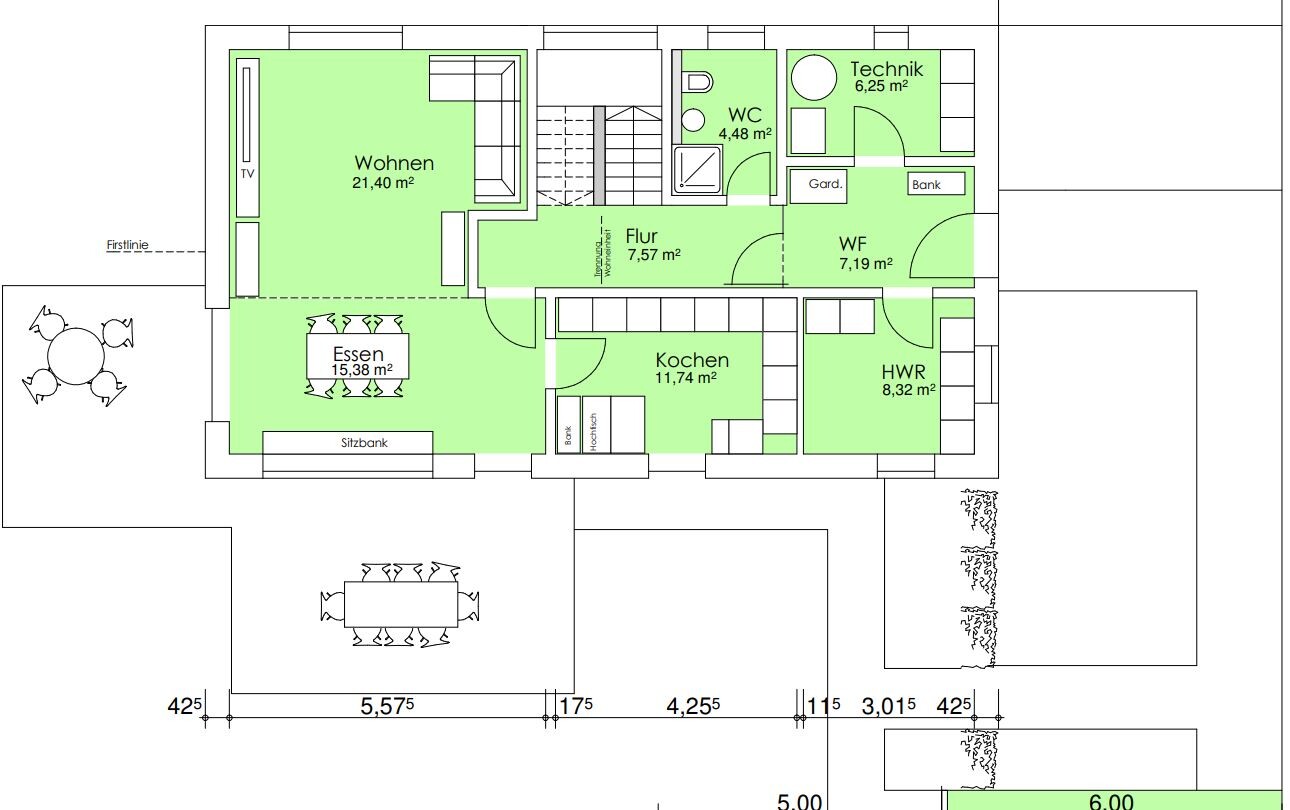
What do you especially like? Why? The southwest garden protected from the street. The living room, which is open yet still brings some calm due to the niche and the door that only leads into the dining area. The kitchen has a terrace door that can be unlocked from outside, so groceries can be carried straight into the kitchen. The walk-in closet, which adds visual calmness to the bedroom. Storage space under the stairs. The separation of the technical room and the utility room, allowing the utility room to be kept tidier.
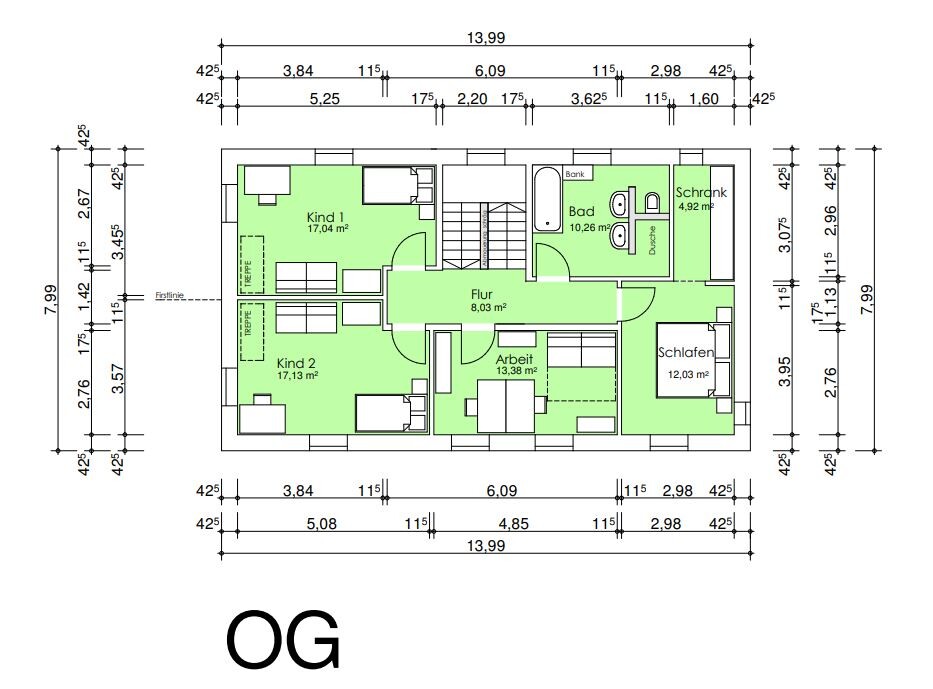
What do you not like? Why? I worry that the bathroom on the ground floor and the office might be somewhat too small. The children’s rooms seem fairly generous with 17 sqm (183 sq ft); 16 sqm (172 sq ft) might have sufficed.
Price estimate according to architect/planner: The architect is handling only phases 1-4 for us. We have not yet decided whether to hire a general contractor or use individual contracts and arrange construction supervision ourselves.
Personal budget limit for the house, including fixtures and fittings: 500k
Preferred heating system: Ground-source heat pump with horizontal trench collector
If you had to give up something, which details/upgrades
- can you do without: We have already dropped the basement and fireplace; we will probably also give up on the “T” layout in the bathroom to avoid making it too dark and cramped.
- cannot do without:
Why is the design the way it is now? For example:
Standard design from the planner? The plan was created individually based on a questionnaire we completed for the architect.
Which requests were implemented by the architect?
- Carport and shed cover the neighbor’s unsightly prefabricated garage.
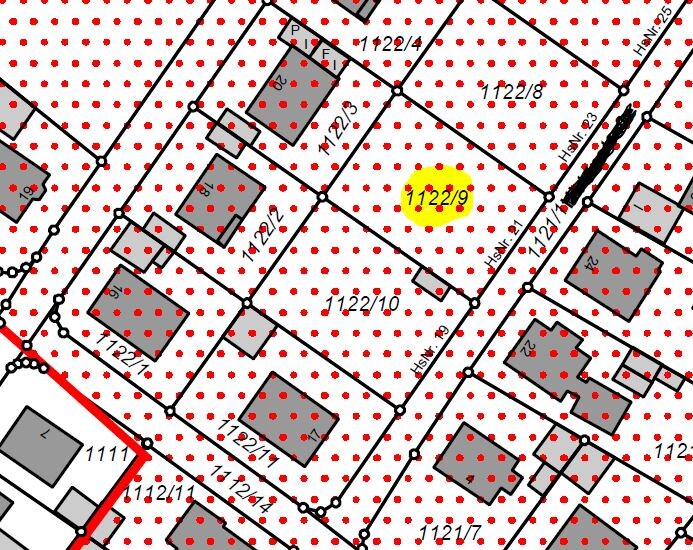
- House and carport form a kind of L shape lying down that creates a protected southwest garden.
- Two children’s rooms with at least 15 sqm (161 sq ft) + office
- Kitchen separated from the living/dining area by sliding door
- Long-term option to convert the upper floor into a separate living unit (for flexibility and eligibility for KfW funding for two dwelling units)
What do you think makes the plan particularly good or bad?
Overall, we quite like the plan. We now want to look at details (for example, the walk-in closet slightly larger by about 1 sqm (11 sq ft) so that a low cabinet could fit against the second wall). The windows are not planned yet and were initially placed arbitrarily by the architect.
We are especially looking forward to your open feedback to optimize the plan further before it gets serious and hopefully avoid some mistakes. 😉
Best regards
Mitch404

many of you probably know this situation: suddenly there are three of you, and you realize that your current apartment will soon be too small. My wife and I have therefore decided to treat ourselves to a single-family home. We are currently working with the architect we chose to develop the floor plan.
Development Plan / Restrictions
Plot size: 700 sqm (7,535 sq ft)
No slope
Site occupancy ratio (building coverage ratio): 0.3
Floor area ratio: 0.6
Number of parking spaces: 2
Number of floors: 2 full stories; with two full stories, a knee wall is not allowed
Roof style: Gable roof
Client Requirements
Style, roof type, building type: The roof style is fixed as a gable roof. The house should also blend in with neighboring buildings, so a more rectangular than square (town villa) footprint is preferred.
Basement, floors: No basement and no sloping ceilings desired; therefore, two full stories
Number of residents, ages: 3 people aged 35, 30, and 0.3 years; space for an additional child desired
Room requirements on ground floor and upper floor: Typical needs of a family with two children and no special hobbies. A sufficiently sized utility room to be able to hang laundry indoors in winter. Kitchen large enough to comfortably bake a cake occasionally (currently only a 6 sqm (65 sq ft) kitchen, which is rather tight). We had also considered a home office on the ground floor to avoid guests needing to enter the upper floor, but overall that made the ground floor feel too large.
Office: The office is for home office use, designed for two workstations (usually not used at the same time) and with the possibility to accommodate occasional overnight guests.
Overnight guests per year: None regularly. If our parents or friends want to stay over, we want to have the option to use the office space for this.
Open or closed architecture: We think open layouts look nice, but in everyday life we want practicality, which includes being able to retreat occasionally. Therefore, a large living/dining area with a kitchen that can be at least partially integrated via a large sliding door, while the rest remains rather closed off.
Conservative or modern construction: Modern construction as far as we like it (for example, an open staircase in the living area is currently trendy but we do not like it, and for the “T” layout solution, we find our bathroom too small and cramped).
Open kitchen, kitchen island: The kitchen should not be fully open but with a large sliding door. A kitchen island and dining area directly in the kitchen would be nice.
Number of dining seats: 8+
Fireplace: No fireplace
Music/surround sound wall: Not desired. Besides the TV, a 2.1 sound system will be installed as now, and that’s enough.
Balcony, roof terrace: Not desired
Garage, carport: Carport
Utility garden, greenhouse: We plan a small utility garden — a few raised beds, maybe 1-2 regular beds — but the focus will be a low-maintenance recreational and leisure garden.
Additional wishes / special features / daily routine, also reasons why some things are desired or not: Each children’s bedroom has an attic ladder leading upward, so the rooms can be expanded upstairs when the kids are teenagers and want more space. We have seen this realized in 2-3 houses and think it’s pretty cool.
House Design
Who designed the plan: Independent architect
What do you especially like? Why? The southwest garden protected from the street. The living room, which is open yet still brings some calm due to the niche and the door that only leads into the dining area. The kitchen has a terrace door that can be unlocked from outside, so groceries can be carried straight into the kitchen. The walk-in closet, which adds visual calmness to the bedroom. Storage space under the stairs. The separation of the technical room and the utility room, allowing the utility room to be kept tidier.
What do you not like? Why? I worry that the bathroom on the ground floor and the office might be somewhat too small. The children’s rooms seem fairly generous with 17 sqm (183 sq ft); 16 sqm (172 sq ft) might have sufficed.
Price estimate according to architect/planner: The architect is handling only phases 1-4 for us. We have not yet decided whether to hire a general contractor or use individual contracts and arrange construction supervision ourselves.
Personal budget limit for the house, including fixtures and fittings: 500k
Preferred heating system: Ground-source heat pump with horizontal trench collector
If you had to give up something, which details/upgrades
- can you do without: We have already dropped the basement and fireplace; we will probably also give up on the “T” layout in the bathroom to avoid making it too dark and cramped.
- cannot do without:
Why is the design the way it is now? For example:
Standard design from the planner? The plan was created individually based on a questionnaire we completed for the architect.
Which requests were implemented by the architect?
- Carport and shed cover the neighbor’s unsightly prefabricated garage.
- House and carport form a kind of L shape lying down that creates a protected southwest garden.
- Two children’s rooms with at least 15 sqm (161 sq ft) + office
- Kitchen separated from the living/dining area by sliding door
- Long-term option to convert the upper floor into a separate living unit (for flexibility and eligibility for KfW funding for two dwelling units)
What do you think makes the plan particularly good or bad?
Overall, we quite like the plan. We now want to look at details (for example, the walk-in closet slightly larger by about 1 sqm (11 sq ft) so that a low cabinet could fit against the second wall). The windows are not planned yet and were initially placed arbitrarily by the architect.
We are especially looking forward to your open feedback to optimize the plan further before it gets serious and hopefully avoid some mistakes. 😉
Best regards
Mitch404

ypg schrieb:
I reviewed the dimensions again: even the sofa corner is too narrow at 2.84m (9 ft 4 in) in the RBM. You’d have to look for a slim family sofa. Lamp, side table, or magazine rack would all have to be arranged in front of it.
Personally, I like these narrow houses, but then they would need a more open floor plan so that it works out.
I would probably just design the house one meter wider – there’s no real reason for this particular shape.
What does the “separation of living unit 1” mean? That won’t work as a separation! Not even later on. The bathroom would then be shared by everyone. 2.84m (9 ft 4 in) is indeed a bit too narrow. Currently, we have 3m (10 ft) for the couch and floor lamp in the corner. It shouldn’t be any less than that.
The bathroom is actually positioned incorrectly in this version; I only realized that thanks to your comment, thank you!
I’ve also considered making the house one meter wider. But with a length of 14m (46 ft) and two full floors, that would add 28 sqm (300 sq ft), so over €50,000, and bring the total living area to almost 200 sqm (2,150 sq ft). I’m afraid that would exceed our budget. The house would then need to be shortened by at least one meter or more. I’ll experiment with that direction.
M
Myrna_Loy5 Oct 2021 22:02Mitch404 schrieb:
The kitchen will not be furnished exactly like that. So far, we only know that we want a sliding door, preferably a small cooking island with seating, and a terrace door that can be unlocked from the outside. A side-by-side fridge should also be included. Everything else is still completely open/unplanned.However, the kitchen is too narrow for that. You’re missing about 1 meter (3 feet).11ant schrieb:
I have seen many development plans with teething problems, but this is the first time I’ve come across one with rubella today ;-)
The plans are missing window dimensions, the structural walls seem to have been planned generously, in several places we’ll need to rehearse the octameter grid again, and the wall limiting the closet in the bedroom is simply positioned incorrectly.
Elevations might be helpful. Which stage of the project are you at?The windows are not planned yet, so dimensions are missing. That will come once we are satisfied with the room layout.
What do you mean by the wall limiting the closet in the bedroom is incorrect?
There are no elevations yet. We are currently fixing the rooms in their positions and sizes. After that, we will move into more detailed planning with windows and the façade.
11ant schrieb:
I explain the architect’s schedule elsewhere according to the HOAI phase model. Two aspects of this approach strike me as inadvisable:
1. Sending the architect off after the approval planning phase and then expecting them to navigate the complex construction process alone strikes me as fundamentally unwise. What’s even worse, in my opinion, is cutting off the architect’s involvement after phase 4, since this handover point is far less suitable than at least extending it through phase 5. Additionally, the willingness to sign an architect contract only up to and including phase 4 is often a sign of architects who are not very practical in two respects: calculation and construction management.
2. Looking for a general contractor (GC) yourselves is actually two mistakes in one: first, that should be the architect’s responsibility; and second, I would never actively seek out a GC, but only allow GCs to bid in the tender. Self-contracting, even when not done as single contracting, is a risky area. 1. Our architect actually offers only phases 1 to 4 because he is employed about 80% of the time by a housing company and lacks the time. If more support is needed, he collaborates with a GC.
2. I expressed myself poorly there. We actually want to build turnkey with one company. However, we didn’t like the planning processes there as they were very fast and careless (understandably, they want to get the signature quickly). Therefore, we decided to first plan independently with an architect and then request bids. How and with whom we will build still remains to be seen.
Please read the comments carefully again!
You’re missing a lot!
No one is talking about that.
As I asked before: where are these two separate living units supposed to be?
Plan it differently…!
Who decided on the 14 meters? Sorry, but I feel the planning stage is missing here—to change something or everything. There’s nothing in this plan that needs to be fixed or kept as is.
You’re missing a lot!
Mitch404 schrieb:
I don’t want a direct view into the living area right now, so our tastes just differ there. ^^
No one is talking about that.
Mitch404 schrieb:
Then it gets difficult with two separate living units.
As I asked before: where are these two separate living units supposed to be?
Mitch404 schrieb:
I’m happy to save the 8sqm (86 sq ft) hallway and use it differently.
Any ideas how? 🙂
Plan it differently…!
Mitch404 schrieb:
I’ve also considered making the house one meter (3.3 ft) wider. But with 14 meters (46 ft) length and two full stories, that’s 28sqm (300 sq ft) more,
Who decided on the 14 meters? Sorry, but I feel the planning stage is missing here—to change something or everything. There’s nothing in this plan that needs to be fixed or kept as is.
GeradeSchräg schrieb:
What pitch should the roof have? Have you already calculated how much space will be left? The width of 8m (26 feet) doesn’t make it any easier.
Why only 8m (26 feet) wide? Is there a specific reason for that? What did the architect say, or was that their idea? The roof pitch hasn’t been decided yet. But I can imagine around 30 degrees. Still, it’s a good point that it would be advantageous for the attic if we make the house wider!
There’s no direct reason for the width. The architect simply prefers building elongated houses, and since I was thinking of this horizontal L-shape combined with the carport, it seemed to create a sheltered garden.
But yes, making it a bit wider and therefore less long sounds very interesting. I will play around with the plans to get a better idea of that.
Similar topics