
ᐅ Bathtub placed in front of window, parapet too low, general contractor is refusing to cooperate
Created on: 20 Sep 2021 14:02
B
BananaJoe
Hello everyone,
we are building our house with a general contractor (GC) and have agreed on a fixed price.
In the bathroom, we have a window with a sill height of 1.12 m (3 ft 8 in) finished floor level (FFL), which is partially located above the bathtub and a small shelf (between the bathtub and the exterior wall), on the right side in the picture.
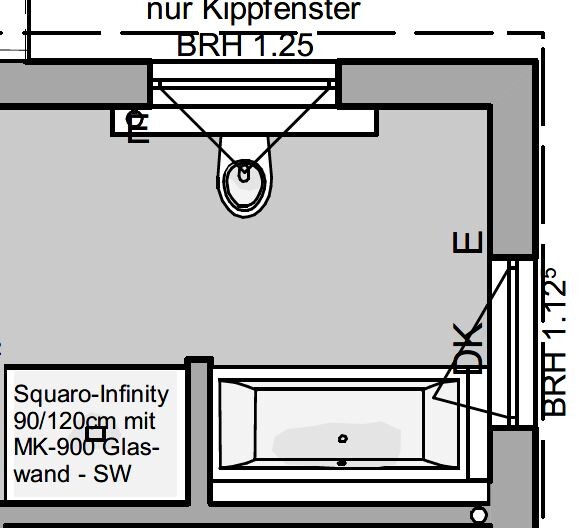
Both I and our expert noticed that according to the building regulations (Hessen), parapet or railing heights must be at least 80 cm (31.5 inches), measured either from finished floor level (which is complied with here) or from any steps, platforms, or similar climbing aids located in front of it (which is not the case here due to the bathtub and shelf). Although we have lockable handles on the upper floor window, our expert says an additional safety measure is required, for example, the installation of a (glass) railing similar to those used on French balconies.
This is also reflected in the recommendations for enforcement of the Hessian Building Code issued by the Ministry of Economic Affairs (marginal note 35.3.1):
“The height of the parapet is generally measured from the top edge of the finished floor to the top edge of the window sill or another fixed parapet-like element, excluding the window frame. If there are elements in front of the parapet, such as cable ducts or ventilation channels, which could be used to climb up, the measurement must be taken from the top edge of those elements.”
Since we have two small children who will eventually bring friends home to play, we strongly believe that some safety provision is necessary here. Our GC, however, sees no need for action because the window has a lockable handle. I have already informed the GC that we would report this issue to the responsible building authority if necessary, so they can verify whether this is compliant (we have built under an exemption procedure, so the building application has not yet been reviewed in detail). Based on the Ministry’s recommendation, I am quite confident that the authority will agree with our expert.
Now to my question: who pays for the additional safety measure (assuming the building authority requires it)?
From a brief search, I found fairly good glass railings (since our bathroom window faces the street, we want the railing to be as discreet as possible, e.g., no bars or similar) for about 500 euros. Including installation, I expect the total cost would not exceed 1,000 euros.
In my view, it’s simple: I purchased a house that complies with legal requirements. If the GC’s planning does not meet these standards and requires rework, they should cover the cost. The GC (or our site manager), on the other hand, argues that if the building authority demands the railing, it was simply overlooked in the planning and therefore not included in the fixed price. If they had known the railing was needed, the price would have been higher, meaning we should bear the cost.
I consider that unreasonable; otherwise, fixed prices are pointless. As a layperson, I assume that the fixed price guarantees a house that meets legal standards. Otherwise, the GC could plan anything and later—if it turns out the structure is unsafe, violates the zoning plan, or is otherwise incorrect—increase the price by whatever amount is necessary to fix the planning mistake...
What’s your opinion?
we are building our house with a general contractor (GC) and have agreed on a fixed price.
In the bathroom, we have a window with a sill height of 1.12 m (3 ft 8 in) finished floor level (FFL), which is partially located above the bathtub and a small shelf (between the bathtub and the exterior wall), on the right side in the picture.
Both I and our expert noticed that according to the building regulations (Hessen), parapet or railing heights must be at least 80 cm (31.5 inches), measured either from finished floor level (which is complied with here) or from any steps, platforms, or similar climbing aids located in front of it (which is not the case here due to the bathtub and shelf). Although we have lockable handles on the upper floor window, our expert says an additional safety measure is required, for example, the installation of a (glass) railing similar to those used on French balconies.
This is also reflected in the recommendations for enforcement of the Hessian Building Code issued by the Ministry of Economic Affairs (marginal note 35.3.1):
“The height of the parapet is generally measured from the top edge of the finished floor to the top edge of the window sill or another fixed parapet-like element, excluding the window frame. If there are elements in front of the parapet, such as cable ducts or ventilation channels, which could be used to climb up, the measurement must be taken from the top edge of those elements.”
Since we have two small children who will eventually bring friends home to play, we strongly believe that some safety provision is necessary here. Our GC, however, sees no need for action because the window has a lockable handle. I have already informed the GC that we would report this issue to the responsible building authority if necessary, so they can verify whether this is compliant (we have built under an exemption procedure, so the building application has not yet been reviewed in detail). Based on the Ministry’s recommendation, I am quite confident that the authority will agree with our expert.
Now to my question: who pays for the additional safety measure (assuming the building authority requires it)?
From a brief search, I found fairly good glass railings (since our bathroom window faces the street, we want the railing to be as discreet as possible, e.g., no bars or similar) for about 500 euros. Including installation, I expect the total cost would not exceed 1,000 euros.
In my view, it’s simple: I purchased a house that complies with legal requirements. If the GC’s planning does not meet these standards and requires rework, they should cover the cost. The GC (or our site manager), on the other hand, argues that if the building authority demands the railing, it was simply overlooked in the planning and therefore not included in the fixed price. If they had known the railing was needed, the price would have been higher, meaning we should bear the cost.
I consider that unreasonable; otherwise, fixed prices are pointless. As a layperson, I assume that the fixed price guarantees a house that meets legal standards. Otherwise, the GC could plan anything and later—if it turns out the structure is unsafe, violates the zoning plan, or is otherwise incorrect—increase the price by whatever amount is necessary to fix the planning mistake...
What’s your opinion?
B
BananaJoe21 Sep 2021 16:10First of all, thank you for all the responses.
Even though many of them don’t address the main question of who has to pay for an additional safety measure if it becomes necessary, I will still try to reply.
Even though many of them don’t address the main question of who has to pay for an additional safety measure if it becomes necessary, I will still try to reply.
haydee schrieb:
How do you secure children’s rooms? How quickly can a stool, small table, toy box, etc. be pushed in front of it?
pagoni2020 schrieb:
Your children won’t be any safer, even if you now install a gate or fully comply with all building regulations.
pagoni2020 schrieb:
If accidents happened exactly where we fear them, it would be simple. I wouldn’t even use a lockable handle there.
guckuck2 schrieb:
Apart from what I consider an exaggerated fear, children eventually get old enough.
Smialbuddler schrieb:
Setting aside the main question, I think you are worrying for the "wrong reasons" or from the wrong perspective.
From your initial post, it seems your concern arose when you (or your expert) read the guideline about (supposedly) protecting children. Without knowing the guideline, you previously considered the bathtub in front of the window with that window sill as acceptable.
FloHB123 schrieb:Whether it is reasonable to install a window guard or other device at that window is not what I wanted to discuss. I realize that there is no 100% safety. But that is not my main concern; what drives me is the question of who has to pay for an additional measure if it is required by building regulations.
In my opinion, you are overreacting a bit here. I consider the risk of something happening here very low.
hampshire schrieb:This has nothing to do with emotions. I just want to make sure that if (which I hope will never happen) a neighbor’s child falls from this window, I’m not the one to blame because I didn’t secure the window properly.
So it’s not a particularly pragmatic solution, even if your emotions initially demand it.
FloHB123 schrieb:No, only fixed climbing aids directly beneath the window are relevant under building law (see examples provided by the ministry in the first post), not furniture.
Then in every room where the window can be fully opened, you wouldn’t be allowed to have small tables, chairs, or stools.
Jann St schrieb:But this is not about an extra service that I want, it is about who bears the cost of fixing a defect. Because if the building authority states that the guardrail is too low due to the bathtub, that is clearly a defect. And before handover, in my opinion, the general contractor (GC) must pay for that to deliver a defect-free house.
Otherwise, in a lump-sum contract (the term “fixed-price contract” is not further defined here), a changed scope of work generally results in additional payment. Installing a guardrail is a typical change of work and therefore subject to extra payment.
Jann St schrieb:That is exactly the point! If we had known during planning that this would mean we have to install a gate, glass panel, or something similar in front of the window, or that the window would only be allowed to tilt open, we would have planned differently.
What could be disputed is if you would have chosen a solution planning-wise that is no longer possible at the current construction stage and you only now have to install a guardrail that does not meet your original expectations because of this construction status.
11ant schrieb:Regarding the quality of planning, I agree with you. But legally, it makes no difference to me: I expect both a GC and an architect to deliver a house that complies with the legal requirements, don’t I?
Come on, let’s not forget the saying “don’t look a gift horse in the mouth” and apply the same demands to a GC-Zeichenknecht “planning” as a private client with chief architect treatment in a single room under HOAI.
11ant schrieb:I am not asking for a redesign; at this stage of construction that would be completely disproportionate. I just want that if the building authority considers a guardrail or any other device necessary, the GC installs and pays for it.
Give up the delusion that the guy owes you a free redesign as the final result, I’m with @Jann St on that.
guckuck2 schrieb:
Make the window tilt-only.
guckuck2 schrieb:
You still have another window in the room. Why all the worry? There are so many solutions in the 50–100€ (about 55 to 110 USD) range...
haydee schrieb:Unfortunately, the other window is only a tilt window. We do have a central controlled ventilation system. However, since there is also a sauna in the bathroom (sorry, I probably should have mentioned that earlier), I want to be able to fully open at least one window. The GC was already aware of the sauna being part of the bathroom during planning. What affordable solutions are there besides a guardrail that still allow me to fully open the window?
@OP don’t you have a ventilation system?
Musketier schrieb:As I said, that is not the topic of this thread, but our three-year-old manages this easily. And unfortunately, three-year-olds can be quite stubborn. Especially since the window position here is rather convenient for these little rascals—they can stand on the shelf next to the window, so they don’t block themselves while opening it.
If the child is old enough to climb onto the bathtub and strong enough to open the window from the worst possible position, they should also be mature enough to discuss this with beforehand. Just like you teach them not to climb on the chair to open the window.
Myrna_Loy schrieb:Exactly, that is part of the problem—the shelf is not only directly below the window but also to the right side, which in my view makes opening the window easier.
The bathtub is not fully in front of the window, rather about 20–30 cm (8–12 inches) over the corner. You would have to open the window fully and climb onto the edge of the tub.
hampshire schrieb:I don’t think asking the building authority will delay handover. The issue would be noted as a defect in the acceptance protocol, and that’s it. If the authority later approves it, the item is checked off; if not, something has to be done. I don’t expect the authority to tell me who pays, only if an additional safety measure is required...
That would be a complete own goal if it delays handover and moving in. The authority also does not give any recommendation on who pays.
hampshire schrieb:I already have the lockable knob (of course not standard; we planned and paid for it during design). I would like to negotiate a deal with the GC. But if the GC says there is no need for action because the lockable handle suffices, that’s difficult. Hence the idea that someone other than my expert (the building authority) should say the lockable handle is inadequate.
Since you don’t want the lockable knob solution, I would try to negotiate a deal with the GC.
11ant schrieb:Is that still possible at this stage? The windows are already installed as mentioned, the walls plastered, the screed drying. Of course, this could have been done before window installation if we had noticed it earlier, but unfortunately, that ship has sailed.
My suggestion means changing the window from a single-leaf, one-piece DK DIN left to a single-leaf, two-piece DK DIN right with a fixed lower part, i.e., fixed glazing of about the lower 20 cm (8 inches), so that the fall protection height would be guaranteed to the opening sash. The additional costs of this measure prior to window installation could be seen as a reasonable GC contribution toward an amicable settlement.
Whether bathing, showering, or using the steam sauna, manual ventilation has never been necessary.
Especially considering that you have a ventilation system, as a general contractor I would only replace the hinge with one that allows tilt function. Besides the fact that the glass parts are ugly, expensive, and impractical.
Especially considering that you have a ventilation system, as a general contractor I would only replace the hinge with one that allows tilt function. Besides the fact that the glass parts are ugly, expensive, and impractical.
H
hampshire21 Sep 2021 16:44BananaJoe schrieb:
This has nothing to do with emotions. I just want to make sure that if (which I hope doesn’t happen) a neighbor’s child ever falls out of this window, I’m not the one at fault for not properly securing it. You have a clear mental picture of the risk scenario and its potential consequences and are acting accordingly. I think that’s the right approach. Your description is purely emotional. Based on that, you draw logical cause-and-effect relationships between the risk and possible outcomes. There is nothing wrong with that.
BananaJoe schrieb:
I would like to make a deal with the general contractor. But if the contractor says there is no need for action because the lockable handle is sufficient, that makes it difficult. That contradicts my experience and background. It doesn’t matter who is right or to blame. Don’t dwell on that. Define your negotiation goal and give the contractor a good reason to want to meet you halfway. Tip: Use the other party’s emotions. I’m beginning to see a market here for negotiation seminars tailored to home builders.
What exactly is your goal?
Are you looking for a solution that can be approved by the building authority / planning permission office (e.g., glass fall protection)?
Do you want a solution that doesn’t fully comply with regulations but still works (e.g., lockable handle and wait until the children are older)?
Are you aiming for a discount and to leave everything as it is in the end?
Are you looking for a solution that can be approved by the building authority / planning permission office (e.g., glass fall protection)?
Do you want a solution that doesn’t fully comply with regulations but still works (e.g., lockable handle and wait until the children are older)?
Are you aiming for a discount and to leave everything as it is in the end?
B
BananaJoe21 Sep 2021 18:23FloHB123 schrieb:
What exactly is your goal?
Do you want a solution that can be approved by the building authority (e.g., glass fall protection)?
Do you want a solution that doesn’t comply with regulations but still works (e.g., lockable handle and waiting until the children are older)?
Do you want a price reduction and just leave everything as it is in the end? The first option. I already have the second, and the third doesn’t help me at all...
I’m also afraid that the general contractor will just choose the cheapest solution, meaning they’ll replace the hinge with a tilt-only version.
Well, we’ll see. I’ll keep you posted. Thanks for your input, even if it wasn’t what I wanted to hear! 🙄
M
Myrna_Loy21 Sep 2021 18:39I think you will hit a dead end there. As has been mentioned several times, the regulations for parapet heights are based on adults. Since the bathtub only extends partially in front of the window and a bathtub is not meant as a standing surface, the planning is likely correct.
I would also change the hinge side. Otherwise, you have to stretch uncomfortably over the bathtub to reach the handle. This way, the window would also serve as a safety feature.
I would also change the hinge side. Otherwise, you have to stretch uncomfortably over the bathtub to reach the handle. This way, the window would also serve as a safety feature.
Similar topics