
ᐅ Bathtub placed in front of window, parapet too low, general contractor is refusing to cooperate
Created on: 20 Sep 2021 14:02
B
BananaJoe
Hello everyone,
we are building our house with a general contractor (GC) and have agreed on a fixed price.
In the bathroom, we have a window with a sill height of 1.12 m (3 ft 8 in) finished floor level (FFL), which is partially located above the bathtub and a small shelf (between the bathtub and the exterior wall), on the right side in the picture.
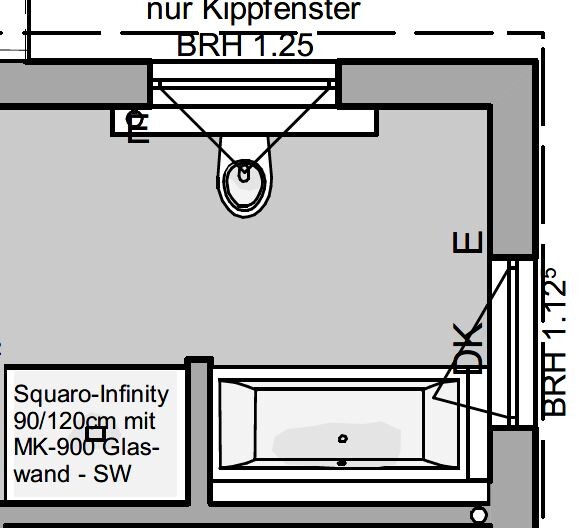
Both I and our expert noticed that according to the building regulations (Hessen), parapet or railing heights must be at least 80 cm (31.5 inches), measured either from finished floor level (which is complied with here) or from any steps, platforms, or similar climbing aids located in front of it (which is not the case here due to the bathtub and shelf). Although we have lockable handles on the upper floor window, our expert says an additional safety measure is required, for example, the installation of a (glass) railing similar to those used on French balconies.
This is also reflected in the recommendations for enforcement of the Hessian Building Code issued by the Ministry of Economic Affairs (marginal note 35.3.1):
“The height of the parapet is generally measured from the top edge of the finished floor to the top edge of the window sill or another fixed parapet-like element, excluding the window frame. If there are elements in front of the parapet, such as cable ducts or ventilation channels, which could be used to climb up, the measurement must be taken from the top edge of those elements.”
Since we have two small children who will eventually bring friends home to play, we strongly believe that some safety provision is necessary here. Our GC, however, sees no need for action because the window has a lockable handle. I have already informed the GC that we would report this issue to the responsible building authority if necessary, so they can verify whether this is compliant (we have built under an exemption procedure, so the building application has not yet been reviewed in detail). Based on the Ministry’s recommendation, I am quite confident that the authority will agree with our expert.
Now to my question: who pays for the additional safety measure (assuming the building authority requires it)?
From a brief search, I found fairly good glass railings (since our bathroom window faces the street, we want the railing to be as discreet as possible, e.g., no bars or similar) for about 500 euros. Including installation, I expect the total cost would not exceed 1,000 euros.
In my view, it’s simple: I purchased a house that complies with legal requirements. If the GC’s planning does not meet these standards and requires rework, they should cover the cost. The GC (or our site manager), on the other hand, argues that if the building authority demands the railing, it was simply overlooked in the planning and therefore not included in the fixed price. If they had known the railing was needed, the price would have been higher, meaning we should bear the cost.
I consider that unreasonable; otherwise, fixed prices are pointless. As a layperson, I assume that the fixed price guarantees a house that meets legal standards. Otherwise, the GC could plan anything and later—if it turns out the structure is unsafe, violates the zoning plan, or is otherwise incorrect—increase the price by whatever amount is necessary to fix the planning mistake...
What’s your opinion?
we are building our house with a general contractor (GC) and have agreed on a fixed price.
In the bathroom, we have a window with a sill height of 1.12 m (3 ft 8 in) finished floor level (FFL), which is partially located above the bathtub and a small shelf (between the bathtub and the exterior wall), on the right side in the picture.
Both I and our expert noticed that according to the building regulations (Hessen), parapet or railing heights must be at least 80 cm (31.5 inches), measured either from finished floor level (which is complied with here) or from any steps, platforms, or similar climbing aids located in front of it (which is not the case here due to the bathtub and shelf). Although we have lockable handles on the upper floor window, our expert says an additional safety measure is required, for example, the installation of a (glass) railing similar to those used on French balconies.
This is also reflected in the recommendations for enforcement of the Hessian Building Code issued by the Ministry of Economic Affairs (marginal note 35.3.1):
“The height of the parapet is generally measured from the top edge of the finished floor to the top edge of the window sill or another fixed parapet-like element, excluding the window frame. If there are elements in front of the parapet, such as cable ducts or ventilation channels, which could be used to climb up, the measurement must be taken from the top edge of those elements.”
Since we have two small children who will eventually bring friends home to play, we strongly believe that some safety provision is necessary here. Our GC, however, sees no need for action because the window has a lockable handle. I have already informed the GC that we would report this issue to the responsible building authority if necessary, so they can verify whether this is compliant (we have built under an exemption procedure, so the building application has not yet been reviewed in detail). Based on the Ministry’s recommendation, I am quite confident that the authority will agree with our expert.
Now to my question: who pays for the additional safety measure (assuming the building authority requires it)?
From a brief search, I found fairly good glass railings (since our bathroom window faces the street, we want the railing to be as discreet as possible, e.g., no bars or similar) for about 500 euros. Including installation, I expect the total cost would not exceed 1,000 euros.
In my view, it’s simple: I purchased a house that complies with legal requirements. If the GC’s planning does not meet these standards and requires rework, they should cover the cost. The GC (or our site manager), on the other hand, argues that if the building authority demands the railing, it was simply overlooked in the planning and therefore not included in the fixed price. If they had known the railing was needed, the price would have been higher, meaning we should bear the cost.
I consider that unreasonable; otherwise, fixed prices are pointless. As a layperson, I assume that the fixed price guarantees a house that meets legal standards. Otherwise, the GC could plan anything and later—if it turns out the structure is unsafe, violates the zoning plan, or is otherwise incorrect—increase the price by whatever amount is necessary to fix the planning mistake...
What’s your opinion?
B
BananaJoe20 Sep 2021 15:08haydee schrieb:
Honestly, I don’t see the problem. To open the window, the child would need to have and be able to use the key. That’s true. But when I’m airing out the bathroom, I don’t want to have to stand next to the window all the time to make sure nothing happens. Also, it’s easy to simply forget to lock the window (no one is perfect).
haydee schrieb:
Moreover, the window is hard to open without the key because the child would have to climb to reach it. Which is usually more of a challenge or motivation for kids rather than a barrier...
haydee schrieb:
If I were the general contractor, I would replace the hinge and only allow tilt function. Sure, that would be the cheaper solution. But in a new build, having a main bathroom window that can’t be fully opened anymore doesn’t seem very state of the art today, does it? And would proper ventilation still be possible then (since it’s commonly said that you need to do shock ventilation, not just tilt ventilation)?
11ant schrieb:
I would make that window a kitchen window with a fixed bottom part and also change the side the window opens on while I’m at it. As I said, the screed is drying right now, so I don’t think changing the windows themselves is still possible or planned (though I’m not sure how complex your suggestion would be).
11ant schrieb:
...yet you can already see downpipes here, and I guess the "E" stands for electric roller shutter controls? Yes, in that floor plan, the switches for the electric shutters and the locations of the downpipes were marked. The more detailed construction drawings came later.
But I see now that it’s not as clear-cut as I thought an hour ago. Although it still feels odd to me that I’m supposed to pay for planning errors by the general contractor despite a fixed price...
B
BananaJoe20 Sep 2021 15:20PS: I don’t really understand why my question, which was about building regulations (I asked who is responsible for the costs if the planning or execution does not comply with the building regulations), was moved to the "Plumbing" section, but I take note of it with interest 🙄
O
Oraclefile20 Sep 2021 15:23Remember that the additional fall protection in the form of a glass panel will also need to be cleaned. You will be responsible for that, and that alone is why we chose not to install it. We also have the window by the bathtub similar to yours, and afterwards we were told that the window must be lockable. Nothing more than that.
Whether we will actually keep it locked all the time is doubtful.
Whether we will actually keep it locked all the time is doubtful.
Hello,
1. Necessity – In my opinion, the expert is correct. A simple lock is not sufficient here, as the building regulations require a structural barrier. It should be possible to mechanically prevent the window from being opened right from the installation phase. A mere “locking” is not enough. However, there are other solutions besides a balustrade.
2. How is your contract structured? Do you have a functional lump sum contract? A pure “fixed price” generally relies on quantities and qualities. However, you most likely have a “consumer construction contract” according to the building code. For a general contractor (GC), this entails a significant duty to inform – meaning the GC is required to advise you of the consequences regarding planning issues. Potentially, you could address the GC through this approach.
Otherwise, under a lump sum contract (the term “fixed price contract” is not more specifically defined here), any changes in scope usually result in additional compensation. Installing a balustrade is a classic example of a changed scope and should therefore be paid for additionally. Moreover, you would have had to pay for the balustrade if you had known about it from the start. Therefore, I believe you do owe compensation to the GC in this case.
The phrase “to build according to the currently recognized rules of technology or building regulations” does not mean the GC does not receive compensation for anything they do not price in advance.
What could be disputed is if you would have chosen a solution earlier that is no longer possible at the current construction stage, and you are now opting for a balustrade only because of the construction status, even though it does not meet your original expectations.
Best regards,
Jann
1. Necessity – In my opinion, the expert is correct. A simple lock is not sufficient here, as the building regulations require a structural barrier. It should be possible to mechanically prevent the window from being opened right from the installation phase. A mere “locking” is not enough. However, there are other solutions besides a balustrade.
2. How is your contract structured? Do you have a functional lump sum contract? A pure “fixed price” generally relies on quantities and qualities. However, you most likely have a “consumer construction contract” according to the building code. For a general contractor (GC), this entails a significant duty to inform – meaning the GC is required to advise you of the consequences regarding planning issues. Potentially, you could address the GC through this approach.
Otherwise, under a lump sum contract (the term “fixed price contract” is not more specifically defined here), any changes in scope usually result in additional compensation. Installing a balustrade is a classic example of a changed scope and should therefore be paid for additionally. Moreover, you would have had to pay for the balustrade if you had known about it from the start. Therefore, I believe you do owe compensation to the GC in this case.
The phrase “to build according to the currently recognized rules of technology or building regulations” does not mean the GC does not receive compensation for anything they do not price in advance.
What could be disputed is if you would have chosen a solution earlier that is no longer possible at the current construction stage, and you are now opting for a balustrade only because of the construction status, even though it does not meet your original expectations.
Best regards,
Jann
How do you childproof a bedroom? How quickly can a stool, small table, toy box, etc. be moved in front of it?
You have a windowsill at the bathroom window, don’t you? From that perspective, you would need to secure the entire bathroom window from the outside. Bathtub, windowsill, and suddenly you’re past the security.
You have a windowsill at the bathroom window, don’t you? From that perspective, you would need to secure the entire bathroom window from the outside. Bathtub, windowsill, and suddenly you’re past the security.
P
pagoni202020 Sep 2021 16:42New standards have been and continue to be developed to ensure maximum safety. However, the greatest and most unpredictable safety risk is the person themselves. All the accidents and mishaps in our experience have happened exactly where you would least expect them.
You wouldn’t leave your child alone in a room just because the window sill is a few centimeters higher. There are electrical outlets, knives, glass stairs with handrails, liquids, ponds, plastic bags!!!, tools... for example, as a child I swallowed a 10 Pfennig coin (typical Swabian...), my son possibly took my father’s sugar pill, another fell off a chair and hit his face on the edge of a shovel or cut his hand on a picture frame, boiling water, mom’s nail polish remover, weed killer, and much more.
Putting building regulations aside, what I want to say is that your children won’t be any safer, even if you install a gate or comply with all the building permit / planning permission requirements.
If accidents happened where and how we expect them, it would be simple. I wouldn’t even use a lockable handle in that case.
I see more danger in feeling safe just because certain requirements have been met; usually, that’s misleading.
You wouldn’t leave your child alone in a room just because the window sill is a few centimeters higher. There are electrical outlets, knives, glass stairs with handrails, liquids, ponds, plastic bags!!!, tools... for example, as a child I swallowed a 10 Pfennig coin (typical Swabian...), my son possibly took my father’s sugar pill, another fell off a chair and hit his face on the edge of a shovel or cut his hand on a picture frame, boiling water, mom’s nail polish remover, weed killer, and much more.
Putting building regulations aside, what I want to say is that your children won’t be any safer, even if you install a gate or comply with all the building permit / planning permission requirements.
If accidents happened where and how we expect them, it would be simple. I wouldn’t even use a lockable handle in that case.
I see more danger in feeling safe just because certain requirements have been met; usually, that’s misleading.
Similar topics