
ᐅ Single-family house floor plan 110 m² – Ground floor + Upper floor – First draft room layout
Created on: 25 Aug 2021 08:40
R
ruebe87
Good morning,
we have now received the first draft of the interior layout for our single-family home from our planner, but we are not quite satisfied, as some of our requests were unfortunately not taken into account. Accordingly, we are disappointed because this will be a "life project" for us, and we feel somewhat let down.
It is a terraced house with a total area of 110m² (1,184 sq ft), divided into 2 floors of 55m² (592 sq ft) each. Additionally, there is a basement and an attic, although the attic cannot be used as living space.
In the basement, we want the kitchen and dining area on the south side, the living room further back, which can be closed off with a sliding door to create a potential retreat space. There should also be a small storage room for food and miscellaneous items as well as a guest toilet.
On the upper floor, there is a master bedroom of about 16m² (172 sq ft) with direct access to a large bathroom, two children's bedrooms, and a separate small bathroom.
In my opinion, shifting the staircase might be a good idea, but since we are not experts, we have fully relied on our planner so far.
Another meeting with him will take place in the next few days, and perhaps you have suggestions and input that we could bring up concretely.
Thank you very much in advance!
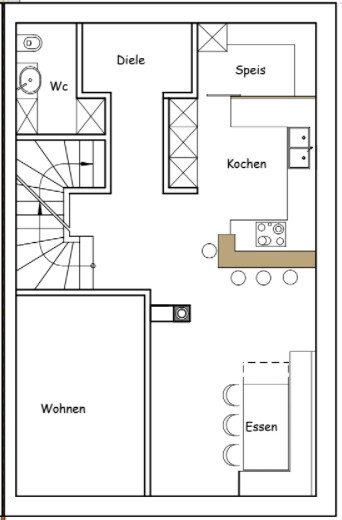
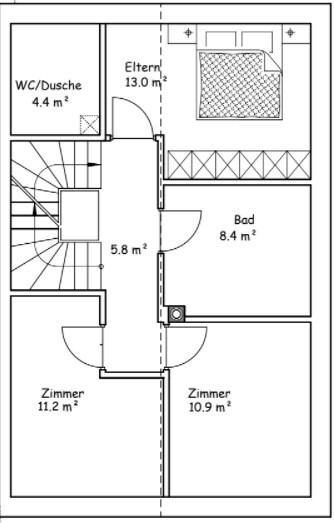
we have now received the first draft of the interior layout for our single-family home from our planner, but we are not quite satisfied, as some of our requests were unfortunately not taken into account. Accordingly, we are disappointed because this will be a "life project" for us, and we feel somewhat let down.
It is a terraced house with a total area of 110m² (1,184 sq ft), divided into 2 floors of 55m² (592 sq ft) each. Additionally, there is a basement and an attic, although the attic cannot be used as living space.
In the basement, we want the kitchen and dining area on the south side, the living room further back, which can be closed off with a sliding door to create a potential retreat space. There should also be a small storage room for food and miscellaneous items as well as a guest toilet.
On the upper floor, there is a master bedroom of about 16m² (172 sq ft) with direct access to a large bathroom, two children's bedrooms, and a separate small bathroom.
In my opinion, shifting the staircase might be a good idea, but since we are not experts, we have fully relied on our planner so far.
Another meeting with him will take place in the next few days, and perhaps you have suggestions and input that we could bring up concretely.
Thank you very much in advance!
In Germany, everyone does the same thing because they see it on TV shows: the cooktop in the island. Nobody stands at the cooktop for hours at a time—if that were the case, I wouldn’t cook anymore but rather have food delivered. And casually standing by the stove chatting only works when you’re cooking pasta and ground meat.
I also assume that both of you work, meaning no one will stand there in the evening and prepare a full menu. It has to be quick; there are a thousand other things to do, like laundry, vacuuming, picking up the child from sports, etc.
Not every family member will cook, but ALL will eventually want or need to access the sink, the trash, or the refrigerator.
Also, not everyone cooks at the cooktop every day. Sometimes meals are cold, there’s pizza from the oven, or a sausage from the grill because the weather is nice. Still, you need water for all these tasks.
Then there’s a steam oven, and if you really use it—which not everyone does—using the cooktop is reduced to preparing steak, sausage, and stew.
And I almost forgot, every other household has a thermal cooker, meaning not even stew is stirred on the cooktop.
To sum up, you need to make a list or observe more precisely how, what, and how often you cook. Also, induction is not comparable to ceramic cooktops. With induction, you have to have everything prepped and ready to go, then just turn it on. You don’t stand around for 10 minutes waiting for water to boil for pasta.
Dirty dishes, whatever they are, go into my dishwasher. In most countries—USA, UK, Australia, and many more—the sink is against the wall. Whether dirty dishes are placed behind or in front, if at all, you can still see them from the table; they don’t disappear just because they are at the back. Discipline helps. While my food is cooking, I clear everything away. In the end, only the greasy pan and one or two pots remain.
More important are the positions of the dishwasher, sink, trash, and refrigerator—avoid corners so you don’t have to step aside all the time. Also important is having some continuous countertop space to, for example, roll out dough or bread six schnitzels.
I also assume that both of you work, meaning no one will stand there in the evening and prepare a full menu. It has to be quick; there are a thousand other things to do, like laundry, vacuuming, picking up the child from sports, etc.
Not every family member will cook, but ALL will eventually want or need to access the sink, the trash, or the refrigerator.
Also, not everyone cooks at the cooktop every day. Sometimes meals are cold, there’s pizza from the oven, or a sausage from the grill because the weather is nice. Still, you need water for all these tasks.
Then there’s a steam oven, and if you really use it—which not everyone does—using the cooktop is reduced to preparing steak, sausage, and stew.
And I almost forgot, every other household has a thermal cooker, meaning not even stew is stirred on the cooktop.
To sum up, you need to make a list or observe more precisely how, what, and how often you cook. Also, induction is not comparable to ceramic cooktops. With induction, you have to have everything prepped and ready to go, then just turn it on. You don’t stand around for 10 minutes waiting for water to boil for pasta.
Dirty dishes, whatever they are, go into my dishwasher. In most countries—USA, UK, Australia, and many more—the sink is against the wall. Whether dirty dishes are placed behind or in front, if at all, you can still see them from the table; they don’t disappear just because they are at the back. Discipline helps. While my food is cooking, I clear everything away. In the end, only the greasy pan and one or two pots remain.
More important are the positions of the dishwasher, sink, trash, and refrigerator—avoid corners so you don’t have to step aside all the time. Also important is having some continuous countertop space to, for example, roll out dough or bread six schnitzels.
M
Myrna_Loy18 Sep 2021 09:37@evelinoz Some people in our family jokingly say that my mother deliberately chose a corner sink so that no one can disturb her while she’s cooking. Standing at the sink or countertop, she blocks access to the trash bin, the sink itself, the dishwasher, the cutlery drawer, the countertop, and the path to the refrigerator. You can ask just once if you need to get by briefly,... but then the look says it all—you wait in the dining room until she’s finished. Even the dog takes a wide berth around the kitchen instead of begging.
First, we need a proper dimensioning here, then replace the sliding door bathroom with a narrow inward-opening door, and the sanitary fixtures (upper floor) also need to be adequately repositioned.
Drainage has already been mentioned as well...
The upper floor corridor will become/is going to be dark...
Drainage has already been mentioned as well...
The upper floor corridor will become/is going to be dark...
you can also install something like this.
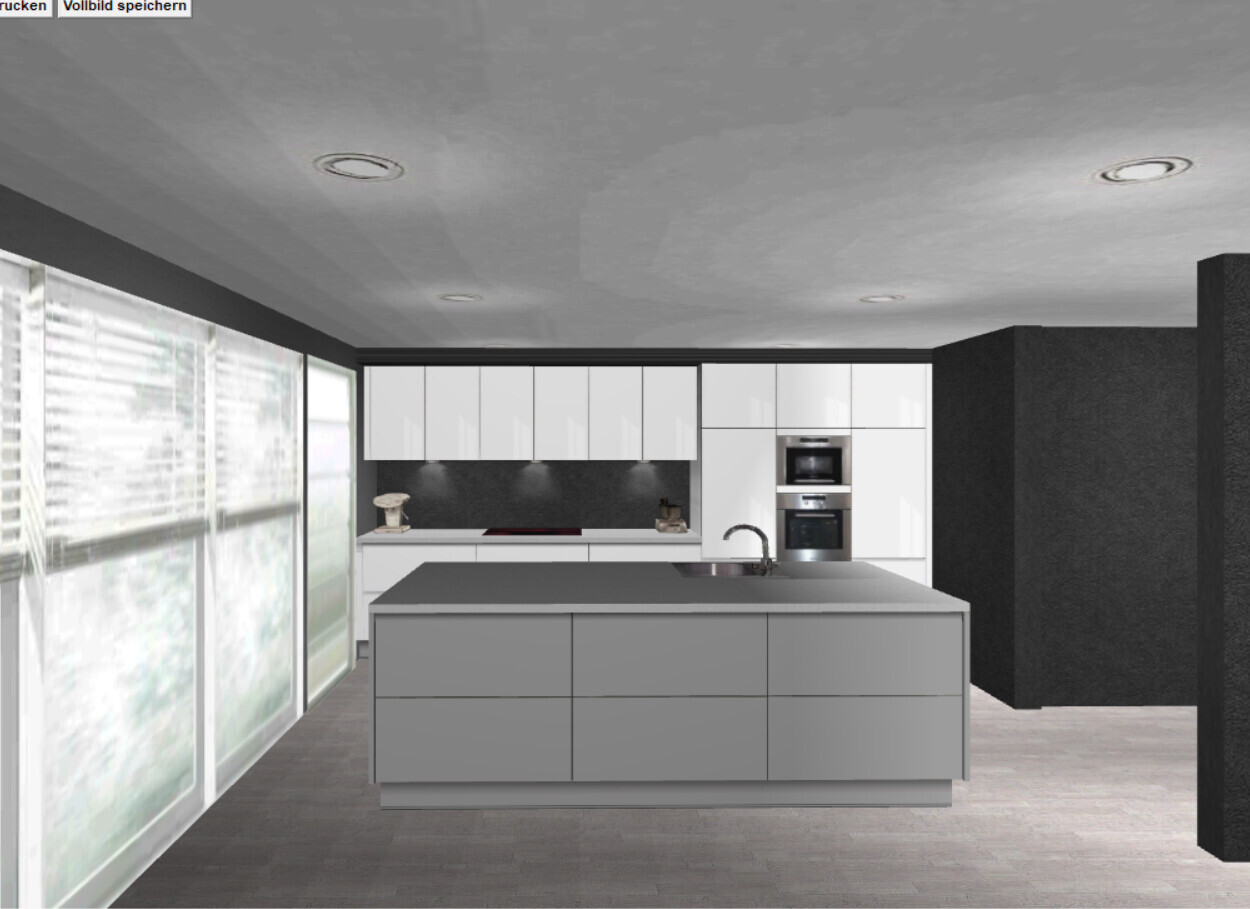
however, the passageways to the stairwell and living room wall should be at least 100cm (40 inches) wide.
It would be ideal if the kitchen nook remains 460cm (180 inches) long, as this fits well with the typical cabinet module sizes of 60 and 90cm (24 and 36 inches).
No matter where you place the cooktop and sink, you have more and better options than in square new-build homes that tend to have a square kitchen space. Square rooms are very difficult to furnish; kitchens in such spaces are usually 300-330cm (120-130 inches) wide, resulting in mini islands and essentially the same layout every time, because there is no alternative.
however, the passageways to the stairwell and living room wall should be at least 100cm (40 inches) wide.
It would be ideal if the kitchen nook remains 460cm (180 inches) long, as this fits well with the typical cabinet module sizes of 60 and 90cm (24 and 36 inches).
No matter where you place the cooktop and sink, you have more and better options than in square new-build homes that tend to have a square kitchen space. Square rooms are very difficult to furnish; kitchens in such spaces are usually 300-330cm (120-130 inches) wide, resulting in mini islands and essentially the same layout every time, because there is no alternative.
driver55 schrieb:
The upper floor hallway will be or become dark… Such remarks can be avoided with a pre-defined 110 square meters (1,184 square feet), or you could suggest adding a skylight above the staircase.
For the sense of space, it would benefit the room and kitchen to arrange the island so it can be walked around. At the front main entrance, allow a minimum of 1 meter (3.3 feet) in width; at the window/terrace side, this could be seen as an emergency exit or a shortcut, where an optical 50 centimeters (20 inches) would suffice. I already suggested this for the room layout (not for the kitchen planning) back in the thread around page 10.
ypg schrieb:
Comments like that are unnecessary with a predefined 110 sqm (1184 sq ft) or the suggestion of a roof window above the stairs In my opinion, it’s a matter of planning, not the square meters.
I understand RH, so this means a terraced house. Does the drawn roof fit accordingly?
Similar topics