
ᐅ Architect-designed house floor plan with a recessed upper level
Created on: 26 Aug 2021 20:36
S
stfn_86
Development Plan / Restrictions
Plot size: 485 sqm (5220 sq ft)
Slope: No slope on the property, but the site will be raised about 1 m (3 ft) above street level due to terrain adjustment
Floor Area Ratio: 0.4
Building Coverage Ratio: Not specified
Building envelope, building line, and boundary: See plan
Peripheral building: Within standard guidelines
Number of parking spaces: TBD
Number of floors: 2
Roof type: Flat roof as specified by the development plan
Architectural style: Modern
Orientation: Garden facing west
Maximum heights/limits: Max building height: 10.50 m (34 ft)
Additional requirements: According to the development plan, no fences or hedges are allowed in the front yard. However, our plot is on the edge of the development area along an existing street. On the opposite side of the street (outside the development area), most houses have fences, so exemption from this regulation might be possible.
Homeowners’ Requirements
Style, roof shape, building type: Modern, cubic
Basement, floors: Partial basement, ground floor, upper floor, penthouse floor
Number of people, ages: M 35, F 34, planning for 1-2 children
Office: M 100% home office, F 40-60% home office, two separate offices needed
Overnight guests per year: few
Open or closed layout: open
Traditional or modern construction: modern
Open kitchen, kitchen island: open, kitchen island
Number of dining seats: TBD
Fireplace: no
Music/sound wall: no
Balcony, roof terrace: roof terrace
Garage, carport: somewhat larger single garage, no double garage needed
Vegetable garden, greenhouse: no
Other wishes/special features/daily routine, including reasons for preferences:
House Design
Planner: Architect
What do you particularly like? Why?
Overall, the layout meets our expectations well, for example modern exterior, lots of natural light, large kitchen.
What do you dislike? Why?
Price estimate by architect: €725,000 (construction + incidental building costs)
Personal budget limit for house including fittings: TBD
Preferred heating system: District heating (mandated)
If you have to give up on something, which details/extensions
-can you forego: lounge, gallery, sauna, possibly one child’s room
-can’t you forego: two offices (one in the penthouse floor, one on the upper floor)
Why is the design the way it is now?
This is the architect’s first draft, which we see as a basis for further revisions.
What is the key/basic question about the floor plan in 130 characters?
What general feedback do you have for us to bring into the next discussion with the architect (besides points under “dislikes”)? I will post the next revision of the floor plan here.
Apologies for the rough dimensions. I added them myself and they are not exact to the last decimal.
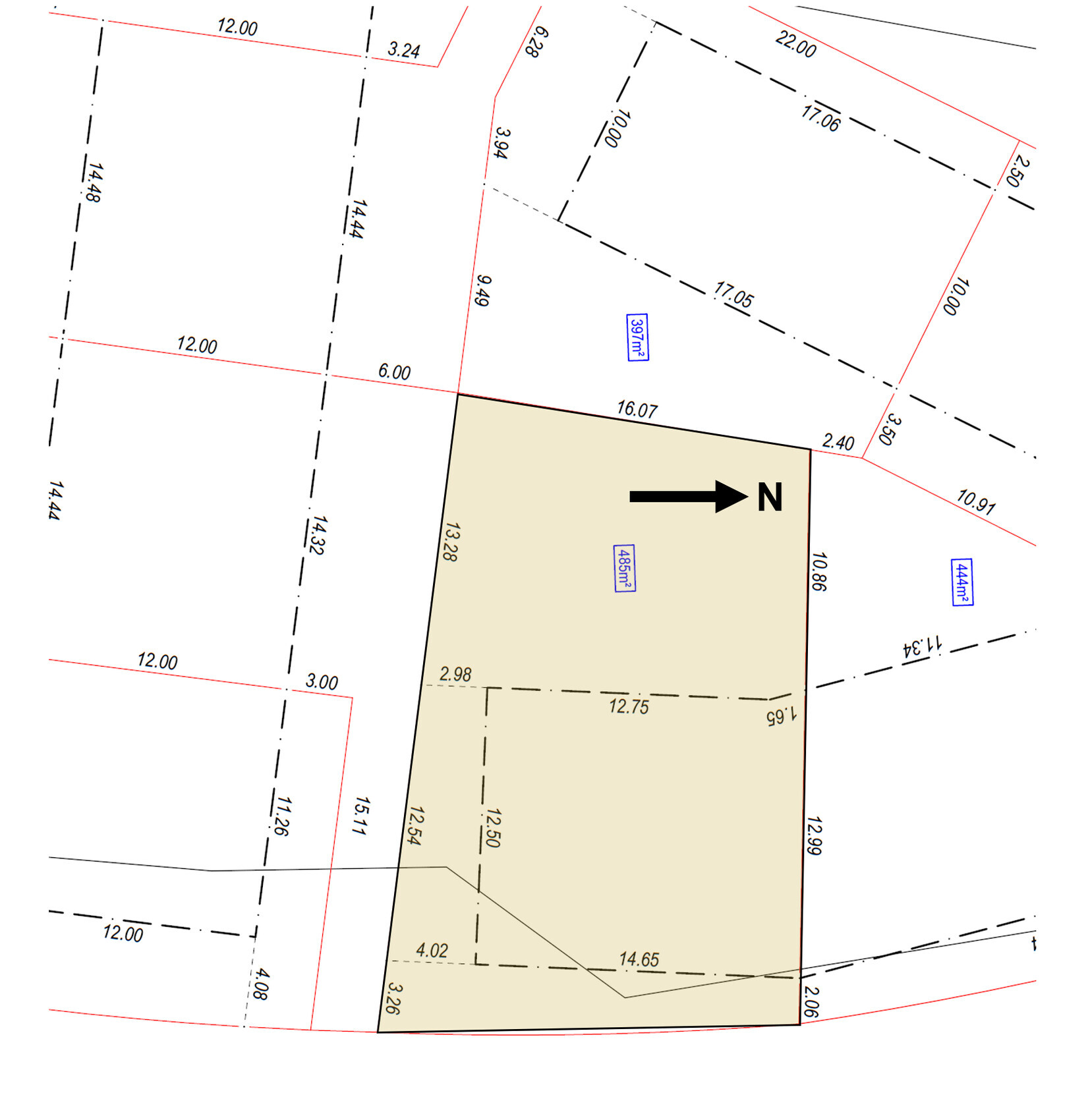
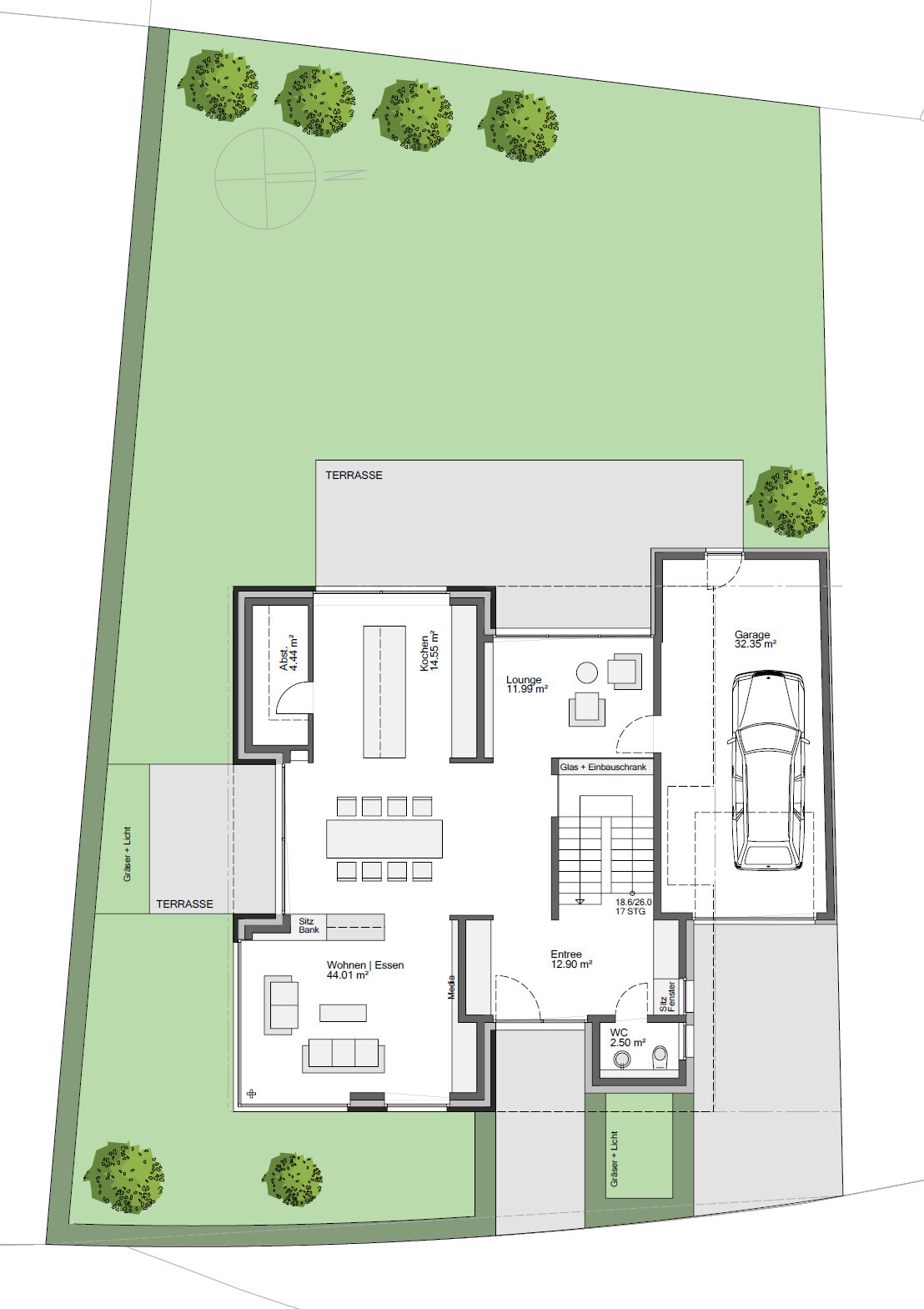
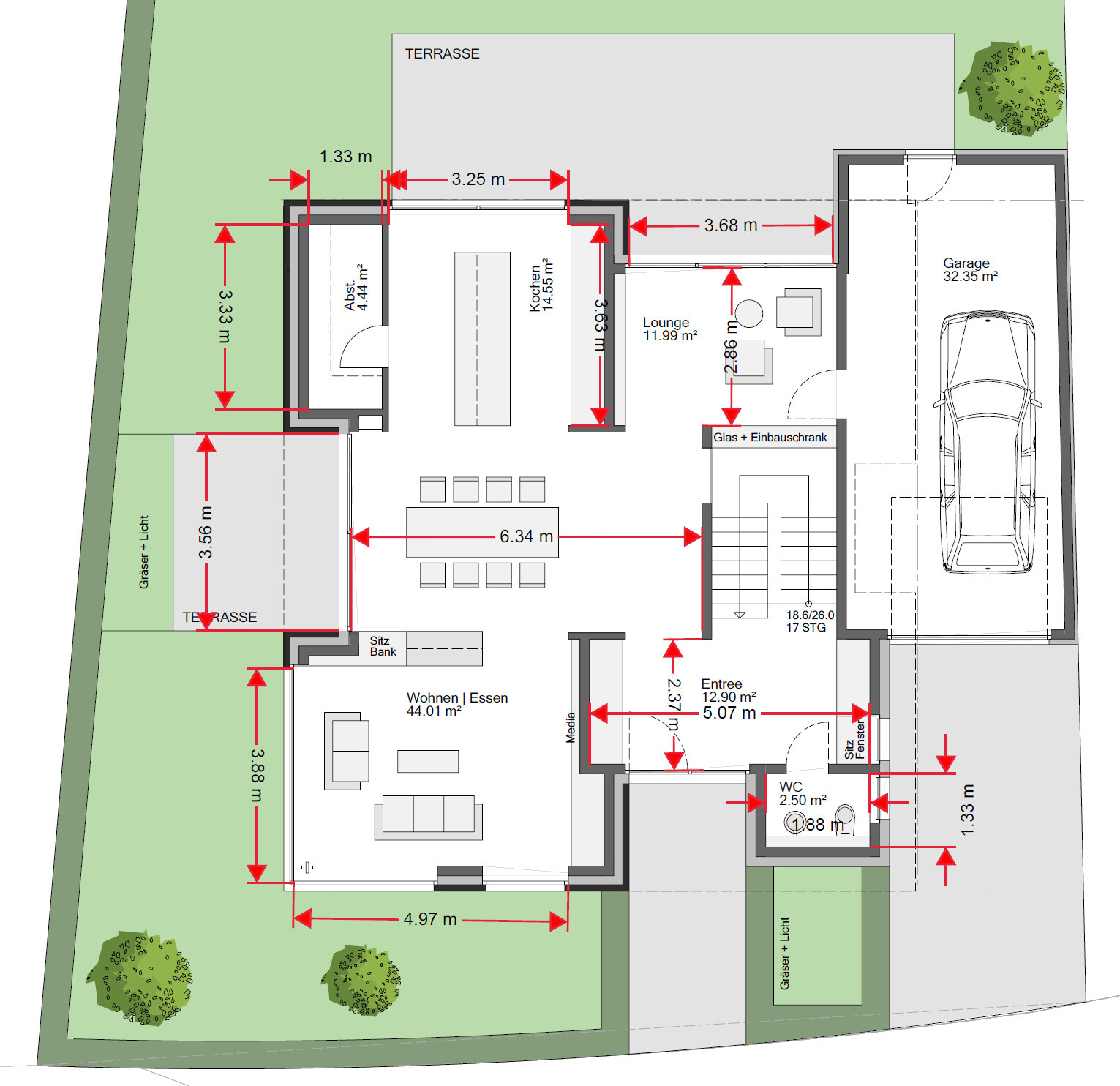
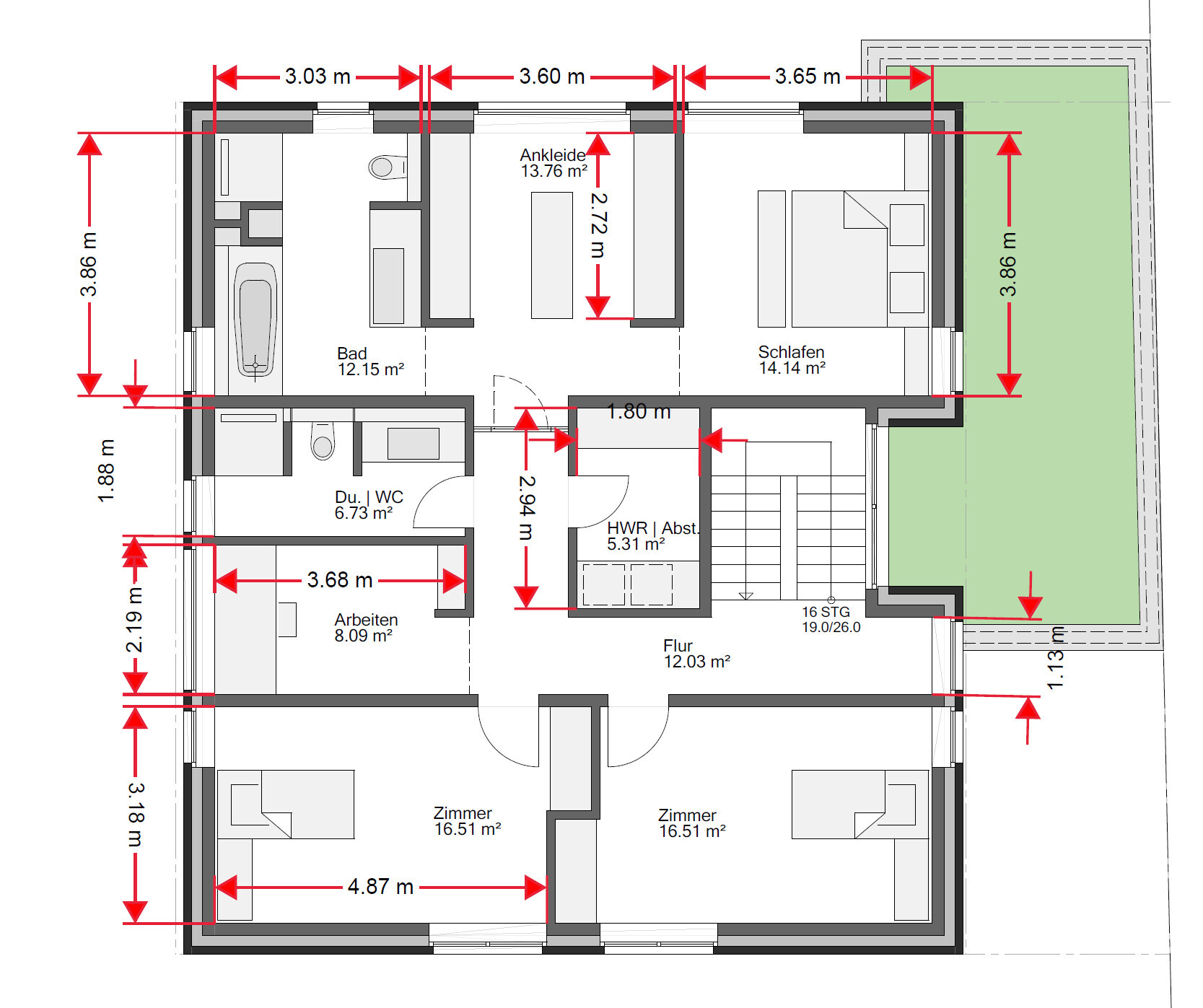
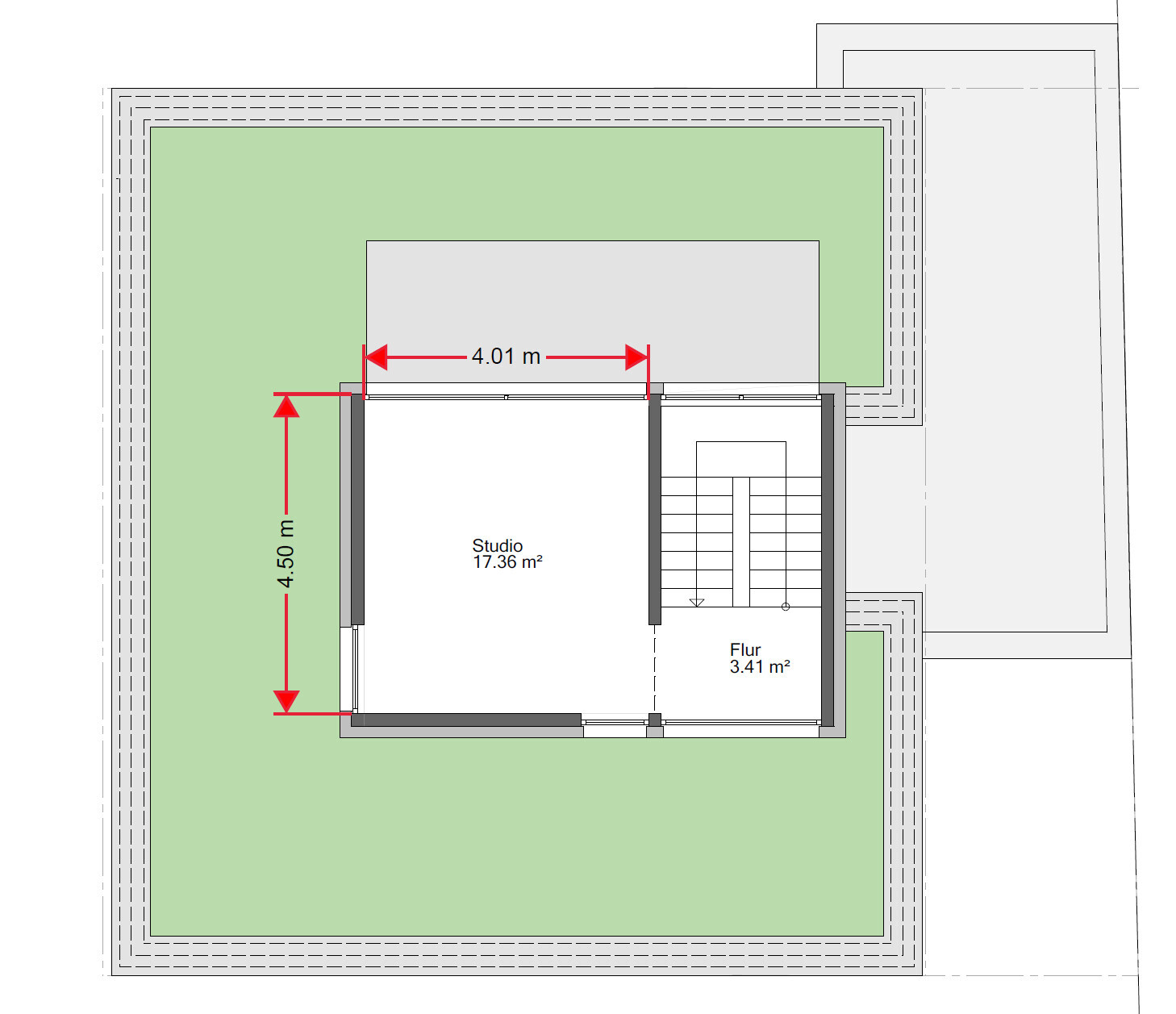
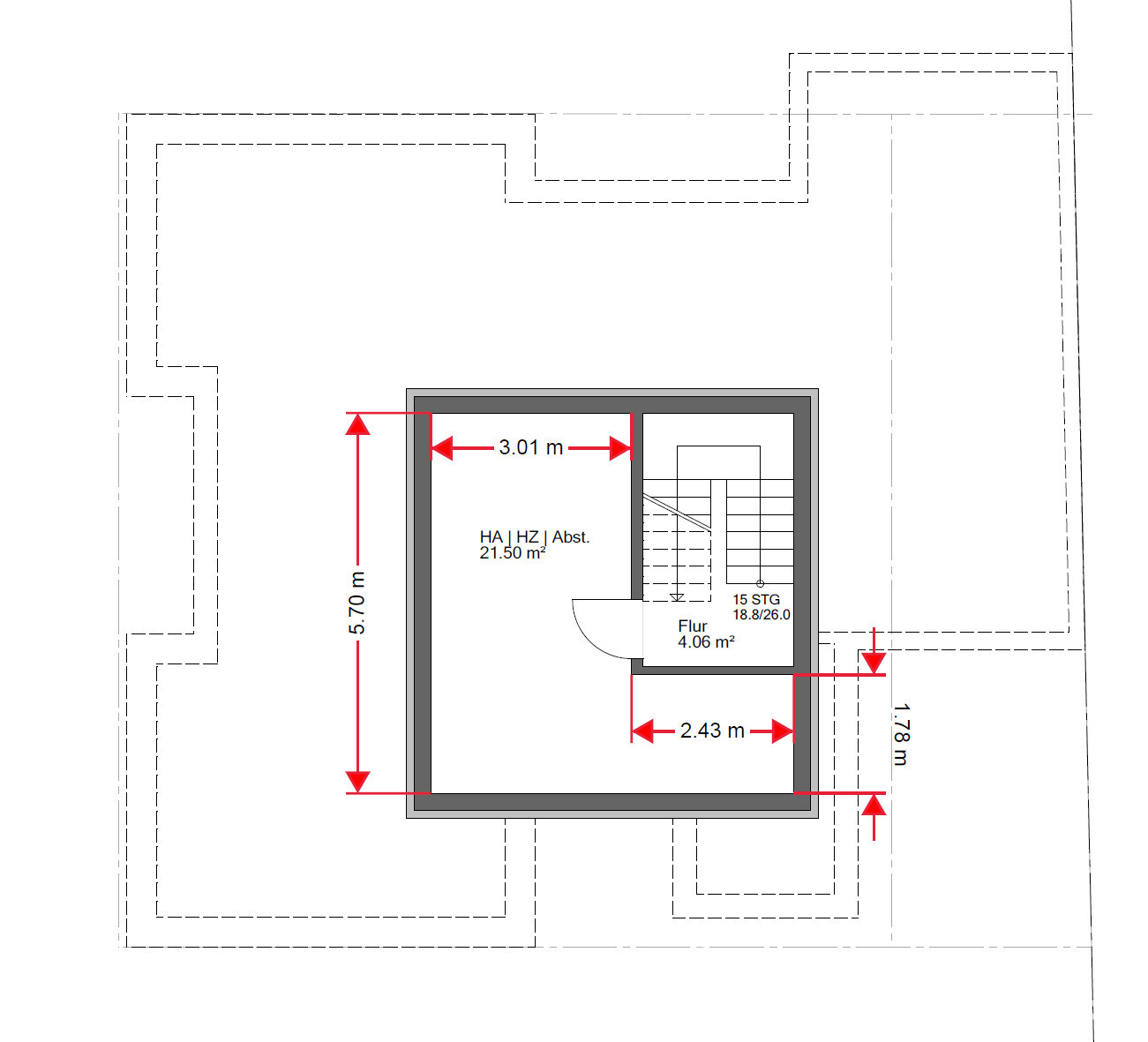
Plot size: 485 sqm (5220 sq ft)
Slope: No slope on the property, but the site will be raised about 1 m (3 ft) above street level due to terrain adjustment
Floor Area Ratio: 0.4
Building Coverage Ratio: Not specified
Building envelope, building line, and boundary: See plan
Peripheral building: Within standard guidelines
Number of parking spaces: TBD
Number of floors: 2
Roof type: Flat roof as specified by the development plan
Architectural style: Modern
Orientation: Garden facing west
Maximum heights/limits: Max building height: 10.50 m (34 ft)
Additional requirements: According to the development plan, no fences or hedges are allowed in the front yard. However, our plot is on the edge of the development area along an existing street. On the opposite side of the street (outside the development area), most houses have fences, so exemption from this regulation might be possible.
Homeowners’ Requirements
Style, roof shape, building type: Modern, cubic
Basement, floors: Partial basement, ground floor, upper floor, penthouse floor
Number of people, ages: M 35, F 34, planning for 1-2 children
Office: M 100% home office, F 40-60% home office, two separate offices needed
Overnight guests per year: few
Open or closed layout: open
Traditional or modern construction: modern
Open kitchen, kitchen island: open, kitchen island
Number of dining seats: TBD
Fireplace: no
Music/sound wall: no
Balcony, roof terrace: roof terrace
Garage, carport: somewhat larger single garage, no double garage needed
Vegetable garden, greenhouse: no
Other wishes/special features/daily routine, including reasons for preferences:
- Possibly a sauna in the penthouse floor. If so, a bathroom should be relocated there and the penthouse floor slightly enlarged. Otherwise, the penthouse floor will serve as a study/guest room.
- Originally no basement was planned, only a utility room on the upper floor. Due to terrain raising, a partial basement now seems reasonable. Currently considering replacing the utility room with a gallery/open space.
House Design
Planner: Architect
What do you particularly like? Why?
Overall, the layout meets our expectations well, for example modern exterior, lots of natural light, large kitchen.
What do you dislike? Why?
- The living room is located at the front as per the architect’s recommendation, placing the kitchen towards the garden. The idea was to protect the living area from street views with a hedge or similar. However, fences or hedges in the front yard are prohibited (see above), so adequate privacy seems difficult. On the other hand, the house is raised relative to the street (finished floor level 30.60 m (100.4 ft), street: 29.50 m (96.8 ft)), which may provide some privacy. I’m unsure if the architect fully considered the fence restriction. Currently, we are thinking about swapping the kitchen and living room.
- The lounge area was not explicitly requested by us and seems like an afterthought to use extra space.
- The dressing room is somewhat oversized.
- The entrance from the garage into the house feels too “American” and might be removed. This would mean a longer path from the garage to the kitchen for unloading groceries.
Price estimate by architect: €725,000 (construction + incidental building costs)
Personal budget limit for house including fittings: TBD
Preferred heating system: District heating (mandated)
If you have to give up on something, which details/extensions
-can you forego: lounge, gallery, sauna, possibly one child’s room
-can’t you forego: two offices (one in the penthouse floor, one on the upper floor)
Why is the design the way it is now?
This is the architect’s first draft, which we see as a basis for further revisions.
What is the key/basic question about the floor plan in 130 characters?
What general feedback do you have for us to bring into the next discussion with the architect (besides points under “dislikes”)? I will post the next revision of the floor plan here.
Apologies for the rough dimensions. I added them myself and they are not exact to the last decimal.
H
hampshire27 Aug 2021 14:38driver55 schrieb:
Exactly. Not everyone wants to carry around 2-3 flat screens… 😀My assumption was that the OP is financing the house from their income. Unless it’s explicitly a specialized IT job, beyond a certain salary level, you’re also paid for thinking. Thinking doesn’t require large screens. A laptop and phone for notes and communication are sufficient; a larger screen is a matter of comfort but doesn’t help with thinking.
hampshire schrieb:
I don’t quite understand—does this refer to completely avoiding any cost inefficiency in construction combined with unrealistic cost optimism? Partly, but mostly yes. An impressive building mass is being developed without clearly addressing the question of site grading; as a result, a space that couldn’t be shifted out of the living room is called a “lounge” (and a tiny room is called a home office), and the basement raises some questions ... all of this makes me think far more of a show-off than just a dreamer or artist.
hampshire schrieb:
The architects have wonderful references on their website and apparently a less cost-conscious clientele. Was the star chef of this design mentioned here?
https://www.instagram.com/11antgmxde/
https://www.linkedin.com/company/bauen-jetzt/
H
hampshire27 Aug 2021 18:4211ant schrieb:
Was the star architect of this design mentioned here? I don’t know how to link to other posts; in June, it was Ferreira-Verfürth from Meerbusch who contributed.
11ant schrieb:
The result includes an air pocket in the living room that cannot be removed, called the "lounge" (and a small room for a home office). The basement raises some questions. The answers to the “open questions” become clear to me quickly.
The lounge is an additional spot to sit and enjoy the evening sun – why should there be only one seating area in a large room?
The small office seems to come from the original poster’s statement that they hardly need (or want) much space.
More basement space simply isn’t necessary; the building services are well concealed there and don’t cause any disturbance.
Sometimes, there is more to consider than just price per square meter, which I would estimate around 4000€ (approximately $4400) here, given a reasonable ceiling height and appropriate fittings for the design. After all, the house would become a caricature of itself if the technical equipment, finishes, and details like windows, stairs, doors, etc., were chosen as budget variants.
hampshire schrieb:
I don’t know how to link to other posts; in June, the post was by Ferreira-Verfürth from Meerbusch. Thanks, I’ll look into them later. By the way, I only know how to link here when I’m on a desktop. When I’m on the go, I just give likes and simple comments; even quoting split posts is quite tedious on mobile :-(
hampshire schrieb:
The answers to the “open questions” become clear to me quickly. [...] More basements simply aren’t necessary; the building services are well-concealed there and don’t cause any issues. However, the house entries are unfortunately built over here, which disrupts many utility providers. And even when cost isn’t the main concern, the phenomenon of the disproportionately slow shrinking of a partial basement on the cost side should be familiar to any planner. In this case of a mini basement, the saved money has long since left the wagon behind. I guess I should add another dimension to my basement rule.
hampshire schrieb:
After all, the house would become a caricature of itself if technical equipment, room allowances, and details like windows, stairs, doors, etc., were chosen in budget versions. Oh, don’t remind me of architect-designed houses with plastic windows!
https://www.instagram.com/11antgmxde/
https://www.linkedin.com/company/bauen-jetzt/
What confuses me:
The space requirements on the upper floor are extremely high. Also, the fact that in addition to bedrooms (number of occupants) plus a children’s bathroom, you now need a separate room for a home office could spark a discussion about where or how living is actually supposed to work anymore. In big cities, building detached single-family houses is often prohibited, while other developments are really being expanded. Anyway, I’m digressing…
I don’t see any general inflation in room sizes here. Everything looks quite normal. Just 1–2 square meters (10–20 square feet) more than in a 160 square meter (1,720 square feet) house…
But some rooms would have to be moved to an additional setback floor. Despite the flood risk, the technical installations are placed in the basement so that the tower doesn’t look like LEGO from a drone’s perspective (oops, all the recesses in the ground floor façade are not mirrored on the upper floor)… if you look at a section through the building, you basically see a spinning top or a taller UFO. That should make you think (if, according to @hampshire, you get paid to think 😉).
The ground floor could accommodate both the technical installations AND a stylish home office, AND be spacious if the square meters were used more efficiently and these recesses were avoided. Sometimes less is more.
With architectural planning, you can even fit a sauna on the upper floor.
I don’t see 4,000 square meters (43,000 square feet) if you straighten out the corners. But you can certainly add the 20% markup typical of architectural calculations to the base factor of 7.
The space requirements on the upper floor are extremely high. Also, the fact that in addition to bedrooms (number of occupants) plus a children’s bathroom, you now need a separate room for a home office could spark a discussion about where or how living is actually supposed to work anymore. In big cities, building detached single-family houses is often prohibited, while other developments are really being expanded. Anyway, I’m digressing…
I don’t see any general inflation in room sizes here. Everything looks quite normal. Just 1–2 square meters (10–20 square feet) more than in a 160 square meter (1,720 square feet) house…
But some rooms would have to be moved to an additional setback floor. Despite the flood risk, the technical installations are placed in the basement so that the tower doesn’t look like LEGO from a drone’s perspective (oops, all the recesses in the ground floor façade are not mirrored on the upper floor)… if you look at a section through the building, you basically see a spinning top or a taller UFO. That should make you think (if, according to @hampshire, you get paid to think 😉).
The ground floor could accommodate both the technical installations AND a stylish home office, AND be spacious if the square meters were used more efficiently and these recesses were avoided. Sometimes less is more.
With architectural planning, you can even fit a sauna on the upper floor.
I don’t see 4,000 square meters (43,000 square feet) if you straighten out the corners. But you can certainly add the 20% markup typical of architectural calculations to the base factor of 7.
Similar topics