
Hello everyone,
we are planning a prefabricated house using timber frame construction. It will have 180 sqm (1,937 sq ft) of living space with underfloor heating, and about 230 sqm (2,475 sq ft) of usable area.
So far, the offer included an air-to-water heat pump from Daikin (Altherma 3R, formerly Rotex HPSU compact Ultra).
Now it seems that this unit might not have enough capacity (?) and as an alternative (additional cost around 4,000) we have been offered a "Wolf heat pump CHC Monoblock 10/300-35".
The Daikin is available in the 4-9 kW version—would that really be insufficient for this size? And what do you think about this offer?
I have the energy-saving regulation heat protection certification and a renewable energy heat law document available, if any information from those is needed.
Thank you very much!
Best regards
we are planning a prefabricated house using timber frame construction. It will have 180 sqm (1,937 sq ft) of living space with underfloor heating, and about 230 sqm (2,475 sq ft) of usable area.
So far, the offer included an air-to-water heat pump from Daikin (Altherma 3R, formerly Rotex HPSU compact Ultra).
Now it seems that this unit might not have enough capacity (?) and as an alternative (additional cost around 4,000) we have been offered a "Wolf heat pump CHC Monoblock 10/300-35".
The Daikin is available in the 4-9 kW version—would that really be insufficient for this size? And what do you think about this offer?
I have the energy-saving regulation heat protection certification and a renewable energy heat law document available, if any information from those is needed.
Thank you very much!
Best regards
D
Deliverer8 Jul 2021 21:47Overall, quite decent. However, I don’t understand why the bathtub and shower aren’t allowed to heat the bathroom. Could it be due to insufficient installation height? Sometimes both are set lower than the floor level.
O
Oetzberger8 Jul 2021 22:00Now, only one wall in the bathroom needed to be covered, then it would have been perfect.

Principle, warranty, always done differently? He simply didn’t want to do it because the bathtub is set into the polystyrene panel, and he couldn’t imagine any loops underneath it. Stability, etc.? I can somewhat understand it with the shower. The drain is integrated with the shower trench. Then the tiler has to install it and also create the slope. He probably doesn’t want to mix the trades there.
It actually is. 😉 Post #207
Oetzberger schrieb:
Only one wall in the bathroom still needed to be covered, then it would have been perfect
It actually is. 😉 Post #207
So, please go ahead and criticize me. First of all, the buffer tank has arrived.
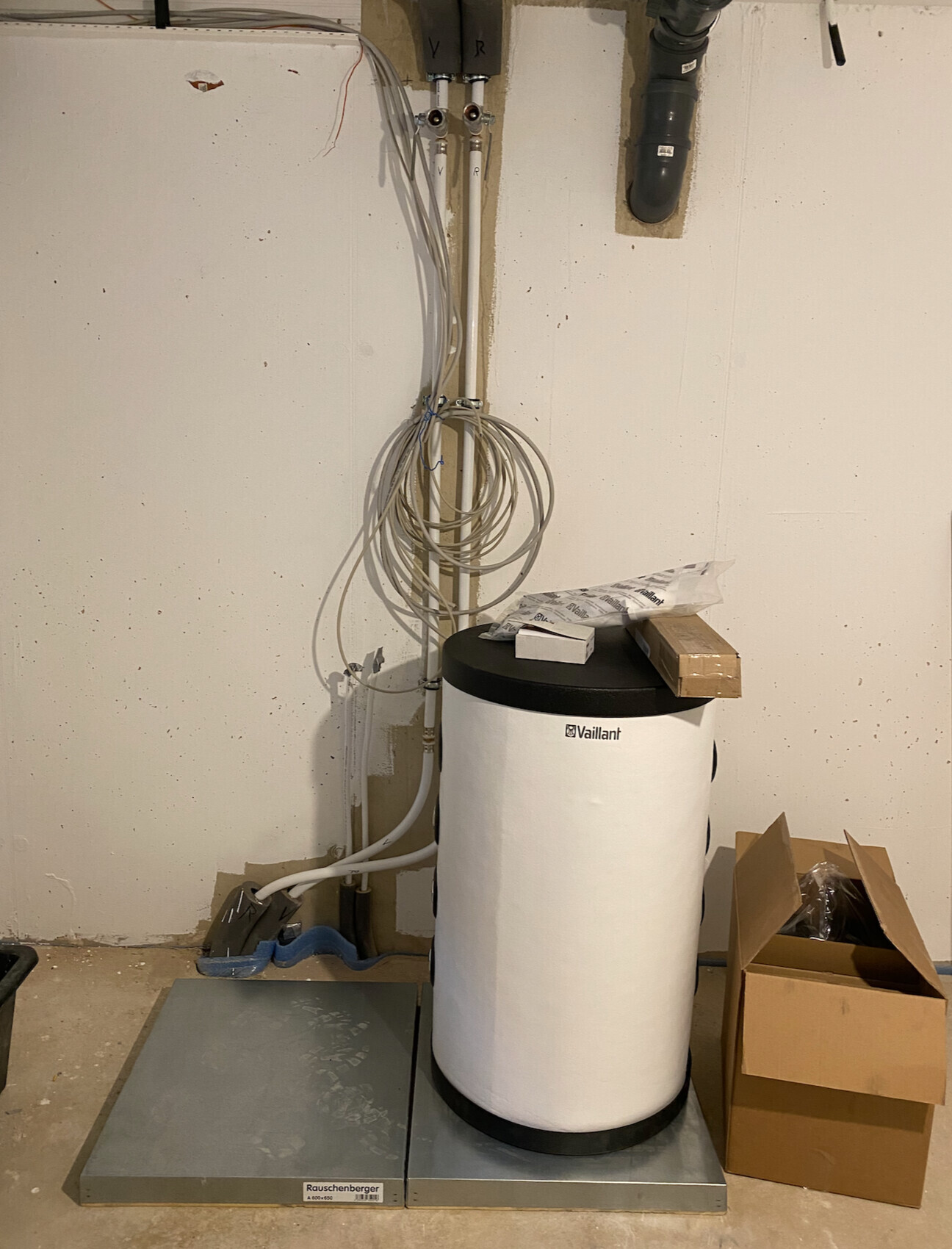
To avoid lengthy discussions about its necessity: the heating technician refused to omit it. It will be installed in the return line. You can’t always win, and after 5 years the warranty will expire, so I can have it disconnected then.
To avoid lengthy discussions about its necessity: the heating technician refused to omit it. It will be installed in the return line. You can’t always win, and after 5 years the warranty will expire, so I can have it disconnected then.

Yes, same here. On the return line, it’s for continuous flow, and with the size (50 liters) it’s actually not such a big deal. But why is this a separate component? My heating engineer told me it’s integrated in the unit tower? Or did you get a bigger one after all?
By the way, have you heard anything about delivery issues? My fellow builder, who still has to rely on the main builder’s heating engineer, said that he can’t get the heat pump delivered. That’s why he now has to run the heating system with an instantaneous water heater on temporary construction power (which we’re sharing 🙄 🤨).
By the way, have you heard anything about delivery issues? My fellow builder, who still has to rely on the main builder’s heating engineer, said that he can’t get the heat pump delivered. That’s why he now has to run the heating system with an instantaneous water heater on temporary construction power (which we’re sharing 🙄 🤨).
D
Deliverer25 Aug 2021 09:5450 liters (13 gallons) in the return flow, not installed in parallel as a manifold, and even physically separated from the rest of the system, is by far the least critical way to integrate a buffer tank. So this is really not problematic and well handled by the plumbing.
I would even recommend this approach to anyone with actuators on the heating circuits, since it can never be completely ruled out that errors or incorrect operation occur.
So: Well done! No complaints from me. ;-)
I would even recommend this approach to anyone with actuators on the heating circuits, since it can never be completely ruled out that errors or incorrect operation occur.
So: Well done! No complaints from me. ;-)
Similar topics