
Hello,
we have already had several discussions with construction companies and have now arrived at a floor plan we are quite satisfied with. However, we are finding it difficult to choose the right builder and are not entirely sure if the floor plan is truly optimal. Also, we have not yet decided whether to build a prefabricated house or a solid (conventional) house.
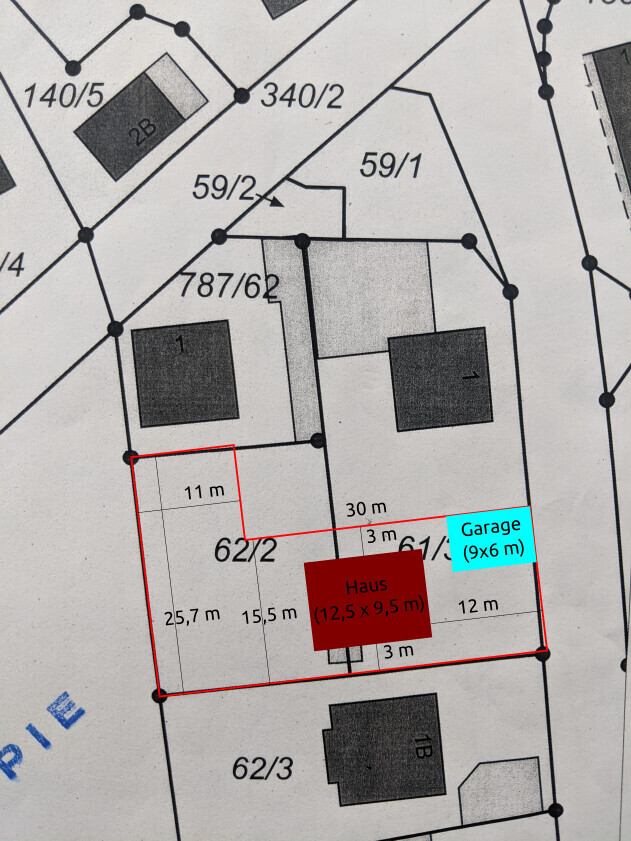
Development Plan / Restrictions
Plot size: 765 sqm (8,236 sq ft)
Slope: no
Site coverage ratio: 0.4
Floor area ratio: 0.5
Building envelope, building line and boundary: 9.5 x 20 m (31 x 66 ft). The plot is 15.5 m (51 ft) wide and a setback of half the eave height (at least 3 m (10 ft)) must be maintained.
Boundary construction: possible for the garage
Number of parking spaces: 2
Number of floors: 2 full stories (or a high knee wall > 2 m (6.5 ft) to keep the eave height under 6 m (20 ft))
Roof type: no specification known
Architectural style: no specification known
Orientation: see site plan
Maximum heights / limits: eave height max. 6 m (20 ft) or accordingly higher setback distance
Other requirements: none
Builders’ Requirements
Architectural style: modern
Roof shape: gable or hip roof
Building type: urban villa
Basement: no
Number of floors: 2 full stories (or a high knee wall > 2 m (6.5 ft) to keep the eave height under 6 m (20 ft))
Number of occupants, age: two people (28), potentially two children in the future
Space requirement for ground floor and upper floor: approx. 180 sqm (1,938 sq ft) total
Office: two offices (both for home office use); one of them also as a guest room
Overnight guests per year: unclear
Open or closed architecture: neither – a compromise
Conservative or modern construction: modern
Open kitchen: no, but with a sliding door that is mostly left open
Kitchen island: yes, at least a peninsula
Number of dining seats: 6 to 10
Fireplace: no
Music / stereo wall: 5.1 sound system with TV, so space needed behind the sofa
Balcony, roof terrace: no
Garage, carport: garage 6 x 9 m (20 x 30 ft)
Utility garden, greenhouse: no
House Design
Who designed it: do-it-yourself
What do you particularly like? Why?
All the required rooms were included; minimal circulation areas; no wasted space; utility room directly next to the bathroom on the upper floor
What do you not like? Why?
We don’t like the bathroom layout because there is little natural light in the room
Estimated cost according to architect/planner: about €450,000 - 500,000 (about $490,000 - 545,000) according to various offers
Personal budget limit for the house, including fittings: €500,000 (about $545,000)
Preferred heating technology: air-to-water heat pump + underfloor heating
If you have to give up something, which details/expansions
-can you do without:
-cannot do without:
all rooms (especially the two offices) are important and must be retained
Why did the design turn out as it is now?
A mix of many examples from various magazines, own ideas, and drawings from different sales consultants/building advisors
What is the most important/fundamental question about the floor plan in 130 characters?
- Do you see any fundamental issues with the floor plan? Do you have better ideas?
- Can the desired rooms be arranged more efficiently on less space?
- How do we find the right builder for our project? We have already had many discussions and received offers but are struggling to decide.
- Prefabricated house or solid house?
Thank you very much and best regards
Rapha811
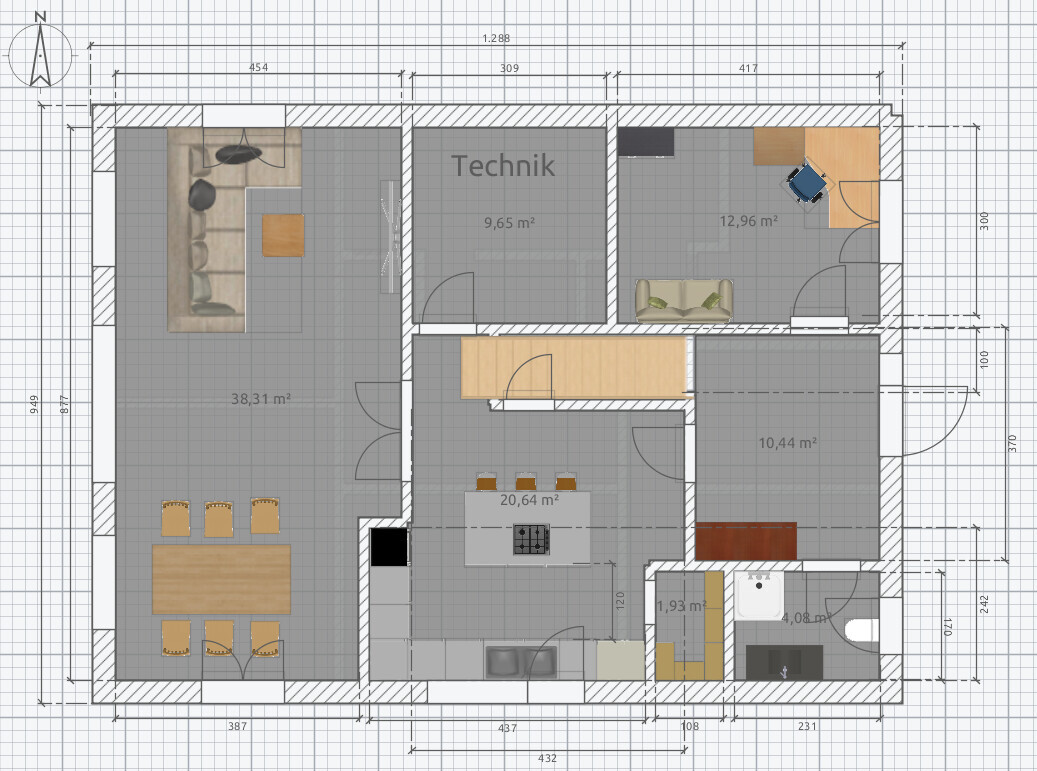
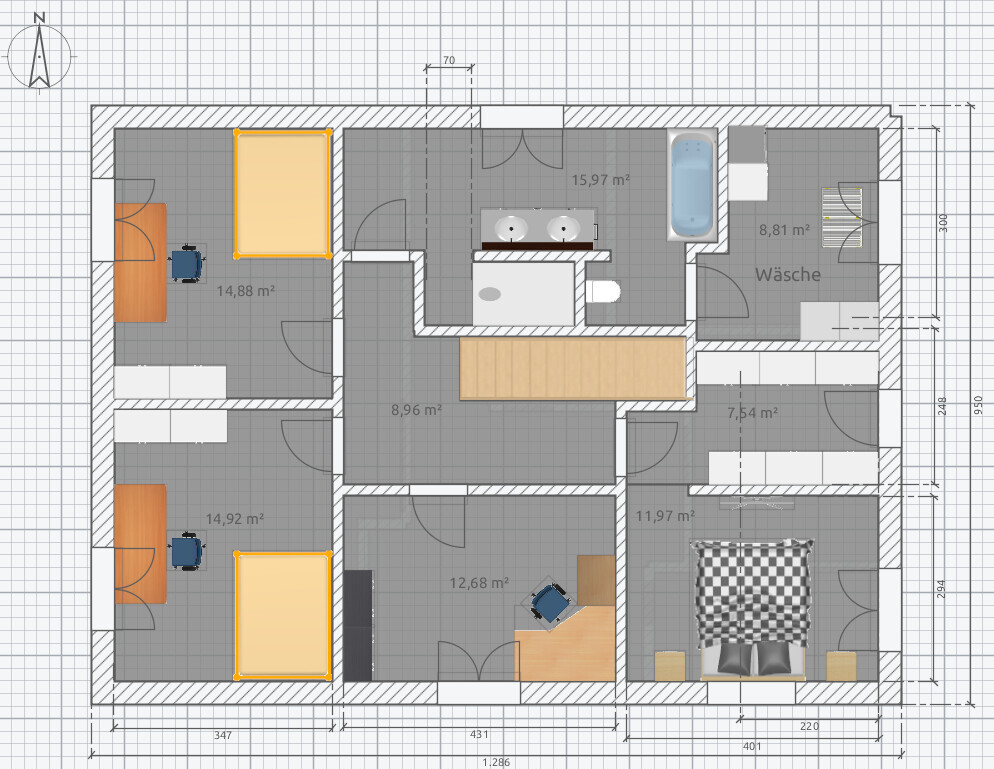
we have already had several discussions with construction companies and have now arrived at a floor plan we are quite satisfied with. However, we are finding it difficult to choose the right builder and are not entirely sure if the floor plan is truly optimal. Also, we have not yet decided whether to build a prefabricated house or a solid (conventional) house.
Development Plan / Restrictions
Plot size: 765 sqm (8,236 sq ft)
Slope: no
Site coverage ratio: 0.4
Floor area ratio: 0.5
Building envelope, building line and boundary: 9.5 x 20 m (31 x 66 ft). The plot is 15.5 m (51 ft) wide and a setback of half the eave height (at least 3 m (10 ft)) must be maintained.
Boundary construction: possible for the garage
Number of parking spaces: 2
Number of floors: 2 full stories (or a high knee wall > 2 m (6.5 ft) to keep the eave height under 6 m (20 ft))
Roof type: no specification known
Architectural style: no specification known
Orientation: see site plan
Maximum heights / limits: eave height max. 6 m (20 ft) or accordingly higher setback distance
Other requirements: none
Builders’ Requirements
Architectural style: modern
Roof shape: gable or hip roof
Building type: urban villa
Basement: no
Number of floors: 2 full stories (or a high knee wall > 2 m (6.5 ft) to keep the eave height under 6 m (20 ft))
Number of occupants, age: two people (28), potentially two children in the future
Space requirement for ground floor and upper floor: approx. 180 sqm (1,938 sq ft) total
Office: two offices (both for home office use); one of them also as a guest room
Overnight guests per year: unclear
Open or closed architecture: neither – a compromise
Conservative or modern construction: modern
Open kitchen: no, but with a sliding door that is mostly left open
Kitchen island: yes, at least a peninsula
Number of dining seats: 6 to 10
Fireplace: no
Music / stereo wall: 5.1 sound system with TV, so space needed behind the sofa
Balcony, roof terrace: no
Garage, carport: garage 6 x 9 m (20 x 30 ft)
Utility garden, greenhouse: no
House Design
Who designed it: do-it-yourself
What do you particularly like? Why?
All the required rooms were included; minimal circulation areas; no wasted space; utility room directly next to the bathroom on the upper floor
What do you not like? Why?
We don’t like the bathroom layout because there is little natural light in the room
Estimated cost according to architect/planner: about €450,000 - 500,000 (about $490,000 - 545,000) according to various offers
Personal budget limit for the house, including fittings: €500,000 (about $545,000)
Preferred heating technology: air-to-water heat pump + underfloor heating
If you have to give up something, which details/expansions
-can you do without:
-cannot do without:
all rooms (especially the two offices) are important and must be retained
Why did the design turn out as it is now?
A mix of many examples from various magazines, own ideas, and drawings from different sales consultants/building advisors
What is the most important/fundamental question about the floor plan in 130 characters?
- Do you see any fundamental issues with the floor plan? Do you have better ideas?
- Can the desired rooms be arranged more efficiently on less space?
- How do we find the right builder for our project? We have already had many discussions and received offers but are struggling to decide.
- Prefabricated house or solid house?
Thank you very much and best regards
Rapha811
kbt09 schrieb:
Much better, but both sofa positions are still quite awkward... how about this way? Maybe move the patio door a bit further upwards on the plan.
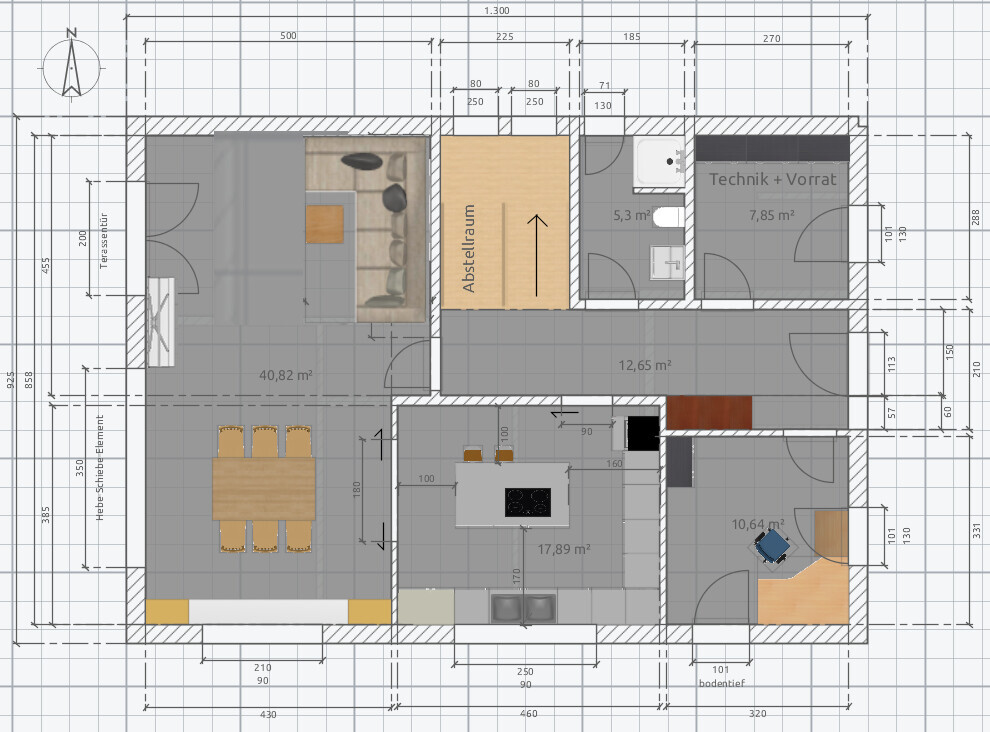
Unfortunately, we don’t like this much either because the TV position is not ideal and no speakers can be placed behind the sofa. The home theater setup is quite important to us, so we need to consider that when positioning the sofa.
11ant schrieb:
I appreciate the willingness to move away from the straight staircase, but otherwise I’m not yet very enthusiastic. Is that because you still don’t like it? Please feel free to share any criticism! 🙂
Rapha811 schrieb:
The only thing that still bothers us is that you can’t see the garden (to the left on the plan) from the sofa That would bother me too. You can definitely communicate that to the architect – it’s especially noticeable here that there is unused space behind the sofa, and on top of that, a patio door. I keep wondering what the trained planner was thinking.
Rapha811 schrieb:
and that we don’t have a hanging chair in the living room That’s a temporary matter. I think it could probably be overlooked unless it’s also supposed to be the spot where the Christmas tree hangs 😉
Rapha811 schrieb:
However, then everything gets quite tight and you would have to replace the corner between dining room and kitchen with a slanted wall, I want to point out that in the dining area there is a 1.40 m (4 ft 7 in) table with 6 seats drawn in, which practically doesn’t work. Draw in a 180/200 cm (6 ft / 6 ft 7 in) table with 4 seats or a 220/240 cm (7 ft 3 in / 7 ft 10 in) table with 6 seats, and you’ll see how little space there really is.
The windows in the private rooms: why are they floor-to-ceiling? Should everyone be able to look in below waist height?

Rapha811 schrieb:
Because you still don’t like it? Please feel free to share your criticism! I see two "mistakes" in
Rapha811 schrieb:
we sat down with a friend who is an interior designer namely "friend" and "interior." In my opinion — as I already mentioned in post #19 — you need an architect. The new version still doesn’t really impress me. I see a move away from the single-flight staircase, but not the underlying issue that would have been solved. The design still looks like that of a 150 m² (1,615 sq ft) house to me. The additional square meters are not evident — and if there can still be slow traffic zones in the sofa area, they apparently were not integrated there either. Maybe an interior designer helps about as much as an ear doctor when you have back pain?
https://www.instagram.com/11antgmxde/
https://www.linkedin.com/company/bauen-jetzt/
ypg schrieb:
That would bother me too. You can communicate something like this to the architect – what stands out negatively here is that there is unused space behind the sofa, plus a patio door. I keep wondering what the trained planner was thinking.
It’s a temporary situation. I think you could probably ignore it unless this is supposed to be the spot where the Christmas tree will be placed 😉
I want to point out that there is a 1.40 m (55 inches) table drawn in the dining area with 6 seats, which practically doesn’t work. Draw a 1.80/2.00 m (71/79 inches) table with 4 seats or a 2.20/2.40 m (87/94 inches) table with 6 seats, and you’ll see how little space there really is.
The windows in the private rooms: why are they floor-to-ceiling? Is it really intended that everyone can look in at waist level? As I said: The space behind the sofa is indeed "unused," but it’s necessary to maintain the correct distance from the speakers. Still, we’re not completely satisfied with it.
How do you conclude that it is a 1.40 m (55 inches) table? In the drawing, the table measures 1.80 x 1.10 m (71 x 43 inches). Accordingly, a 2.40 m (94 inches) table would also easily fit. The table can also be rotated by 90°.
We really need to reconsider the floor-to-ceiling windows on the upper floor – thanks for pointing that out!
11ant schrieb:
I see two "mistakes," namely "befreundet" and "Innen" [Note: untranslated per instructions]. In my opinion – which I already noted in post #19 – you need an architect. I’m still not impressed by the new version. I see a departure from the straight staircase, but not the problem that was supposedly solved. To me, the design still looks like a 150 m² (1,615 sq ft) house. I don’t see the additional square meters. And if there are still slow spots in the sofa area, apparently they weren’t included there either. Maybe an interior architect is as helpful for this as an ENT specialist is for back pain? I don’t quite understand why the design looks like a 150 m² (1,615 sq ft) house? Specifically, where does it feel too tight or too small? For us, everything except for the sofa area is quite well thought-out, so we currently don’t see a need to consult an external architect.
Similar topics