
Hello everyone!
I’ve mentioned before that we plan to install a wooden privacy fence along the side of our property bordering the neighbor. The plan was for rounded fence panels, 180cm (71 inches) tall at the highest point and the same width.
The local DIY store gave me a quote for the materials, including delivery. Normally, this store is not particularly expensive.
The total for materials for 19.5m (64 feet) of fencing came to over 1000€. The panels themselves were about 500€, with the rest being the “miscellaneous parts.” One costly item is the wood stain planned (three times 4L (1 gallon) of Bondex long-lasting protective stain) for nearly 200€. The advisor also said we need to use H-posts and set them in concrete. He quoted a 40kg (88 lbs) bag of screed concrete for each post.
I know that here in northern Germany it’s probably better to set the posts in concrete, but do I really need 400kg (880 lbs) of concrete for a 19.5m (64 feet) wooden fence? It seems crazy to me.
With L-brackets, screws, posts, etc., the entire project came to just over 1000€, and then we still have to assemble it ourselves — and we’re not sure if we can manage that. I had originally thought of using the quick-setting concrete that only needs watering, but I expected 2–3 bags would be enough.
Do you think the quote for materials is realistic? I’m a bit shocked.
Now we’re considering alternatives. For example, I could order a mixed package of “natural hedge bouquet” with 160 plants online for about 280€, which would green up the whole garden and cost only about a quarter of what the fence would. However, the noise insulation to the neighbor’s property would probably be weaker than with a wooden fence (anyone with experience here?), and we would have to wait a few years until the plants grow tall enough to screen the view of the metal shed. But honestly, I’d almost prefer to invest a four-figure amount in greenery rather than in a fence.
What would you recommend?
I’ve mentioned before that we plan to install a wooden privacy fence along the side of our property bordering the neighbor. The plan was for rounded fence panels, 180cm (71 inches) tall at the highest point and the same width.
The local DIY store gave me a quote for the materials, including delivery. Normally, this store is not particularly expensive.
The total for materials for 19.5m (64 feet) of fencing came to over 1000€. The panels themselves were about 500€, with the rest being the “miscellaneous parts.” One costly item is the wood stain planned (three times 4L (1 gallon) of Bondex long-lasting protective stain) for nearly 200€. The advisor also said we need to use H-posts and set them in concrete. He quoted a 40kg (88 lbs) bag of screed concrete for each post.
I know that here in northern Germany it’s probably better to set the posts in concrete, but do I really need 400kg (880 lbs) of concrete for a 19.5m (64 feet) wooden fence? It seems crazy to me.
With L-brackets, screws, posts, etc., the entire project came to just over 1000€, and then we still have to assemble it ourselves — and we’re not sure if we can manage that. I had originally thought of using the quick-setting concrete that only needs watering, but I expected 2–3 bags would be enough.
Do you think the quote for materials is realistic? I’m a bit shocked.
Now we’re considering alternatives. For example, I could order a mixed package of “natural hedge bouquet” with 160 plants online for about 280€, which would green up the whole garden and cost only about a quarter of what the fence would. However, the noise insulation to the neighbor’s property would probably be weaker than with a wooden fence (anyone with experience here?), and we would have to wait a few years until the plants grow tall enough to screen the view of the metal shed. But honestly, I’d almost prefer to invest a four-figure amount in greenery rather than in a fence.
What would you recommend?
Apparently, this is just about pure theory? Coconut mats, old felt blankets, thuja hedges.
I would have already tested quite a few things over a meter (3 feet) by now...
Enforce quiet hours on Sundays and otherwise set time windows for music or for Kati’s rest. That should be manageable. The neighbors seem to only need the music for gardening anyway. Hopefully. Next year the child will be old enough to actually bother the neighbors 😉
I would have already tested quite a few things over a meter (3 feet) by now...
Enforce quiet hours on Sundays and otherwise set time windows for music or for Kati’s rest. That should be manageable. The neighbors seem to only need the music for gardening anyway. Hopefully. Next year the child will be old enough to actually bother the neighbors 😉

kati1337 schrieb:
that his 2-meter (6.5 feet) tall, very old and dense thuja trees are practically useless? Two meters (6.5 feet) high is not effective if it doesn’t match the propagation characteristics of the specific sound – for proper planning, you would need measurement microphones at/in/with several locations, heights, and angles. "Dense" is not correct, because then the sound has to deflect – where else should it dissipate?
However, it makes little sense for me, as a semi-informed person, to give a layperson a basic seminar on the fundamentals of acoustic construction, when there are professional experts available commercially in the business directories.
https://www.instagram.com/11antgmxde/
https://www.linkedin.com/company/bauen-jetzt/
I am revisiting my suggestion from a few weeks ago for discussion: to mask an unpleasant noise with a more pleasant one.
If you don’t mind the sound of running water, a stream along the affected boundary might be worth considering. Near the terrace, a powerful pump could supply a waterfall about one meter (3 feet) high, creating a nice soothing sound. Additionally, two smaller cascades with stones that create turbulence further upstream in the stream. Perhaps a strong water feature in a basin halfway along the course as well. Usually running quietly but equipped with a power mode (or an automatic sound control): when the neighbor turns up the noise again, the pump runs at full capacity. Then you only hear the mill clattering by the flowing stream... This is all something you can build yourself, using stones, gravel, and pond liner.
If you don’t mind the sound of running water, a stream along the affected boundary might be worth considering. Near the terrace, a powerful pump could supply a waterfall about one meter (3 feet) high, creating a nice soothing sound. Additionally, two smaller cascades with stones that create turbulence further upstream in the stream. Perhaps a strong water feature in a basin halfway along the course as well. Usually running quietly but equipped with a power mode (or an automatic sound control): when the neighbor turns up the noise again, the pump runs at full capacity. Then you only hear the mill clattering by the flowing stream... This is all something you can build yourself, using stones, gravel, and pond liner.

Scout schrieb:
I’m bringing up again my suggestion from a few weeks ago: to mask an unpleasant noise with a more pleasant one.
If you don’t mind the sound of flowing water, then a small stream along the affected boundary could be worth considering. Near the terrace, a strong pump powers a waterfall about one meter (3 feet) high, which creates a nice rushing sound. Add two smaller cascades (with stones that create swirling water) further back along the stream. Perhaps also a powerful water feature in a basin halfway along. Usually it runs quietly but with a power button (or an automatic sound control): when the neighbor gets loud again, the pump runs at full capacity. Then all you hear is the waterwheel clattering by the rushing stream... You can build all of this yourself using stones, gravel, and pond liner. Do you happen to have some example pictures or something like that?
In general, I find the sound of flowing water wonderful. We also already have electricity available that we haven’t used yet. So it’s definitely worth considering. Can a stream, fountain, or something similar really mask noise like that?
Masking: yes. If the speaker is 8 meters (26 ft) away from you and the waterfall is 2 meters (6.5 ft) away, at the same frequency and volume, the waterfall will be perceived as 4 times louder.
From the terrace, there is a boundary wall 400 cm (13 ft) deep and 200 cm (6.5 ft) high. This already absorbs some sound.
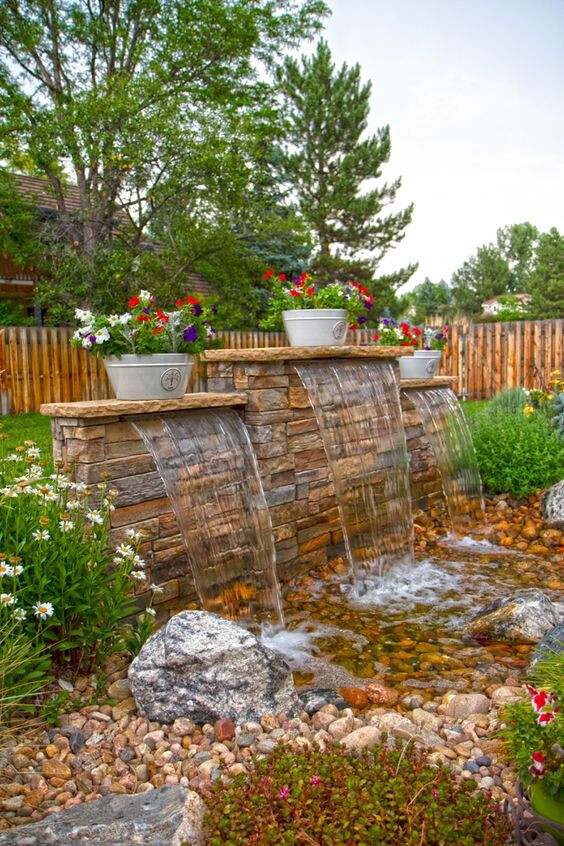
Now, perpendicular to the wall, there is another wall of the same type, 160 cm (63 inches) high (you can create a sheltered seating area behind this) and from there, 80 cm (31 inches) down, a waterfall:
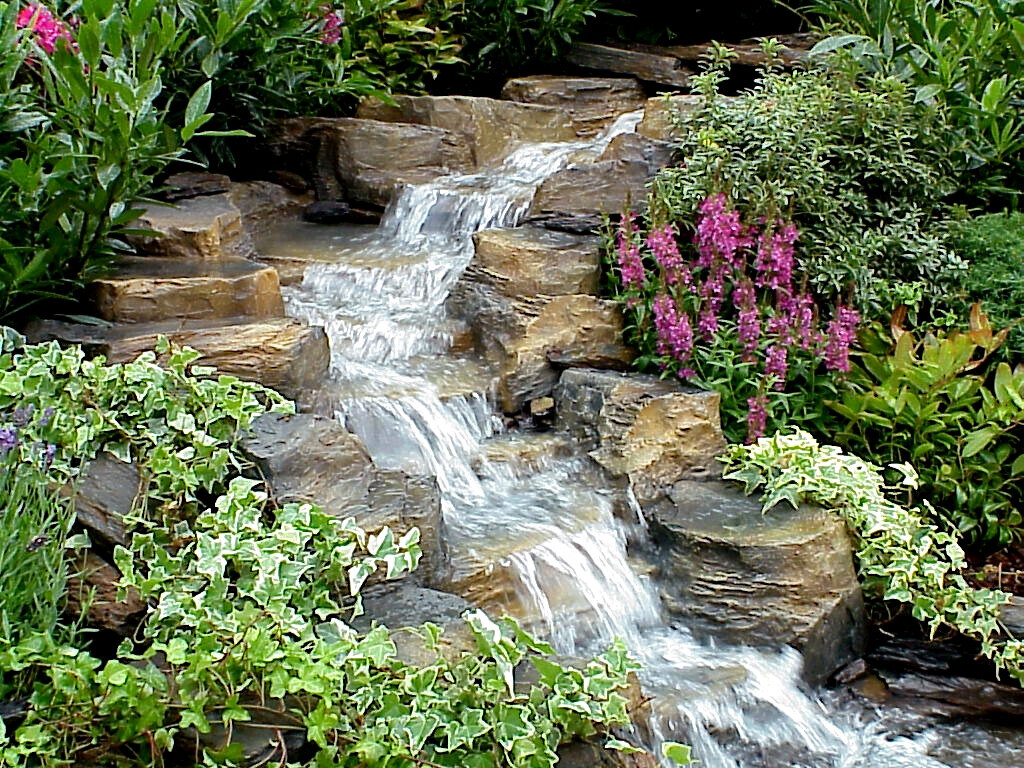
From the remaining 80 cm (31 inches) height, the water continues over several roaring rapids downward
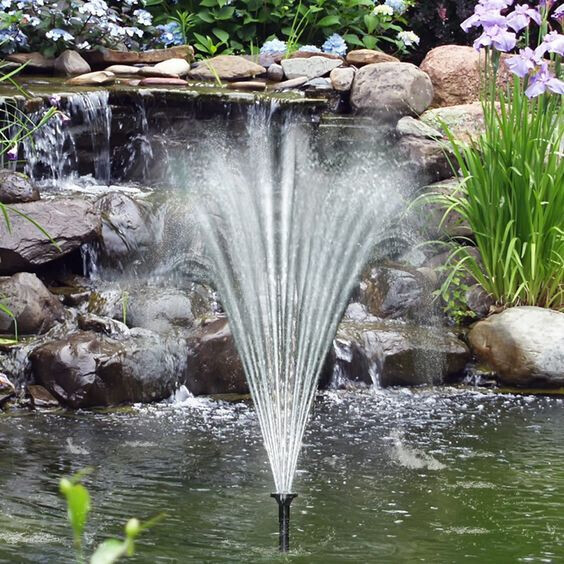
After about another four meters (13 ft), everything ends up in a pond with a water feature fountain
and from there, all the water is pumped back up again.
A landscape gardener can design something like this for you, but depending on your skill level, you could also build it yourself as a DIY project: You can build the waterfall wall yourself using shuttering blocks and facing bricks. There are ready-made fiberglass water channels available; for the slope, you will need to add some earth fill. The pond basin can be lined with a pond liner. Add a powerful pump and a water spout. Done.
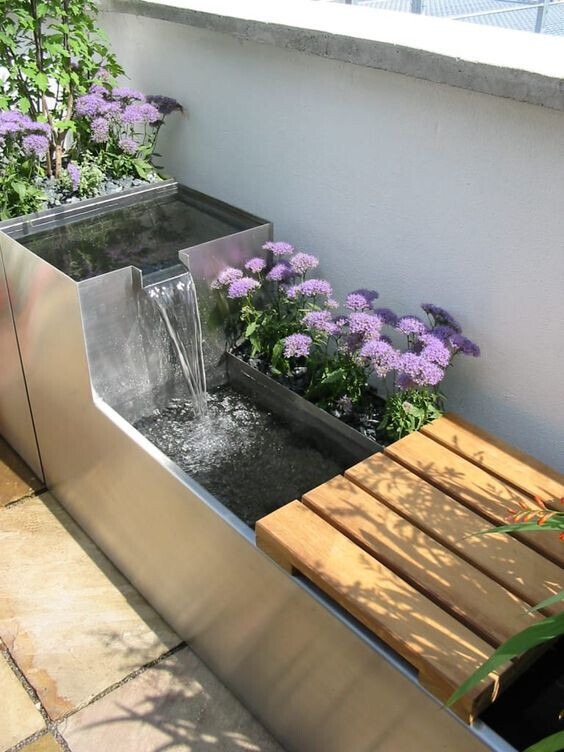
For a simpler start, there are also prefabricated basins like this– if your preferred lounging area is right next to it, that might be sufficient (but only for that!)
From the terrace, there is a boundary wall 400 cm (13 ft) deep and 200 cm (6.5 ft) high. This already absorbs some sound.
Now, perpendicular to the wall, there is another wall of the same type, 160 cm (63 inches) high (you can create a sheltered seating area behind this) and from there, 80 cm (31 inches) down, a waterfall:
From the remaining 80 cm (31 inches) height, the water continues over several roaring rapids downward
After about another four meters (13 ft), everything ends up in a pond with a water feature fountain
and from there, all the water is pumped back up again.
A landscape gardener can design something like this for you, but depending on your skill level, you could also build it yourself as a DIY project: You can build the waterfall wall yourself using shuttering blocks and facing bricks. There are ready-made fiberglass water channels available; for the slope, you will need to add some earth fill. The pond basin can be lined with a pond liner. Add a powerful pump and a water spout. Done.
For a simpler start, there are also prefabricated basins like this– if your preferred lounging area is right next to it, that might be sufficient (but only for that!)
PS: Just take a boombox like the one your neighbor has, playing the most annoying song, and sit by a rushing stream (which might not be easy to find in northern Germany, I guess). Now observe how far you need to be from the stream or the boombox for the music to no longer be perceived as unpleasant. If this distance is realistically achievable for you, you will then need to recreate this sound environment as accurately as possible in your own home.
Similar topics