
Hello everyone,
Due to bad weather, we didn’t make as much progress on the landscaping as planned, but now we are moving forward and are currently planning the automatic irrigation system.
We have tried several planners for this, and the one from DVS worked best for us. However, some aspects are still unclear, so I hope to get some feedback on our plan and clarify a few open questions.
Here is our current plan:
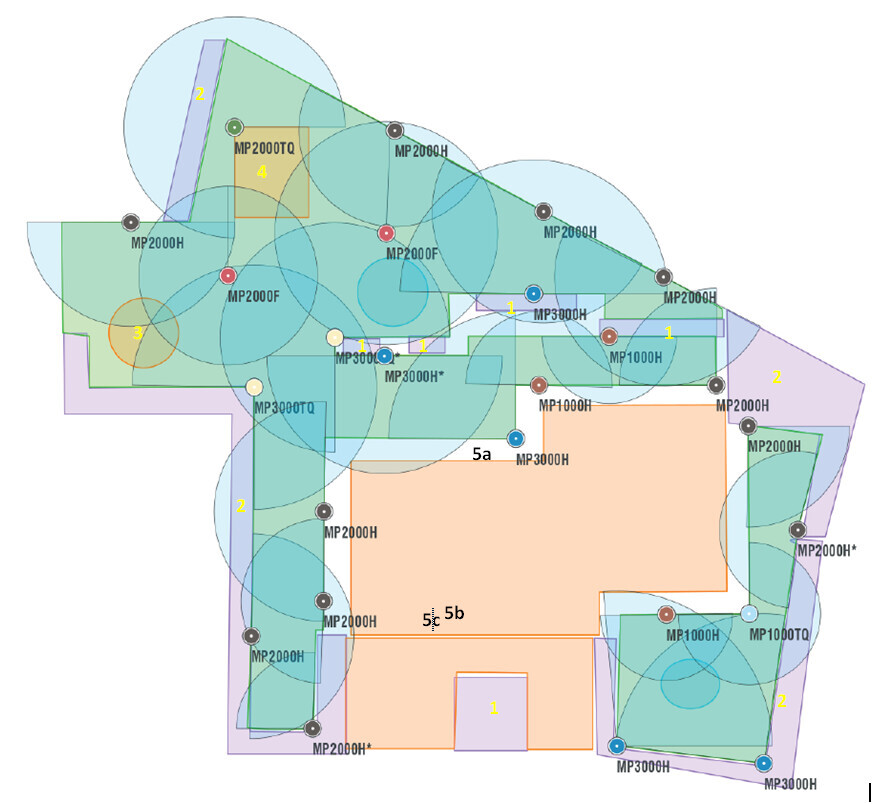
Legend:
Orange: house, terrace at the house, paved areas in front of the house
Green: lawn
White areas: paths/stairs/terrace
1: raised garden beds
2: hedges
3: trampoline (in-ground)
4: terrace
5a-c: potential water faucets (a: outside, b: roof terrace on garage, c: inside the garage)
General information:
Currently, we have planned the entire supply through faucet 5a. More on this below in the questions.
The plot slopes about 7m (23 ft) from top to bottom towards the street.
Especially in the upper bottom left area, there are zones with less-than-optimal irrigation. This area is not used much, and perfect irrigation would be too expensive due to the many angles and "obstacles" (trampoline, terrace).
The following questions came up during the planning:
1. Multiple water sources: I assume that if I want to use multiple water sources, I will need to purchase as many irrigation controllers, valve manifolds, etc., as there are sources, correct?
2. Considering the slope: Do I need to take the slope into account during the planning? I couldn’t enter this in the planner. I imagine it might affect the pressure, so irrigation zones going uphill should have fewer sprinklers planned accordingly.
3. Quality levels of components: For many parts, you can choose between Eco, Expert, and Premium. These usually have a significant impact on price, but I don’t see a clear benefit from the descriptions.
Currently, we plan to use Expert quality for the irrigation controller and valve manifold, and Eco for the rest.
Is the upgrade to better materials worth the extra cost (for example, the installation unit for Hunter MP Rotators is about €12 (about $13); with 21 rotators that’s roughly €250 (about $275))?
4. Drip irrigation: Neither the manual nor the planner showed how much water demand to calculate per square meter, so I’m unsure if one connection is enough for a raised bed or hedge, or if several should be planned.
Related to this: Does each raised bed need a separate irrigation line, or can one line branch off to supply several raised beds?
Thanks in advance for all your answers 🙂
Due to bad weather, we didn’t make as much progress on the landscaping as planned, but now we are moving forward and are currently planning the automatic irrigation system.
We have tried several planners for this, and the one from DVS worked best for us. However, some aspects are still unclear, so I hope to get some feedback on our plan and clarify a few open questions.
Here is our current plan:
Legend:
Orange: house, terrace at the house, paved areas in front of the house
Green: lawn
White areas: paths/stairs/terrace
1: raised garden beds
2: hedges
3: trampoline (in-ground)
4: terrace
5a-c: potential water faucets (a: outside, b: roof terrace on garage, c: inside the garage)
General information:
Currently, we have planned the entire supply through faucet 5a. More on this below in the questions.
The plot slopes about 7m (23 ft) from top to bottom towards the street.
Especially in the upper bottom left area, there are zones with less-than-optimal irrigation. This area is not used much, and perfect irrigation would be too expensive due to the many angles and "obstacles" (trampoline, terrace).
The following questions came up during the planning:
1. Multiple water sources: I assume that if I want to use multiple water sources, I will need to purchase as many irrigation controllers, valve manifolds, etc., as there are sources, correct?
2. Considering the slope: Do I need to take the slope into account during the planning? I couldn’t enter this in the planner. I imagine it might affect the pressure, so irrigation zones going uphill should have fewer sprinklers planned accordingly.
3. Quality levels of components: For many parts, you can choose between Eco, Expert, and Premium. These usually have a significant impact on price, but I don’t see a clear benefit from the descriptions.
Currently, we plan to use Expert quality for the irrigation controller and valve manifold, and Eco for the rest.
Is the upgrade to better materials worth the extra cost (for example, the installation unit for Hunter MP Rotators is about €12 (about $13); with 21 rotators that’s roughly €250 (about $275))?
4. Drip irrigation: Neither the manual nor the planner showed how much water demand to calculate per square meter, so I’m unsure if one connection is enough for a raised bed or hedge, or if several should be planned.
Related to this: Does each raised bed need a separate irrigation line, or can one line branch off to supply several raised beds?
Thanks in advance for all your answers 🙂
H
hampshire6 Aug 2021 08:33sub-xero schrieb:
Otherwise, the purpose of an elaborate irrigation system wouldn’t be entirely clear to me, unless you live in the desert.Sometimes you do things a bit more elaborately than necessary just for your own enjoyment, right?
Automatic irrigation is convenient and helps maintain the garden. Without automatic watering, it’s difficult to achieve a “proper” lawn, as manual irrigation usually isn’t enough. Even during holidays, flower beds and hedges receive sufficient water this way.
A more concerning issue is the use of fresh water. The area size is missing. For lawns, you can expect about 15-20 liters/m²/week (0.5-0.7 gallons/ft²/week)...
This adds up to several cubic meters of water. Therefore, it’s better to build a large cistern and channel all possible drainage water into it. With a powerful pump, you get enough pressure and flow rate to cover larger irrigation zones, which means fewer valves are needed. This also reduces irrigation time, as not many zones have to run consecutively.
A more concerning issue is the use of fresh water. The area size is missing. For lawns, you can expect about 15-20 liters/m²/week (0.5-0.7 gallons/ft²/week)...
This adds up to several cubic meters of water. Therefore, it’s better to build a large cistern and channel all possible drainage water into it. With a powerful pump, you get enough pressure and flow rate to cover larger irrigation zones, which means fewer valves are needed. This also reduces irrigation time, as not many zones have to run consecutively.
Thank you for the responses.
We don’t have a rainwater tank because water prices are quite low in our area, so a tank wouldn’t be cost-effective in the medium term.
Could you explain why? It’s clear that better quality components ensure a longer lifespan, but are there any other advantages of Expert over Eco?
I initially tried strip sprinklers as well. However, since they are always too narrow, I found the circular sprinklers (are they called that?) to be more cost-effective. The shown property area is about 1200sqm (including the house footprint).
With the sprinkler placement, we tried to reduce costs. The relevant areas were shown as "well watered" or "slightly under-watered" in the planner. The most important spots were all "well watered." We are willing to accept the less well-watered areas to save money.
rick2018 schrieb:
Don’t you have a rainwater tank you could use?
We don’t have a rainwater tank because water prices are quite low in our area, so a tank wouldn’t be cost-effective in the medium term.
rick2018 schrieb:
Go with the Expert quality.
Could you explain why? It’s clear that better quality components ensure a longer lifespan, but are there any other advantages of Expert over Eco?
rick2018 schrieb:
You have many areas where strip sprinklers would make more sense. Unfortunately, no dimensions were provided. How large is the property?
[...]
Overall, your sprinkler placement is not optimal (head-to-head coverage).
I initially tried strip sprinklers as well. However, since they are always too narrow, I found the circular sprinklers (are they called that?) to be more cost-effective. The shown property area is about 1200sqm (including the house footprint).
With the sprinkler placement, we tried to reduce costs. The relevant areas were shown as "well watered" or "slightly under-watered" in the planner. The most important spots were all "well watered." We are willing to accept the less well-watered areas to save money.
Is your water really that cheap?
Let’s say you have a 1200m2 (12,917 sq ft) plot, with 600m2 (6,458 sq ft) of lawn area.
You need 15–20 liters per m2 per week (0.4–0.5 gallons per sq ft per week). Watering is required for half the year, minus one third as natural rainfall:
600 * 20 = 12,000 liters/week (3,170 gallons/week) * 52 = 624m3/year (22,034 cubic feet/year) / 2 = 312m3 * 0.6666 = 208m3 (7,345 cubic feet) of fresh water per year. This does not yet include flower beds, hedges, etc.
A cistern has the advantage that you can buffer heavy rainfalls. Not only for your own use but also to relieve the sewage system.
You could install a powerful pump there and save at least half of your valves/circuits. However, it rarely pays off financially. But you won’t use fresh water either — unless you run a nursery?
This is the quality sweet spot. Especially the fittings and housings are pressure-regulated, which simplifies the whole system considerably. I can only recommend doing it right from the start. It shouldn’t really matter if you have a few more sprinklers or valves. For a new installation, you don’t have to dig, etc.
DVS is by far not the cheapest everywhere. PE-HD pipes, fittings, etc. can be found cheaper in other shops. Valve boxes for DIY installation are also cheaper. Hydrawise controllers are available in many places as well...
Let’s say you have a 1200m2 (12,917 sq ft) plot, with 600m2 (6,458 sq ft) of lawn area.
You need 15–20 liters per m2 per week (0.4–0.5 gallons per sq ft per week). Watering is required for half the year, minus one third as natural rainfall:
600 * 20 = 12,000 liters/week (3,170 gallons/week) * 52 = 624m3/year (22,034 cubic feet/year) / 2 = 312m3 * 0.6666 = 208m3 (7,345 cubic feet) of fresh water per year. This does not yet include flower beds, hedges, etc.
A cistern has the advantage that you can buffer heavy rainfalls. Not only for your own use but also to relieve the sewage system.
You could install a powerful pump there and save at least half of your valves/circuits. However, it rarely pays off financially. But you won’t use fresh water either — unless you run a nursery?
This is the quality sweet spot. Especially the fittings and housings are pressure-regulated, which simplifies the whole system considerably. I can only recommend doing it right from the start. It shouldn’t really matter if you have a few more sprinklers or valves. For a new installation, you don’t have to dig, etc.
DVS is by far not the cheapest everywhere. PE-HD pipes, fittings, etc. can be found cheaper in other shops. Valve boxes for DIY installation are also cheaper. Hydrawise controllers are available in many places as well...
 Schimi179110 Aug 2021 20:11
In some municipalities, it is possible to apply for a second water meter specifically for garden irrigation. This can at least save you from paying wastewater fees.
Similar topics