
Hello dear forum community,
until now I have been a silent reader, but now I would like to actively ask for your help.
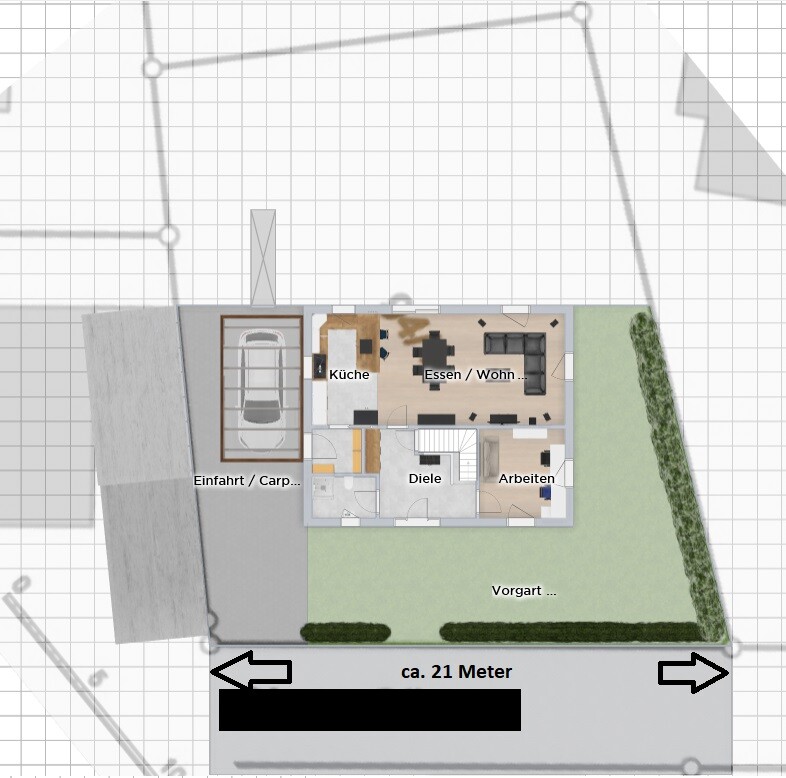
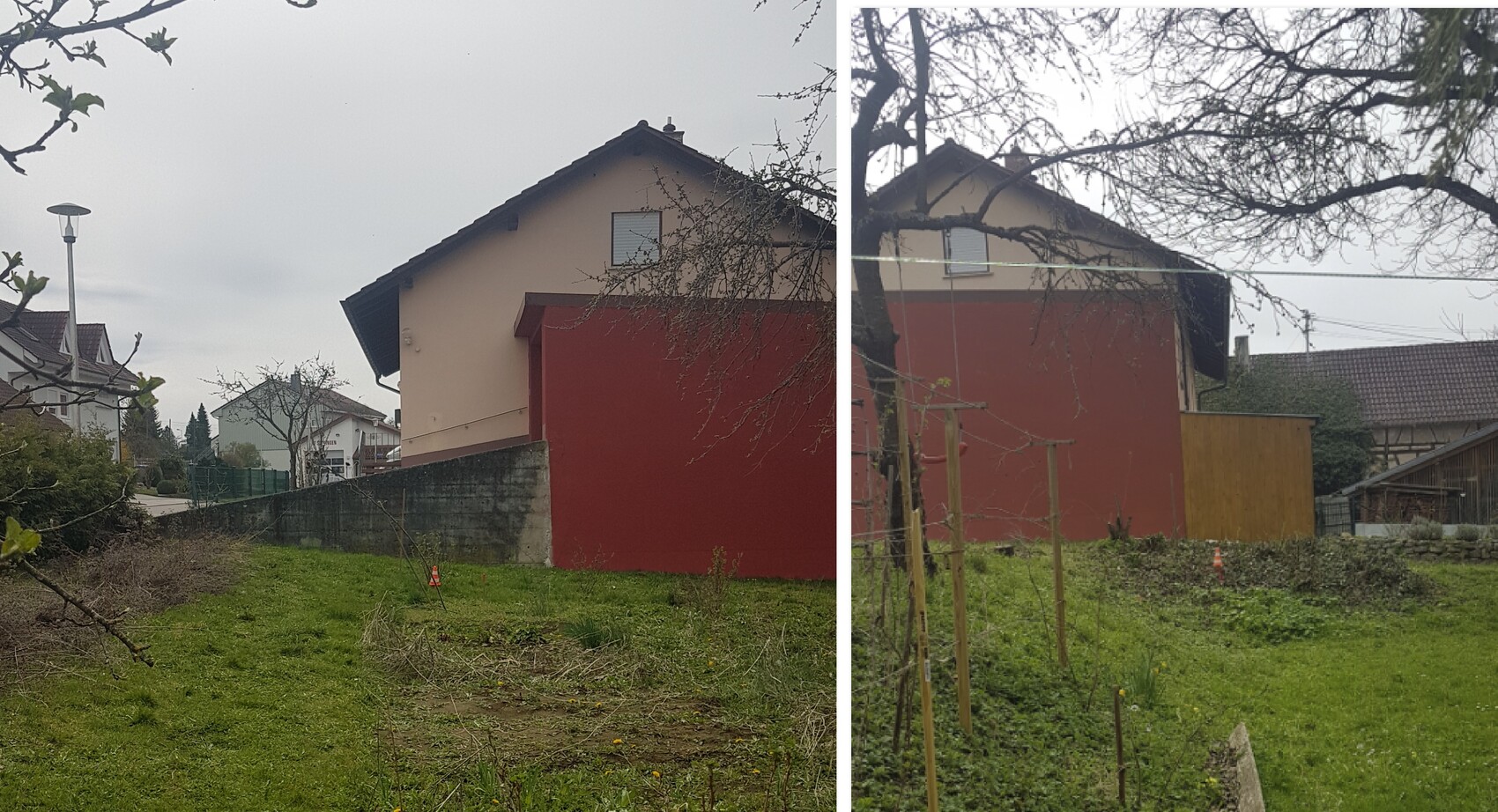
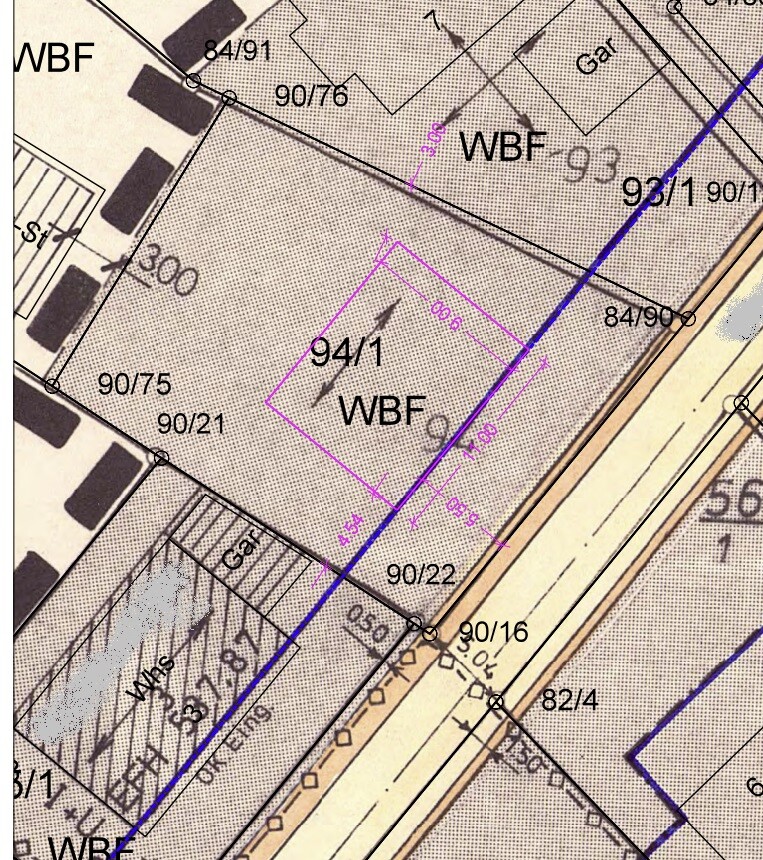
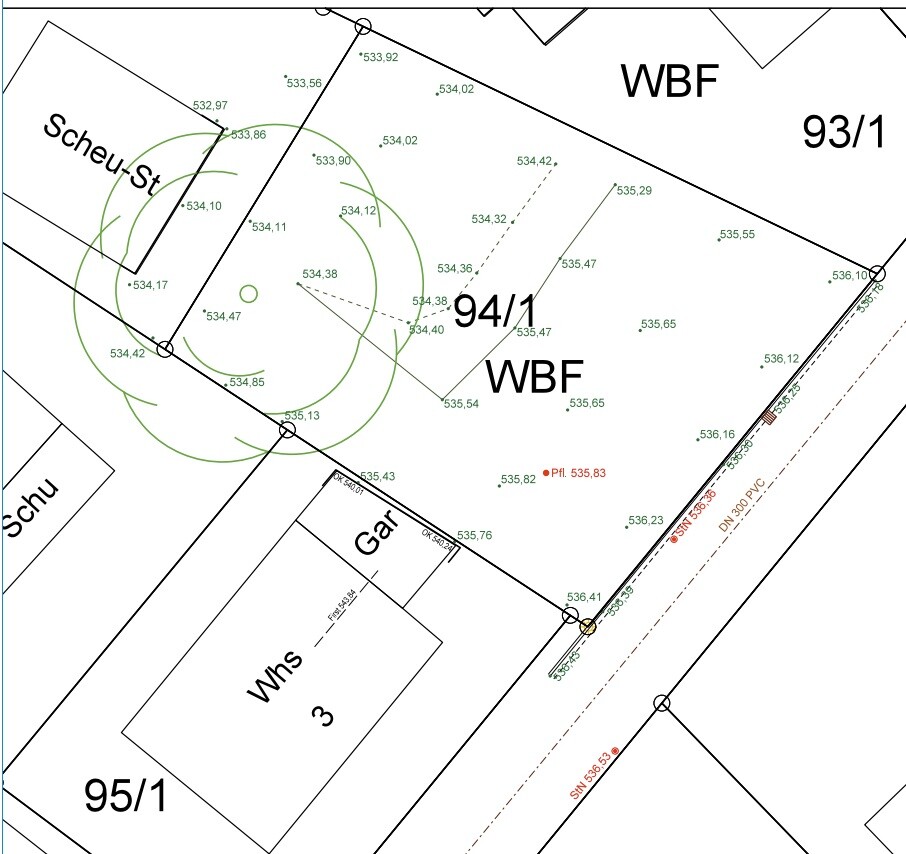
We own a plot of about 500 m² (5380 sq ft) in BW and are planning to build a house. The plot slopes down approximately 2.20 meters (7 ft) from the street view towards the northwest. We plan a prefabricated house (KFW55EE standard) with a basement, where the back of the basement faces the slope and looks out into the garden behind. The neighboring plots are already developed. The floor plan is also quite fixed. On the street side, to the left of the planned house, a parking space and later a carport for one vehicle are planned. Next to the house, which will be about 11 x 9 meters (36 x 30 ft) in size, there remains a trapezoidal area about 4.50 meters (15 ft) wide at the front (corner of the house) and 6 meters (20 ft) wide at the back, and 9 meters (30 ft) long, up to the property boundary with the southwest neighbor, designated for the carport. The plan was to build the carport at ground level next to our house. The neighbor has a garage at this location, which is accessed from the street via a steep ramp (see pictures).
The question now is how to hold back the parking area from the garden?
We have considered the following options:
- A dry stone wall would be nice; it can be a bit rustic. However, I have concerns because the vehicle standing on it increases earth pressure and a height of about 2 meters (7 ft) with a width of 6 meters (20 ft) would need to be retained. We actually did not want to create terraces there, as that would take up too much space and there is a roughly 15-meter (50 ft) tall walnut tree in the garden.
- Concrete wall: A concrete wall connected to the basement foundation. This would take up the least garden space but would also not be cheap and would require a strong foundation. Is it possible and advisable to simply attach this wall to the basement wall? Or at least connect the foundation with the slab under the basement?
- Concrete blocks: What I find very interesting are the Redi Rock from Mauthe. These are concrete blocks with a visible surface that looks like a stone wall. Since the parts interlock with studs (like Lego blocks) and are relatively large and heavy (500-1000 kg / 1100-2200 lb each), no concrete foundation is necessary; a gravel base is sufficient and the blocks are installed dry (theoretically reusable). I also like the look, but installation would require heavy machinery (excavator, wheel loader, crane, or similar) due to the weight of the blocks. I found few prices, but roughly about 200 per m² (square meter).
- Gabions on a foundation: I don’t find this very appealing and it’s not cheap either. I haven’t looked into it much.
What do you think about these alternatives? Or do you have other ideas?
until now I have been a silent reader, but now I would like to actively ask for your help.
We own a plot of about 500 m² (5380 sq ft) in BW and are planning to build a house. The plot slopes down approximately 2.20 meters (7 ft) from the street view towards the northwest. We plan a prefabricated house (KFW55EE standard) with a basement, where the back of the basement faces the slope and looks out into the garden behind. The neighboring plots are already developed. The floor plan is also quite fixed. On the street side, to the left of the planned house, a parking space and later a carport for one vehicle are planned. Next to the house, which will be about 11 x 9 meters (36 x 30 ft) in size, there remains a trapezoidal area about 4.50 meters (15 ft) wide at the front (corner of the house) and 6 meters (20 ft) wide at the back, and 9 meters (30 ft) long, up to the property boundary with the southwest neighbor, designated for the carport. The plan was to build the carport at ground level next to our house. The neighbor has a garage at this location, which is accessed from the street via a steep ramp (see pictures).
The question now is how to hold back the parking area from the garden?
We have considered the following options:
- A dry stone wall would be nice; it can be a bit rustic. However, I have concerns because the vehicle standing on it increases earth pressure and a height of about 2 meters (7 ft) with a width of 6 meters (20 ft) would need to be retained. We actually did not want to create terraces there, as that would take up too much space and there is a roughly 15-meter (50 ft) tall walnut tree in the garden.
- Concrete wall: A concrete wall connected to the basement foundation. This would take up the least garden space but would also not be cheap and would require a strong foundation. Is it possible and advisable to simply attach this wall to the basement wall? Or at least connect the foundation with the slab under the basement?
- Concrete blocks: What I find very interesting are the Redi Rock from Mauthe. These are concrete blocks with a visible surface that looks like a stone wall. Since the parts interlock with studs (like Lego blocks) and are relatively large and heavy (500-1000 kg / 1100-2200 lb each), no concrete foundation is necessary; a gravel base is sufficient and the blocks are installed dry (theoretically reusable). I also like the look, but installation would require heavy machinery (excavator, wheel loader, crane, or similar) due to the weight of the blocks. I found few prices, but roughly about 200 per m² (square meter).
- Gabions on a foundation: I don’t find this very appealing and it’s not cheap either. I haven’t looked into it much.
What do you think about these alternatives? Or do you have other ideas?

Since we don’t have any floor plans, we can only speculate, but from the posts by @Si0n1989 I understand that the basement is currently unused and the living/dining area is on the ground floor. Also, there is mention or a drawing of an outdoor staircase leading to the garden. So here is my question...
@Si0n1989, could you please enlighten us? Would you be willing to share the other floor plans with us?
@Si0n1989, could you please enlighten us? Would you be willing to share the other floor plans with us?
H
hanghaus200012 Jul 2021 13:54The development plan with building limits should also be helpful.

hanghaus2000 schrieb:
If that’s how it should be, then a slightly optimized version. A 6 x 7 m (20 x 23 ft) carport with parking for two cars is definitely a must. I would leave out the retaining wall. Well-compacted backfill and a slope ratio of 1:2 are sufficient. Only the carport roof extends beyond the 6 m (20 ft), but that should not be a problem. Besides, the neighbor did not build right on the boundary. This means you’ll need to use part of the neighbor’s land to avoid a gap between the buildings. Either the neighbor gifts you that piece of land or you buy it.
[ATTACH alt="Hanggrundstück-carport-abfangen-510546-1.JPG"]63604[/ATTACH] I made a mistake, the distance from the parking spot to the street is 5 meters (16 ft). There is nothing about two parking spaces in the zoning plan; does this come from some other building regulation? Regarding the neighbor’s garage, yes, you’d have to discuss that with them, that’s true. Currently, I tend to place the house as is first and then have the earthworks roughly done for the exterior landscaping, just like you said, simply cutting away the soil behind the carport. hanghaus2000 schrieb:
For me, the question is more why plan the terrace in the basement (lower ground floor)? People usually prefer direct access from the living/dining area on one level. The nicest spot on the property is at the back in the garden. The neighboring plot behind belongs to my parents, so this is behind the garden as I mean it. The main opening direction is towards the existing garden. The basement is planned to be developed later, and because of the slope, it makes sense to have it look out onto the lower garden. For now, it will just be lawn, with a possible garden terrace later on. In front of the house there will be a small terrace facing the front garden, basically to the east. Hangman schrieb:
Since we don’t have floor plans, we can only speculate, but from the posts by @Si0n1989 I understand that the basement is currently unused and living/dining is on the ground floor. Also, there was mention or drawing of an outdoor staircase to the garden. So my question...
@Si0n1989, could you clarify for us? Would you share the other floor plans? Unfortunately, I’m not home this week and don’t have access to the latest floor plans, but I will attach some that are not fully up to date. I tried to sketch the changes in the basement with my smartphone, but it’s not great. There is a large room downstairs with three openings to the garden, which will basically become three separate rooms later. Access to the garden should be possible for the homeowner on the right side. So, from the living room, you can reach the garden via a door on the north wall, going down a ramp or sloping terrain into the garden. Alternatively, you can go through the kitchen, then the pantry to the carport, and from there into the garden (depending on how the masonry or slope is done there, a stone staircase will be installed or just a simple slope). That’s the general idea.
hanghaus2000 schrieb:
The zoning/planning permission plan with building boundaries should also be helpful. There is already an excerpt from the zoning plan in the first post (showing the position of the house on the lot).
H
hanghaus200012 Jul 2021 20:48You don’t seriously mean the French balcony in the living room, do you?
hanghaus2000 schrieb:
You don’t seriously mean the French balcony in the living room?Yes, we plan to add either stairs or a balcony there later. We actually want a balcony, but our budget makes that difficult. That’s why it’s designed so that a cantilever balcony can easily be added afterwards. Don’t you think that’s a good idea? As I said, it’s not completely finished yet, and we want to keep our options open.Similar topics