
Hello dear forum community,
until now I have been a silent reader, but now I would like to actively ask for your help.
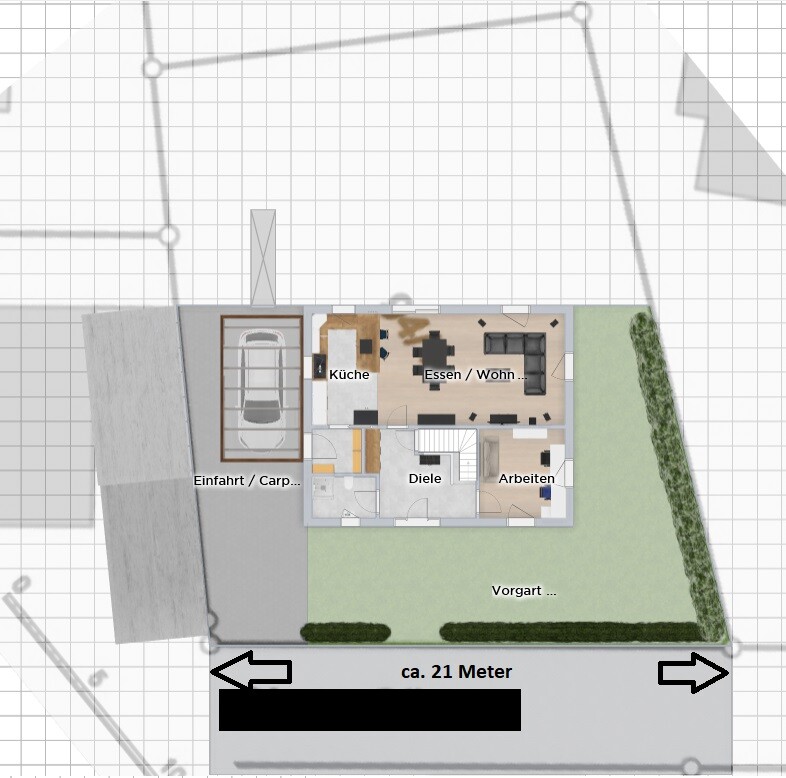
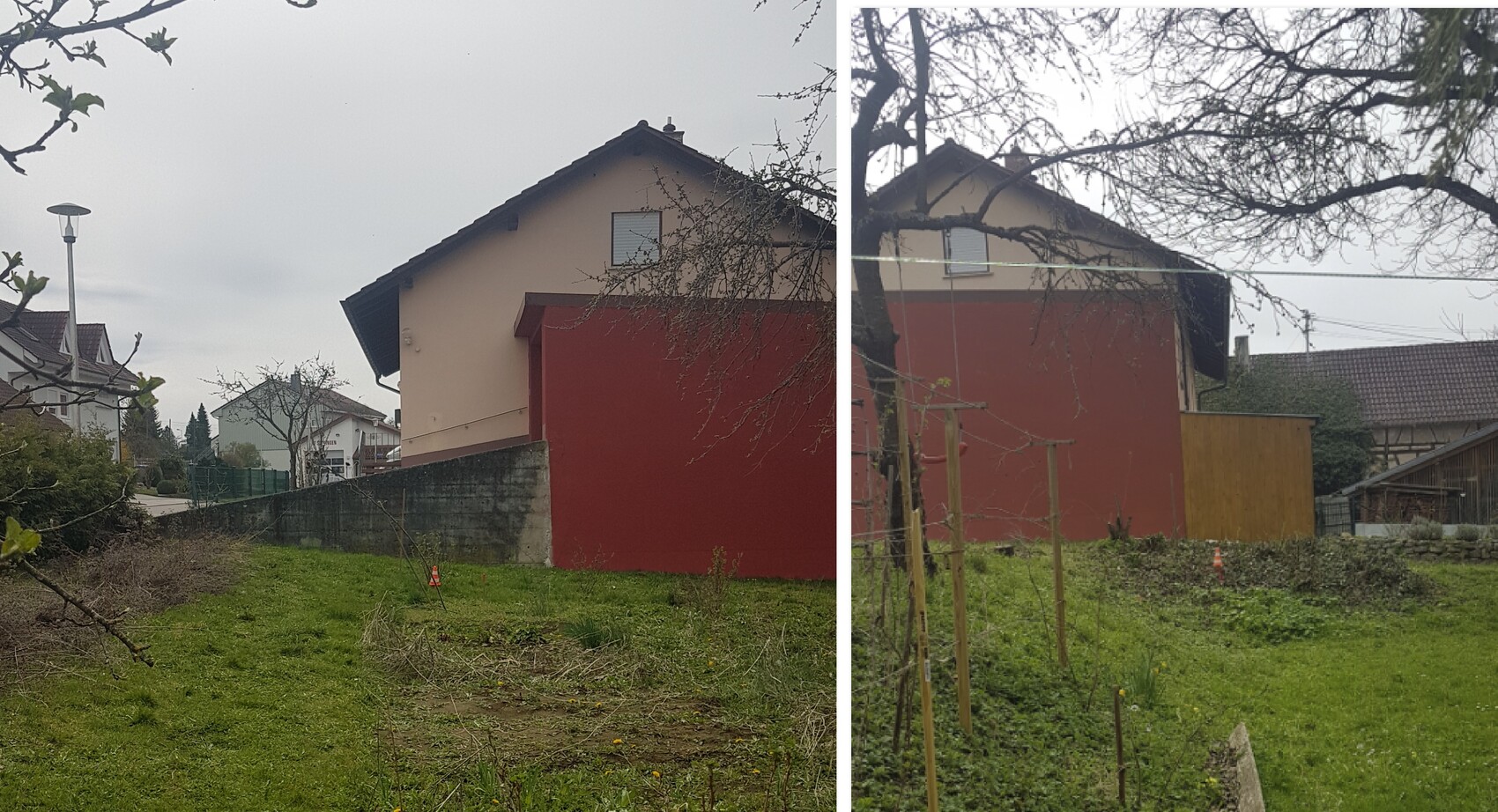
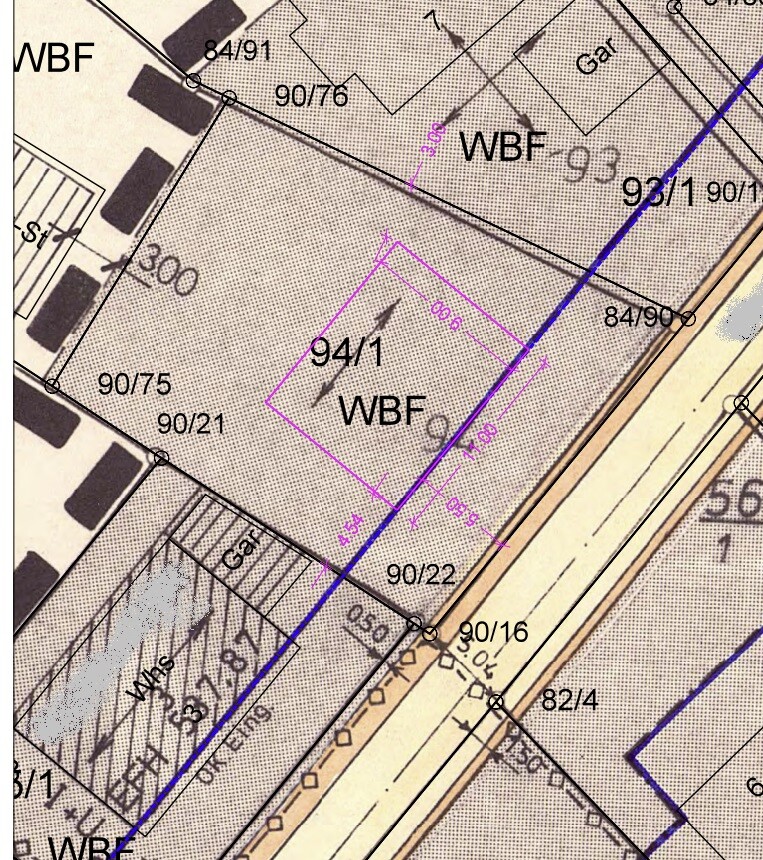
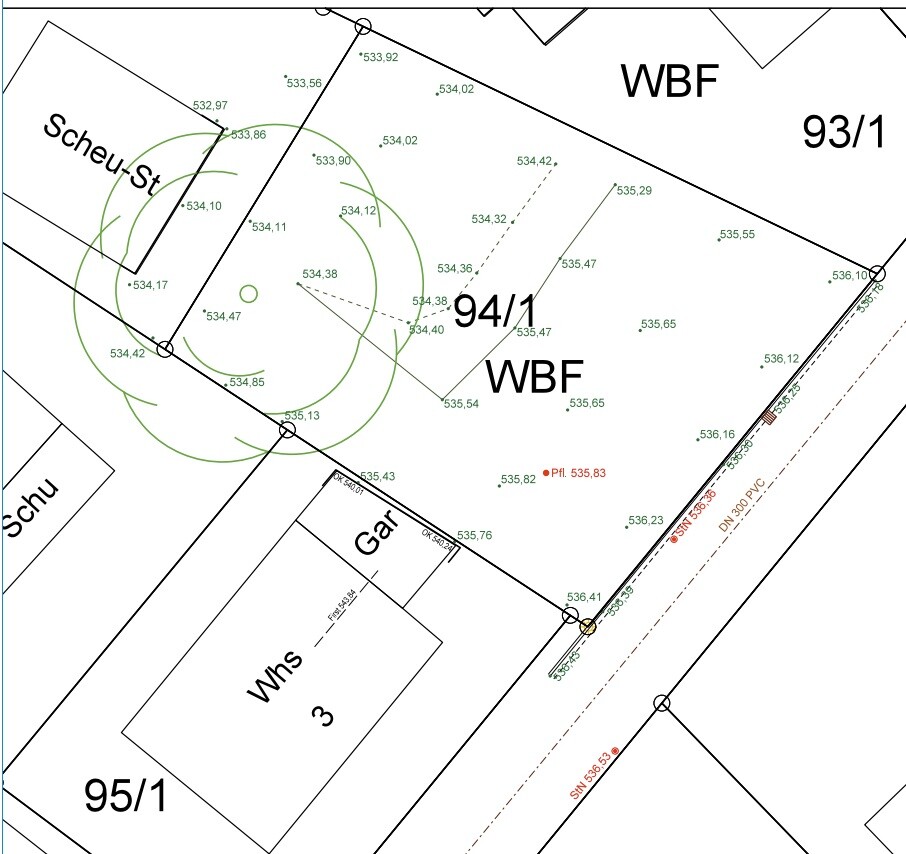
We own a plot of about 500 m² (5380 sq ft) in BW and are planning to build a house. The plot slopes down approximately 2.20 meters (7 ft) from the street view towards the northwest. We plan a prefabricated house (KFW55EE standard) with a basement, where the back of the basement faces the slope and looks out into the garden behind. The neighboring plots are already developed. The floor plan is also quite fixed. On the street side, to the left of the planned house, a parking space and later a carport for one vehicle are planned. Next to the house, which will be about 11 x 9 meters (36 x 30 ft) in size, there remains a trapezoidal area about 4.50 meters (15 ft) wide at the front (corner of the house) and 6 meters (20 ft) wide at the back, and 9 meters (30 ft) long, up to the property boundary with the southwest neighbor, designated for the carport. The plan was to build the carport at ground level next to our house. The neighbor has a garage at this location, which is accessed from the street via a steep ramp (see pictures).
The question now is how to hold back the parking area from the garden?
We have considered the following options:
- A dry stone wall would be nice; it can be a bit rustic. However, I have concerns because the vehicle standing on it increases earth pressure and a height of about 2 meters (7 ft) with a width of 6 meters (20 ft) would need to be retained. We actually did not want to create terraces there, as that would take up too much space and there is a roughly 15-meter (50 ft) tall walnut tree in the garden.
- Concrete wall: A concrete wall connected to the basement foundation. This would take up the least garden space but would also not be cheap and would require a strong foundation. Is it possible and advisable to simply attach this wall to the basement wall? Or at least connect the foundation with the slab under the basement?
- Concrete blocks: What I find very interesting are the Redi Rock from Mauthe. These are concrete blocks with a visible surface that looks like a stone wall. Since the parts interlock with studs (like Lego blocks) and are relatively large and heavy (500-1000 kg / 1100-2200 lb each), no concrete foundation is necessary; a gravel base is sufficient and the blocks are installed dry (theoretically reusable). I also like the look, but installation would require heavy machinery (excavator, wheel loader, crane, or similar) due to the weight of the blocks. I found few prices, but roughly about 200 per m² (square meter).
- Gabions on a foundation: I don’t find this very appealing and it’s not cheap either. I haven’t looked into it much.
What do you think about these alternatives? Or do you have other ideas?
until now I have been a silent reader, but now I would like to actively ask for your help.
We own a plot of about 500 m² (5380 sq ft) in BW and are planning to build a house. The plot slopes down approximately 2.20 meters (7 ft) from the street view towards the northwest. We plan a prefabricated house (KFW55EE standard) with a basement, where the back of the basement faces the slope and looks out into the garden behind. The neighboring plots are already developed. The floor plan is also quite fixed. On the street side, to the left of the planned house, a parking space and later a carport for one vehicle are planned. Next to the house, which will be about 11 x 9 meters (36 x 30 ft) in size, there remains a trapezoidal area about 4.50 meters (15 ft) wide at the front (corner of the house) and 6 meters (20 ft) wide at the back, and 9 meters (30 ft) long, up to the property boundary with the southwest neighbor, designated for the carport. The plan was to build the carport at ground level next to our house. The neighbor has a garage at this location, which is accessed from the street via a steep ramp (see pictures).
The question now is how to hold back the parking area from the garden?
We have considered the following options:
- A dry stone wall would be nice; it can be a bit rustic. However, I have concerns because the vehicle standing on it increases earth pressure and a height of about 2 meters (7 ft) with a width of 6 meters (20 ft) would need to be retained. We actually did not want to create terraces there, as that would take up too much space and there is a roughly 15-meter (50 ft) tall walnut tree in the garden.
- Concrete wall: A concrete wall connected to the basement foundation. This would take up the least garden space but would also not be cheap and would require a strong foundation. Is it possible and advisable to simply attach this wall to the basement wall? Or at least connect the foundation with the slab under the basement?
- Concrete blocks: What I find very interesting are the Redi Rock from Mauthe. These are concrete blocks with a visible surface that looks like a stone wall. Since the parts interlock with studs (like Lego blocks) and are relatively large and heavy (500-1000 kg / 1100-2200 lb each), no concrete foundation is necessary; a gravel base is sufficient and the blocks are installed dry (theoretically reusable). I also like the look, but installation would require heavy machinery (excavator, wheel loader, crane, or similar) due to the weight of the blocks. I found few prices, but roughly about 200 per m² (square meter).
- Gabions on a foundation: I don’t find this very appealing and it’s not cheap either. I haven’t looked into it much.
What do you think about these alternatives? Or do you have other ideas?

hanghaus2000 schrieb:
I haven’t seen any floor plans yet.
Can you tell me the elevation of your basement level? 534 m (1752 ft)? Is the terrace then located below?
Are you allowed to build a carport facing the street?
Is there a zoning plan, or is it a regulation according to section 34? There is a zoning plan. A carport facing the street is not permitted. A traffic area of 6 meters (20 ft) must be maintained between the carport/garage and the street.
Exactly. The terrace is planned below, adjacent to the garden level (afternoon and evening sun), at about 534 m (1752 ft). The single-family house will then be at around 536.70 m (1762 ft). Possibly a small terrace in front of the house facing the street for morning coffee. Regarding the elevation level, the street is at approximately...
H
hanghaus200012 Jul 2021 11:01Here is a version with the carport facing the street.
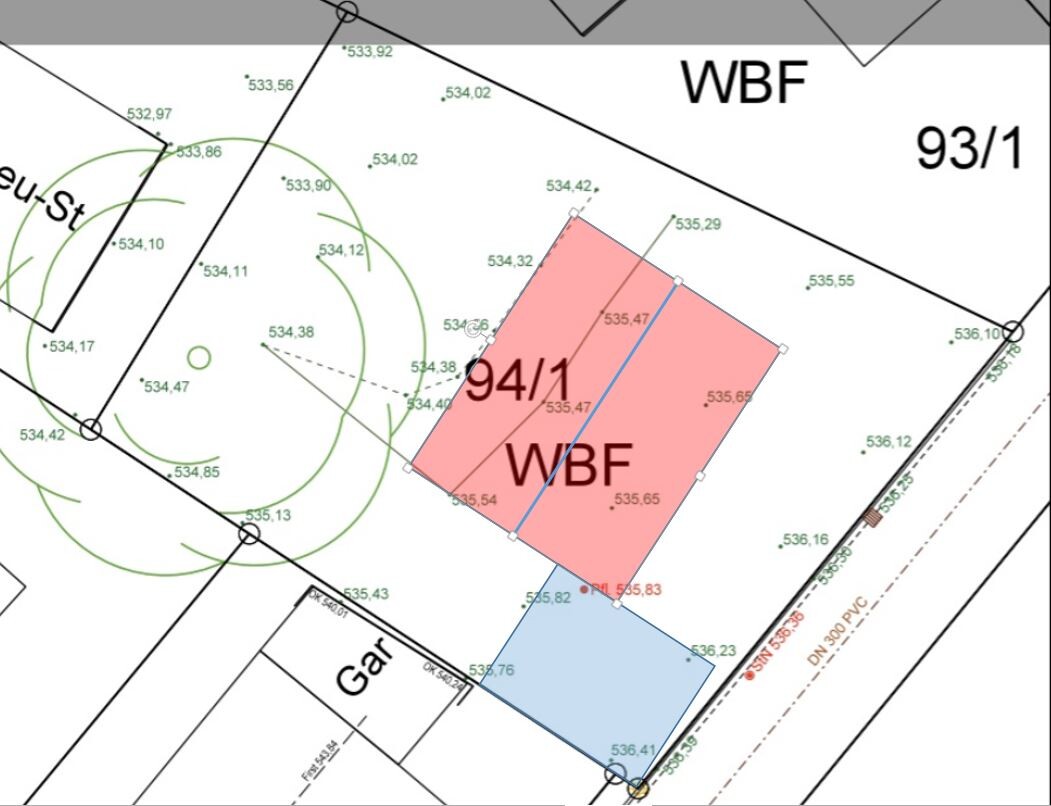
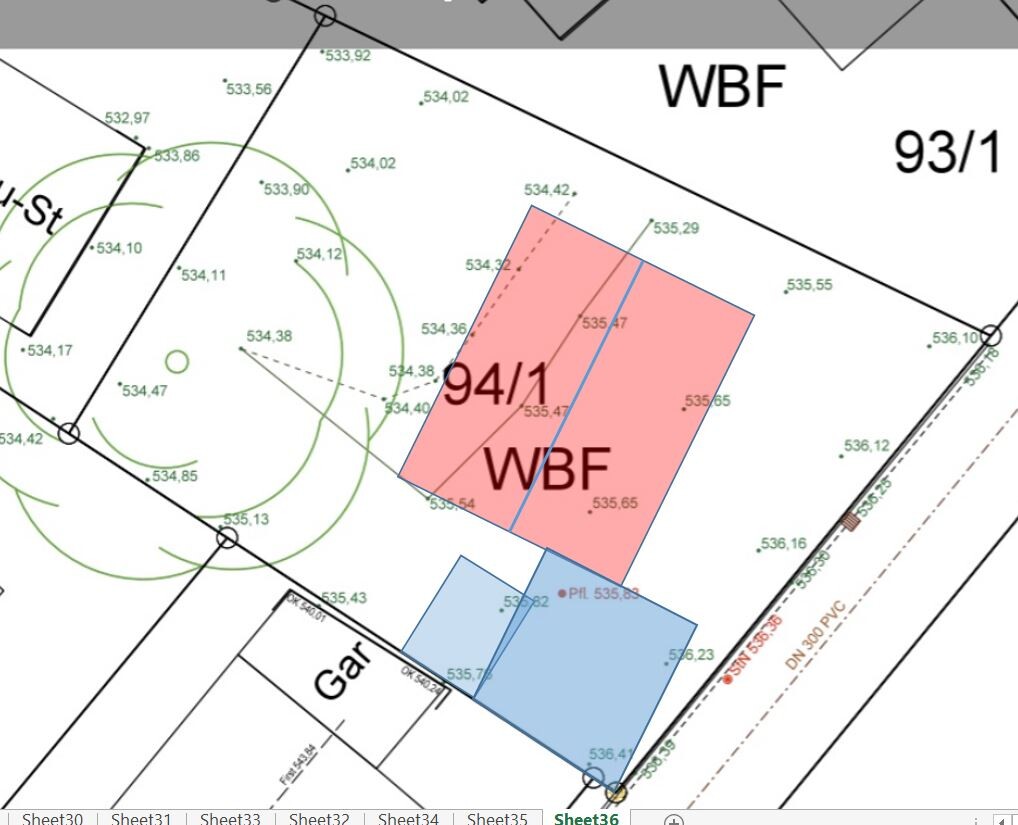

There is a development plan. A carport facing the street is not allowed. A traffic area of 6 meters (20 feet) must be maintained between the carport/garage and the street.
Exactly. The terrace should be located below in front of the garden level (nice light in the afternoon and evening) at around 534 m (1,752 feet). The single-family house will then be at about 536.70 m (1,760 feet). Possibly a small terrace in front of the house towards the street for having coffee in the morning. Regarding the elevation level, the street is at approximately 536.40–536.20 m (1,759–1,758 feet). How would you recommend bridging the difference in height to the house? We actually do not want stairs. The house is 5.50 m (18 feet) away from the street, so I was thinking of creating a slight slope towards the house. A 30 cm (12 inch) rise over 5.50 m (18 feet) equals about 3.12 degrees or 5.45 percent. Is that too steep?
Exactly. The terrace should be located below in front of the garden level (nice light in the afternoon and evening) at around 534 m (1,752 feet). The single-family house will then be at about 536.70 m (1,760 feet). Possibly a small terrace in front of the house towards the street for having coffee in the morning. Regarding the elevation level, the street is at approximately 536.40–536.20 m (1,759–1,758 feet). How would you recommend bridging the difference in height to the house? We actually do not want stairs. The house is 5.50 m (18 feet) away from the street, so I was thinking of creating a slight slope towards the house. A 30 cm (12 inch) rise over 5.50 m (18 feet) equals about 3.12 degrees or 5.45 percent. Is that too steep?
H
hanghaus200012 Jul 2021 11:36If it has to be like that, then somewhat optimized. A carport measuring 6 × 7 meters (20 × 23 feet) for parking two cars is definitely a must. I would leave out the retaining wall. Well-compacted backfill and a slope of 1:2 is sufficient. Only the carport roof extends beyond the 6 meters (20 feet). That should not be a problem. By the way, the neighbor did not build on the boundary line. This means you need to access the neighbor’s property to avoid a gap between the buildings. Either the neighbor gives you that piece of land as a gift or you buy it.
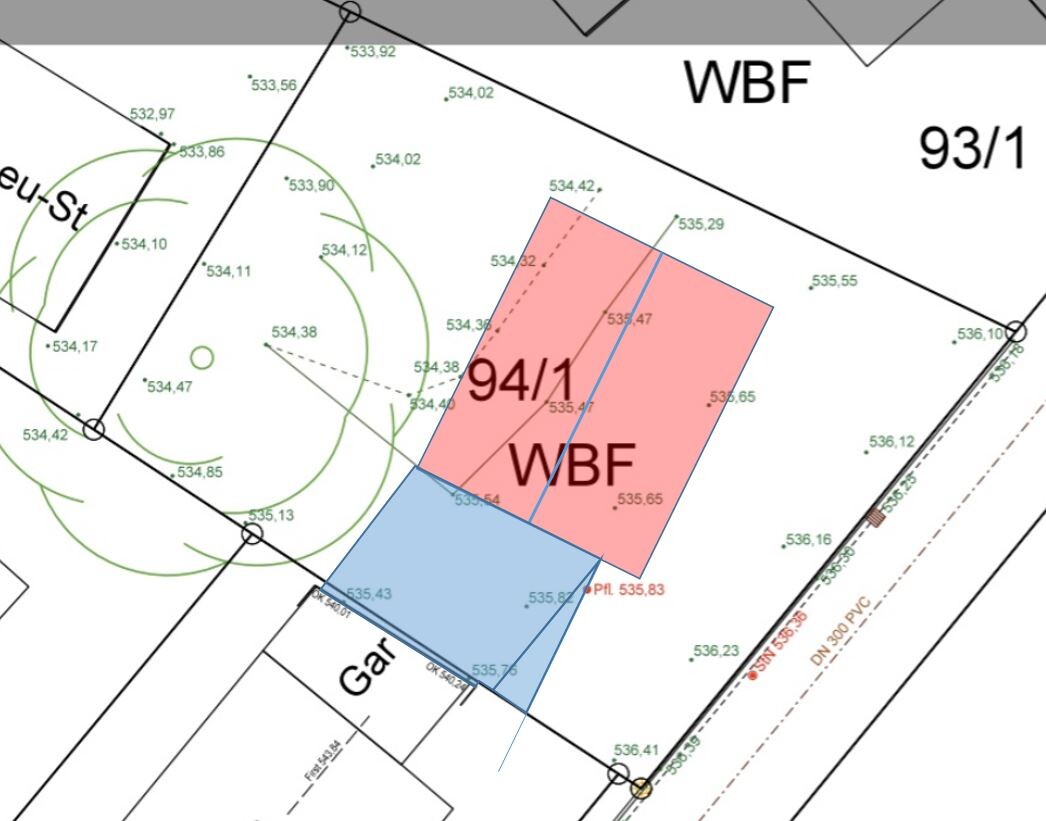

As a precaution, you can use standard concrete L-blocks to support the carport and then fill them with soil. A few centimeters will still stick out at the top, which you can simply cover with plants. You plan to create a path or stairs from the carport to the property anyway, right? This will run along the slope.
Our situation is quite similar, but in our case, the carport is not directly attached to the house; it is on the left in the picture (you can only see the orange drainage pipe... the carport is not built yet). The house is on the right, and the three steps on the right lead to the ground floor balcony.
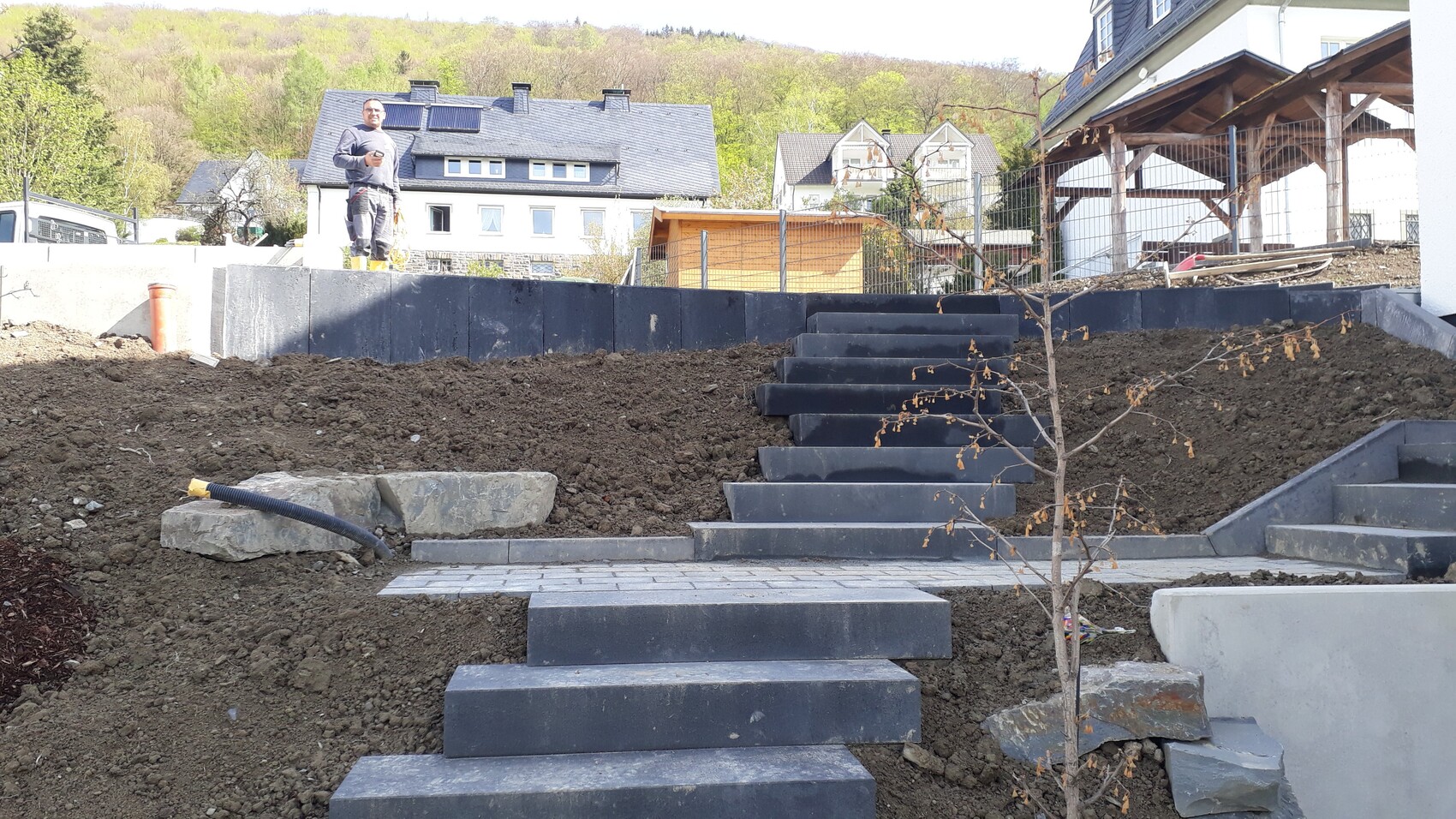
Our paved area in front of the house (roughly in the center of the image) has about an 8% slope, which is completely unproblematic. Public facilities consider 6% as barrier-free—so the values you mentioned are perfectly fine and can be made level. Only at the point where the building meets the ground floor, you need to be careful with the planned timber frame construction. You probably won’t be able to lay paving directly against the wall there. We installed a drainage channel from Brink (SystemAir) in that area.
By the way, how do you access the garden from the ground floor? Through the currently unused basement? Or will there be an external staircase?
One subjective note: I consider the direct access from the carport to the pantry unnecessary. In my opinion, it can be omitted without replacement—especially if it stands in the way of a better solution for the carport or neighboring garage (for example, due to different elevation levels).
Feel free to ask if you have any questions.
Our situation is quite similar, but in our case, the carport is not directly attached to the house; it is on the left in the picture (you can only see the orange drainage pipe... the carport is not built yet). The house is on the right, and the three steps on the right lead to the ground floor balcony.
Our paved area in front of the house (roughly in the center of the image) has about an 8% slope, which is completely unproblematic. Public facilities consider 6% as barrier-free—so the values you mentioned are perfectly fine and can be made level. Only at the point where the building meets the ground floor, you need to be careful with the planned timber frame construction. You probably won’t be able to lay paving directly against the wall there. We installed a drainage channel from Brink (SystemAir) in that area.
By the way, how do you access the garden from the ground floor? Through the currently unused basement? Or will there be an external staircase?
One subjective note: I consider the direct access from the carport to the pantry unnecessary. In my opinion, it can be omitted without replacement—especially if it stands in the way of a better solution for the carport or neighboring garage (for example, due to different elevation levels).
Feel free to ask if you have any questions.
H
hanghaus200012 Jul 2021 13:28Hangman schrieb:
By the way: how do you access the garden from the ground floor? Through the currently unused basement? Or will there be an external staircase? For me, the question is rather why the terrace is planned in the basement? Usually, people prefer to have access from the living and dining area on the same level.
Similar topics