
Hello everyone,
we are planning a prefabricated house using timber frame construction. It will have 180 sqm (1,937 sq ft) of living space with underfloor heating, and about 230 sqm (2,475 sq ft) of usable area.
So far, the offer included an air-to-water heat pump from Daikin (Altherma 3R, formerly Rotex HPSU compact Ultra).
Now it seems that this unit might not have enough capacity (?) and as an alternative (additional cost around 4,000) we have been offered a "Wolf heat pump CHC Monoblock 10/300-35".
The Daikin is available in the 4-9 kW version—would that really be insufficient for this size? And what do you think about this offer?
I have the energy-saving regulation heat protection certification and a renewable energy heat law document available, if any information from those is needed.
Thank you very much!
Best regards
we are planning a prefabricated house using timber frame construction. It will have 180 sqm (1,937 sq ft) of living space with underfloor heating, and about 230 sqm (2,475 sq ft) of usable area.
So far, the offer included an air-to-water heat pump from Daikin (Altherma 3R, formerly Rotex HPSU compact Ultra).
Now it seems that this unit might not have enough capacity (?) and as an alternative (additional cost around 4,000) we have been offered a "Wolf heat pump CHC Monoblock 10/300-35".
The Daikin is available in the 4-9 kW version—would that really be insufficient for this size? And what do you think about this offer?
I have the energy-saving regulation heat protection certification and a renewable energy heat law document available, if any information from those is needed.
Thank you very much!
Best regards
D
Deliverer7 Jul 2021 15:42The buffer tank is only necessary if you have individual room control. If you omit both, which is very, very sensible for the efficient operation of the heat pump, you will save a lot of money. You can find help with this in the HTD forum.
The heating installer will say that the heat pump cannot defrost without a buffer. Then you respond: "I always keep all heating circuits open, so there is more than enough water."
Regarding the size of the heat pump: You choose it only after you have the room-by-room heating load calculation. Have this prepared and provided to you by whoever is responsible. The person designing the underfloor heating needs this anyway (if not, they are doing it wrong!).
Then select a heat pump that fits as closely as possible. NOT larger and also WITHOUT extra capacity for domestic hot water.
The heating installer will say that the heat pump cannot defrost without a buffer. Then you respond: "I always keep all heating circuits open, so there is more than enough water."
Regarding the size of the heat pump: You choose it only after you have the room-by-room heating load calculation. Have this prepared and provided to you by whoever is responsible. The person designing the underfloor heating needs this anyway (if not, they are doing it wrong!).
Then select a heat pump that fits as closely as possible. NOT larger and also WITHOUT extra capacity for domestic hot water.
Deliverer schrieb:
The buffer tank is only necessary if you have individual room control....Have I misunderstood until now that nowadays, in new construction, you are not allowed to do without individual room control anymore?
N
nordanney7 Jul 2021 17:00netuser schrieb:
Did I misunderstand that nowadays, in new construction, it is no longer allowed to do without the ERR?That is true during construction (exemptions are practically impossible). However, afterwards, no one forces you to disable the controllers and run the heating system "fully automatic," which is actually often recommended.nordanney schrieb:
That is generally true during construction (exemptions are nearly impossible). However, afterwards, no one forces you to disable the controls and run the heating system fully automatic, which by the way is often recommended.This matches my understanding so far. However, wouldn’t that also mean that everyone would have to be required to install a buffer tank, since it is needed for ERR…?!

I just don’t understand the difference between theory and practice when it comes to the tradespeople.
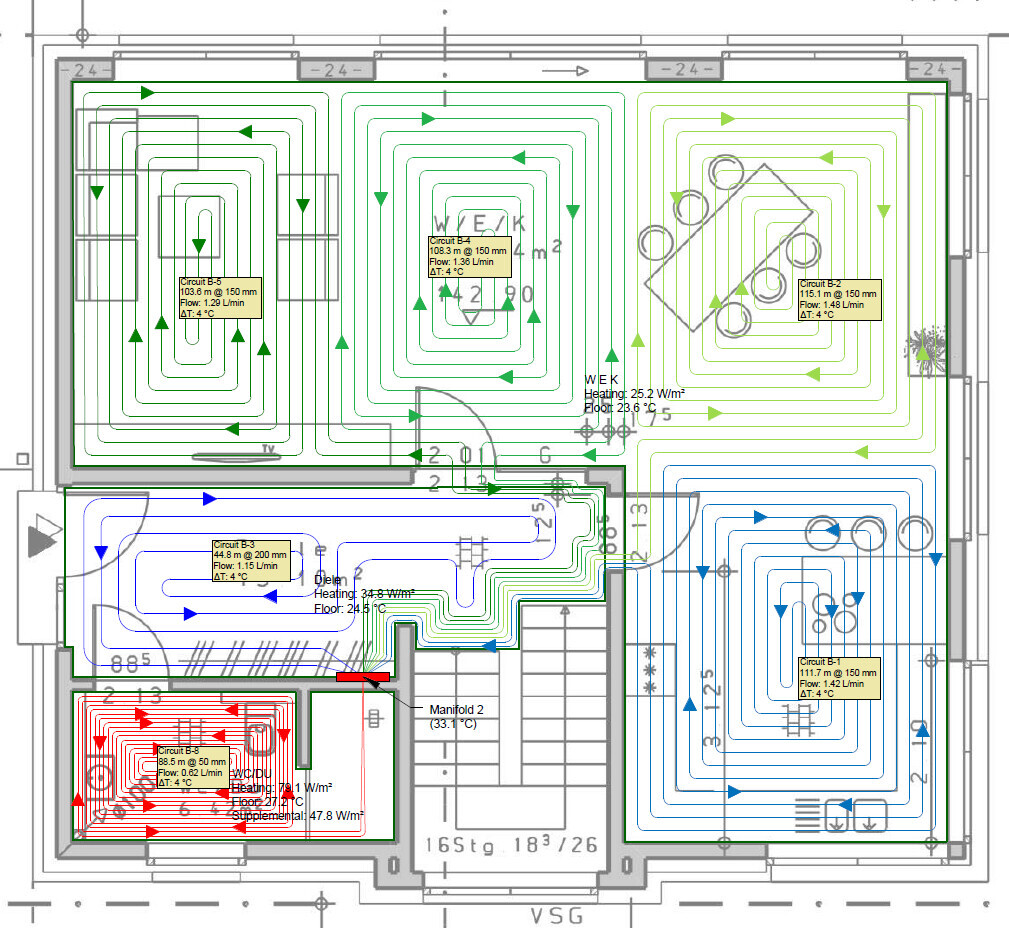
Theory: 4 heating circuits with a 15cm (6 inch) pipe spacing:
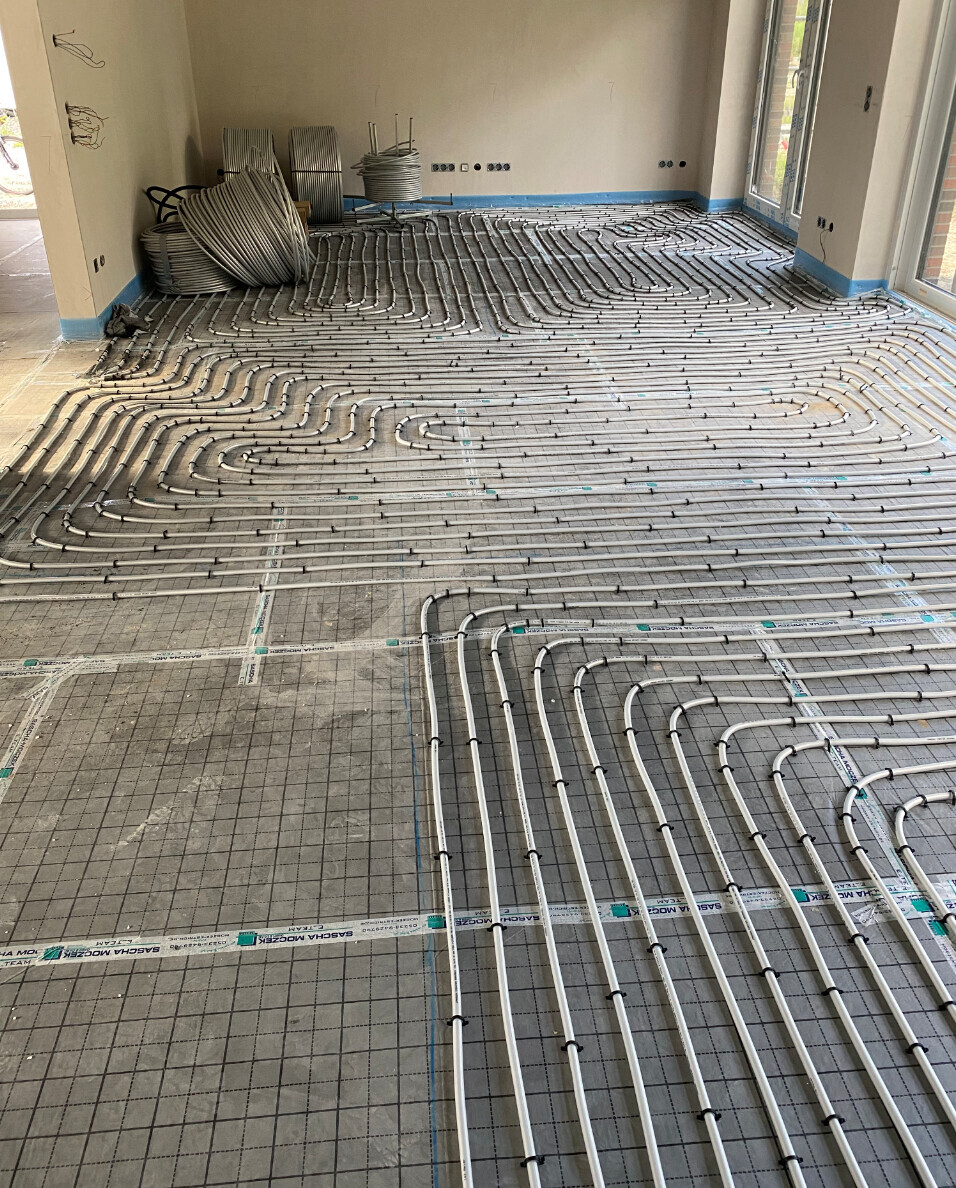
Practice: 6 heating circuits with a 10cm (4 inch) pipe spacing:
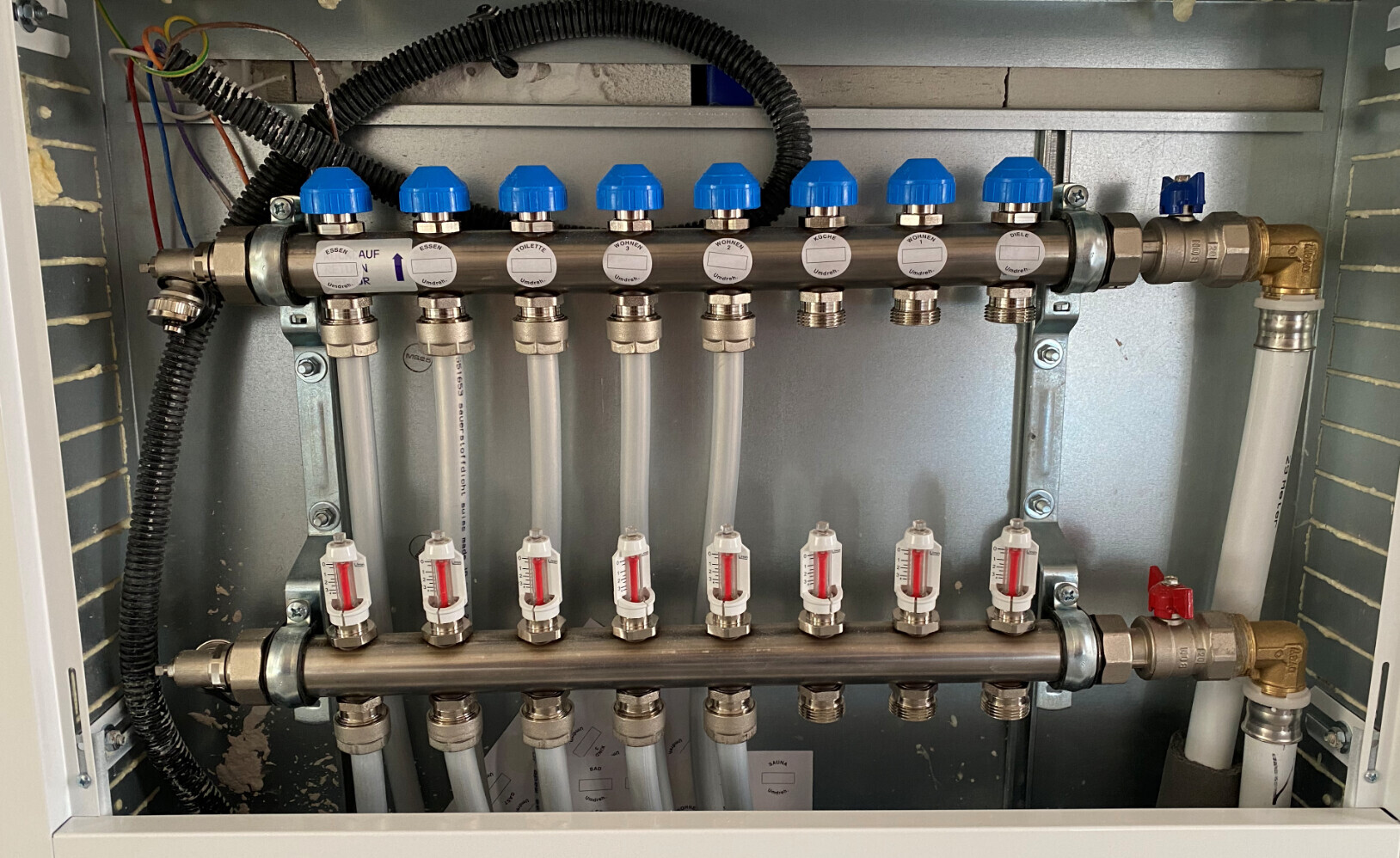
Heating circuit manifold:
Sometimes I wonder if they do this on purpose? We keep discussing how it should be done, and the general contractor complains about warranties, and then everything is done differently? It’s starting to get on my nerves a bit. I’m just wondering if my concerns are justified or if I should just let it go.
The planned flow rate should be 1.45 liters per minute (l/min). Now I guess I need to throttle it down to about 1 l/min?
Theory: 4 heating circuits with a 15cm (6 inch) pipe spacing:
Practice: 6 heating circuits with a 10cm (4 inch) pipe spacing:
Heating circuit manifold:
Sometimes I wonder if they do this on purpose? We keep discussing how it should be done, and the general contractor complains about warranties, and then everything is done differently? It’s starting to get on my nerves a bit. I’m just wondering if my concerns are justified or if I should just let it go.
The planned flow rate should be 1.45 liters per minute (l/min). Now I guess I need to throttle it down to about 1 l/min?
D
Deliverer7 Jul 2021 21:1915 cm (6 inches) would have been nonsense anyway. 10 cm (4 inches) is fine.
But why is there an empty area at the bottom left?
Still, there are several reports from people who have had the ERR function deactivated. If that doesn’t work, make sure the actuators are powered off and open. Then you can simply unplug the cables. Of course, it’s a pity to waste money on this...
If there is no chance to convince the heating technician to switch to a buffer-free system, at least have a small buffer tank (50 liters (13 gallons)) installed in series on the return line. Not in parallel as a hydraulic separator. Otherwise, you won't be able to pump properly or heat efficiently without losses.
Two evenings on the HTD forum and maybe an hour of discussion can save several thousand euros in investment and a similar amount in electricity costs over the system’s lifetime. It’s worth the effort.
But why is there an empty area at the bottom left?
Still, there are several reports from people who have had the ERR function deactivated. If that doesn’t work, make sure the actuators are powered off and open. Then you can simply unplug the cables. Of course, it’s a pity to waste money on this...
If there is no chance to convince the heating technician to switch to a buffer-free system, at least have a small buffer tank (50 liters (13 gallons)) installed in series on the return line. Not in parallel as a hydraulic separator. Otherwise, you won't be able to pump properly or heat efficiently without losses.
Two evenings on the HTD forum and maybe an hour of discussion can save several thousand euros in investment and a similar amount in electricity costs over the system’s lifetime. It’s worth the effort.
Similar topics