
ᐅ Floor Plan Single-Family Home with Granny Flat as a Three-Unit Residence
Created on: 5 Jul 2021 06:50
F
florian93
Hello everyone,
I have been a quiet reader here for a long time and have gained a lot of information and ideas from this forum. Many thanks for that!
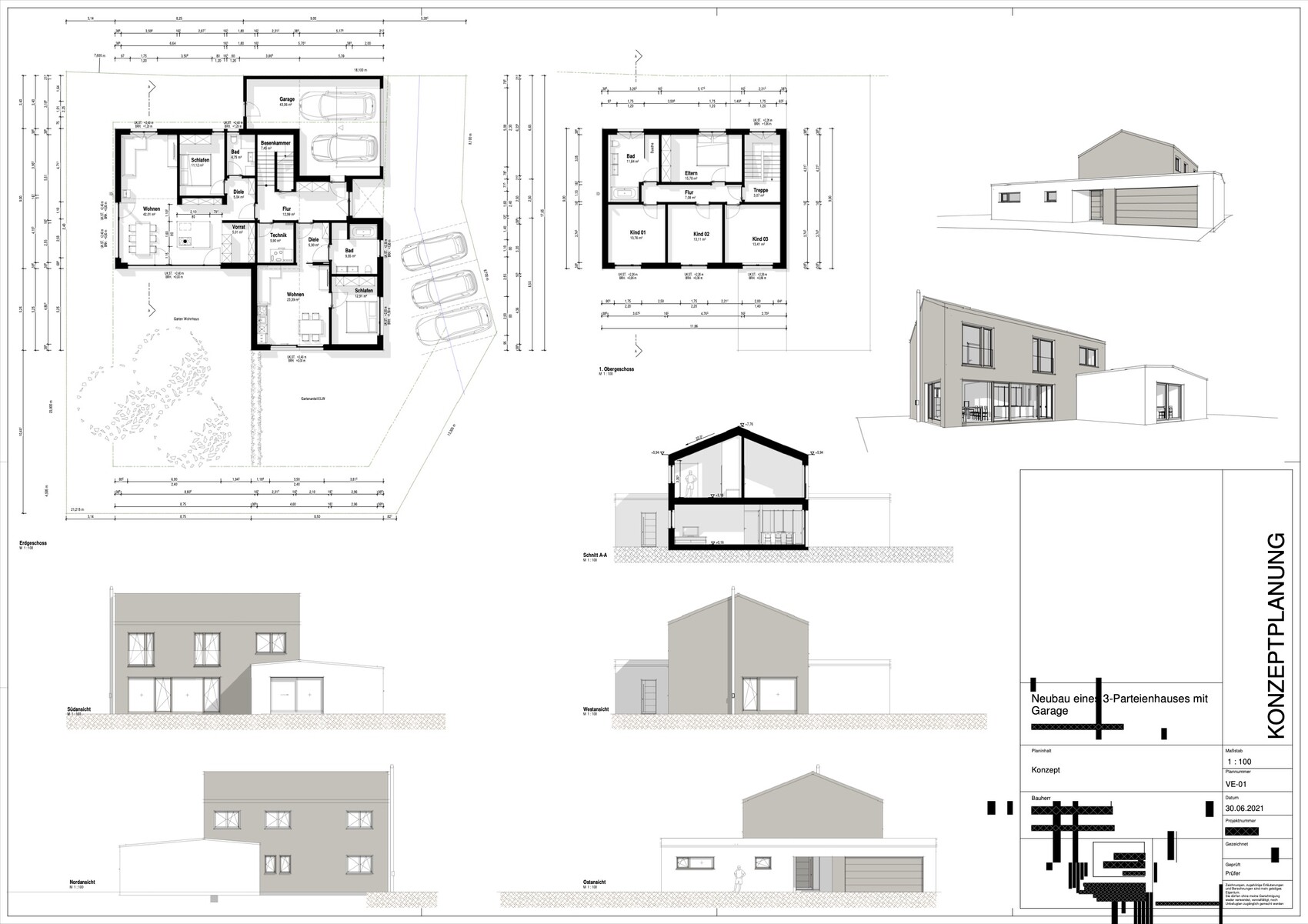
Since the end of last year, we have been looking into building a house. Initially, we spoke with a few turnkey construction companies. We moved forward with planning more concretely with one company. However, we were never completely satisfied with the results, as we felt the flexibility and individuality were always limited beyond a certain point. Meanwhile, we have turned to an architect from the neighboring village who will support us from planning to the finished house (phases 1-8). We have now reached the point of a "final" draft including a cost estimate.
Development plan/restrictions
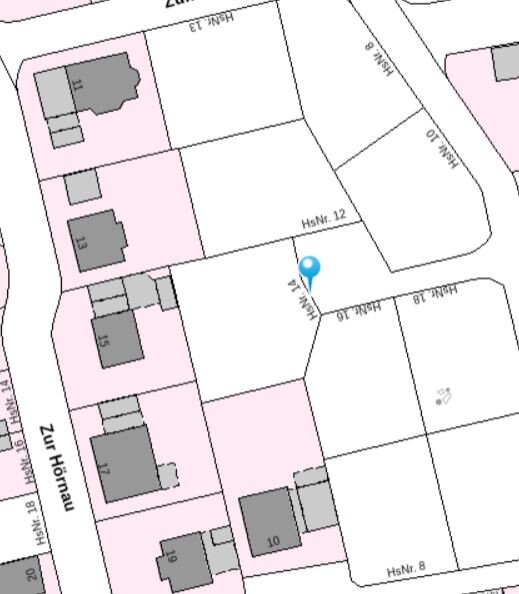
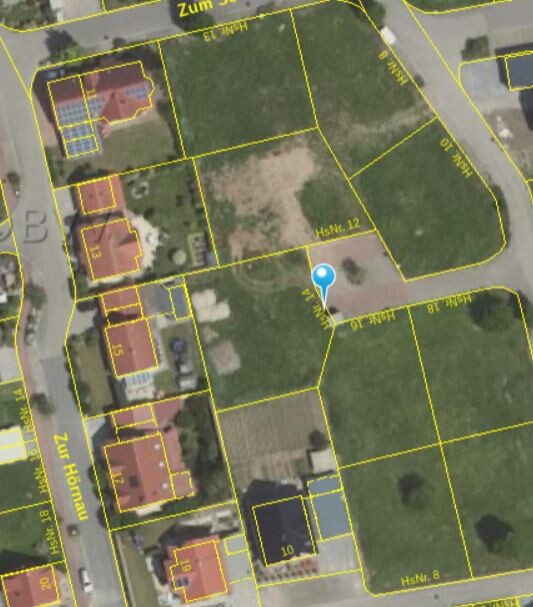
Plot size: 709 sqm (7,630 sq ft)
Slope: No
Floor area ratio (FAR): 0.4
Floor space index (FSI): 0.8
Building envelope, building line, and boundary: see plan
Edge construction: garage
Number of parking spaces: 1.5 per residential unit (= 5)
Number of floors: 1.5
Roof type: 38-47° (100-116°F) gable or half-hipped roof
Style: No specification
Orientation: No specification
Maximum height/restrictions: None
Other requirements: None
Client requirements
Style, roof type, building type: Classic-modern, gable roof
Basement, floors: 2 full floors (according to development plan only 1.5 => however, neighbors in the immediate area have been granted permission for 2 as long as the overall height does not exceed 1.5, which requires a lower roof pitch)
Number of people, age:
Space requirements on ground floor and upper floor:
Office: home office
Overnight guests per year: can sleep on the sofa
Open or closed architecture: open
Conservative or modern construction: modern
Open kitchen, kitchen island: open, kitchen island maybe
Number of dining seats: 6
Fireplace: provision for future installation
Music/stereo wall: No
Balcony, roof terrace: No
Garage, carport: garage, but also open to a carport (depending on savings)
Vegetable garden, greenhouse: No, possibly a small utility area in the garden
Other wishes/special features/daily routine, including reasons for choices or exclusions: None
House design
Who designed the plan: architect
What do you especially like? Why?
What do you dislike? Why?
Cost estimate according to architect/planner:
Personal budget limit for the house, including fittings: Is it even possible to define this nowadays?
Preferred heating system: heat pump
If you had to give up something, which features/extensions
- you can live without: fireplace (or just fireplace preparation), smart home (I’m an IT professional and can retrofit it myself later)
- you cannot live without: none
Why does the design look as it does now? For example:
Standard design from the planner? Basic idea is ours + several discussions with the architect
Which wishes were implemented by the architect?
What makes it particularly good or bad in your opinion?
What is the most important/basic question about the floor plan summed up in 130 characters?
I have been a quiet reader here for a long time and have gained a lot of information and ideas from this forum. Many thanks for that!
Since the end of last year, we have been looking into building a house. Initially, we spoke with a few turnkey construction companies. We moved forward with planning more concretely with one company. However, we were never completely satisfied with the results, as we felt the flexibility and individuality were always limited beyond a certain point. Meanwhile, we have turned to an architect from the neighboring village who will support us from planning to the finished house (phases 1-8). We have now reached the point of a "final" draft including a cost estimate.
Development plan/restrictions
Plot size: 709 sqm (7,630 sq ft)
Slope: No
Floor area ratio (FAR): 0.4
Floor space index (FSI): 0.8
Building envelope, building line, and boundary: see plan
Edge construction: garage
Number of parking spaces: 1.5 per residential unit (= 5)
Number of floors: 1.5
Roof type: 38-47° (100-116°F) gable or half-hipped roof
Style: No specification
Orientation: No specification
Maximum height/restrictions: None
Other requirements: None
Client requirements
Style, roof type, building type: Classic-modern, gable roof
Basement, floors: 2 full floors (according to development plan only 1.5 => however, neighbors in the immediate area have been granted permission for 2 as long as the overall height does not exceed 1.5, which requires a lower roof pitch)
Number of people, age:
- Currently: 3 (Dad 27, Mom 25, son 1)
- Future: 4-5 (Dad, Mom, 2-3 children) + 2 in granny flat (parents, in about 5-10 years)
Space requirements on ground floor and upper floor:
- Ground floor + upper floor:
- Size: approx. 160-180 sqm (1,722-1,938 sq ft); inspired by the new build of an acquaintance
- Rooms ground floor: open kitchen/dining/living area + small pantry, office, utility/technical room, guest WC
- Rooms upper floor: large bathroom, master bedroom, 3 children’s rooms
- Granny flat:
- Size: approx. 50 sqm (538 sq ft); based on our old 2-room apartment
- Rooms: open kitchen/dining/living area, bathroom, bedroom
Office: home office
Overnight guests per year: can sleep on the sofa
Open or closed architecture: open
Conservative or modern construction: modern
Open kitchen, kitchen island: open, kitchen island maybe
Number of dining seats: 6
Fireplace: provision for future installation
Music/stereo wall: No
Balcony, roof terrace: No
Garage, carport: garage, but also open to a carport (depending on savings)
Vegetable garden, greenhouse: No, possibly a small utility area in the garden
Other wishes/special features/daily routine, including reasons for choices or exclusions: None
House design
Who designed the plan: architect
What do you especially like? Why?
- Use as a single-family house plus granny flat, with the option to separate into 3 units later, e.g., when children grow older or if renting is desired
- Separate garden areas for the main house and granny flat
- Large windows facing south => lots of daylight (neighbor to the south is quite far away + good privacy to the east thanks to granny flat)
- Garden/terraces on the south side
- Direct access to the garage from inside
- Direct access to the granny flat for times of sole family use
What do you dislike? Why?
- Very dark entrance area
- Concern that the kitchen/dining/living area might be too small or cramped
Cost estimate according to architect/planner:
- Note: everything calculated very generously based on current raw material prices
- All-in: 778k (we already own the serviced land)
- of which 40k are additional construction costs
- of which 35k already planned for furnishings
- of which 50k already planned for outdoor facilities and open spaces
- Resulting in:
- after deductions for subsidies: 662k (3x KfW 40 Plus + energy consultant = 116k)
- after deductions for assured DIY work: 642k
- after deduction of approx. 160k for granny flat (financed by parents): 482k
Personal budget limit for the house, including fittings: Is it even possible to define this nowadays?
Preferred heating system: heat pump
If you had to give up something, which features/extensions
- you can live without: fireplace (or just fireplace preparation), smart home (I’m an IT professional and can retrofit it myself later)
- you cannot live without: none
Why does the design look as it does now? For example:
Standard design from the planner? Basic idea is ours + several discussions with the architect
Which wishes were implemented by the architect?
- Almost all of our wishes
- Staircase with straight steps
What makes it particularly good or bad in your opinion?
- Good: not a run-of-the-mill standard design, visually very appealing (in our opinion)
- Bad: nothing
What is the most important/basic question about the floor plan summed up in 130 characters?
- We would simply like some unbiased opinions/optimizations from third parties
- How can the entrance area be improved in terms of natural light?
Myrna_Loy schrieb:
It’s been a while since I looked into the topic of accessory apartments, but if I remember correctly, you can’t legally plan two accessory apartments within a single-family house.
So if you plan three dwelling units, you are essentially building a multi-family house. Is that allowed under the building permit / planning permission? And then there are additional requirements beyond fire protection, such as separate meters for each unit.
If creating dwelling units were as easy as running a few extra cables and allowing for a drywall partition, everyone would do it. There is a parallel thread that deals exactly with this. However, my tone there was heavily criticized—I was just stating the facts 😉
F
florian937 Jul 2021 08:27We sat down again last night to brainstorm on our own. A quick note: no, the granny flat was not yet part of our considerations. We’ll be discussing that with my parents again over the weekend. Our focus was on the ground floor, especially on eliminating the bottleneck leading to the dining and living areas and significantly shortening the routes to the upper floor. We have already mentioned several times that we were not completely satisfied with the kitchen layout. Now we would like to get valuable feedback on our idea. We will also be discussing it with our architect in the coming days.
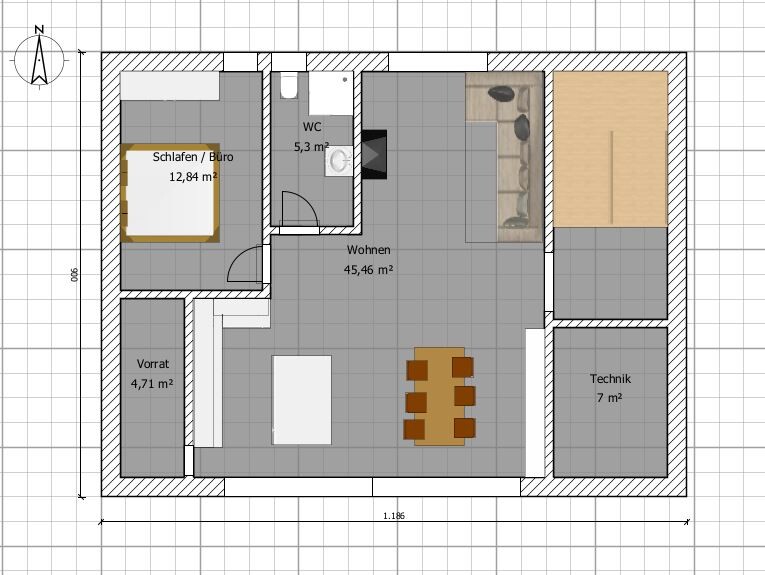
And again in 3D:
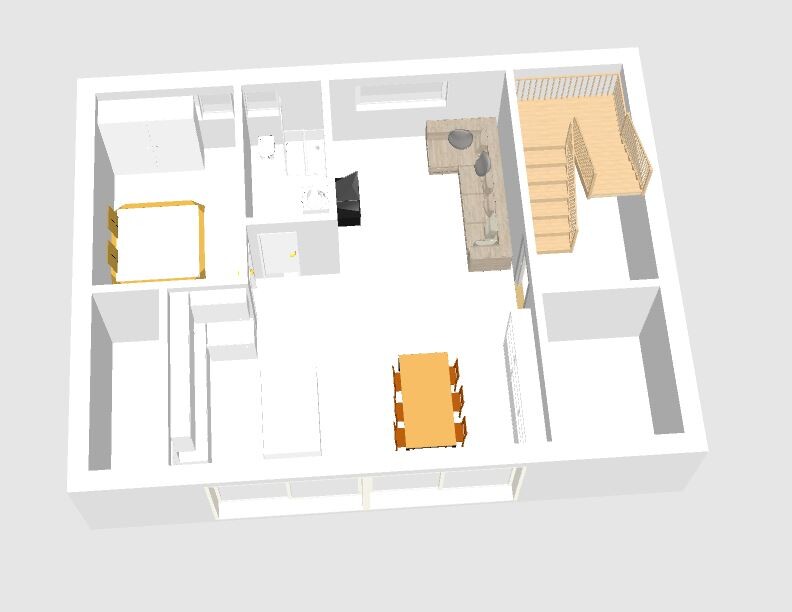
And again in 3D:
M
Myrna_Loy7 Jul 2021 08:34I would say, it's better to leave this to the architect.
These offsets, corners, and doors only make the space feel busy and turn it into a large passage area. I also don’t think you can design your house independently of the granny flat.
And the bulky door in the kitchen area? Really?
These offsets, corners, and doors only make the space feel busy and turn it into a large passage area. I also don’t think you can design your house independently of the granny flat.
And the bulky door in the kitchen area? Really?
Lack of Storage Space
There is a lack of specifications for three residential units.
The unnecessary insistence on having three units is making things difficult for you. Why are you sticking to this plan?
Use accurate measurements for your experiments. In your pantry, you can only enter from the side with empty hands and shoe size 38 (US women’s size 7.5 / UK size 5).
There is no coatroom, the bedroom is suitable for vampires, and the living area is divided by a large circulation path.
Your parents should consider exactly how and to what extent they are willing to accept limitations in the apartment.
There is a lack of specifications for three residential units.
The unnecessary insistence on having three units is making things difficult for you. Why are you sticking to this plan?
Use accurate measurements for your experiments. In your pantry, you can only enter from the side with empty hands and shoe size 38 (US women’s size 7.5 / UK size 5).
There is no coatroom, the bedroom is suitable for vampires, and the living area is divided by a large circulation path.
Your parents should consider exactly how and to what extent they are willing to accept limitations in the apartment.
F
florian937 Jul 2021 09:05I already knew you would be a tough audience... 😀
We are not insisting that the design be implemented exactly as it is. It was just a thought exercise to address a few points of criticism. Of course, we will discuss everything again with the architect, especially regarding the third residential unit.
I wouldn’t call it stubborn insistence either. We’re not doing this solely because of the subsidy, even though that is often assumed. We are mainly doing it to avoid limiting ourselves, so that in the future we could separate the ground floor and upper floor.
I understand the criticism regarding the pantry. It really isn’t ideal as it is now. It needs to be about 50–60 cm (20–24 inches) wider. Or removed entirely, and instead the kitchen made larger (= automatically more storage space in the kitchen).
We are not insisting that the design be implemented exactly as it is. It was just a thought exercise to address a few points of criticism. Of course, we will discuss everything again with the architect, especially regarding the third residential unit.
I wouldn’t call it stubborn insistence either. We’re not doing this solely because of the subsidy, even though that is often assumed. We are mainly doing it to avoid limiting ourselves, so that in the future we could separate the ground floor and upper floor.
I understand the criticism regarding the pantry. It really isn’t ideal as it is now. It needs to be about 50–60 cm (20–24 inches) wider. Or removed entirely, and instead the kitchen made larger (= automatically more storage space in the kitchen).
You’re setting yourselves up for problems now.
You have to meet certain requirements for three residential units that are missing in your current plan.
You’re making compromises now and in 25 years you might be living alone in a house with three residential units designed for singles or couples that are no longer suitable.
I know of two houses that were designed for three residential units in a way that families could also live in each unit. We also moved out of a multi-generation house because the residential unit was too small and outdated. A swap wasn’t possible because the unit ideal for families also had to be wheelchair accessible. No matter what, we would have had to pay a six-figure sum for a compromise. We could have moved to my in-laws. Two additional units had also once been planned there. That would have meant a six-figure investment, longer commutes to work, waiting lists for daycare, and why move to a small town where I don’t feel comfortable?
You have to meet certain requirements for three residential units that are missing in your current plan.
You’re making compromises now and in 25 years you might be living alone in a house with three residential units designed for singles or couples that are no longer suitable.
I know of two houses that were designed for three residential units in a way that families could also live in each unit. We also moved out of a multi-generation house because the residential unit was too small and outdated. A swap wasn’t possible because the unit ideal for families also had to be wheelchair accessible. No matter what, we would have had to pay a six-figure sum for a compromise. We could have moved to my in-laws. Two additional units had also once been planned there. That would have meant a six-figure investment, longer commutes to work, waiting lists for daycare, and why move to a small town where I don’t feel comfortable?
Similar topics