
Hello, I am currently wondering if our lighting is sufficient, or rather, I’m curious about what kind of lighting you have in your living room, whether hanging or standing.
Our open-plan living and dining area is about 35 square meters (375 square feet). On one side, there is a tunable white LED strip in a cove with 3600 lumens indirect light, and with an opal cover, it emits about 2800 lumens. Opposite that, we have spotlights illuminating the cabinets with a total of 2000 lumens. This forms the basic lighting. Do you think this is enough, or would it feel too dark? I specifically bought a floor lamp for the couch. Of course, there is also the lighting of the media wall.
Now I’m wondering whether to switch on the ceiling outlet above the sofa, but that would mean quite a lot of lamps.
How much light do you have around your sofa?
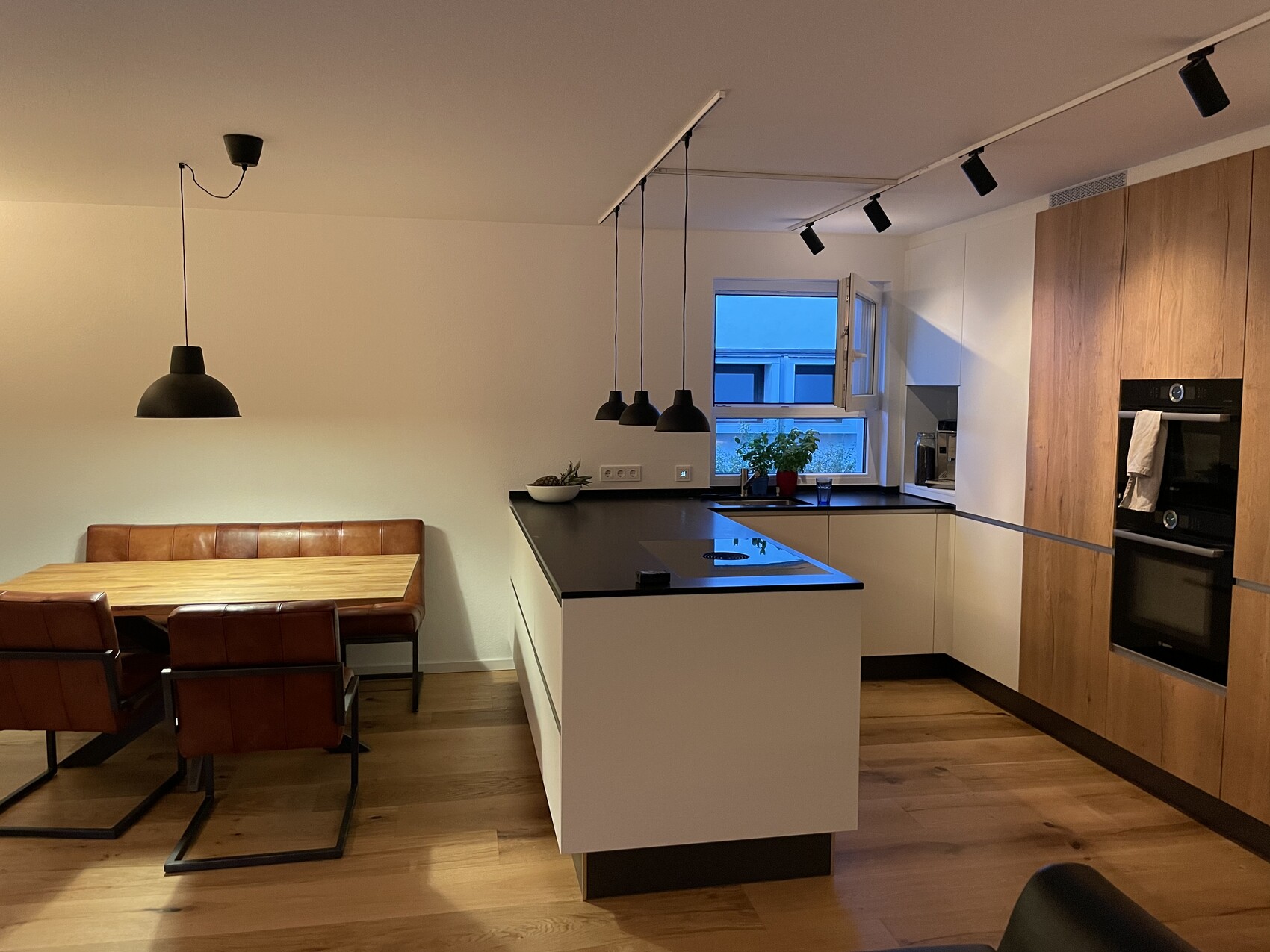
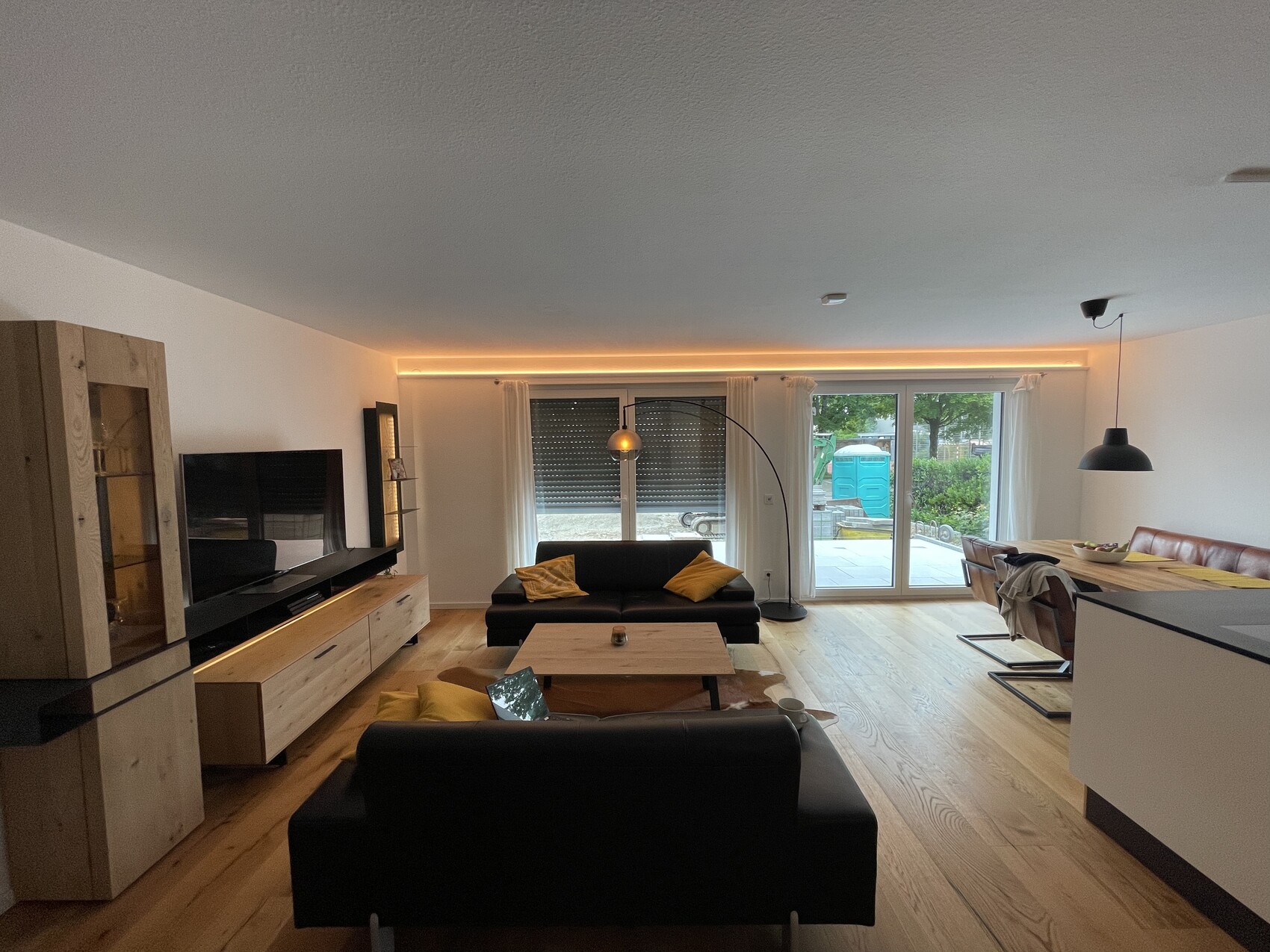
Our open-plan living and dining area is about 35 square meters (375 square feet). On one side, there is a tunable white LED strip in a cove with 3600 lumens indirect light, and with an opal cover, it emits about 2800 lumens. Opposite that, we have spotlights illuminating the cabinets with a total of 2000 lumens. This forms the basic lighting. Do you think this is enough, or would it feel too dark? I specifically bought a floor lamp for the couch. Of course, there is also the lighting of the media wall.
Now I’m wondering whether to switch on the ceiling outlet above the sofa, but that would mean quite a lot of lamps.
How much light do you have around your sofa?
hampshire schrieb:
Lumens measure luminous flux, not brightness. You can't tell whether it will be too dark, too bright, or comfortable just from that value. Thanks, I was struggling with that question too.
@NoggerLoger
You should actually be able to tell exactly where the problem lies—that is, where it feels uncomfortable for you.
Mood lighting like track lighting or cabinet lighting is overrated in my opinion. People prefer to read there, but the light is usually missing. Everyone has their own preferences when it comes to writing at the table, playing games, or watching TV.
For example, we need some form of “general lighting” near the sofa. Then I need something brighter when I read there. Having a (brighter) lamp on the TV wall makes watching TV easier for us. There is always an accent light on in the open kitchen—so overall, there are three lamps on every evening that aren’t considered general lighting, and the wattage doesn't really matter. Our main ceiling light hardly ever gets turned on, except when I’m sewing in the living room at night or assembling IKEA furniture.
That’s how it works for us; it’s different elsewhere.
Try to move away from numbers 🙂
N
NoggerLoger4 Jul 2021 20:26I have already done some calculations in Dialux for the hallway and bathroom, which roughly fit when adjusting the lumens and using common lux values. In reality, it usually looks a bit different, especially since everyone perceives lighting differently.
 Schimi17914 Jul 2021 21:51
hampshire schrieb:
Lumen is not brightness,
…Online you can find about ‘lumen’:
“Lumen is the unit that measures the total amount of light emitted by a lamp in all directions. It describes the luminous flux of the lamp.
For example, a 40 watt incandescent bulb produces about 400 lumens.
…”
H
hampshire4 Jul 2021 22:59You can find almost everything on the internet, including shortcuts. Lumen is a precisely defined physical unit. For omnidirectional light sources like an incandescent bulb, this statement is not incorrect. However, it no longer applies to directional light sources such as LEDs. Maybe try consulting a different source.
The comparison between a laser pointer and an incandescent bulb becomes clear: the 40-watt incandescent bulb has a luminous flux of about 400-430 lumens. A laser pointer with 20 lumens is clearly brighter but, of course, has a lower luminous flux.
The comparison between a laser pointer and an incandescent bulb becomes clear: the 40-watt incandescent bulb has a luminous flux of about 400-430 lumens. A laser pointer with 20 lumens is clearly brighter but, of course, has a lower luminous flux.
Schimi17915 Jul 2021 05:39Sure, the geometry of the light bulb also plays a role. However, in residential areas, we are far from the precision of a laser pointer when it comes to light bulbs. For traditional light bulbs, “lumens” are always taken into account when assessing brightness, ideally with comparable shapes.
Schimi17915 Jul 2021 06:02But it is true that 'lumen' does not provide an ideal comparison value for brightness when the geometries and surroundings differ significantly.
More water can flow through a pipe with a very small diameter than through a pipe with a larger diameter. In the case of pipes as well, the geometry, in this case the diameter, should be comparable.
More water can flow through a pipe with a very small diameter than through a pipe with a larger diameter. In the case of pipes as well, the geometry, in this case the diameter, should be comparable.
Similar topics