
ᐅ Planning a Mechanical Ventilation System with Heat Recovery: Component Placement and Duct Lengths
Created on: 18 Jun 2021 20:29
D
domino649
Hello everyone,
I am planning to have a single-family house built and intend to install a controlled residential ventilation system myself.
My plan is to have the ventilation duct with a diameter of 75 mm (3 inches) embedded in the concrete ceiling, and to install the remaining components later on my own.
It is necessary to specify the positions of the air vents and the inlets and outlets for outdoor air and exhaust air in the basement wall soon.
The ventilation system I have planned is shown in the attachments.
1. The ventilation duct from the inlet to the distributor can be up to 20 meters (65 feet) long. Are there any limitations on the length between the distributors and the ventilation unit?
Which type of duct is used here (160 mm (6 inches)) – foam or metal?
2. How is the basement wall penetration sealed? Is it sufficient to install an air shaft?
3. What would you change in the planning?
Air vents with a diameter of 125 mm (5 inches) in the ceiling.
The house includes a basement, two full floors, and a recessed top floor (flat roof) with a rooftop terrace.
The exterior walls are made of aerated concrete (Ytong) and are 36.5 cm (14 inches) thick.
Thank you very much.
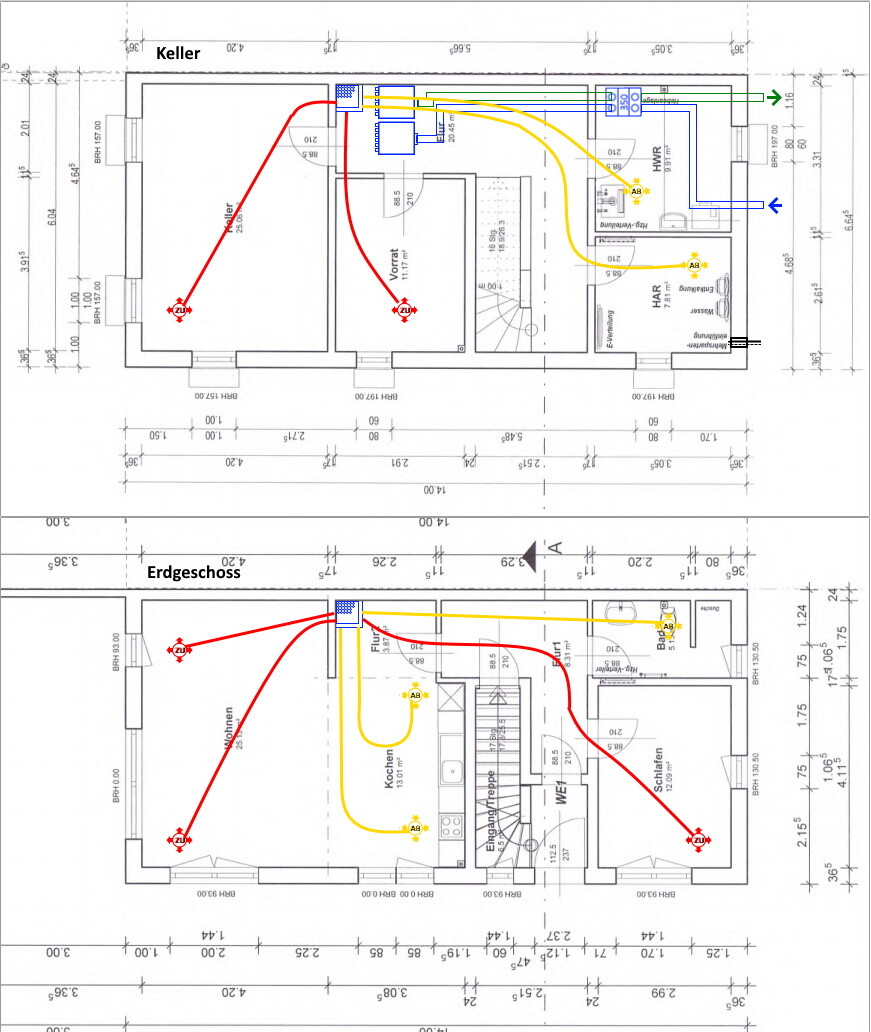

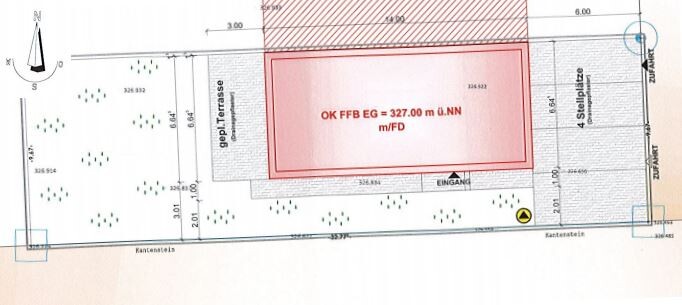
I am planning to have a single-family house built and intend to install a controlled residential ventilation system myself.
My plan is to have the ventilation duct with a diameter of 75 mm (3 inches) embedded in the concrete ceiling, and to install the remaining components later on my own.
It is necessary to specify the positions of the air vents and the inlets and outlets for outdoor air and exhaust air in the basement wall soon.
The ventilation system I have planned is shown in the attachments.
1. The ventilation duct from the inlet to the distributor can be up to 20 meters (65 feet) long. Are there any limitations on the length between the distributors and the ventilation unit?
Which type of duct is used here (160 mm (6 inches)) – foam or metal?
2. How is the basement wall penetration sealed? Is it sufficient to install an air shaft?
3. What would you change in the planning?
Air vents with a diameter of 125 mm (5 inches) in the ceiling.
The house includes a basement, two full floors, and a recessed top floor (flat roof) with a rooftop terrace.
The exterior walls are made of aerated concrete (Ytong) and are 36.5 cm (14 inches) thick.
Thank you very much.

domino649 schrieb:
How do you handle basement wall penetrations? A 20cm (8 inches) sleeve for the 160mm (6.3 inches) foam pipe? And how do you seal it on the outside?A 160mm (6.3 inches) pipe through a DN200 (8 inches) ring seal (Doyma or similar). Yes, it’s expensive, but you need it.
A small tip from an amateur: we have ventilation slots in the floor on the upper floor (except in the bathroom), and if you can manage it somehow, I think it’s more comfortable to have them in the ceiling. We put a lot of thought into their placement, but now they’re still annoying when arranging the furniture. 🙂
D
domino64921 Jun 2021 12:17Strahleman schrieb:
I also don’t quite understand why there are two exhausts in the "cooking" area. Why not just use one exhaust vent with two connections? I was thinking that having two exhaust vents in the cooking area and two supply vents in the open living area would help optimize airflow; otherwise, for example, a kitchen island or another piece of furniture might block the circulation.
Is this a bad idea, and should I just use one vent with two ducts instead?
D
domino64921 Jun 2021 15:51Strahleman schrieb:
For sealing the basement pipe penetrations to the outside, there are Hauff or Doyma annular space seals. The former can be found quite affordably at building supply stores like Heim Baustoffe or similar. The pipes from the basement penetration to the ventilation unit are insulated pipes and flexible silencers. From the ventilation unit to the distributor, you usually have spiral ducting and silencers. But here you have flexibility regarding what you use in the end. These foam pipes with an inner diameter of 160 mm (6.3 inches) have an outer diameter of 190 mm (7.5 inches).
That means I would need 2 of the following annular space seals:
Standard annular space seal with infinitely adjustable super-segment ring technology.
HSD250 SSG 1x159-211 b40 A2/EPDM55
Sealing width up to Ø 250 mm (9.8 inches): 40 mm (1.6 inches)
FEATURES
Lining pipe/core drill Øi (mm): 250 (9.8 inches)
Additionally, 2 lining pipes are required.
In my basement, the wall elements are prefabricated and then installed on site and filled with concrete.
Which lining pipes are best suited for this?
Cement composite pipe with special coating?
ZVR250/240 FC Item no.: 1200250240
FEATURES
Lining pipe Øi (mm): 250 (9.8 inches)
Optimal application range for medium pipe Øa (mm): 160 - 210 (6.3 - 8.3 inches)
Max. possible application range for medium pipe Øa (mm): 0 - 214 (0 - 8.4 inches)
Lining pipe Øa (mm): 269 (10.6 inches)
Wall thickness (mm): 240 (9.4 inches)
Are my considerations correct?