
ᐅ Reducing Traffic Noise Through Construction Methods and Noise Barrier Walls
Created on: 9 Jun 2021 09:30
W
werner71
Hello,
we are planning to build a small single-family house on our plot. The location of the plot is generally good, but there is increased noise in the mornings and evenings due to rush hour traffic.
I measured the sound pressure level using a smartphone app. I cannot vouch for the accuracy of the values, but they roughly correspond (subjectively) to confirmed measurements from similar plots that I know of.
When no vehicle passes by: 55 dB.
With a car: up to 68 dB.
With a truck: up to 78 dB.
At the moment, the noise level outdoors seems too high to me. To still be able to build on the plot, I am considering a noise barrier wall and a house design oriented away from the street (solid construction, soundproof windows, insulation with mineral wool) (see attachment, noise barrier wall marked with red dashed line).
I have no doubts about achieving the desired quietness inside the house through these measures. My question is: what about the outdoor areas?
I am already in contact with a specialist for soundproof walls, and the next step will be to discuss the overall planning with an architect. For this, I wanted to provide a few wishes and ideas. That’s why I have the following questions:
Thank you very much for your suggestions!
Best regards
Werner
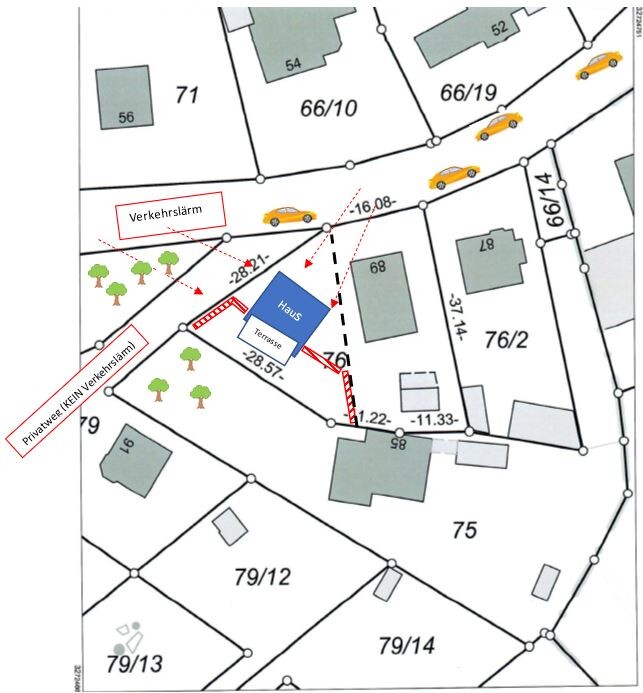
we are planning to build a small single-family house on our plot. The location of the plot is generally good, but there is increased noise in the mornings and evenings due to rush hour traffic.
I measured the sound pressure level using a smartphone app. I cannot vouch for the accuracy of the values, but they roughly correspond (subjectively) to confirmed measurements from similar plots that I know of.
When no vehicle passes by: 55 dB.
With a car: up to 68 dB.
With a truck: up to 78 dB.
At the moment, the noise level outdoors seems too high to me. To still be able to build on the plot, I am considering a noise barrier wall and a house design oriented away from the street (solid construction, soundproof windows, insulation with mineral wool) (see attachment, noise barrier wall marked with red dashed line).
I have no doubts about achieving the desired quietness inside the house through these measures. My question is: what about the outdoor areas?
I am already in contact with a specialist for soundproof walls, and the next step will be to discuss the overall planning with an architect. For this, I wanted to provide a few wishes and ideas. That’s why I have the following questions:
- What do you estimate the noise reduction would be from a suitable building design on the terrace (e.g. -15 dB)?
- Do you have any suggestions for the design to keep noise levels low on the terrace?
- Are there any experiences with noise reduction from the combination of a noise barrier wall and a terrace oriented away from the street (e.g. noise barrier wall - 15 dB, house design an additional - 8 dB)?
- Do you have any other suggestions for measures I could take to keep noise exposure low?
Thank you very much for your suggestions!
Best regards
Werner
M
Myrna_Loy9 Jun 2021 13:27If noise is such a problem and an 8 dB reduction on the terrace is desired, then the wall must fully enclose the house to block out sounds like lawnmowers, string trimmers, and similar. I no longer hear the cars, but hours of lawn mowing… 🙂
Hannes S schrieb:
Exactly. The noise only occurs in the morning and afternoon for about 2 hours. If a noise barrier wall would do anything at all, it would divide the property in half.
I agree with MarCh. It makes more sense to orient the house more along a north-south axis and install proper soundproof windows facing the street. That would likely be much more effective than a wall in the garden and probably cheaper as well.
The reflection from number 91 remains the same, with or without the wall. So, if you put up a 2.5-meter (8-foot) high wall there, you just block the view 🙂 Myrna_Loy schrieb:
If noise is such a problem and you want an 8 dB reduction on the terrace, then the wall would have to completely enclose the house to block out lawn mowers, string trimmers, etc. I don’t hear the cars anymore, but hours of lawn mowing,... 🙂 We have lived right next to it for 20 years now. I still haven’t gotten used to the traffic noise. Compared to that, a lawn mower sounds as “melodious” to me as the “plucking of a harp.” ;-)
Especially because the lawn is mowed at most once a week, while cars race by almost continuously every day.
H
hampshire9 Jun 2021 13:45werner71 schrieb:
Whether the effort is worth it and then being labeled a troublemaker No, it’s not worth it. However, forming and initiating interest groups is definitely worthwhile. At our previous place of residence, we were able to initiate speed reductions on both local and district roads – not everywhere, but at some locations. At our new home, we are encouraging communities to leave more meadow areas on green strips and are increasingly gaining support to avoid gravel gardens. Those who build majorities bring about change; that’s how our system works.
On some pleasant weekend days, over 200 motorcyclists per hour pass through certain villages nearby, revving their engines and creating noise pollution in entire valleys for whole days. No offense to motorcyclists, but the dosage makes the poison. Here, too, growing interest groups are forming and changes are in sight. With some perseverance, political engagement is worthwhile and ultimately forms a foundation for the functioning of our democratic system.
This won’t solve your problem immediately, but in the long run, it addresses the same issue for many.
haydee schrieb:
If the noise bothers you that much, then maybe consider a different plot. What do you gain if it’s quiet but you live in a cage?
Noise sensitivity is subjective. That’s exactly the point: to carefully evaluate a "life decision" to the best of your knowledge and conscience, so you don’t regret it later.
hampshire schrieb:
No, it’s not worth it. However, forming and initiating interest groups is definitely worthwhile. At our previous residence, we were able to initiate speed reductions both on local roads and county roads – not everywhere, but in some places. At our new residence, we are managing to encourage municipalities to leave more meadow areas on green strips and are increasingly gaining approval to avoid gravel gardens. Creating majorities brings about change; that is how our system works.
On some pleasant weekend days, there are places where over 200 motorcyclists pass through the villages per hour, roaring through and acoustically impacting entire valleys throughout the day. Nothing against motorcyclists, but it’s the dose that makes the poison. Interest groups are also forming more strongly here, and changes are in sight. With some persistence, political engagement is worthwhile and ultimately forms the basis for the functioning of our democratic system.
This won’t solve your problem immediately, but in the long run, it addresses the same problem for many. I’ll bring this up in a chat with the neighbor. Let’s see what the response is. Good argument!