
ᐅ Feedback on Single-Family Home Floor Plan, 222 sqm Requested
Created on: 6 Jun 2021 22:25
*
*Sterntaler*
Hello everyone,
After you helped us so much with planning our bathroom, we would now appreciate your feedback on the overall floor plan of our house. We have to mention that with this version (except for the layout of the bathroom on the upper floor and the corner windows in the office and the bedroom above, which will each be replaced by two regular windows), we have almost reached the final version. This means a complete redesign is no longer possible and also not something we want.
Building Regulations / Restrictions
Plot size: 5 ares
Slope: no
Site coverage ratio: ?
Floor area ratio: 0.4
Building envelope, building line and boundaries: Building envelope has already been exceeded and approved. Building boundaries were fully used except for the boundary to the neighbor in the southwest (max 3 meters (10 feet)).
Edge development: Garage on the boundary
Number of parking spaces: 2
Number of floors: 2 full stories
Roof type: hipped roof
Style: urban villa
Orientation: living rooms facing south, front door in the northeast
Maximum heights / limits
Other requirements: /
Homeowner Requirements
Style, roof type, building type
Basement, floors: classic-modern, preferably simple/symmetrical roof shape, urban villa, 2 full stories, no basement
Number of occupants, age: 3 persons (adults in mid-30s, 1-year-old child)
Space requirements on ground floor, upper floor: see plan
Office: home office
Guests per year (estimated): about 10
Open or closed architecture: partly open, partly closed
Conservative or modern construction: rather modern
Open kitchen, cooking island: yes, U-shaped kitchen
Number of dining seats: 6
Fireplace: yes
Music / stereo wall: no
Balcony, roof terrace: balcony
Garage, carport: garage
Utility garden, greenhouse: no
Additional wishes / special features / daily routine, also reasons why certain things should or shouldn’t be: /
House Design
Who created the plan:
- Planner from a construction company
What do you particularly like? Why?
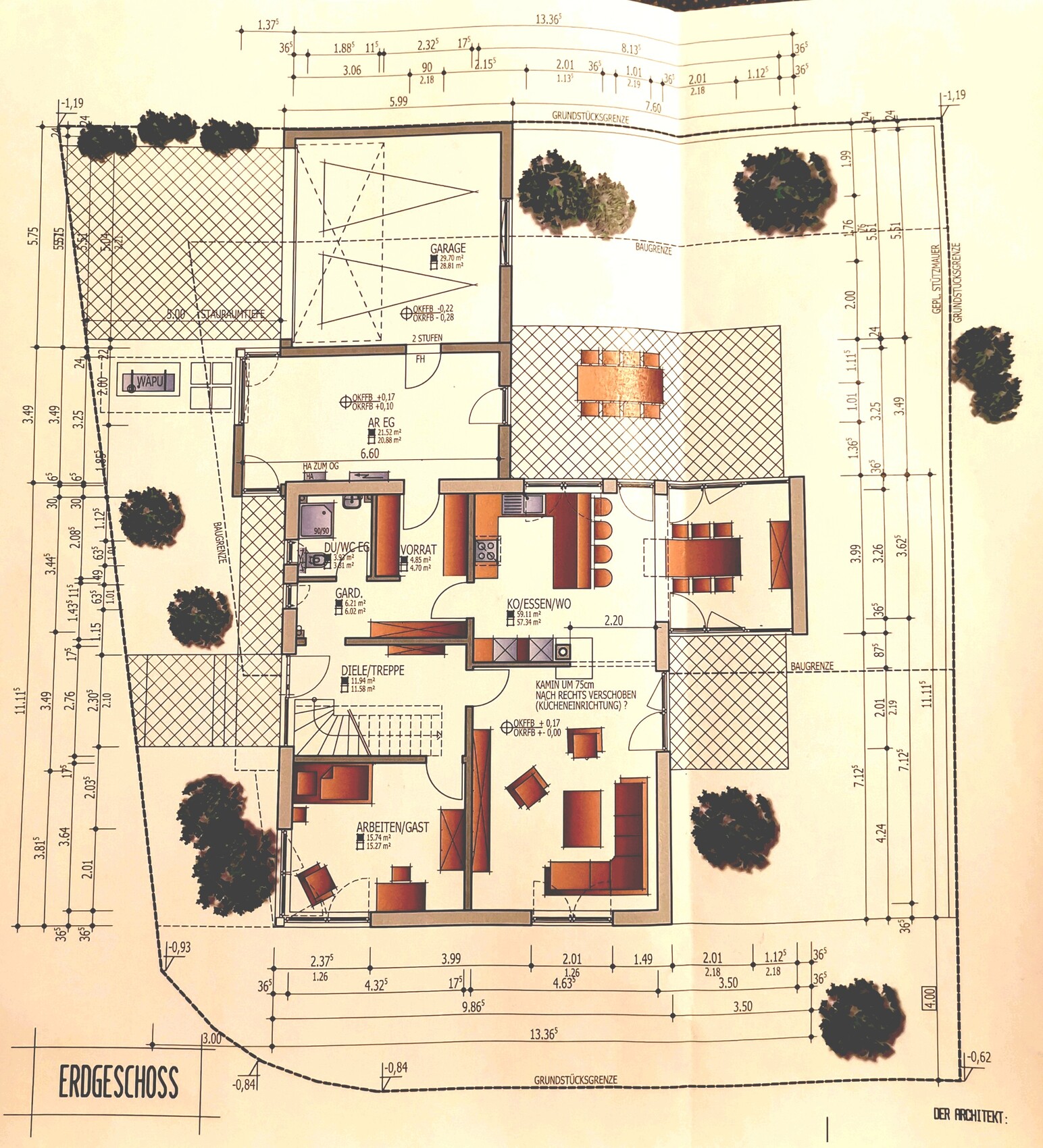
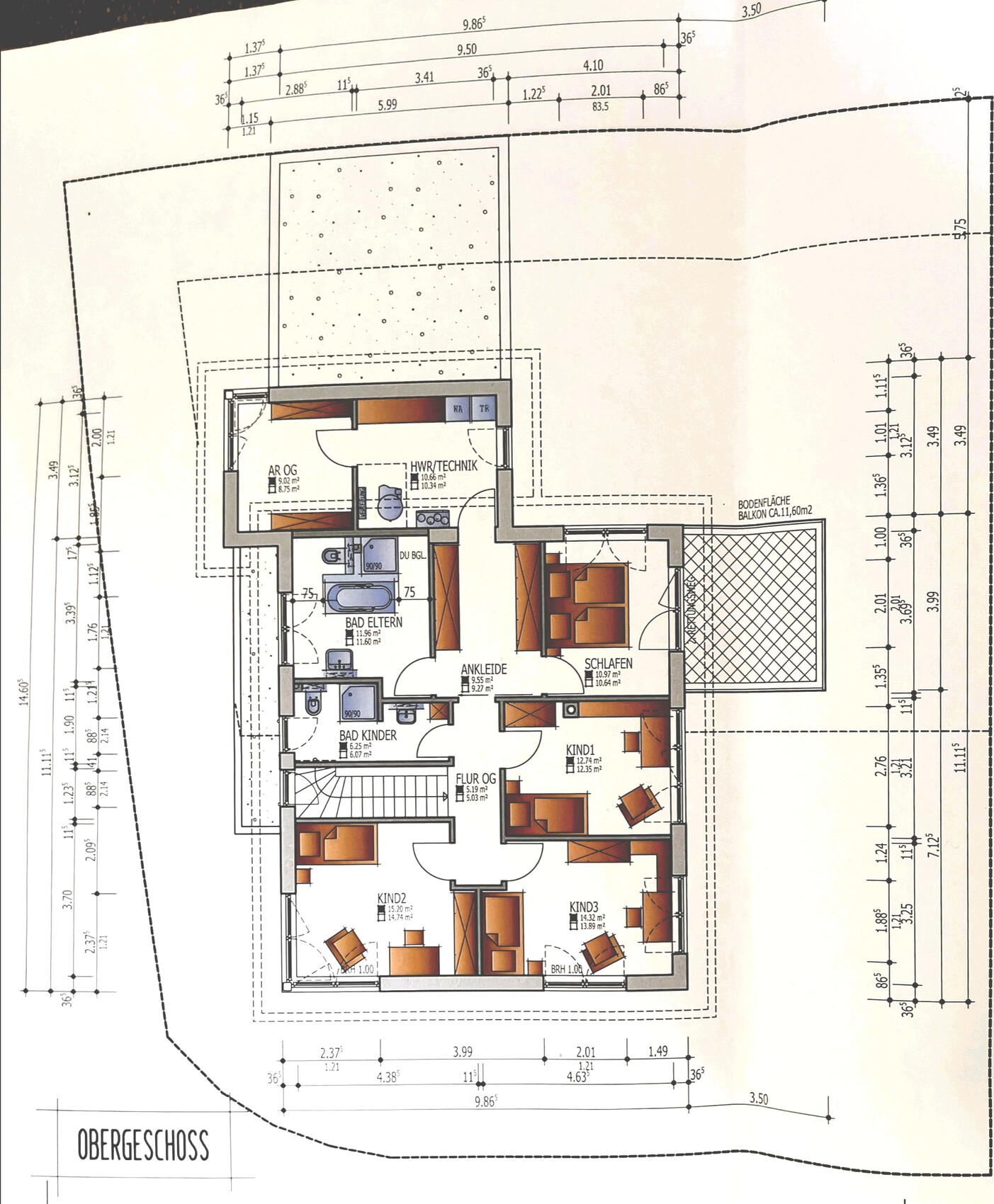
The floor plan is very practical (for example, the pantry is close to the kitchen and garage, utility room on the upper floor where most laundry accumulates), our corner windows in the "garage gap," which provide a great view over the fields, our light-filled dining area overlooking the garden, the parents’ area because we find the bathroom-dressing-bedroom layout very nice and practical, location of the coat closet: hidden but easily accessible from both the front door and the garage
What do you dislike? Why?
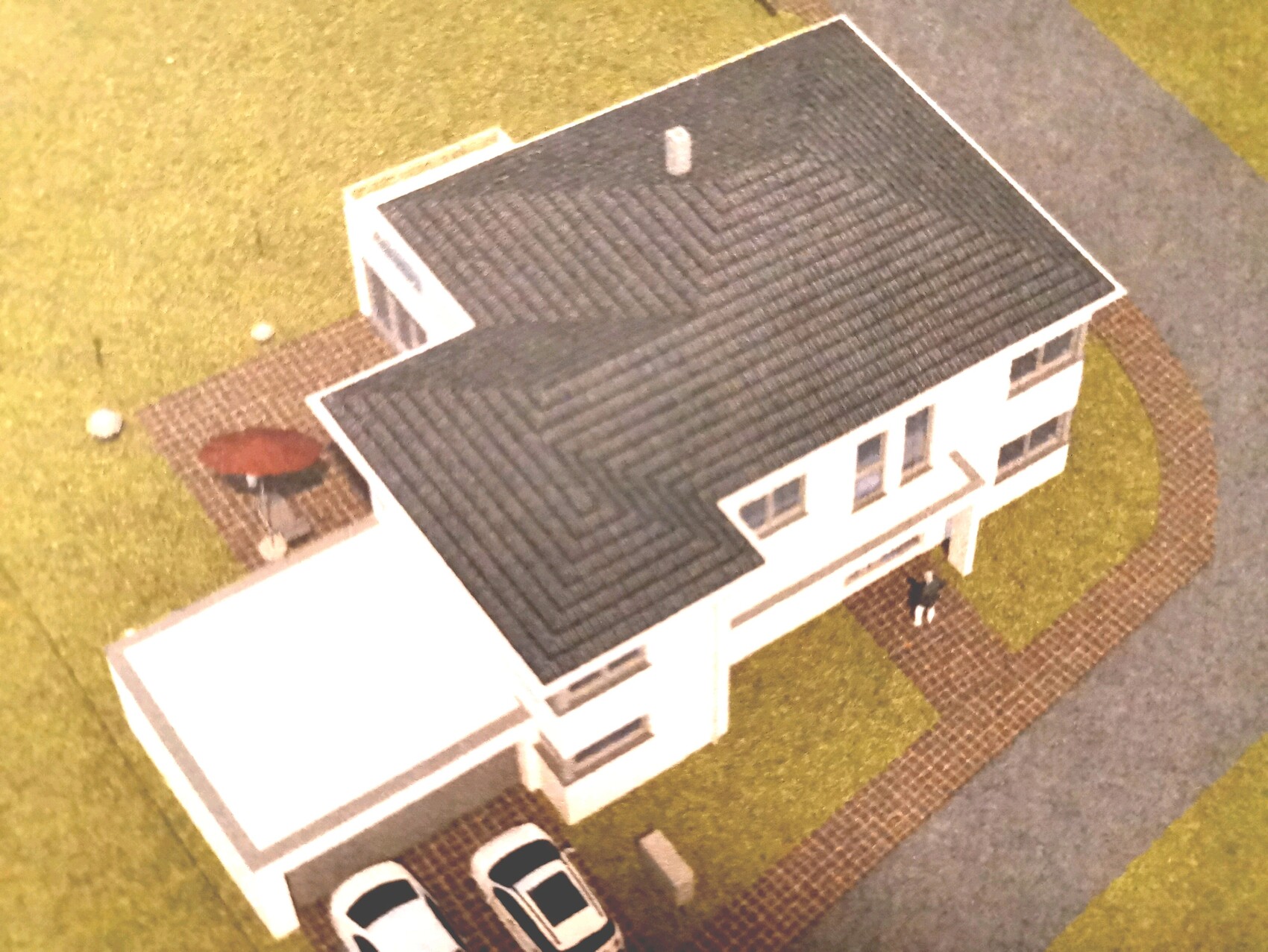
The roof shape, which unfortunately cannot be designed differently. Due to the “garage gap” (our basement replacement that was added later, making optimal use of the building envelope and taking up little garden space), the roof is not symmetrical but somewhat "bumpy."
Cost estimate according to architect/planner: still in progress
Personal cost limit for the house, including fixtures: should be within budget
Preferred heating technology: air/water heat pump + fireplace in the living room
If you had to do without certain details or expansions
- Can you do without: possibly the fireplace
- Cannot do without: garage gap, office, garage, 3 children’s rooms, photovoltaic panels on the roof
Why is the design the way it is now? Many of our own considerations, discussions with others, gathering inspiration from the internet and prefab house centers, personal living experience, restrictions due to the shape of the plot and soil conditions
Is this a standard design from the planner? No
Which requests were implemented by the architect? Basically all (except for the complicated roof shape)
What do you consider particularly good or bad? See above.
What is the most important/basic question about the floor plan in 130 characters?
What do you like about our floor plan? Do you see any potential problems or disadvantages we have not considered? Do you have ideas for a different roof design with minimal changes to the floor plan?
After you helped us so much with planning our bathroom, we would now appreciate your feedback on the overall floor plan of our house. We have to mention that with this version (except for the layout of the bathroom on the upper floor and the corner windows in the office and the bedroom above, which will each be replaced by two regular windows), we have almost reached the final version. This means a complete redesign is no longer possible and also not something we want.
Building Regulations / Restrictions
Plot size: 5 ares
Slope: no
Site coverage ratio: ?
Floor area ratio: 0.4
Building envelope, building line and boundaries: Building envelope has already been exceeded and approved. Building boundaries were fully used except for the boundary to the neighbor in the southwest (max 3 meters (10 feet)).
Edge development: Garage on the boundary
Number of parking spaces: 2
Number of floors: 2 full stories
Roof type: hipped roof
Style: urban villa
Orientation: living rooms facing south, front door in the northeast
Maximum heights / limits
Other requirements: /
Homeowner Requirements
Style, roof type, building type
Basement, floors: classic-modern, preferably simple/symmetrical roof shape, urban villa, 2 full stories, no basement
Number of occupants, age: 3 persons (adults in mid-30s, 1-year-old child)
Space requirements on ground floor, upper floor: see plan
Office: home office
Guests per year (estimated): about 10
Open or closed architecture: partly open, partly closed
Conservative or modern construction: rather modern
Open kitchen, cooking island: yes, U-shaped kitchen
Number of dining seats: 6
Fireplace: yes
Music / stereo wall: no
Balcony, roof terrace: balcony
Garage, carport: garage
Utility garden, greenhouse: no
Additional wishes / special features / daily routine, also reasons why certain things should or shouldn’t be: /
House Design
Who created the plan:
- Planner from a construction company
What do you particularly like? Why?
The floor plan is very practical (for example, the pantry is close to the kitchen and garage, utility room on the upper floor where most laundry accumulates), our corner windows in the "garage gap," which provide a great view over the fields, our light-filled dining area overlooking the garden, the parents’ area because we find the bathroom-dressing-bedroom layout very nice and practical, location of the coat closet: hidden but easily accessible from both the front door and the garage
What do you dislike? Why?
The roof shape, which unfortunately cannot be designed differently. Due to the “garage gap” (our basement replacement that was added later, making optimal use of the building envelope and taking up little garden space), the roof is not symmetrical but somewhat "bumpy."
Cost estimate according to architect/planner: still in progress
Personal cost limit for the house, including fixtures: should be within budget
Preferred heating technology: air/water heat pump + fireplace in the living room
If you had to do without certain details or expansions
- Can you do without: possibly the fireplace
- Cannot do without: garage gap, office, garage, 3 children’s rooms, photovoltaic panels on the roof
Why is the design the way it is now? Many of our own considerations, discussions with others, gathering inspiration from the internet and prefab house centers, personal living experience, restrictions due to the shape of the plot and soil conditions
Is this a standard design from the planner? No
Which requests were implemented by the architect? Basically all (except for the complicated roof shape)
What do you consider particularly good or bad? See above.
What is the most important/basic question about the floor plan in 130 characters?
What do you like about our floor plan? Do you see any potential problems or disadvantages we have not considered? Do you have ideas for a different roof design with minimal changes to the floor plan?
H
hanghaus20007 Jun 2021 14:06I won’t comment on the floor plans for now.
Why no slope? Are retaining walls shown at the boundary? Are there any sections from the architect?
What is the architect’s name?
Without a development plan or height information of the terrain, I cannot make any statements about the plot. Photos and an extract from the geoportal are quite helpful.
Why no slope? Are retaining walls shown at the boundary? Are there any sections from the architect?
What is the architect’s name?
Without a development plan or height information of the terrain, I cannot make any statements about the plot. Photos and an extract from the geoportal are quite helpful.
H
hanghaus20007 Jun 2021 14:46In my opinion, the house is far too large for the small plot. The floor area ratio of 0.4 is not being adhered to.
Of course, you can get exemptions for everything. But the floor area ratio wasn’t invented and set without reason.
By the way, where is north?
@ypg The entrance is right next to the staircase. 😉
I also get the impression that a part was added to a standard design. It’s no coincidence that the walls are not drawn uniformly.
Of course, you can get exemptions for everything. But the floor area ratio wasn’t invented and set without reason.
By the way, where is north?
@ypg The entrance is right next to the staircase. 😉
I also get the impression that a part was added to a standard design. It’s no coincidence that the walls are not drawn uniformly.
G
GeradeSchräg7 Jun 2021 15:01Already a bit dated, like the 70s.
In my opinion, the exterior and interior don’t really match. The living area of over 200m² (over 2,150 sq ft) doesn’t really feel that size. There are quite a few things I would change...
First of all, I would try to open up the entire living/dining/kitchen area.
Remove the kitchen wall along the bottom of the plan by the fireplace. Remove the door from the kitchen to the entrance hall. Extend the kitchen units along the left side of the plan. Possibly shorten the dining room bay window but extend it along the bottom of the plan and rotate the dining table.
At least shorten the wall between the cloakroom and the hallway to create a more spacious entrance area.
Have the wall on the left side of the living room flush with the study room.
The roof shape depends on the overall volume of the house. If you want a completely symmetrical roof, then everything below it should also be symmetrical. The only thing you could possibly do here without changing the volume is to enlarge the roof so that all offsets are covered. I can’t tell you how that would look or if it’s sensible, but then the roof would be symmetrical.
If the building is already too big anyway, the only solution is to go back to the drawing board.
In my opinion, the exterior and interior don’t really match. The living area of over 200m² (over 2,150 sq ft) doesn’t really feel that size. There are quite a few things I would change...
First of all, I would try to open up the entire living/dining/kitchen area.
Remove the kitchen wall along the bottom of the plan by the fireplace. Remove the door from the kitchen to the entrance hall. Extend the kitchen units along the left side of the plan. Possibly shorten the dining room bay window but extend it along the bottom of the plan and rotate the dining table.
At least shorten the wall between the cloakroom and the hallway to create a more spacious entrance area.
Have the wall on the left side of the living room flush with the study room.
*Sterntaler* schrieb:
Do you possibly have an idea of how to change the roof design – maybe with minimal changes to the floor plan?
The roof shape depends on the overall volume of the house. If you want a completely symmetrical roof, then everything below it should also be symmetrical. The only thing you could possibly do here without changing the volume is to enlarge the roof so that all offsets are covered. I can’t tell you how that would look or if it’s sensible, but then the roof would be symmetrical.
hanghaus2000 schrieb:
In my opinion, the house is way too big for the small plot. The floor area ratio of 0.4 is not met.
If the building is already too big anyway, the only solution is to go back to the drawing board.
H
hampshire7 Jun 2021 15:26First impression: What a large house on a relatively small plot. I wonder if it will even get approved. But I’m sure you have already checked that.
Second impression: Surprisingly many tight spots in 220sqm (2,368 sq ft).
Third impression: Lots of unconventional details—and unlike my predecessors, I actually appreciate some of them, provided the homeowners have considered what this means in everyday life.
I don’t want to criticize the architect since we don’t know the agreements made. On the one hand, we complain about architects who want to realize their own ideas at their clients’ expense; on the other hand, we criticize those who follow their clients’ wishes so closely that some aspects become more expensive or less practical than necessary. So, which is it?
Under these circumstances, I would reject this design for my own life—but I’m not the standard. I can imagine families for whom this fits perfectly—and then it’s absolutely the right choice.
Second impression: Surprisingly many tight spots in 220sqm (2,368 sq ft).
Third impression: Lots of unconventional details—and unlike my predecessors, I actually appreciate some of them, provided the homeowners have considered what this means in everyday life.
- Staircase right next to the entrance – consequence: you potentially bring more “street dirt” upstairs than if it were located elsewhere. This was the case in my parents’ home (built in 1970) and nobody minded. It wouldn’t bother me either.
- Parallel corridor / partition wall in the hallway – consequence: a lot of space needed for circulation areas increases construction costs. For an active family, the coat storage area feels cramped, and people get in each other’s way. Longer walking distances to get jackets from the upper living area, very shallow wardrobe depth—how do you hang all clothes for a family of five there? Still, I like the idea because you could place a nice chest of drawers in the hallway—for all I know, the house might already exist and needs a spot like that. I could live with it, except for the limited storage space for jackets, shoes, and umbrellas...
- Work area and walking path crossing in the kitchen – consequence: you get in each other’s way; cooking and baking together turns into a bit of “Tetris,” which seems unnecessary in such a large house. I wouldn’t accept that compromise.
- Massive solid wall in the dining area – consequence: you hardly see the (small) garden and mostly face paved surfaces. Reminds me of big city penthouse vibes, which is not my preference.
- Large space between garage and house – consequence: increased construction costs, especially if this space becomes part of the thermal envelope. I can imagine many uses that make this space desirable. Unfortunately, it’s too small for a snooker table. 😉
- Utility room behind the walk-in closet – consequence: daily trips go through a rather private “barefoot zone.” I would accept that in a historic building but would never design it that way myself.
- Two terraces – I like this for different weather conditions and separate areas when the kids get older and want their own space at home and outside.
- Despite the large floor area, the rooms upstairs are rather small – matter of preference; I don’t like that.
- Roof design – I find it successful; it might be a bit more expensive. Installing photovoltaics on this roof is great—using east, west, and south-facing areas. The surface could be better used with solar tiles than standard panels, although this doesn’t make it cheaper, but at least not ugly. (Bet the usual suspects will criticize me for this...)
- Large living area anticipated to have little natural light – if you like that.
- Very large sealed surfaces compared to a very small garden. I find this neither attractive nor up to date—if the municipality even permits it…
- Split unit visible from the street – perfect spot for pranks and damage by careless drivers.
I don’t want to criticize the architect since we don’t know the agreements made. On the one hand, we complain about architects who want to realize their own ideas at their clients’ expense; on the other hand, we criticize those who follow their clients’ wishes so closely that some aspects become more expensive or less practical than necessary. So, which is it?
Under these circumstances, I would reject this design for my own life—but I’m not the standard. I can imagine families for whom this fits perfectly—and then it’s absolutely the right choice.
*
*Sterntaler*7 Jun 2021 15:46OWLer schrieb:
I’m really sorry, but I have to agree with the general consensus.
On the ground floor, I see six rooms that serve mainly as passageways, which to me is the opposite of coziness.
1. Cloakroom
2. Pantry
3. Kitchen
4. Living room
5. Mysterious storage room, where you access the pantry through a cluttered storage area
6. Hallway – obviously, and just for completeness.
Basically, the entire ground floor is just circulation space, and only the dining area feels cozy in the classic sense, and even that is quite cramped. The window radii have already been mentioned.
The design feels to me like the homeowners went to the general contractor with a very specific idea, and then filler rooms and extra corridors were added. It seems the passageway from the garage to the pantry only came about because there was no more room for the office and utility areas upstairs, and this was accepted as a convenient solution—or have I misunderstood that?
What helped me a lot back then was to clearly define the MUST-have requirements and debate the NICE-to-have ones, possibly accepting a less-than-perfect implementation for these. Our floor plan, created by the architect (= draftsman) of the general contractor—who has many satisfied homeowners—got more and more complicated. I definitely see myself in this complexity.
We finally hit the brakes and started completely over from scratch, which helped us break through the mental block. In my floor plan thread, I didn’t even attach the flawed general contractor plans because we got increasingly unhappy with each revision.
Questions such as:
Do you really need three bathrooms with showers, two of them upstairs?
Do you really need the dining room, which is very unfavorable from an energy perspective?
Do you really need two offices?
Do you need such a large storage room, or could you use the crawl space under the roof? 90% of other homeowners also get by just fine with the utility room.
Please clearly state which rooms you REALLY need. The points raised are understandable. But sometimes you get stuck on things and don’t see the downsides anymore.
Yes, you definitely have a good nose for this or speak from experience. It was indeed the case that we went to the architect with fairly specific ideas... I’m interested, how did you proceed? Did you simply start again from scratch with the same builder?
After all these comments, we feel very uncomfortable carrying out this plan as it is. And even though it would be quite a drastic step, starting over might be better than stubbornly sticking to the plan and regretting it later when living there. Or we might keep tweaking the existing floor plan...
What is important to us, though:
- 3 children’s bedrooms
- open or semi-open living/dining area
- passage from the garage into the house
- pantry next to the kitchen
- guest bathroom with shower
- a ground floor room that can be converted into a bedroom in old age
- space for bicycles, garden tools, and storage (we don’t want a basement)
Maybe someone had similar criteria and found a different solution? (At least for the ground floor). Feel free to share your floor plan.
OWLer schrieb:
I’m really sorry, but I have to agree with the general consensus.
On the ground floor, I see six rooms that serve mainly as passageways, which to me is the opposite of coziness.
1. Cloakroom
2. Pantry
3. Kitchen
4. Living room
5. Mysterious storage room, where you access the pantry through a cluttered storage area
6. Hallway – obviously, and just for completeness.
Basically, the entire ground floor is just circulation space, and only the dining area feels cozy in the classic sense, and even that is quite cramped. The window radii have already been mentioned.
The design feels to me like the homeowners went to the general contractor with a very specific idea, and then filler rooms and extra corridors were added. It seems the passageway from the garage to the pantry only came about because there was no more room for the office and utility areas upstairs, and this was accepted as a convenient solution—or have I misunderstood that?
What helped me a lot back then was to clearly define the MUST-have requirements and debate the NICE-to-have ones, possibly accepting a less-than-perfect implementation for these. Our floor plan, created by the architect (= draftsman) of the general contractor—who has many satisfied homeowners—got more and more complicated. I definitely see myself in this complexity.
We finally hit the brakes and started completely over from scratch, which helped us break through the mental block. In my floor plan thread, I didn’t even attach the flawed general contractor plans because we got increasingly unhappy with each revision.
Questions such as:
Do you really need three bathrooms with showers, two of them upstairs?
Do you really need the dining room, which is very unfavorable from an energy perspective?
Do you really need two offices?
Do you need such a large storage room, or could you use the crawl space under the roof? 90% of other homeowners also get by just fine with the utility room.
Please clearly state which rooms you REALLY need.M
Myrna_Loy7 Jun 2021 15:54About 80% of those planning to build meet these criteria—there are dozens of example floor plans available. They all pretty much look the same. 😉
Similar topics