
After completing our house, we were told that some settlement cracks might appear. What is still considered normal?
On the ground floor, in the kitchen and living room, there’s enough space between the floor tile and the edge to fit a finger. On the first floor, there are horizontal cracks in the wall. The ceiling on the first floor has already been patched with plaster, and the silicone sealant in the bathroom has cracked... *frustrated*.
Honestly, I don’t want to remove all the joints and regrout them, but I probably have no other choice, right? I wanted to ask here first; otherwise, I’ll have to talk to the builder.
On the ground floor, in the kitchen and living room, there’s enough space between the floor tile and the edge to fit a finger. On the first floor, there are horizontal cracks in the wall. The ceiling on the first floor has already been patched with plaster, and the silicone sealant in the bathroom has cracked... *frustrated*.
Honestly, I don’t want to remove all the joints and regrout them, but I probably have no other choice, right? I wanted to ask here first; otherwise, I’ll have to talk to the builder.
Since 2011, progress has finally been made. A lawyer has been involved, and a court-appointed expert visited the site. Numerous photos were taken of the damage, and core drilling (3 holes with a diameter of 16cm (6 inches) each) was carried out in the utility room.
We are now waiting for the expert’s report and hope to recover the advanced costs and have the damages repaired by the construction company as far as possible.
Does anyone know whom I could hire for the professional sealing of the drill holes? Thanks in advance.
I will definitely keep you updated on how this turns out. Best regards
We are now waiting for the expert’s report and hope to recover the advanced costs and have the damages repaired by the construction company as far as possible.
Does anyone know whom I could hire for the professional sealing of the drill holes? Thanks in advance.
I will definitely keep you updated on how this turns out. Best regards
B
Bauexperte29 Aug 2013 09:50Hello,
Best regards, Bauexperte
Herma07 schrieb:If the court, based on the expert assessment, concludes that the cracks are not simply typical settlement cracks—and you do not agree to a settlement—your contracting party must seal the drilled holes as part of the repair measures. I would recommend waiting for the final ruling anyway.
Does anyone know who I could hire for the professional sealing of the drilled holes? Thanks in advance.
I will definitely keep you updated on how this turns out.
Best regards, Bauexperte
The repair work is now in full progress. Fortunately, the attorney and court fees were covered by the opposing party, and we also received 50% coverage of the expert appraisal costs. Additionally, we were granted an extended warranty and a sum of X for the repairs.
It was found that the concrete slab is in good condition (confirmed by core drilling), but the screed had not dried properly before tiling was done. Furthermore, the drying contractors did a poor job, which caused cracks in the plaster. If anyone has any questions, feel free to ask.
It was found that the concrete slab is in good condition (confirmed by core drilling), but the screed had not dried properly before tiling was done. Furthermore, the drying contractors did a poor job, which caused cracks in the plaster. If anyone has any questions, feel free to ask.
J
JanWichmann7 Jan 2014 20:00Thank you for your information; it helps everyone dealing with similar issues.
Could you please share a photo of the core drilling?
Could you please share a photo of the core drilling?
The core drillings are approximately 16 cm (6 inches) in diameter and about 30 cm (12 inches) deep – they had to go through the screed, the concrete slab, and into the ground. After that, several photos and measurements were taken, and the tiler professionally sealed it again.
The first drilling was done too close to the wall, which caused a short circuit, and the power went out here for a few hours until the emergency electrician arrived. That’s why there is the elongated hole; they had to repair the cable and chip open even more.

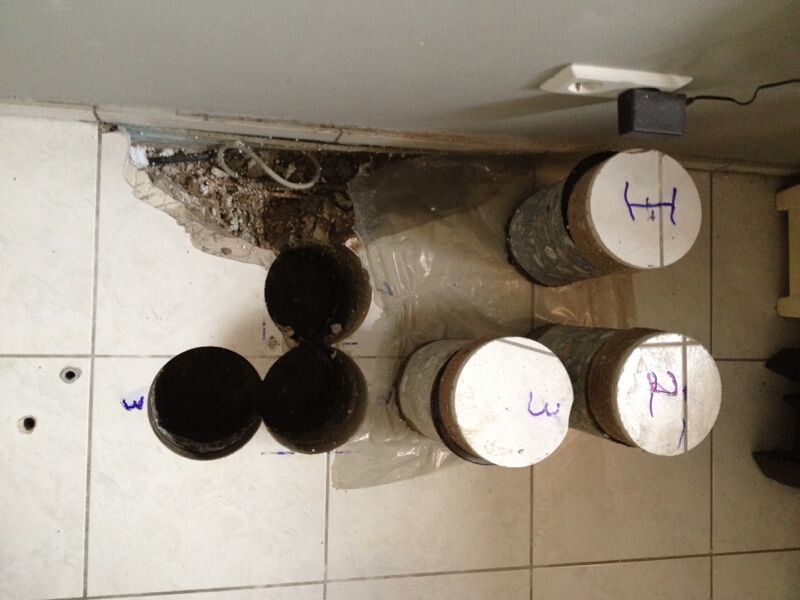
The first drilling was done too close to the wall, which caused a short circuit, and the power went out here for a few hours until the emergency electrician arrived. That’s why there is the elongated hole; they had to repair the cable and chip open even more.
Similar topics