
ᐅ Floor plan for a narrow semi-detached house – basement plus two full floors, attic without knee wall
Created on: 26 May 2021 11:30
M
mrtnsbr
Hello everyone, I’ve been reading here for a long time, and we have been searching for a suitable house/plot in the Stuttgart area for years. Now, it’s about to happen.
- It will be a semi-detached house, and the external shape and the exterior wall thickness are practically fixed. Inside, I can change almost anything.
- The furniture shown in the plans is mainly for layout purposes (but corresponds to our current furniture).
- The kitchen was quickly planned in about 5 minutes – it might be completely different later.
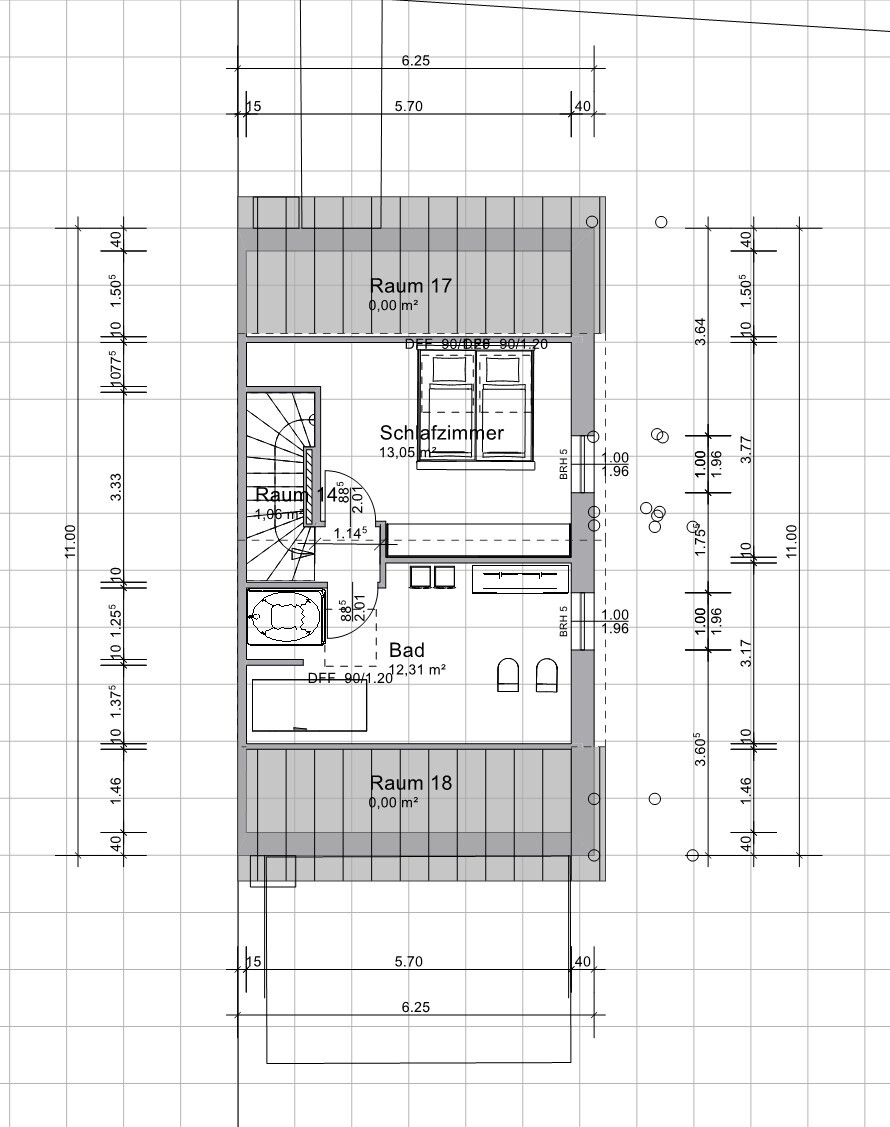
- The attic (parents’ bedroom and bathroom) is a work in progress. If anyone has tips on how to nicely fit the bathroom there, I’d appreciate it. I’m currently struggling especially with the planning of the soil pipes.
- In the attic -> The walls are exactly at 1m (3 feet 3 inches) height. The wall in the bathroom, which stands oddly next to the shower, is at the 2m (6 feet 7 inches) line.
- We plan to install glass doors in several places – otherwise, the stairwell would be very dark.
- Photovoltaic panels are planned on the south side -> only a few roof windows are desired.
A few questions:
- The stairs from the ground floor to the first floor -> quarter turn. Otherwise, half-turn stairs. Has anyone used this and would advise against it, or is this fine?
- I just had the idea to build the staircase with masonry on both sides. The niche in the stairwell (U-shaped) would then be used as a service shaft (e.g., for underfloor heating). Is this possible? Does anyone do this? Basically, a drywall tunnel from the basement to the attic (with suitable fastening at each floor slab – of course, I can’t stack drywall over 4 floors without support).
Building Regulations / Restrictions
Plot size: 320 sqm (3445 sqft)
Slope: no
Plot ratio / floor area ratio / building envelope, building line and boundary: exactly specified. The house is positioned exactly within the building envelope according to the zoning plan. The external dimensions cannot be adjusted.
Adjacent buildings: west - semi-detached neighbor, south - access road, north - cul-de-sac, east - municipal green area
Parking spaces: we have one car and about 8 bicycles – a double garage is possible and planned, mainly to be used as a bike workshop.
Number of floors – attic without knee walls, dormers not possible
Roof type – gable, 35 degrees (no alternatives allowed)
Style – rather modern / standard
Orientation – fixed
Maximum height/limits – fixed due to semi-detached design
Owners’ Requirements
Number of people, ages – 4 (2 adults, 2 elementary school children)
Space requirements on ground floor and upper floors – large living area on one floor, then children’s floor, then parents’ floor
Office: family use or home office? Mainly home office, both of us work at least 50% from home (even outside of the pandemic)
Guests per year – grandparents regularly stay up to a week
Open or closed architecture – living area should be clearly separated from children’s floor
Traditional or modern construction – good question, I think we are rather traditional
Open kitchen, kitchen island – open to closed; currently open in the plan
Number of dining seats – 6
Fireplace – would be nice but absolutely a nice-to-have. Space will likely be too tight.
Balcony, roof terrace – no
Garage, carport – planned
Utility garden, greenhouse – no
House Design
Who designed the plan:
- Do-it-Yourself
What do you like most? Why?
- Separation from living room to stairs: we currently find the open design annoying every evening – because of the kids.
- The pantry (as small as it is).
- The stairs to the basement: we all cycle a lot, including in muddy conditions. Access via the basement and an extra shower there is great.
- Parents' bedroom in the attic is on the north side (a bit cooler and away from the street).
What do you dislike? Why?
- The side with the basement stairs and light wells is useful, but it’s not very nice with the railing and so on.
Price estimate according to the architect/planner: 850,000
Personal price limit for the house, including equipment: not quite sure yet.
Preferred heating system: heat pump. We would possibly like a ventilation system, but the general contractor is reluctant, and I don’t trust their planning. I lack enough knowledge myself.
If you have to give up something, on which details/additions?
- can give up: open kitchen
- cannot give up: closed living room
Why has the design ended up like it is now? For example:
There is a standard semi-detached house plan for narrow houses, with half-turn stairs on every floor, narrow kitchen next to the main entrance.
This is what I planned with a tool. We already live in a similar floor plan (terraced house) but with one floor less. So at least I knew what I don’t want anymore (everything open via the stairwell).
What is the most important/fundamental question about the floor plan in 130 characters?
Is there any obvious nonsense that should not be done like this?
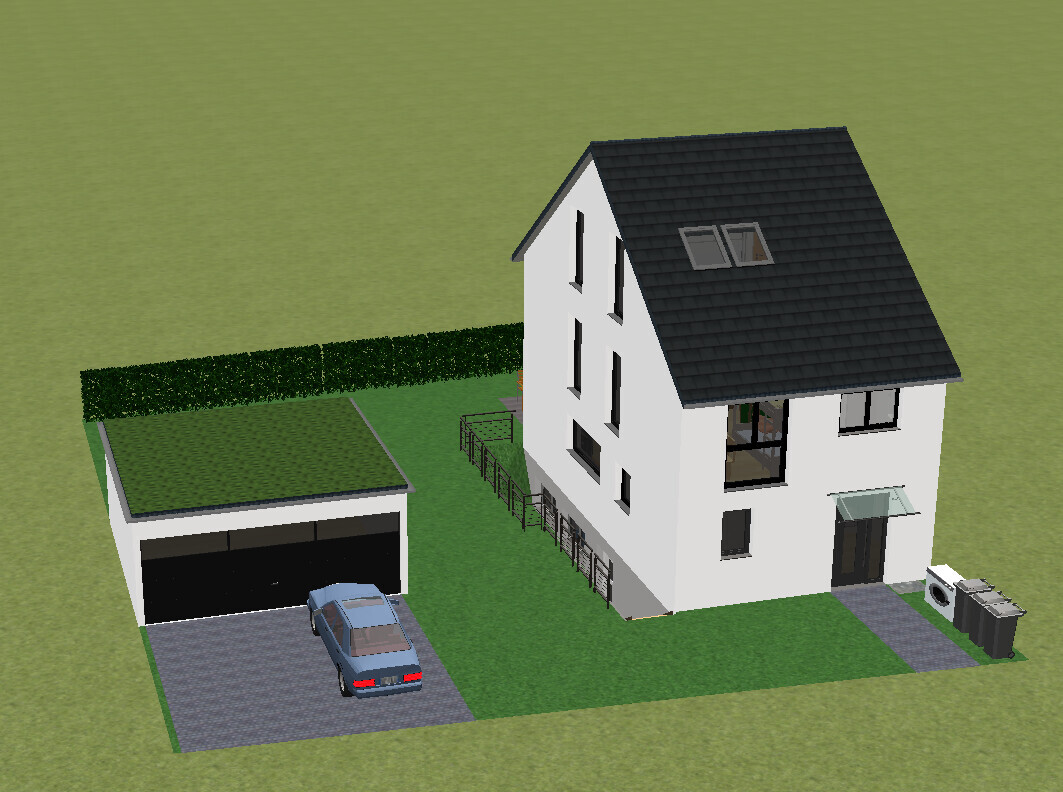
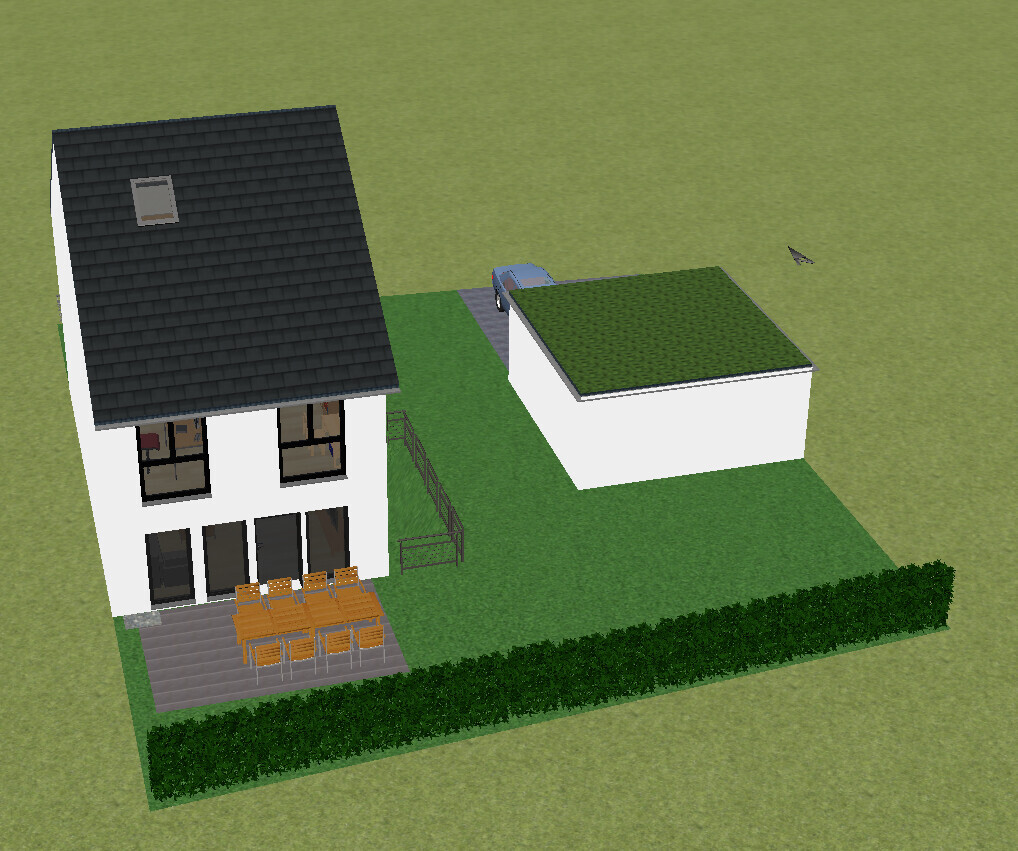
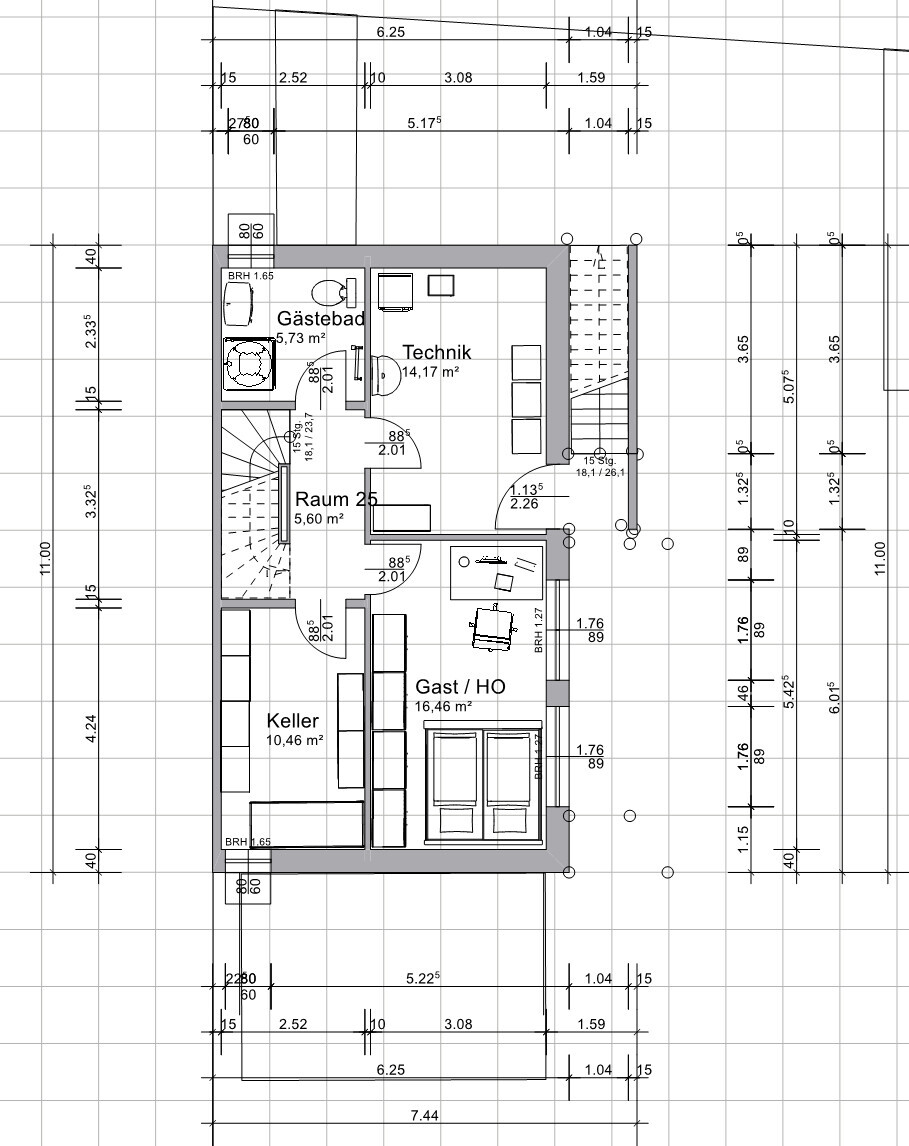
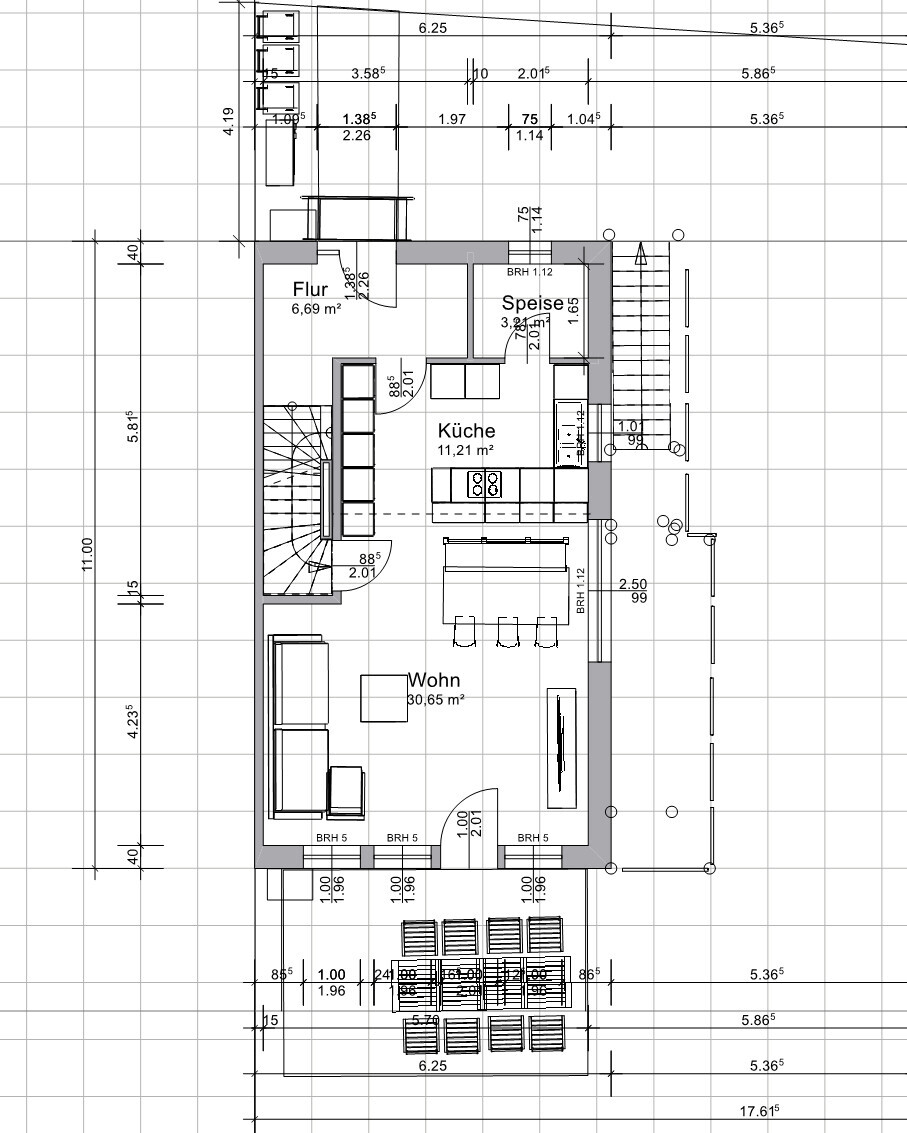
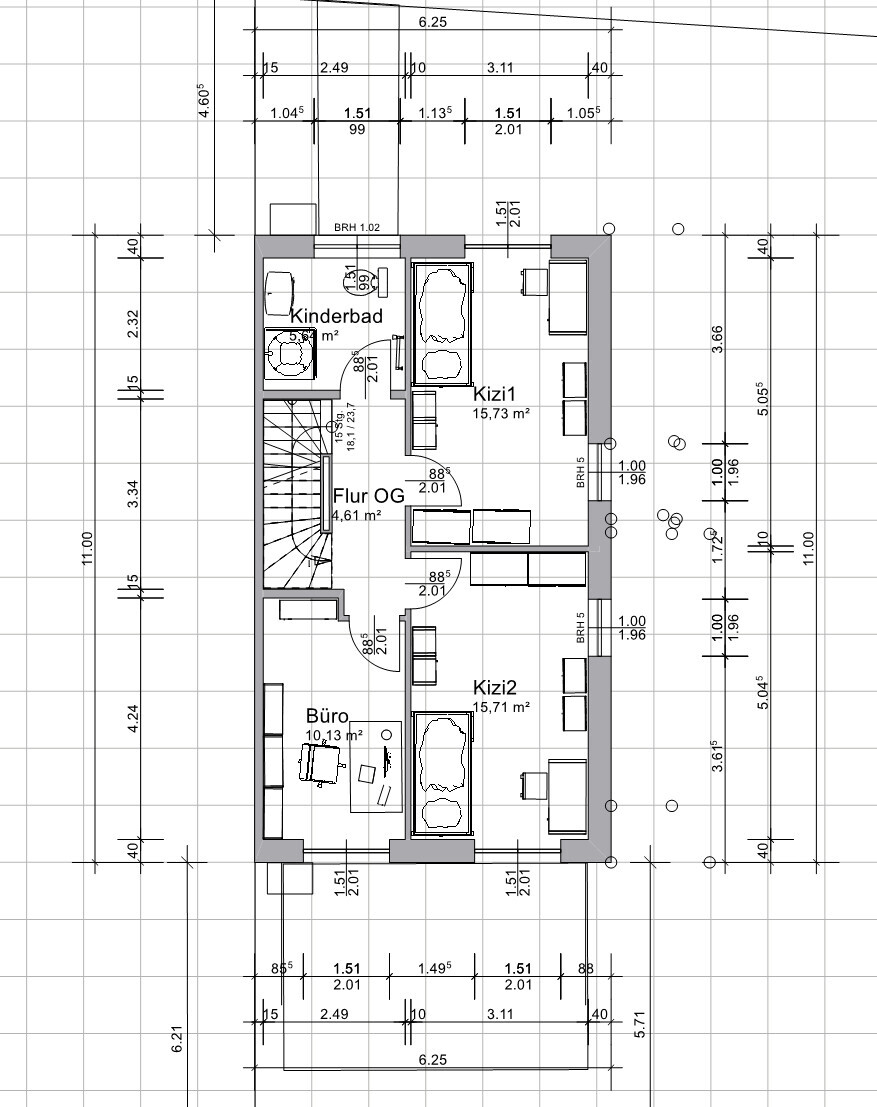
- It will be a semi-detached house, and the external shape and the exterior wall thickness are practically fixed. Inside, I can change almost anything.
- The furniture shown in the plans is mainly for layout purposes (but corresponds to our current furniture).
- The kitchen was quickly planned in about 5 minutes – it might be completely different later.
- The attic (parents’ bedroom and bathroom) is a work in progress. If anyone has tips on how to nicely fit the bathroom there, I’d appreciate it. I’m currently struggling especially with the planning of the soil pipes.
- In the attic -> The walls are exactly at 1m (3 feet 3 inches) height. The wall in the bathroom, which stands oddly next to the shower, is at the 2m (6 feet 7 inches) line.
- We plan to install glass doors in several places – otherwise, the stairwell would be very dark.
- Photovoltaic panels are planned on the south side -> only a few roof windows are desired.
A few questions:
- The stairs from the ground floor to the first floor -> quarter turn. Otherwise, half-turn stairs. Has anyone used this and would advise against it, or is this fine?
- I just had the idea to build the staircase with masonry on both sides. The niche in the stairwell (U-shaped) would then be used as a service shaft (e.g., for underfloor heating). Is this possible? Does anyone do this? Basically, a drywall tunnel from the basement to the attic (with suitable fastening at each floor slab – of course, I can’t stack drywall over 4 floors without support).
Building Regulations / Restrictions
Plot size: 320 sqm (3445 sqft)
Slope: no
Plot ratio / floor area ratio / building envelope, building line and boundary: exactly specified. The house is positioned exactly within the building envelope according to the zoning plan. The external dimensions cannot be adjusted.
Adjacent buildings: west - semi-detached neighbor, south - access road, north - cul-de-sac, east - municipal green area
Parking spaces: we have one car and about 8 bicycles – a double garage is possible and planned, mainly to be used as a bike workshop.
Number of floors – attic without knee walls, dormers not possible
Roof type – gable, 35 degrees (no alternatives allowed)
Style – rather modern / standard
Orientation – fixed
Maximum height/limits – fixed due to semi-detached design
Owners’ Requirements
Number of people, ages – 4 (2 adults, 2 elementary school children)
Space requirements on ground floor and upper floors – large living area on one floor, then children’s floor, then parents’ floor
Office: family use or home office? Mainly home office, both of us work at least 50% from home (even outside of the pandemic)
Guests per year – grandparents regularly stay up to a week
Open or closed architecture – living area should be clearly separated from children’s floor
Traditional or modern construction – good question, I think we are rather traditional
Open kitchen, kitchen island – open to closed; currently open in the plan
Number of dining seats – 6
Fireplace – would be nice but absolutely a nice-to-have. Space will likely be too tight.
Balcony, roof terrace – no
Garage, carport – planned
Utility garden, greenhouse – no
House Design
Who designed the plan:
- Do-it-Yourself
What do you like most? Why?
- Separation from living room to stairs: we currently find the open design annoying every evening – because of the kids.
- The pantry (as small as it is).
- The stairs to the basement: we all cycle a lot, including in muddy conditions. Access via the basement and an extra shower there is great.
- Parents' bedroom in the attic is on the north side (a bit cooler and away from the street).
What do you dislike? Why?
- The side with the basement stairs and light wells is useful, but it’s not very nice with the railing and so on.
Price estimate according to the architect/planner: 850,000
Personal price limit for the house, including equipment: not quite sure yet.
Preferred heating system: heat pump. We would possibly like a ventilation system, but the general contractor is reluctant, and I don’t trust their planning. I lack enough knowledge myself.
If you have to give up something, on which details/additions?
- can give up: open kitchen
- cannot give up: closed living room
Why has the design ended up like it is now? For example:
There is a standard semi-detached house plan for narrow houses, with half-turn stairs on every floor, narrow kitchen next to the main entrance.
This is what I planned with a tool. We already live in a similar floor plan (terraced house) but with one floor less. So at least I knew what I don’t want anymore (everything open via the stairwell).
What is the most important/fundamental question about the floor plan in 130 characters?
Is there any obvious nonsense that should not be done like this?
Scout schrieb:
Regarding the building envelope and such:
Often, exceptions are allowed for secondary components like stairs (which I guess is already the case for the exterior staircase, right?), as well as for conservatories and bay windows. This way, you could extend your dining room with a bay window, but in exchange, the window directly above in the basement office would have to be omitted. Okaaay... that would be seriously cool. I’ll take this to the architect! Thanks for the tip!
M
Myrna_Loy26 May 2021 13:31You’re just one knee surgery away from cursing the missing bathroom on the couch-sleeping floor. 😀
And here’s another idea for your dark stairwell: there is a "daylight spot" from a well-known roof window manufacturer starting with "V," a sort of light tube that can bring natural light into your stairwell.
You could also consider adding a large skylight from the bathroom on the upper floor (OG) facing the stairs and hallway.
You could also consider adding a large skylight from the bathroom on the upper floor (OG) facing the stairs and hallway.
Scout schrieb:
And another idea for your dark stairwell: there is a "daylight spot" from that well-known roof window manufacturer starting with "V," a kind of light tube that could bring natural light into your stairwell.
Maybe also a large skylight from the bathroom on the upper floor facing the stairs and hallway. Nice idea – I hadn’t heard of that before! But I’m not sure if we really need it. That’s more for when you have an attic space, isn’t it? In our case (according to the current plan), the roof is fully converted. I actually wanted to include a window above the stairs, but was advised against it because it would be roughly 5 to 6 meters (16 to 20 feet) above the stairs, making it very difficult and potentially dangerous to clean.
In the bathroom, I only want a roof window because that’s where the photovoltaic panels will go. The window is meant to replace, more or less, one or two modules (depending on the module size).
Currently, I’m planning it like this: a high window into the bathroom (as you described) and then a frosted glass door for the bathroom. It won’t be exactly 1000 lumens bright, but at least you can go up the stairs without needing a light on.
H
hampshire26 May 2021 14:25Some input from 18 years of living in a slice-style villa:
- Light – In the stairwell, proper lighting is sufficient; light there is purely functional. In the living areas, lighting is part of the quality of life. Consider the darker months and include more side windows – even if they are just additional light strips. Also think about shading for the summer.
- Daily life with children – Happy children run in and out to play, often not handling the things they carry with the greatest care. Items left in the wrong place mean dirt. The main reasons for running “in and out” are: “I want to tell you something/ask you something,” “I want something to drink/eat,” or “I need the bathroom.” From this practical perspective, it makes sense to place the supervising adult, bathroom, and kitchen close together to limit the uncontrolled transfer of items to as small an area of the house as possible. Therefore: put the toilet on the ground floor (you probably have a great partner, so listen to them… 😉)
- Retreat space – visually, we liked the open stairwell that led into the dining area. However, noise from the table and living room spread extensively through the house, and the need for a quiet retreat turned out to be a significant limitation for three of the four to five residents (I didn’t mind, guests and exchange students have to take what they get). In the end, we preferred to have the staircase closed off from the hallway.
- Living in the garden – Don’t limit yourself to having just one terrace to sit on. Depending on the location, a spot in front of the house can be a blessing for playing children, supervising parents, chatting with people without inviting them inside, and exchanging with neighbors. A place for socializing with or without food or a barbecue is great. For this spot, practical proximity to food preparation and privacy count. However, this place doesn’t necessarily have to be where you sunbathe and read a book. Separating the functions of outdoor spaces (as you do inside the house) offers freedom for outdoor design and makes planning a “terrace” easier.
- Daily life with teenagers – We were so glad to have a separate bathroom and a separate floor under the roof! I like that.
I find the option without a guest bathroom quite feasible.
I think taking the stairs down to the basement is perfectly reasonable, and with more space and the shower facility, it actually adds real value to the basement. Always arguing with a knee injury is, in my opinion, pointless—if that’s the case, there are usually more issues than just the toilet.
You can also access the basement directly from the garden, which children can easily get used to.
I would plan the door from the hallway to the kitchen as a sliding door. It will mostly be left open, but you can close it when you want quiet upstairs or downstairs.
Overall, I like the design considering the external conditions.
I think taking the stairs down to the basement is perfectly reasonable, and with more space and the shower facility, it actually adds real value to the basement. Always arguing with a knee injury is, in my opinion, pointless—if that’s the case, there are usually more issues than just the toilet.
You can also access the basement directly from the garden, which children can easily get used to.
I would plan the door from the hallway to the kitchen as a sliding door. It will mostly be left open, but you can close it when you want quiet upstairs or downstairs.
Overall, I like the design considering the external conditions.
Similar topics