
ᐅ Mechanical Ventilation with Heat Recovery – Planning the Locations for Supply and Exhaust Air
Created on: 5 May 2021 02:01
M
mwinkelm
Hello everyone,
The planning for our semi-detached house is becoming more concrete. Now we need to determine the positions of the outlets for the central mechanical ventilation system with heat recovery.
I have read quite a bit on the topic and tried to consider the usual best practices. However, it is quite overwhelming at first and leaves some uncertainty. That’s why I would appreciate it if you could take a look based on your experience.
In general, everything is initially planned as ceiling outlets. However, the concept of displacement ventilation also makes sense to me, so wall outlets near the floor for the supply air could also be considered. What are your thoughts on this?
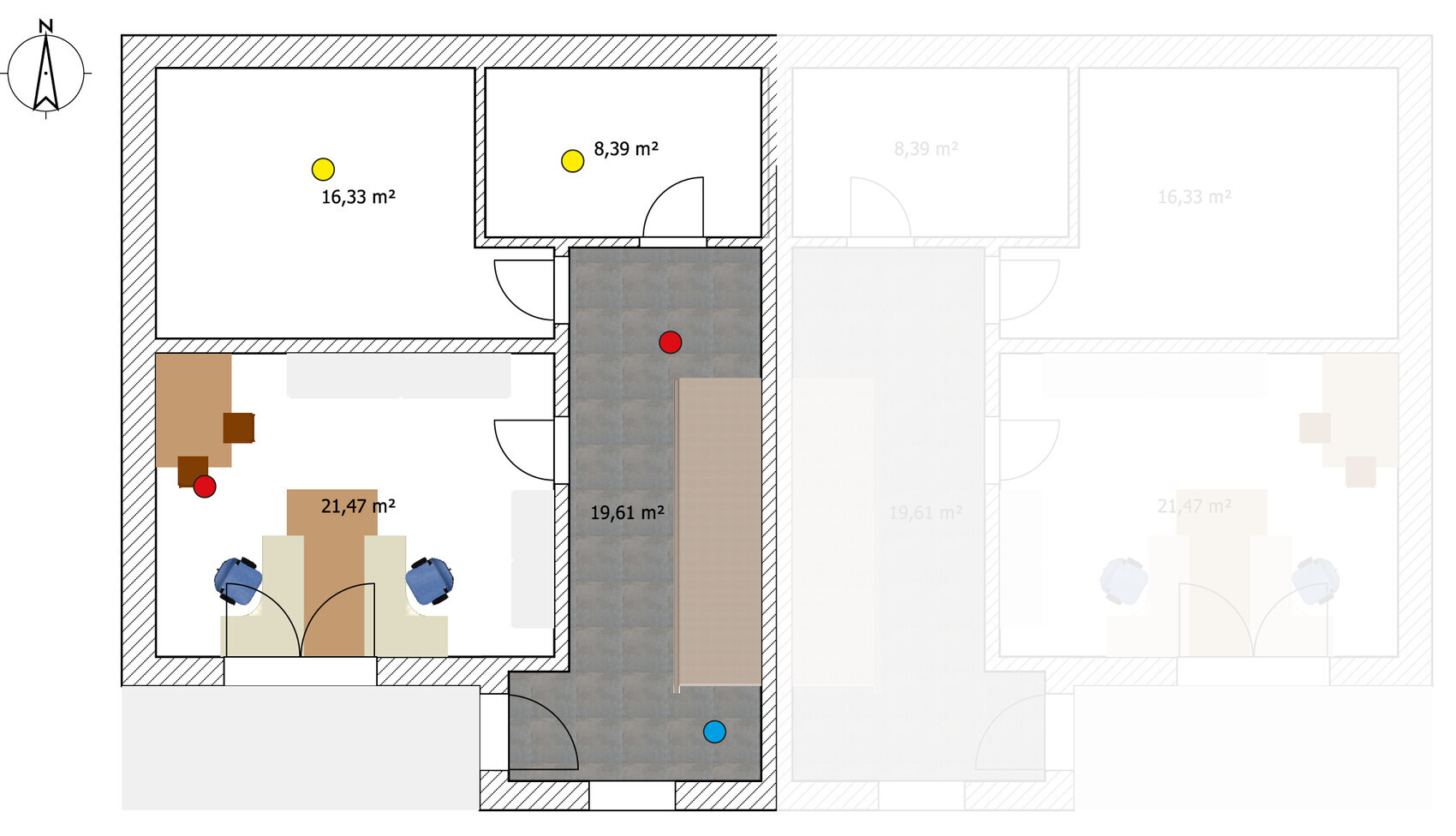
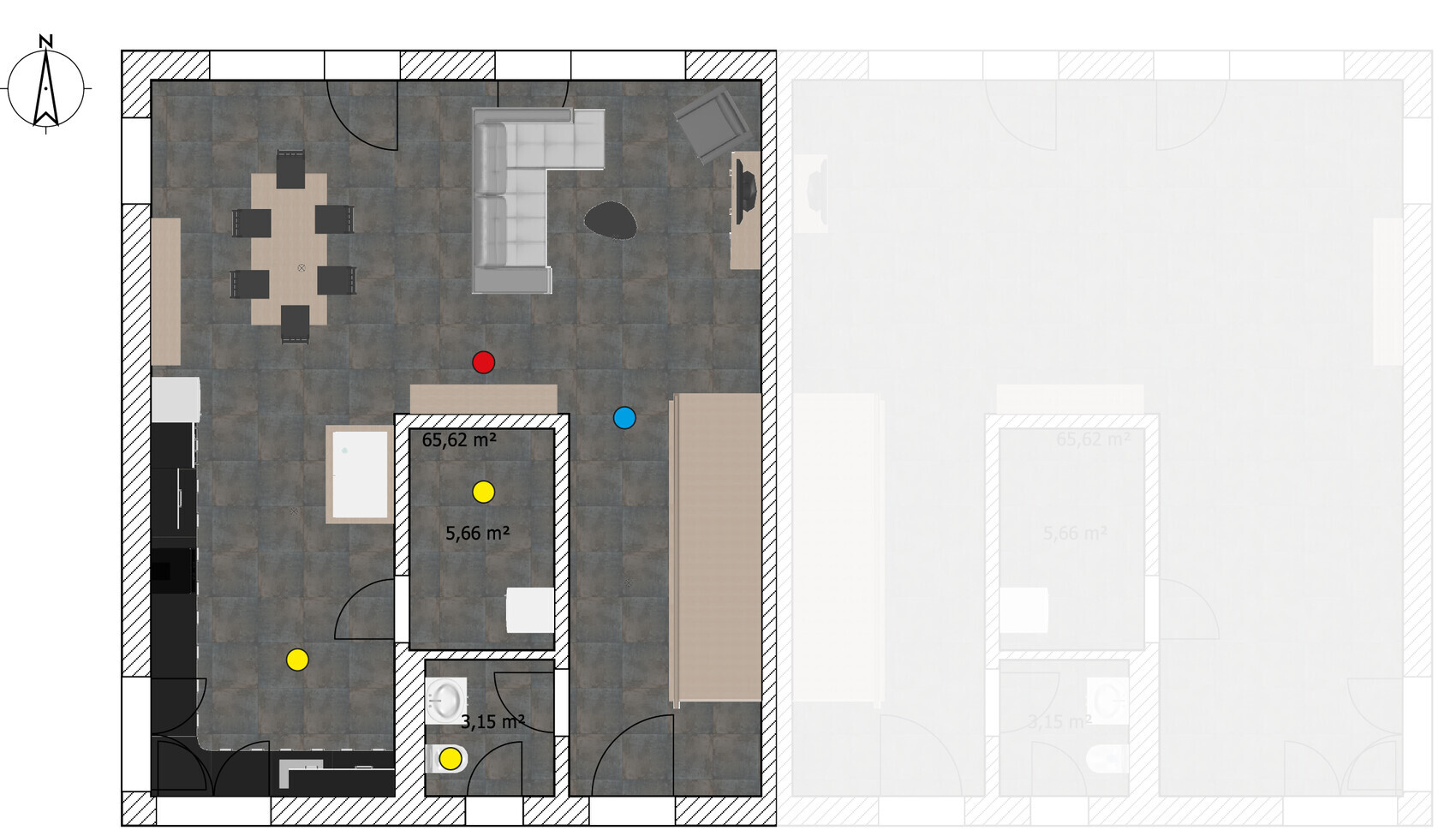
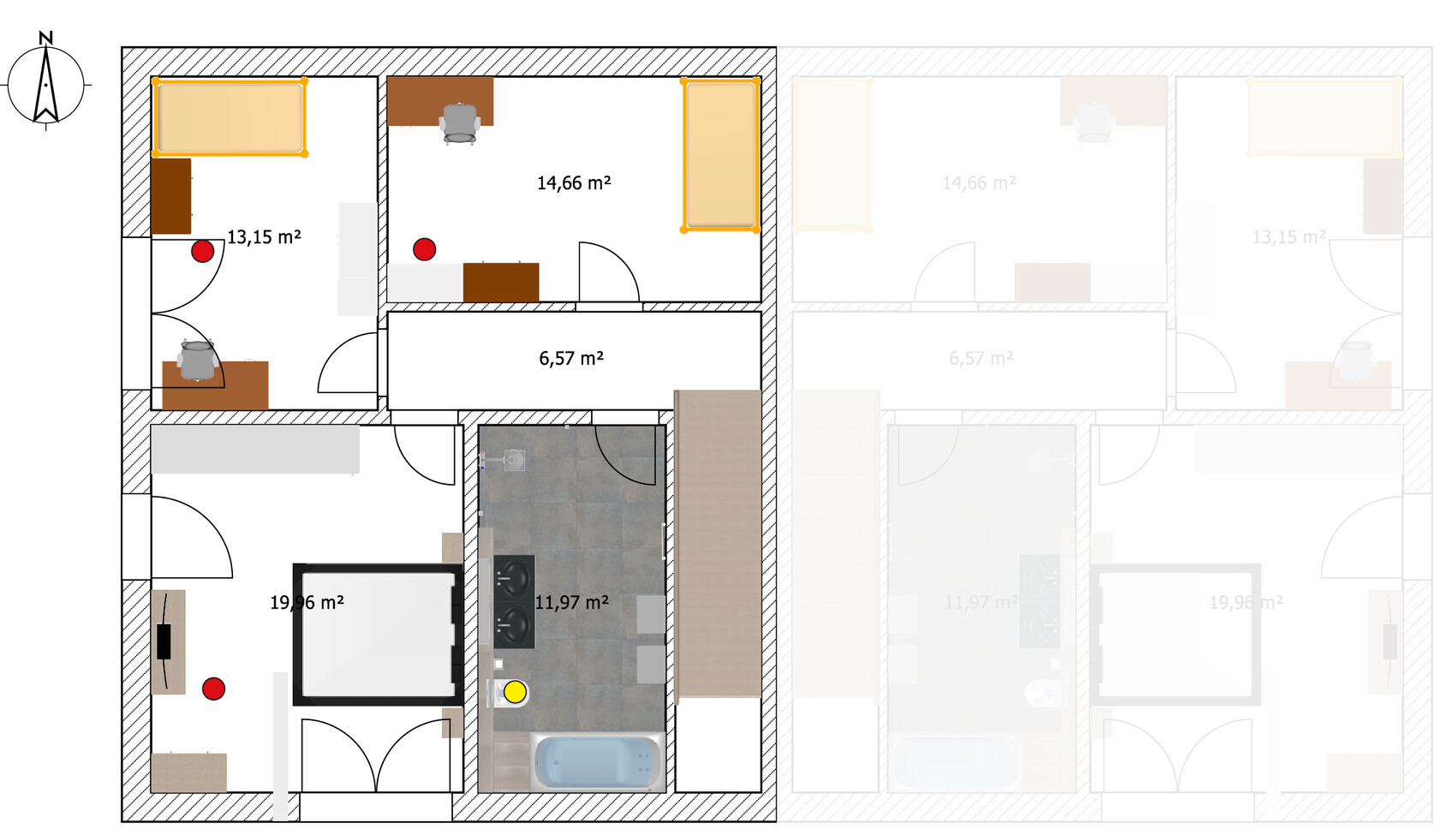
Yellow dots = Extract air
Red dots = Supply air
Blue dots = Alternative supply air (as a possible alternative position for the same room instead of the red dot)
Ground floor:
Upper floor:
Attic floor:
Thank you very much in advance!
Markus
The planning for our semi-detached house is becoming more concrete. Now we need to determine the positions of the outlets for the central mechanical ventilation system with heat recovery.
I have read quite a bit on the topic and tried to consider the usual best practices. However, it is quite overwhelming at first and leaves some uncertainty. That’s why I would appreciate it if you could take a look based on your experience.
In general, everything is initially planned as ceiling outlets. However, the concept of displacement ventilation also makes sense to me, so wall outlets near the floor for the supply air could also be considered. What are your thoughts on this?
Yellow dots = Extract air
Red dots = Supply air
Blue dots = Alternative supply air (as a possible alternative position for the same room instead of the red dot)
Ground floor:
- The additional table indicated in the office will ultimately not be placed there.
- I am unsure whether the supply air in the hallway should preferably be near the front door or not.
Upper floor:
- The alternative supply air position is meant to better cover the hallway area. Or is this not relevant, and is it more important that air is supplied directly into the dining/living area?
- Would it be better to have two outlets in the large living and dining area to minimize noise?
Attic floor:
- The children’s rooms are a bit of a headache because it is very difficult to predict exactly how the furniture will be arranged at this stage.
- In the slightly larger children’s room, I’m also not certain about the door position yet. It might be placed all the way to the left (opposite the bedroom door). In that case, the supply air would need to be located elsewhere.
Thank you very much in advance!
Markus
AxelH. schrieb:
The manufacturer of our system has specified exact minimum clearances here to prevent feedback.Unfortunately, I can’t find any information about this from Vallox, not even in the user manual or installation guide for the currently planned Vallox ValloPlus 270 MV system.
The only thing that comes to mind now is: What about the noise level of the exhaust air on a terrace about 3 meters (10 feet) high? Would you hear anything at all? Or would it already need to be very quiet outside? (For your information: Installing silencers is definitely planned)

mwinkelm schrieb:
So in our case, the following alternative to the combined vent (red/yellow on the west side) should be possible without significant extra effort. That looks reasonable. I would definitely prefer this option over the combined vent. As for the noise, I wouldn’t worry at all with the usual pipe diameters of these fittings. Most likely, you would only be able to hear anything during complete calm conditions at night. Have you already received any information about the nominal air exchange rate?

mwinkelm schrieb:
The only thing that comes to mind now is: What about the noise level from the exhaust air at the terrace at a height of about 3 meters (10 feet)? Can you hear anything at all there?Our exhaust air runs from the technical room in the basement through a light well to the outside. And you can hear it quite clearly within a few meters (yards) of the air outlet. However, it's not the airflow itself that you hear, but the device operating directly behind it. The duct length between the mechanical ventilation system with heat recovery and the air outlet is less than 1 meter (3 feet).AxelH. schrieb:
Our exhaust air goes from the technical room in the basement through a light well to the outside. We could do that too, since we also have a light well on the west side, but it doesn’t seem practical to me. As you yourself confirm, this opens a path for noise from the technical room to escape outside.
K1300S schrieb:
Have you already received any information about the nominal air change rate? I have values for the air flow rates and know the room sizes. So I did some calculations:
Basic formula: Air change rate = airflow in m³/h / room volume in m³ (assuming 2.5m (8 feet) ceiling height)
| Floor | Room | Size in m² (sq ft) | Type | Airflow (planned) m³/h | Air change rate | Conclusion |
| Basement | Entrance/Hallway | 14 | Supply air | 20 | 0.57 | Barely acceptable, but does it make sense? Better to place capacity in the office! |
| Basement | Office | 21 | Supply air | 20 | 0.38 | Too low |
| Basement | Technical room/Laundry | 16.36 | Exhaust air | 20 | ||
| Basement | Storage room | 8.12 | Exhaust air | 20 | ||
| Ground floor | Kitchen | 16.17 | Exhaust air | 40 | ||
| Ground floor | Living/Dining | 35.4 | Supply air | 40 | 0.45 | Too low |
| Ground floor | Pantry | 5.14 | Exhaust air | 20 | ||
| Ground floor | WC | 3.44 | Exhaust air | 20 | ||
| Upper floor | Child 1 | 11.57 | Supply air | 20 | 0.69 | Rather too low |
| Upper floor | Child 2 | 12.11 | Supply air | 20 | 0.66 | Rather too low |
| Upper floor | Bedroom | 19 | Supply air | 40 | 0.84 | OK |
| Upper floor | Bathroom | 10.38 | Exhaust air | 40 | ||
| 172.69 | 320 |
I also entered the building data into Vallox’s planning tool and got different values (30/60 instead of 20/40). To me, this overall suggests a slight under-sizing, right? Helios’s tool gives similar results. I suspect the planner just entered the data into the tool and somehow came up with the lower numbers. However, I would expect a bit more because designing and sizing a mechanical ventilation system is an individual process and shouldn’t be based solely on average values. As a rough guide, it’s probably okay, but in my opinion, a specialized planner should go beyond that and provide advice.
What do you think of my assessment? Any major mistakes in the formula?
I’m looking forward to the second round with him.
mwinkelm schrieb:
That could also be done here since we have a light well on the west side as well, but it doesn’t seem practical to me. Because, as you yourself confirm, this allows sound from the technical room to escape outside.That’s true, but it’s completely unproblematic for us since everything is located on the seldom-used north side of the garden. And as mentioned, you can hear the mechanical ventilation at the air outlet, but compared to the noise generated by some air-to-water heat pumps installed outdoors, it’s negligible.Similar topics