
ᐅ Mechanical Ventilation with Heat Recovery – Planning the Locations for Supply and Exhaust Air
Created on: 5 May 2021 02:01
M
mwinkelm
Hello everyone,
The planning for our semi-detached house is becoming more concrete. Now we need to determine the positions of the outlets for the central mechanical ventilation system with heat recovery.
I have read quite a bit on the topic and tried to consider the usual best practices. However, it is quite overwhelming at first and leaves some uncertainty. That’s why I would appreciate it if you could take a look based on your experience.
In general, everything is initially planned as ceiling outlets. However, the concept of displacement ventilation also makes sense to me, so wall outlets near the floor for the supply air could also be considered. What are your thoughts on this?
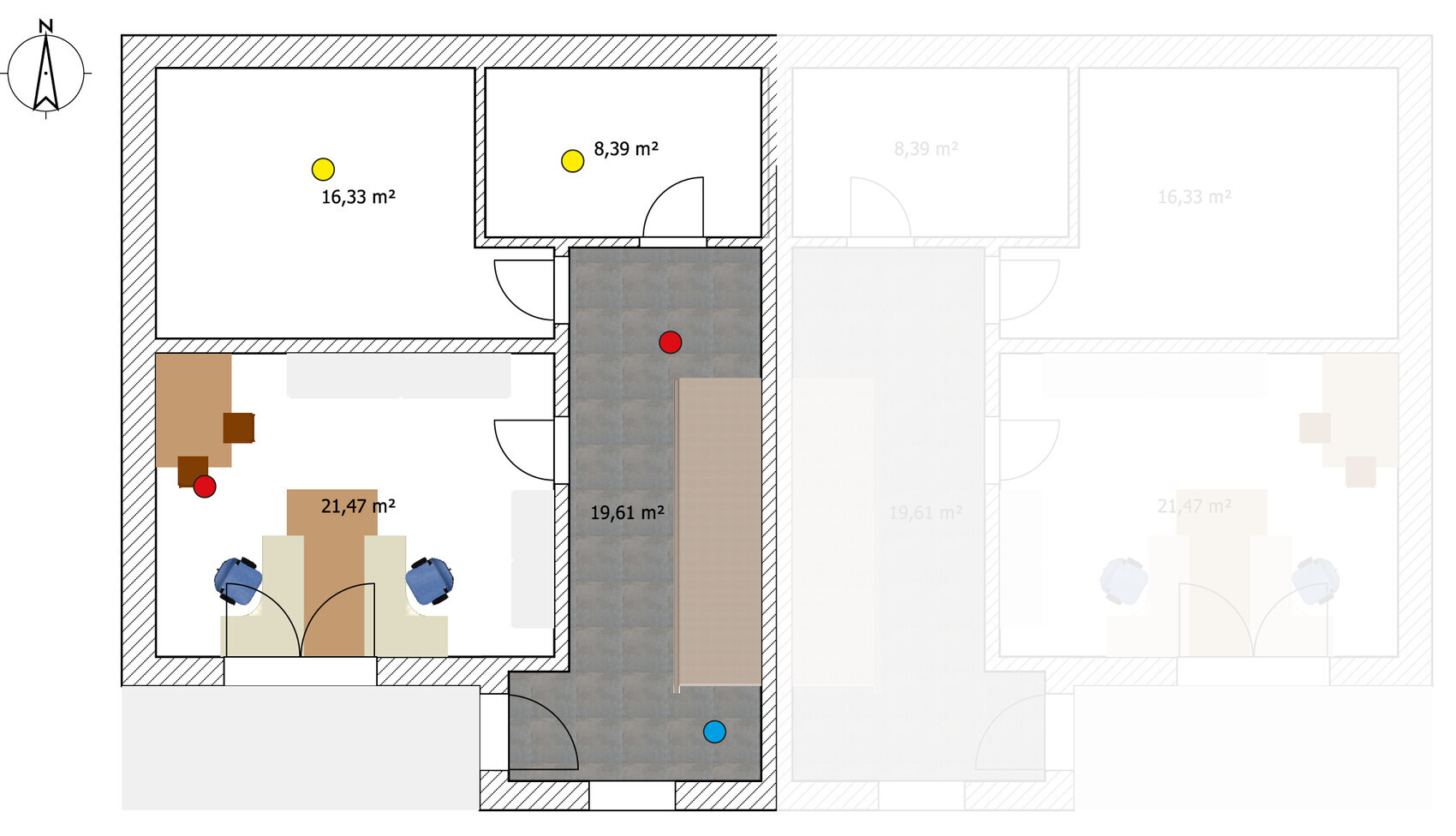
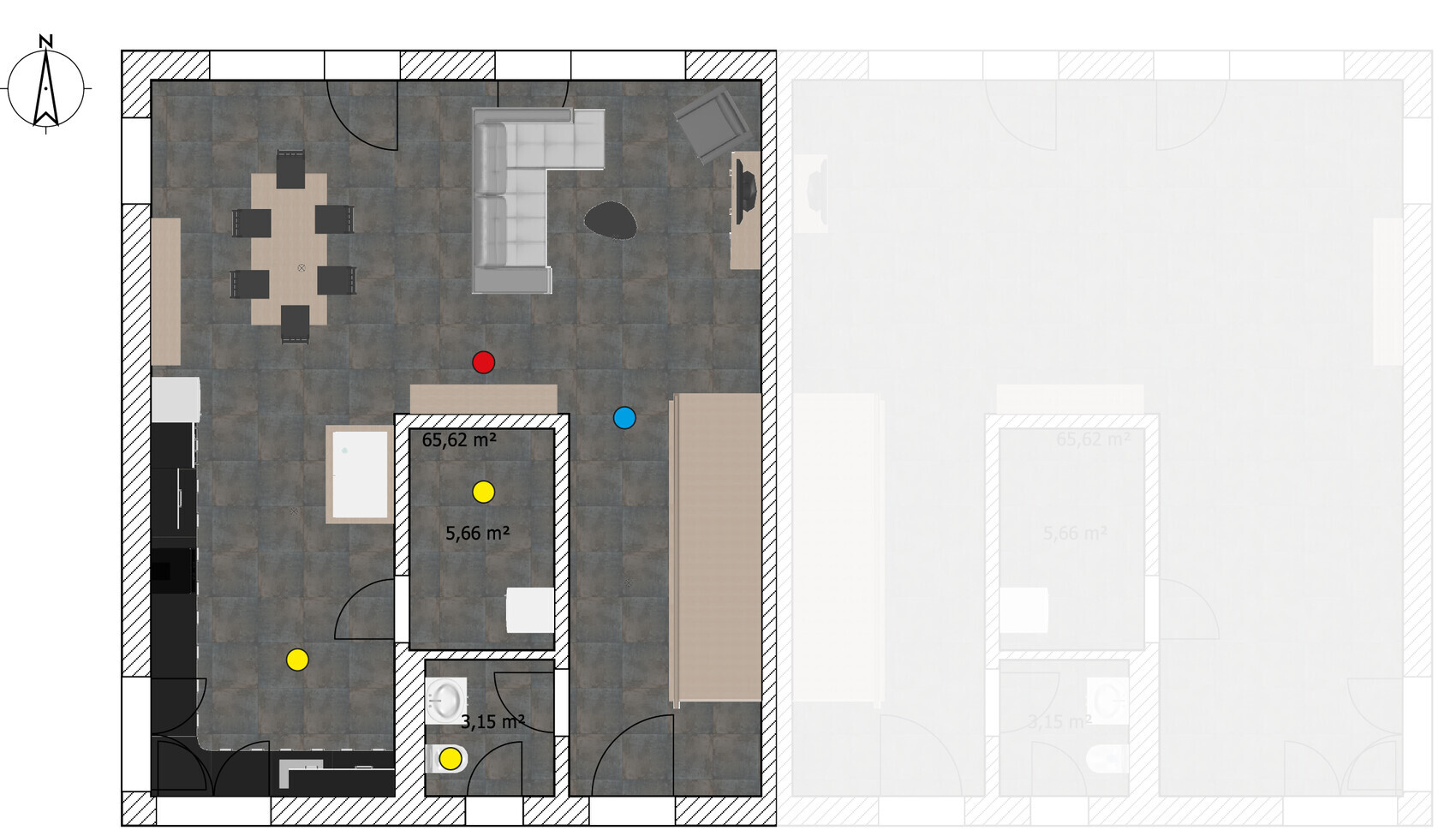
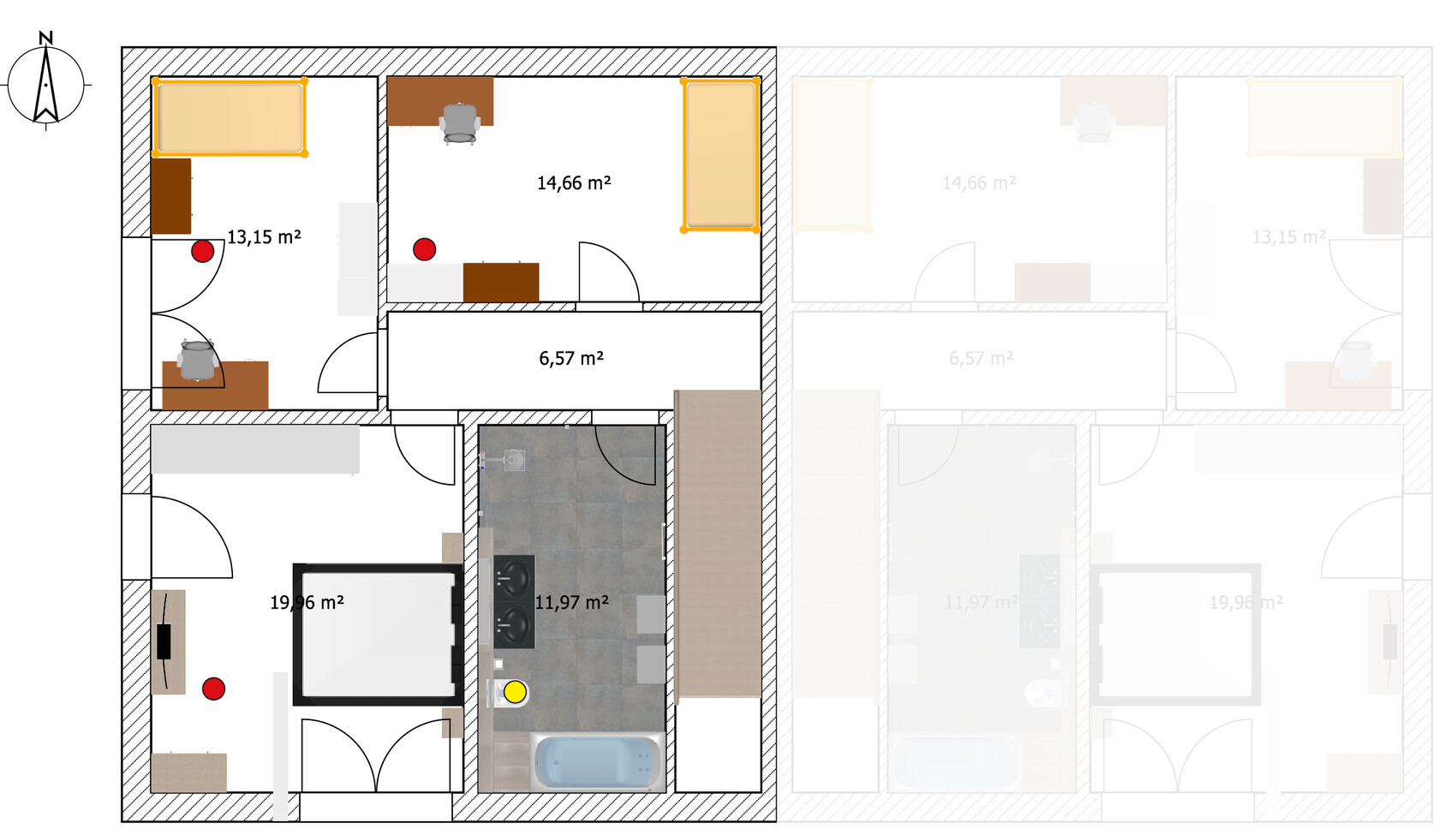
Yellow dots = Extract air
Red dots = Supply air
Blue dots = Alternative supply air (as a possible alternative position for the same room instead of the red dot)
Ground floor:
Upper floor:
Attic floor:
Thank you very much in advance!
Markus
The planning for our semi-detached house is becoming more concrete. Now we need to determine the positions of the outlets for the central mechanical ventilation system with heat recovery.
I have read quite a bit on the topic and tried to consider the usual best practices. However, it is quite overwhelming at first and leaves some uncertainty. That’s why I would appreciate it if you could take a look based on your experience.
In general, everything is initially planned as ceiling outlets. However, the concept of displacement ventilation also makes sense to me, so wall outlets near the floor for the supply air could also be considered. What are your thoughts on this?
Yellow dots = Extract air
Red dots = Supply air
Blue dots = Alternative supply air (as a possible alternative position for the same room instead of the red dot)
Ground floor:
- The additional table indicated in the office will ultimately not be placed there.
- I am unsure whether the supply air in the hallway should preferably be near the front door or not.
Upper floor:
- The alternative supply air position is meant to better cover the hallway area. Or is this not relevant, and is it more important that air is supplied directly into the dining/living area?
- Would it be better to have two outlets in the large living and dining area to minimize noise?
Attic floor:
- The children’s rooms are a bit of a headache because it is very difficult to predict exactly how the furniture will be arranged at this stage.
- In the slightly larger children’s room, I’m also not certain about the door position yet. It might be placed all the way to the left (opposite the bedroom door). In that case, the supply air would need to be located elsewhere.
Thank you very much in advance!
Markus

K1300S schrieb:
Definitely. It’s just that as a builder, you sometimes have plans that contradict the proposal (from the manufacturer or installer), so these should be adjusted accordingly. But I would always start with a “technical” proposal. We did the same.
At first, everything sounded perfect and understandable from a technical perspective, especially regarding airflow, but in the end, adjustments were necessary because the placement directly above the bed or couch wasn’t suitable...
Regarding the “technical planning,” I would novice-ly argue that often there isn’t much behind it.
Most planners follow 1-2 basic rules and place the supply/exhaust air elements “randomly” in the corners, just to ensure proper airflow.
Even when it comes to distances from walls, you hear many differing opinions from specialists. Some place the elements 20 cm (8 inches) from the wall without any problem, others claim at least 50 cm (20 inches) is necessary, and others even suggest 1.0 to 1.5 m (3.3 to 5 feet)...
Well. As for airflow, I recommend entering the title of a research report into a search engine and skimming through the summary:
“Air movements in freely ventilated living spaces”
I believe this puts some of the stubborn statements from forums and certain “specialist planners” into perspective.
netuser schrieb:
Well, strictly speaking, the ceiling outlets also need to be coordinated with the furniture layout.
Distances from tall cabinets, not being directly above areas where people sit or stand, and so on should be considered. Exactly, and I think these are two important rules regarding the positioning of ceiling vents.
netuser schrieb:
So everything has pros and cons! I agree. For me, a ceiling vent is the least noticeable since I rarely look up. Also, in terms of positioning, ceiling vents seem easier to me compared to wall or floor vents. For floor-to-ceiling windows, a floor vent in front of the window is of course optimal since furniture is unlikely to be placed there. But for us, for example, a child’s room has only roof windows, so a floor vent would be impractical there. And if you don’t use ceiling-high furniture, then a ceiling vent could possibly even be positioned above a cabinet (provided there is enough space below the vent).
netuser schrieb:
If I understood correctly, the gap for the controlled residential ventilation system is somewhat larger than usual? As an alternative to enlarging this gap, a door frame ventilation grille (on the interior doors) was suggested to us. Apart from the look, this option may have some advantages according to my initial brief research (no impact on sound insulation, no extra light through a bigger gap). I still need to read up a bit more on this.
netuser schrieb:
Regarding “technical planning,” I would say as a layperson that often there isn’t much going on behind it.
Most planners follow 1-2 basic rules and place the supply/exhaust elements “randomly” in corners as long as the airflow is adequate.
Even when it comes to wall distances, you hear many different opinions from specialists: some place the elements 20cm (8 inches) from the wall without issues, others claim at least 50cm (20 inches) is needed, and some even say 1.0 to 1.5m (3 to 5 feet)… That really resonates with me. I have read many different opinions on this too. In the end, I don’t think it makes a significant difference whether a vent is 50cm (20 inches) or 100cm (40 inches) from the wall. If I have to move it that far away in a (perhaps somewhat smaller) child’s room, it will almost inevitably end up above the play area where the child might spend extended time.
netuser schrieb:
That probably puts some of the persistent claims from forums and so-called “experts” into perspective. Interesting study, though I think it mainly applies to this specific floor plan or at least yields insights relevant to similar situations (mostly single-level apartments). Still, it’s interesting to read and might help to dispel some myths.
We recently had our discussion with the general contractor’s planner. It was as I expected. Essentially, the question was more: “How do you roughly plan to furnish your future home?” We then discussed the vent positions together. Ultimately though, I didn’t really get the feeling that the GC often plans controlled residential ventilation systems. 🙄
Much more interesting than the ceiling vents was the topic of ducting to distribute air throughout the house. We hadn’t considered that when designing the floor plan. Unfortunately, we only considered the option of controlled residential ventilation after the building permit/planning permission was already in process. Therefore, there will now be a small boxed-in section (shown in green in the images below) in the dining room and the child’s room above (under the sloped ceiling) to accommodate the larger ducts.
Tip for anyone seriously considering a controlled residential ventilation system: Keep it in mind during the floor plan design phase and try to plan the duct concealment cleverly!
Here is an update to our planning (each arrow indicates a duct at the vent location):
Ground floor/basement (sloped site)
Upper floor
I think supply air in the open living/dining area is necessary here since otherwise there would be no supply air on this level.
T_im_Norden schrieb:
Pantry has neither supply nor exhaust air. Why do you think the pantry should not have exhaust air?
Attic floor
The planner proposes, probably for simplicity, to place supply and exhaust vents on the façade at the same location and to use a combined weather protection grille. Is that okay, or are there significant disadvantages and should supply and exhaust air be completely separated? Currently, this is planned on the west side of the house, facing the neighbor. The south side faces a quiet street.
Regarding sizing the system, I will also try using the manufacturer’s tool (it is supposed to be Vallox). The planned values seem very tight to me.
Thanks to everyone!
mwinkelm schrieb:
no impact on sound insulationUnfortunately, that’s not correct. If air can pass through, sound essentially travels along as a "passenger" as well. In fact, our door supplier mentioned that for soundproof doors, it is crucial to fully foam the gap between the frame and the wall to prevent a sound bridge there. What he said about frame ventilators in this context, I’d rather not repeat here. 😉mwinkelm schrieb:
The planner wants (probably for simplicity) to place supply and exhaust air on the facade at the same spotDo you perhaps mean outdoor air supply and exhaust air? 😉 I would think carefully about that, as otherwise there might be a "short circuit." Also, even if different sides of the house are used, the typical wind direction should be considered to avoid the exhaust air being immediately drawn in as outdoor air again.T
T_im_Norden15 May 2021 08:09Two outlets per room allow the airflow velocity to be kept low while simultaneously enabling higher volumes to be supplied.
No people stay in the pantry (supply air), and no odors or CO2 should be produced there (exhaust air).
No people stay in the pantry (supply air), and no odors or CO2 should be produced there (exhaust air).
A
AllThumbs15 May 2021 11:16K1300S schrieb:
I’d rather not repeat what he said about the frame ventilators in this context. 😉 Yes, please do. What was his opinion on that? I’m actually considering pushing the trade in that direction as well.
Similar topics