
ᐅ Retrofitting Underfloor Heating: District Heating or Electric?
Created on: 6 May 2021 19:05
A
Axel900
Good evening,
we want to remove the old tiles in our kitchen (about 18m² (194 sq ft), historic building from 1900, ceiling height 3.60m (12 ft), ground floor) and install underfloor heating. At the moment, we are heating with an old small radiator connected to district heating. A roofer has already inspected the room and advised against a traditional underfloor heating system due to the installation height. Instead, he recommended installing electric heating mats to supplement our radiator. The floor will also need insulation from the basement side. We plan to install tiles again. A room temperature of 18-19°C (64-66°F) is completely sufficient for us.
What about the (ongoing) costs?
Which option is more cost-effective?
Would it also be possible to mill out the screed and lay heating pipes so that the radiator could be removed?
I am not familiar with underfloor heating and have never had one before...
I would appreciate any advice.
we want to remove the old tiles in our kitchen (about 18m² (194 sq ft), historic building from 1900, ceiling height 3.60m (12 ft), ground floor) and install underfloor heating. At the moment, we are heating with an old small radiator connected to district heating. A roofer has already inspected the room and advised against a traditional underfloor heating system due to the installation height. Instead, he recommended installing electric heating mats to supplement our radiator. The floor will also need insulation from the basement side. We plan to install tiles again. A room temperature of 18-19°C (64-66°F) is completely sufficient for us.
What about the (ongoing) costs?
Which option is more cost-effective?
Would it also be possible to mill out the screed and lay heating pipes so that the radiator could be removed?
I am not familiar with underfloor heating and have never had one before...
I would appreciate any advice.

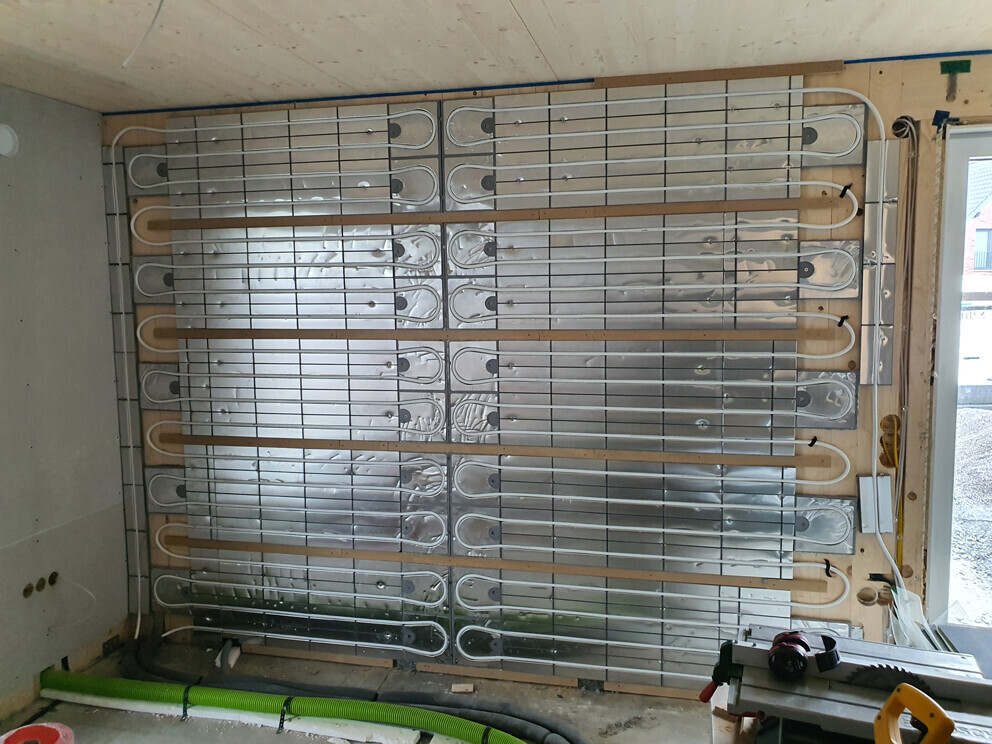
Just as an idea, here is a picture of my currently installed wall heating system. The system can also be installed on the floor. The total system height is only 2.5cm (1 inch). On top of that, dry screed (Fermacell boards) can be laid directly, plus tile, resulting in a total thickness of about 6–7cm (2.5–2.75 inches). Additionally, there is no water exposure like with cement or anhydrite screed, and the installation is completed quickly. DIY installation is also easily possible.
nordanney schrieb:
An electric underfloor heating system is probably one of the most inefficient options you can install. You can literally watch the electricity meter running.
But the tiles do get warm, that’s true. However, you don’t need additional electric underfloor heating for 18-19°C (64-66°F). That’s quite cold already. Oh, I see, we were talking past each other. I was referring to a water-based underfloor heating system. I agree with you about electric underfloor heating.
That would only be the alternative if a water-based underfloor heating system cannot be installed.
If the screed layer is thick enough, there shouldn’t be any problem installing a water-based underfloor heating system, right?
i_b_n_a_n schrieb:
Just as an idea, here is a picture of my currently installed wall heating system. The system can also be installed on the floor. The overall system height is only 2.5cm (1 inch). Dry screed panels (Fermacell boards) can be laid directly on top, plus tiles, resulting in a total build-up of about 6-7cm (2.5-2.75 inches). Additionally, there is no water exposure as with cement or anhydrite screeds, and the installation is quick. Doing it yourself is also possible with some effort.
Yes, this would roughly be the alternative to a hydronic (water-based) underfloor heating system. With an electric underfloor heating system, we would still need our radiator to warm the space, and the electric system would be used mainly to warm the tiles, since our tiles get very cold. Ideally, an electric underfloor heating system with the lowest power rating should be chosen to avoid high energy bills. However, I still prefer the water-based underfloor heating system.
N
nordanney7 May 2021 20:14Axel900 schrieb:
Oh, I see, we misunderstood each other. I was talking about the water-based underfloor heating. I agree about the electric underfloor heating.Good then ;-)The problem will only be adapting it to the district heating system. A professional has to handle that. Including floor covering, you need at least 7 cm (3 inches) including insulation (assuming the basement ceiling is also insulated). This applies whether it’s a dry screed or conventional method.
Similar topics