
ᐅ Air-to-Water Heat Pump in a KfW55 Energy Standard House / Heating Load, Standards?
Created on: 2 May 2021 23:33
C
chamäleonC
chamäleon2 May 2021 23:33Hello heating experts,
we are currently planning our heating system with the heating contractor. There has been a lot of discussion lately between the architect, energy consultant, and heating contractor, as the calculations from the heating contractor and energy consultant differed significantly. But let's start from the beginning.
The energy consultant originally calculated the heating load for our house using the simplified method (DIN EN 12831-1:2017-09 section 8) as follows:
Outdoor design temperature -16°C (3°F)
Room temperature +20°C (68°F)
Heat transfer coefficient Ht = 0.261 W/(m²K)
Heat transfer surface A = 584.8 m² (6293 ft²)
Building air change rate at design temperature nGeb = 0.50 h⁻¹
Air volume V = 745.6 m³ (26,331 ft³)
= Building heating load 10.1 kW
The heating contractor offered us a Stiebel Eltron LWZ 5 S Plus. As a layperson, I pointed out that 10 kW versus 5 kW seemed illogical and that 10.1 kW appeared quite high. The calculation was then adjusted since the outdoor design temperature for my postal code is -10°C (14°F). With all other parameters unchanged, the energy consultant now calculates a building heating load of 8.4 kW. But even here, from my non-expert perspective, 8.4 kW contrasts with the 5 kW output of the heat pump.
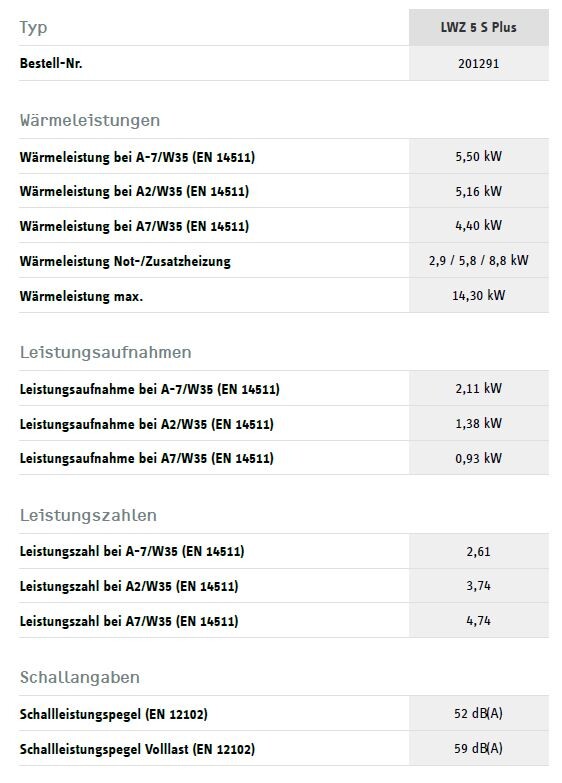
However, the product information states that the air-to-water heat pump is recommended up to 8.0 kW (see attachment).
The reason for the discrepancies seems to be that the building heating load was calculated according to DIN 12831, while the heat output of the LWZ is based on EN 14511. Therefore, everything is supposedly compatible.
The heating contractor also mentioned that in all living rooms, we will install 15 cm (6 inches) of underfloor heating, and in the bathrooms, we will push the system to its limits.
Here are a few details about our single-family house: KfW 55 standard, monolithic construction with 36.5 Poroton blocks. The ground floor plus upper floor (entirely heated) covers 171 m² (1841 ft²), with a partially heated basement. The heated basement area amounts to an additional 29.3 m² (315 ft²).
To add to the confusion, I also used a frequently quoted online heating load calculator (first Google search result for "Energy Saving Ordinance heating load estimate") and with the given parameters, I arrived at a heating load of 5.25 kW.
I am completely confused now. Three different heating loads, two standards—what should I trust?
Thank you very much for your input. I would appreciate any clarification on this.

we are currently planning our heating system with the heating contractor. There has been a lot of discussion lately between the architect, energy consultant, and heating contractor, as the calculations from the heating contractor and energy consultant differed significantly. But let's start from the beginning.
The energy consultant originally calculated the heating load for our house using the simplified method (DIN EN 12831-1:2017-09 section 8) as follows:
Outdoor design temperature -16°C (3°F)
Room temperature +20°C (68°F)
Heat transfer coefficient Ht = 0.261 W/(m²K)
Heat transfer surface A = 584.8 m² (6293 ft²)
Building air change rate at design temperature nGeb = 0.50 h⁻¹
Air volume V = 745.6 m³ (26,331 ft³)
= Building heating load 10.1 kW
The heating contractor offered us a Stiebel Eltron LWZ 5 S Plus. As a layperson, I pointed out that 10 kW versus 5 kW seemed illogical and that 10.1 kW appeared quite high. The calculation was then adjusted since the outdoor design temperature for my postal code is -10°C (14°F). With all other parameters unchanged, the energy consultant now calculates a building heating load of 8.4 kW. But even here, from my non-expert perspective, 8.4 kW contrasts with the 5 kW output of the heat pump.
However, the product information states that the air-to-water heat pump is recommended up to 8.0 kW (see attachment).
The reason for the discrepancies seems to be that the building heating load was calculated according to DIN 12831, while the heat output of the LWZ is based on EN 14511. Therefore, everything is supposedly compatible.
The heating contractor also mentioned that in all living rooms, we will install 15 cm (6 inches) of underfloor heating, and in the bathrooms, we will push the system to its limits.
Here are a few details about our single-family house: KfW 55 standard, monolithic construction with 36.5 Poroton blocks. The ground floor plus upper floor (entirely heated) covers 171 m² (1841 ft²), with a partially heated basement. The heated basement area amounts to an additional 29.3 m² (315 ft²).
To add to the confusion, I also used a frequently quoted online heating load calculator (first Google search result for "Energy Saving Ordinance heating load estimate") and with the given parameters, I arrived at a heating load of 5.25 kW.
I am completely confused now. Three different heating loads, two standards—what should I trust?
Thank you very much for your input. I would appreciate any clarification on this.
T
T_im_Norden3 May 2021 06:59Find a professional office to calculate the underfloor heating system and the heating load.
It costs a few hundred euros but is very helpful.
Set temperature requirements for individual rooms, and the supply temperatures should not exceed 30°C (86°F).
Check with the builder whether they will work based on these installation plans (there have been cases where the builder backed out because they did not agree with them).
You need a proper calculation for the underfloor heating system.
The length of each heating circuit should not exceed 100 meters (330 feet).
The heating circuit manifolds on each floor must be connected with adequately sized pipes.
If possible, install underfloor heating in bathrooms, including under the shower and bathtub areas.
Consider wall heating in the bathrooms as an option.
Do you have a mechanical ventilation system with heat recovery?
This must be taken into account in the calculation.
https://www.hausbau-forum.de/threads/lwwp-dimensionierung-im-neubau.36049/page-16
It costs a few hundred euros but is very helpful.
Set temperature requirements for individual rooms, and the supply temperatures should not exceed 30°C (86°F).
Check with the builder whether they will work based on these installation plans (there have been cases where the builder backed out because they did not agree with them).
You need a proper calculation for the underfloor heating system.
The length of each heating circuit should not exceed 100 meters (330 feet).
The heating circuit manifolds on each floor must be connected with adequately sized pipes.
If possible, install underfloor heating in bathrooms, including under the shower and bathtub areas.
Consider wall heating in the bathrooms as an option.
Do you have a mechanical ventilation system with heat recovery?
This must be taken into account in the calculation.
https://www.hausbau-forum.de/threads/lwwp-dimensionierung-im-neubau.36049/page-16
T
T_im_Norden3 May 2021 07:01Who used the wrong NAT for the calculation? The builder or the energy consultant?
C
chamäleon3 May 2021 08:50T_im_Norden schrieb:
Who used the wrong design temperature for the calculation?
The builder or the energy consultant?The energy consultant. The -10°C (14°F) is now appropriate for our postal code.I just spoke again with the builder and asked what supply temperature he calculates with, or if, for example, he can guarantee 30°C (86°F), and what pipe spacing he intends to use. The answer was no, he can’t guarantee that. Besides, he doesn’t know the house parameters ;-) and the pipe spacing is usually 15cm (6 inches) in living and bedrooms and 10cm (4 inches) in the bathroom. I then asked whether the bathroom would still reach 24°C (75°F) with a 30°C (86°F) supply temperature…
After that, the conversation suddenly moved into the right direction. Instead of general statements, it shifted to agreeing that it should be calculated. A further coordination is now taking place between the builder, energy consultant, and architect.
What I still don’t understand is what the different outputs in the product datasheet mean: 8 kW according to DIN 12831 and 5.5 kW according to DIN 14511. Would the heat pump generally be suitable (without considering efficiency) to heat the house without the electric backup heater constantly running? Can someone clarify this for me? Thanks a lot.
N
nordanney3 May 2021 08:52chamäleon schrieb:
To add to the confusion, I used the frequently cited online heat load calculator (the first Google result for "Energy Saving Ordinance heat load estimation") and with the given parameters, I arrived at a heat load of 5.25 kW. This is based on approximately 2 people and a central mechanical ventilation system with heat recovery (-10°C (14°F) outside temperature). The value fits perfectly. The results from my engineering firms (with room-by-room heat load calculations and the corresponding design of the underfloor heating) and those from the calculator you used matched almost exactly in my case.
chamäleon schrieb:
The builder also stated that they would install 15cm (6 inches) of pipe in all living areas and "go all out" in the bathrooms. That alone would be reason enough to change the builder immediately. Idiot!
Layperson’s opinion: The 5 S Plus is a good fit.
But: Do you really want to size the heating system for only 20°C (68°F)? That would be too cold for me. A professional should calculate this. Flow/return temperatures of 30/26°C (86/79°F) for 22°C (72°F) living areas and 24°C (75°F) bathrooms.
C
chamäleon3 May 2021 08:52T_im_Norden schrieb:
Do you have a mechanical ventilation system with heat recovery?
[/URL]Yes, the mechanical ventilation system includes heat recovery.
Similar topics