
ᐅ Is a Damp Proof Membrane Required Under Floating Cork Flooring?
Created on: 24 Apr 2021 21:38
H
Hausbaer
Hello,
we are having floating cork flooring installed. It is a new build, and the screed has passed the CM measurement test, so it is dry enough for installation. The floor installer is not using a PE foil as a vapor barrier, contrary to the manufacturer’s instructions. We find this a bit odd, since the installation guide clearly states that a vapor barrier is always required on mineral substrates like screeds.
The installer argues that this is not necessary for new builds, but rather for older buildings and those without basements, even though new screeds generally still contain more residual moisture.
How critical do you think this is, and should one insist on strictly following the installation instructions?
we are having floating cork flooring installed. It is a new build, and the screed has passed the CM measurement test, so it is dry enough for installation. The floor installer is not using a PE foil as a vapor barrier, contrary to the manufacturer’s instructions. We find this a bit odd, since the installation guide clearly states that a vapor barrier is always required on mineral substrates like screeds.
The installer argues that this is not necessary for new builds, but rather for older buildings and those without basements, even though new screeds generally still contain more residual moisture.
How critical do you think this is, and should one insist on strictly following the installation instructions?
i_b_n_a_n schrieb:
The DIN standards are developed by expert committees (professionals!) for a reason and are continuously, though slowly, updated to reflect current conditions. If a PE foil is required, it might serve purposes beyond what you assumed. A floating floor as you described probably won’t slide well on bare screed and could warp as a result. Also, consider why many buildings apply a bitumen membrane on top of the screed on the ground floor despite using waterproof concrete... But for questions like these, we have a moderator and flooring expert here! (KlaRa) Just send a message...Regarding the sliding/surface abrasion issue, the screed can also be smoothed with a leveling compound (at least that’s how it was done in our case).
Hello questioner.
Regarding PE film under floating floors made of wood, cork, or wood-based materials, the following applies:
The PE film is always required.
In new buildings (new screeds), usually only one moisture measurement is taken. For an area of about 120m² (1,292 sq ft), this is considered sufficient, but it is still quite limited when compared to the 100cm² (15.5 sq in) surface area required by the testing authority.
Therefore, there is always a certain residual risk accepted by current standards concerning potential variations in screed thickness or measurement errors (due to the inaccuracy of the CM device).
Even in older buildings, PE film is necessary because you cannot be 100% sure that the cement screed (which applies only to cement screeds) is sufficiently dry. This is simply because cement screeds can absorb moisture depending on the indoor air humidity (here: > 70%), meaning they can become damp again.
Thirdly, as already mentioned in one of the posts, PE film also acts as a slip layer. Floating floor coverings will always move, whether due to thermal expansion or moisture absorption from the air.
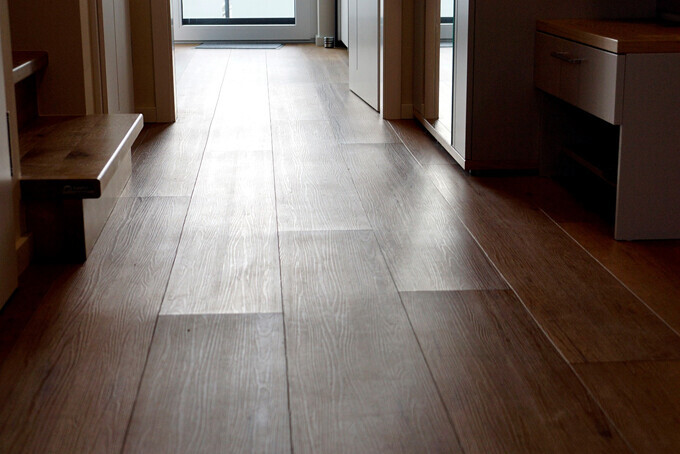
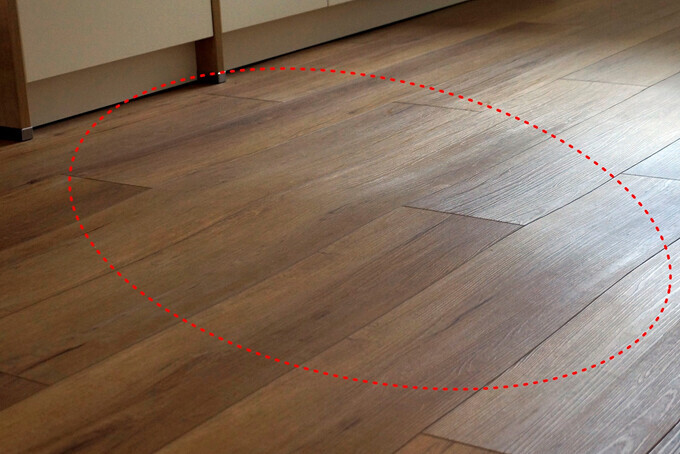
If you restrict the expansion behavior of the floor covering, the floor surface may soon look like in these two attached pictures.
Here, a floor covering with a cork backing was installed directly on the actually still unlevelled screed.
My advice regarding the necessary correction (removing the covering, installing a double layer of PE film, and reinstalling the covering) was ignored by the contractor. It will soon become apparent what will happen when the underfloor heating is in use. Although I already know...
------------------
Short answer to your question: Yes, install a single layer of PE film about 0.15mm thick!
Regards, KlaRa
Regarding PE film under floating floors made of wood, cork, or wood-based materials, the following applies:
The PE film is always required.
In new buildings (new screeds), usually only one moisture measurement is taken. For an area of about 120m² (1,292 sq ft), this is considered sufficient, but it is still quite limited when compared to the 100cm² (15.5 sq in) surface area required by the testing authority.
Therefore, there is always a certain residual risk accepted by current standards concerning potential variations in screed thickness or measurement errors (due to the inaccuracy of the CM device).
Even in older buildings, PE film is necessary because you cannot be 100% sure that the cement screed (which applies only to cement screeds) is sufficiently dry. This is simply because cement screeds can absorb moisture depending on the indoor air humidity (here: > 70%), meaning they can become damp again.
Thirdly, as already mentioned in one of the posts, PE film also acts as a slip layer. Floating floor coverings will always move, whether due to thermal expansion or moisture absorption from the air.
If you restrict the expansion behavior of the floor covering, the floor surface may soon look like in these two attached pictures.
Here, a floor covering with a cork backing was installed directly on the actually still unlevelled screed.
My advice regarding the necessary correction (removing the covering, installing a double layer of PE film, and reinstalling the covering) was ignored by the contractor. It will soon become apparent what will happen when the underfloor heating is in use. Although I already know...
------------------
Short answer to your question: Yes, install a single layer of PE film about 0.15mm thick!
Regards, KlaRa
KlaRa schrieb:
Hello questioner.
Regarding the PE (polyethylene) sheet under floating floors made of wood, cork, or wood-based panels, the following applies:
The PE sheet is always necessary.
For new constructions (new screeds), usually only one residual moisture measurement is carried out. Considering, for example, 120m² (1300 ft²), this is generally regarded as sufficient but still limited when compared to the 100cm² (15.5 sq. inches) area that the testing authority requires.
Therefore, there is always a certain residual risk accepted by current technical standards, which relates to possible variations in screed thickness or measurement errors (due to the inaccuracy of the CM device).
Even in older buildings, a PE sheet is necessary because you cannot be 100% certain that the cement screed (this only applies to cement screeds) is sufficiently dry. This is simply because cement screeds can absorb moisture depending on the indoor air humidity (here: > 70%), thus becoming damp again.
Thirdly, as already mentioned in one of the posts, the PE sheet also acts as a sliding layer. Floating floor coverings always move, whether caused by temperature changes or the absorption of (air) moisture!
If you restrict the expansion behavior of the floor covering, the surface may soon look like the ones in the two attached pictures.
Here, a cork-backed covering was installed on the actually un-levelled screed.
My advice regarding the necessary correction (remove the covering, install a double layer of PE, and reinstall) was ignored by the contractor. It will soon become apparent what will happen once the underfloor heating is in use. I already know...
------------------
Short answer to your question: Yes, install a single layer of about 0.15mm (6 mil) PE sheet!
Regards, KlaRa Thank you for your assessment. But what do you say about this:
nordanney schrieb:
Think about what you are doing with the sheet. The moisture you are assuming will cause long-lasting mold growth under the sheet ;-) The floor installer applied a gypsum-based leveling compound. I am currently a little concerned that mold might develop under the sheet (which lies on top of the leveling compound), since gypsum is said to be very prone to mold.
Hausbaer schrieb:
... because gypsum is said to mold very quickly.However, that is a misconception; pure gypsum does not mold since it is purely mineral-based.@ Hausbaer: Those who emphasize the topic of "mold fungi" usually have no other "killer argument."
The fact is that polyethylene (PE) foil always belongs under any floating installation of wood/wood-based materials as well as cork flooring.
If a gypsum-based leveling compound was used here for surface leveling, then please consider the PE foil only as a slip layer for the future floor covering.
If the situation should arise later that, for whatever reason, moisture rises from the back and the screed releases its excess residual moisture "upwards" (toward the center of the room), you will undoubtedly notice this from other signs even before any mold spores can settle: there will be creaking with every step you take.
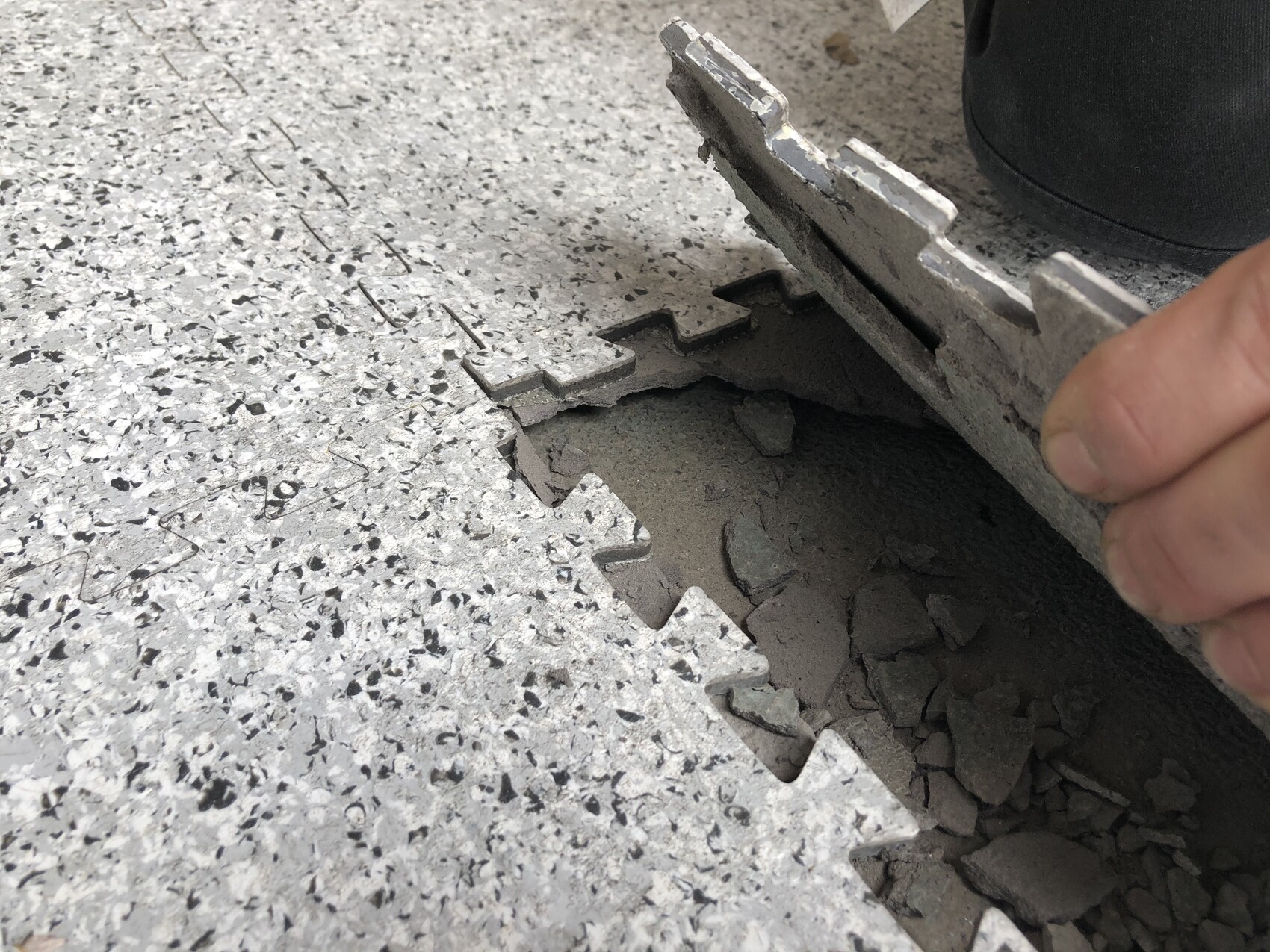
It creaks because the gypsum-containing leveling compound has detached from the screed surface and crumbled.
No, this is not a joke or an unfounded claim; it corresponds to my practical experience. It looks exactly like in the attached photo.
So don’t be misled by comments that miss the point.
You asked here in this forum, you received at least one useful answer, and now you must decide on your own which path to take with full responsibility.
Best regards and good luck with your decision:
KlaRa
The fact is that polyethylene (PE) foil always belongs under any floating installation of wood/wood-based materials as well as cork flooring.
If a gypsum-based leveling compound was used here for surface leveling, then please consider the PE foil only as a slip layer for the future floor covering.
If the situation should arise later that, for whatever reason, moisture rises from the back and the screed releases its excess residual moisture "upwards" (toward the center of the room), you will undoubtedly notice this from other signs even before any mold spores can settle: there will be creaking with every step you take.
It creaks because the gypsum-containing leveling compound has detached from the screed surface and crumbled.
No, this is not a joke or an unfounded claim; it corresponds to my practical experience. It looks exactly like in the attached photo.
So don’t be misled by comments that miss the point.
You asked here in this forum, you received at least one useful answer, and now you must decide on your own which path to take with full responsibility.
Best regards and good luck with your decision:
KlaRa
 schubert7927 Apr 2021 06:46
Conclusion: Definitely use a vapor barrier! Removing the flooring later is simply a hassle!
Similar topics