
Hello everyone,
Attached is a photo of a wall that our neighbor built. Since it looks quite unattractive, we are wondering how to improve its appearance.
Plastering would be an option, but I’m not sure if it would last over time, as the wall or formwork blocks could get damp. The neighbor placed a membrane behind it and poured concrete, but I’m still unsure about this.
Would paint hold on that surface?
Or would it be better to simply spray paint it?
Thanks for any tips and experiences!
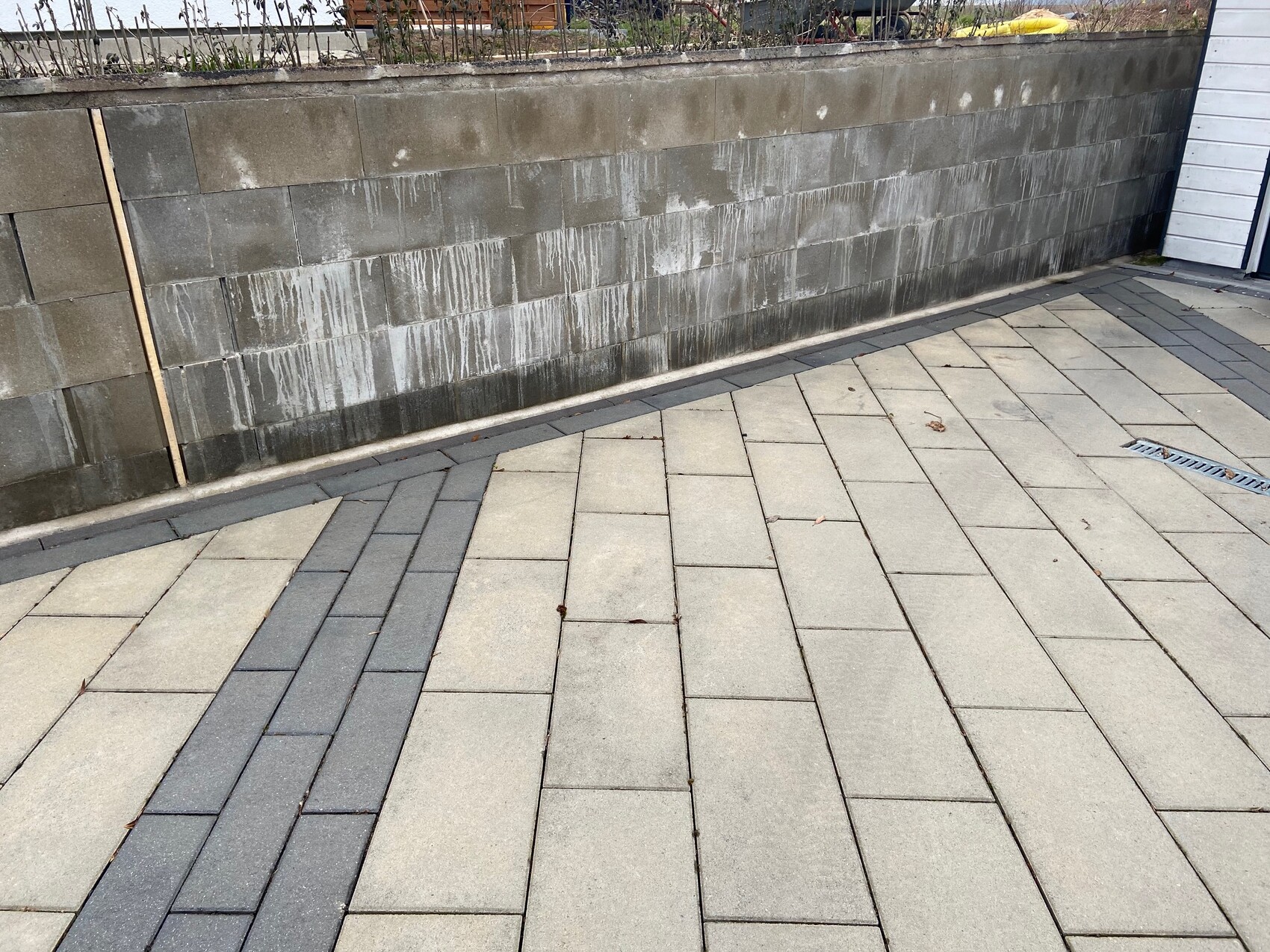
Attached is a photo of a wall that our neighbor built. Since it looks quite unattractive, we are wondering how to improve its appearance.
Plastering would be an option, but I’m not sure if it would last over time, as the wall or formwork blocks could get damp. The neighbor placed a membrane behind it and poured concrete, but I’m still unsure about this.
Would paint hold on that surface?
Or would it be better to simply spray paint it?
Thanks for any tips and experiences!
N
nordanney23 Mar 2021 14:10Rhombus cladding. He pays for the materials, you install the stuff. A good deal for both parties.
Talking to him probably won’t lead to any success, as the wall was already a point of contention when it was built.
It was much higher and had to support his terrain.
As more and more soil slid onto our property, we pushed for a solution.
And that was his solution.
By the way, the construction of the wall took 2–3 years.
If anything, the initiative would have to come from us.
At least we are “allowed” to do something, because essentially it is his wall.
Would a nice graffiti make sense?
It is on the east side, so there is no strong direct sunlight.
It was much higher and had to support his terrain.
As more and more soil slid onto our property, we pushed for a solution.
And that was his solution.
By the way, the construction of the wall took 2–3 years.
If anything, the initiative would have to come from us.
At least we are “allowed” to do something, because essentially it is his wall.
Would a nice graffiti make sense?
It is on the east side, so there is no strong direct sunlight.
Maybe a silly question, but is there an obligation to provide the neighbor with an aesthetically pleasing surface when designing a boundary, whether it’s a fence, wall, hedge, or something else? I understand this if it’s a boundary construction purely for enclosure.
But what if there is a slope retention structure of any kind on one’s own property?
Background: The neighbor has dug out or lowered the natural ground level at the boundary, and I want or need to raise the natural level on my side by 10-20 cm (4-8 inches). So, in terms of slope stabilization, aren’t we basically in the same situation?
The only response from the neighbor, who dug out the area first, is “Do as you think best.”
I don’t see why I should build something visually appealing for them if they are neither financially contributing nor offering any help with the work. For me, that means the simplest and cheapest solution, especially since I don’t have to look at it and the neighbor is not involved.
If necessary, I would even consider leaving the entire slope retention on my side. Would it be sufficient then to keep 5-10 cm (2-4 inches) away from the boundary, instead of placing the slope retention structure directly on the boundary line?
But what if there is a slope retention structure of any kind on one’s own property?
Background: The neighbor has dug out or lowered the natural ground level at the boundary, and I want or need to raise the natural level on my side by 10-20 cm (4-8 inches). So, in terms of slope stabilization, aren’t we basically in the same situation?
The only response from the neighbor, who dug out the area first, is “Do as you think best.”
I don’t see why I should build something visually appealing for them if they are neither financially contributing nor offering any help with the work. For me, that means the simplest and cheapest solution, especially since I don’t have to look at it and the neighbor is not involved.
If necessary, I would even consider leaving the entire slope retention on my side. Would it be sufficient then to keep 5-10 cm (2-4 inches) away from the boundary, instead of placing the slope retention structure directly on the boundary line?
P
pagoni202023 Mar 2021 21:43@hg6806 A graffiti is a nice idea too, but in my opinion, the priority should be to avoid applying anything directly onto the damp concrete blocks. Otherwise, you would first need to prepare the current surface and waterproof it against moisture, which is a significant effort. Plus, it will likely get dirty repeatedly because of the water coming off the wall.
Therefore, a simple substructure would be useful so that moisture or water can stay behind it or drain away.
Of course, it depends on whether this is your living room view or somewhere hidden behind the garage; I would base my effort on that.
If he lets you do something casual there, that’s fine. Why should he do or pay for something he doesn’t even see? It is better when things fit together, but I wouldn’t want to get upset about it.
If you don’t want to spend much money, you can also do this with regular, rough-sawn battens or boards, screwed onto the substructure with small gaps, either crosswise or lengthwise, similar to rhomboid cladding; it’s inexpensive and looks good in my opinion.
... certainly not, but if you always see it from your sofa, it’s no fun.
Of course, that works and is enough. You are responsible for the function, not the appearance.
As long as you don’t somehow cooperate, I would keep a few centimeters away. I once did it this way because the neighbor didn’t want a joint solution, and later he piled his soil against it...
Stories like this cause neighborhood conflicts... I left it at that.
However, I wouldn’t want to intentionally build something ugly either; that would feel wrong to me. If he then builds his wall 3cm (1 inch) away from the boundary too, you’d have a dreaded gap of 6cm (2.5 inches) between. That would be really annoying; he should just pile his soil against it, and the problem’s solved.
Therefore, a simple substructure would be useful so that moisture or water can stay behind it or drain away.
Of course, it depends on whether this is your living room view or somewhere hidden behind the garage; I would base my effort on that.
If he lets you do something casual there, that’s fine. Why should he do or pay for something he doesn’t even see? It is better when things fit together, but I wouldn’t want to get upset about it.
If you don’t want to spend much money, you can also do this with regular, rough-sawn battens or boards, screwed onto the substructure with small gaps, either crosswise or lengthwise, similar to rhomboid cladding; it’s inexpensive and looks good in my opinion.
lesmue79 schrieb:
Are you obligated to provide your neighbor with an aesthetically pleasing surface when designing a boundary?
... certainly not, but if you always see it from your sofa, it’s no fun.
lesmue79 schrieb:
For me, the cheapest and simplest solution applies if I don’t have to look at it anyway and there’s no input from the neighbor.
Of course, that works and is enough. You are responsible for the function, not the appearance.
lesmue79 schrieb:
I would even go so far as to keep the entire retaining structure on my side if necessary. Would it be sufficient to stay 5–10cm (2–4 inches) away from the boundary, rather than placing the slope retaining structure directly on the boundary?
As long as you don’t somehow cooperate, I would keep a few centimeters away. I once did it this way because the neighbor didn’t want a joint solution, and later he piled his soil against it...
Stories like this cause neighborhood conflicts... I left it at that.
However, I wouldn’t want to intentionally build something ugly either; that would feel wrong to me. If he then builds his wall 3cm (1 inch) away from the boundary too, you’d have a dreaded gap of 6cm (2.5 inches) between. That would be really annoying; he should just pile his soil against it, and the problem’s solved.
K
knalltüte23 Mar 2021 23:13
.... Of course, that's possible, that would be enough. You are responsible for the function, not for the appearance. And this is where the writer is quite mistaken. The builder of the wall is responsible for a "decent" appearance. For example, an unplastered concrete wall can, but does not have to, meet this standard. I discussed this point a few months ago with a friend (civil engineer) because I look out from my rental apartment onto an unattractive garage wall. Unfortunately, in reality, this will probably result either in a lawsuit or a neighborhood conflict, or in lengthy negotiations without success. A difficult situation. Is there no way to plant anything else in narrow containers to cover the wall? (Climbing plants/ivy, tall grasses, etc.)
P
pagoni202023 Mar 2021 23:25superzapp schrieb:
and that’s exactly where the writer is probably mistaken.Really? Something like that exists?..... 😀 In general, I always advocate for a reasonable solution, which is why I would have done something proper on the neighbor’s side from the start to reach a mutual agreement here. I’m about to face a similar situation myself, and I don’t want the neighbor to be upset when they look at my building.
I would be interested to know where this is regulated, if you happen to have that information handy.
On top of that, there’s the problem of being right versus getting what you want, and if tensions are already high, it will probably be difficult to resolve. For that reason, I would prefer to handle it myself.
Similar topics