
K
kinderpingui21 Mar 2021 09:26Hello everyone,
I’m not sure if my question fits in this category, and I couldn’t find any posts addressing my specific issue here or in other forums.
My post is less about advice on how to fix the described defect and more about whether our general contractor (GC) can legally proceed as they are:
We are building with a local GC who has been in business for 25 years, and we remain very satisfied with our choice. For several years now, especially since the company switched to monolithic construction, they have frequently encountered the problem of cracks appearing in the exterior plaster around the transition area between masonry, precast concrete ceiling panels, and the parapet (attic wall) on flat roof constructions. Since then, they have continuously tried, but without success, to solve this issue. Here are the relevant construction details for the parapet area:
Masonry: 36.5 cm (14 inches) Poroton T9
Precast concrete ceiling panel: 22 cm (9 inches) thick, with 120 mm (5 inches) exterior insulation (Poroton ceiling edge shells)
Parapet: one 36.5 cm (14 inches) Poroton T9 block, topped with a Poroton U-shaped shell filled with concrete and anchored about 1 meter (3 feet) from each corner into the precast concrete panels with reinforcing steel
Exterior plaster in the parapet area is applied in two layers, reinforced with mesh
This was the plan so far. The GC assumes the cause is that the ceilings settle (slightly sag) during the first year, causing the corners of the slabs at the parapet to slightly lift upward, which then leads to cracks in the exterior plaster. When cracks were repaired after one year, this phenomenon reportedly did not reoccur.
Various measures have already been taken: more reinforcement, wider blocks for the parapet filled with more concrete to apply more load on the slabs, preventing the slab from “rising” at the exterior edge. So far, none of this has been successful.
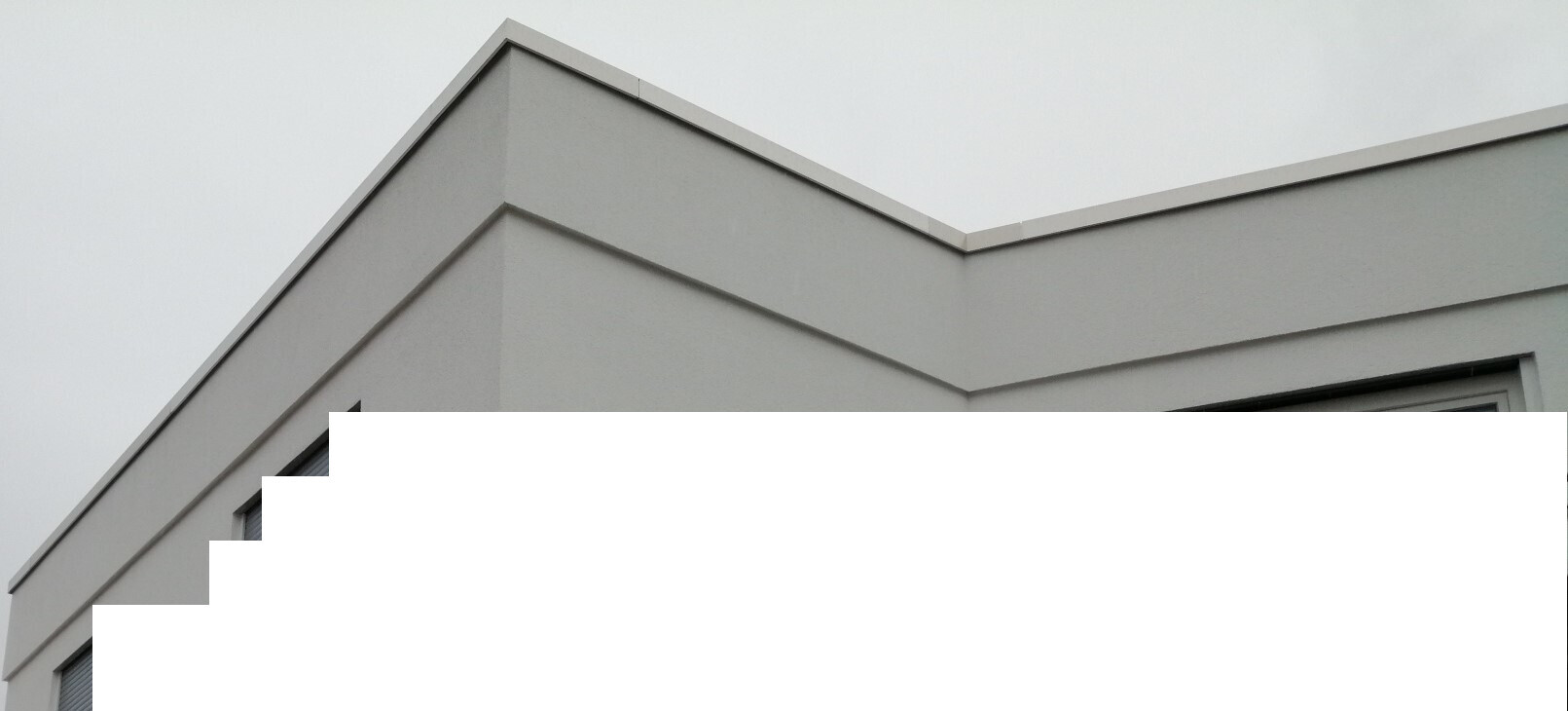
Now the plan is to install exterior insulation and finish system (EIFS/WDVS) with 40 mm (1.5 inches) thickness on the parapet area, extending downward about 20 cm (8 inches) over the transition from masonry to the precast ceiling panel (see photo). Besides the fact that this looks terrible, we wonder if this will actually solve the problem and have rejected this approach. Instead, we proposed delaying plastering the house for one year, since the problem reportedly ceases to appear after that period.
Our current options are:
1. Proceed with the original plan but sign a waiver excluding cracks from warranty coverage because the problem is known and we do not want to accept the GC’s solution
2. Accept the unattractive EIFS/WDVS variant
3. Remove the plastering work from the contract and manage the exterior plaster ourselves next year
We are not really happy with any of these options. Ideally, we would choose option 1 but without the exclusion clause, meaning everything stays as contractually agreed. Can the GC legally force such a clause on us? Is it lawful if the house undergoes such a major change in appearance (we definitely would not have chosen a flat roof if we had known about this look from the start)?
Thank you very much for your help, and apologies if this post is in the wrong subforum.
I’m not sure if my question fits in this category, and I couldn’t find any posts addressing my specific issue here or in other forums.
My post is less about advice on how to fix the described defect and more about whether our general contractor (GC) can legally proceed as they are:
We are building with a local GC who has been in business for 25 years, and we remain very satisfied with our choice. For several years now, especially since the company switched to monolithic construction, they have frequently encountered the problem of cracks appearing in the exterior plaster around the transition area between masonry, precast concrete ceiling panels, and the parapet (attic wall) on flat roof constructions. Since then, they have continuously tried, but without success, to solve this issue. Here are the relevant construction details for the parapet area:
Masonry: 36.5 cm (14 inches) Poroton T9
Precast concrete ceiling panel: 22 cm (9 inches) thick, with 120 mm (5 inches) exterior insulation (Poroton ceiling edge shells)
Parapet: one 36.5 cm (14 inches) Poroton T9 block, topped with a Poroton U-shaped shell filled with concrete and anchored about 1 meter (3 feet) from each corner into the precast concrete panels with reinforcing steel
Exterior plaster in the parapet area is applied in two layers, reinforced with mesh
This was the plan so far. The GC assumes the cause is that the ceilings settle (slightly sag) during the first year, causing the corners of the slabs at the parapet to slightly lift upward, which then leads to cracks in the exterior plaster. When cracks were repaired after one year, this phenomenon reportedly did not reoccur.
Various measures have already been taken: more reinforcement, wider blocks for the parapet filled with more concrete to apply more load on the slabs, preventing the slab from “rising” at the exterior edge. So far, none of this has been successful.
Now the plan is to install exterior insulation and finish system (EIFS/WDVS) with 40 mm (1.5 inches) thickness on the parapet area, extending downward about 20 cm (8 inches) over the transition from masonry to the precast ceiling panel (see photo). Besides the fact that this looks terrible, we wonder if this will actually solve the problem and have rejected this approach. Instead, we proposed delaying plastering the house for one year, since the problem reportedly ceases to appear after that period.
Our current options are:
1. Proceed with the original plan but sign a waiver excluding cracks from warranty coverage because the problem is known and we do not want to accept the GC’s solution
2. Accept the unattractive EIFS/WDVS variant
3. Remove the plastering work from the contract and manage the exterior plaster ourselves next year
We are not really happy with any of these options. Ideally, we would choose option 1 but without the exclusion clause, meaning everything stays as contractually agreed. Can the GC legally force such a clause on us? Is it lawful if the house undergoes such a major change in appearance (we definitely would not have chosen a flat roof if we had known about this look from the start)?
Thank you very much for your help, and apologies if this post is in the wrong subforum.
H
HilfeHilfe21 Mar 2021 10:16Regarding point 1, of course it can be excluded. Freedom of contract.
K
kinderpingui21 Mar 2021 16:59But we signed a contract last year that did not include that, I probably should have mentioned it 🙄 we are just about to move in. The exterior plaster is supposed to be applied soon...
K
knalltüte21 Mar 2021 17:23kinderpingui schrieb:
...We are building with a local general contractor (GC) who has been in the market for 25 years, and we are still very satisfied with our choice. For several years now, especially since the company started using monolithic construction, they have frequently had issues with cracks forming in the exterior plaster around the transition areas between masonry, precast concrete slabs, and the parapet on flat roof buildings. They have been continuously trying—so far unsuccessfully—to resolve this problem.
...
This has been the planning so far. The GC assumes that the ceilings settle (slightly bend or sag downward) during the first year, which causes the edges of the slabs near the parapet to move slightly upward, leading to cracks in the exterior plaster. If the cracks were repaired after one year, this phenomenon reportedly did not reoccur.
Various measures have already been taken: additional reinforcement, wider blocks used as parapet filled with more concrete for increased load on the ceilings, to prevent the slab edge from lifting in the exterior area. None of these solutions have been successful so far.
Therefore, the current plan is to apply an external thermal insulation composite system (ETICS / external insulation) with a thickness of 40mm (1.6 inches) around the parapet area, extending down about 20cm (8 inches) below the transition from masonry to precast slab (see photo). Besides the fact that it looks simply awful, we are wondering whether this approach will actually solve the problem, so we have rejected this method. Instead, we suggested postponing the exterior plastering of the house by one year, since the problem supposedly does not occur after that time.Unfortunately, I can’t provide any information regarding legal options 🙄However, I want to point out that a GC who has been building this way for years should seek professional advice to permanently solve the issue. I could recommend someone 😀
So, he wants to discuss the 40mm (1.6 inches) thick external insulation “by moonlight” so that it conveniently hides the expected crack underneath?
In my opinion, the insulation will either stay bonded on the top or bottom and the crack will then appear at the edge of the insulation. Unless the GC’s “discussion” was successful beforehand 🤨
By the way, I don’t find the appearance of the added insulation terribly bad—but, as always in life, that’s a matter of personal taste :p
K
kinderpingui1 Apr 2021 13:07We just had our personal meeting with the company. In my opinion, the meeting was solution-oriented and fair to the interests of both parties.
The following options were discussed:
1. The mentioned external thermal insulation composite system (ETICS / external wall insulation), which they themselves don’t find visually appealing for our house and therefore are reluctant to install.
2. Proceed as planned, accepting the risk for us due to the clause already mentioned. Understandably, the company does not want to implement it that way from a construction perspective, knowing it could lead to problems. They also have serious concerns about this clause and do not want to transfer the risk to us but are interested in finding a solution for this issue for future projects as well.
3. Remove the trade from the contract and handle it through a separate contractor (which in my view doesn’t improve the situation).
4. For now, only the base coat will be applied promptly. Over the next 1-3 years, it will be monitored whether cracks develop; only then will the top coat and paint be applied, which would also cover any cracks that may have formed. Downsides: We would have additional costs for erecting scaffolding twice and for double masking, plus the usual market price increases.
Advantages: Construction will still be ongoing around us over the next two years (so possible dirt won’t get on the top coat). Furthermore, it would still be managed entirely through our general contractor, and from the time the top coat is applied in 1-3 years, we would then have a 5-year warranty on the plaster.
Our preference strongly leans toward option 4, shared by both us and the construction company. From your perspective, is there anything here that could cause problems or that we should consider?
For your information: Our general contractor has already involved several experts and specialists in this matter. So far, none have found a solution without detours. According to them, our company is not alone with this problem. It seems to be widespread since the whole KfW building program. We will now keep a close eye on various new development areas.
The following options were discussed:
1. The mentioned external thermal insulation composite system (ETICS / external wall insulation), which they themselves don’t find visually appealing for our house and therefore are reluctant to install.
2. Proceed as planned, accepting the risk for us due to the clause already mentioned. Understandably, the company does not want to implement it that way from a construction perspective, knowing it could lead to problems. They also have serious concerns about this clause and do not want to transfer the risk to us but are interested in finding a solution for this issue for future projects as well.
3. Remove the trade from the contract and handle it through a separate contractor (which in my view doesn’t improve the situation).
4. For now, only the base coat will be applied promptly. Over the next 1-3 years, it will be monitored whether cracks develop; only then will the top coat and paint be applied, which would also cover any cracks that may have formed. Downsides: We would have additional costs for erecting scaffolding twice and for double masking, plus the usual market price increases.
Advantages: Construction will still be ongoing around us over the next two years (so possible dirt won’t get on the top coat). Furthermore, it would still be managed entirely through our general contractor, and from the time the top coat is applied in 1-3 years, we would then have a 5-year warranty on the plaster.
Our preference strongly leans toward option 4, shared by both us and the construction company. From your perspective, is there anything here that could cause problems or that we should consider?
For your information: Our general contractor has already involved several experts and specialists in this matter. So far, none have found a solution without detours. According to them, our company is not alone with this problem. It seems to be widespread since the whole KfW building program. We will now keep a close eye on various new development areas.

I would like to help, but I don’t understand the whole problem: the crop of the image hides (due to which secrets exactly?) more than it reveals, is difficult to assess in terms of scale and perspective, and doesn’t show any problematic area, nor is it explained. The small part that is visible looks flawless. The text mentions plaster that is still to be applied – however, the picture gives the impression of a finished top coat. I am completely at a loss as to what problem is (or was) supposed to be shown.
https://www.instagram.com/11antgmxde/
https://www.linkedin.com/company/bauen-jetzt/
https://www.instagram.com/11antgmxde/
https://www.linkedin.com/company/bauen-jetzt/
Similar topics