
N
Nanopixel13 Mar 2021 16:00Hello everyone,
I measured the voltage at the starting device on the back of my refrigerator (similar to the one in the attached picture) using a multimeter and noticed some unusual readings. Terminals 1 and 2 are directly connected to the power cable and therefore have constant voltage; here, about 230V is measured, as expected. Terminals 3 and 4 have voltage when the relay switches on (meaning when the compressor is supposed to run). When the unit is running and you measure here, you get a voltage of over 270V (!). Even when measuring between 4 and 2 or between 1 and 3 (in the switched state), you get this value. How can this be explained?
Best regards,
N
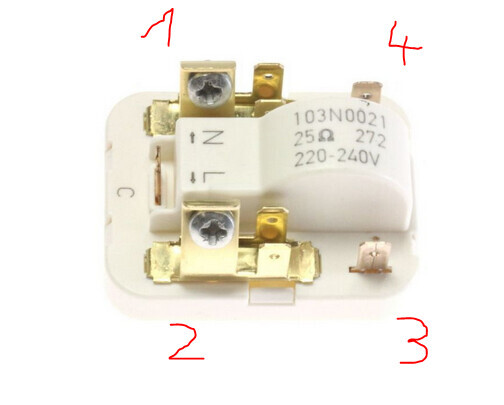
I measured the voltage at the starting device on the back of my refrigerator (similar to the one in the attached picture) using a multimeter and noticed some unusual readings. Terminals 1 and 2 are directly connected to the power cable and therefore have constant voltage; here, about 230V is measured, as expected. Terminals 3 and 4 have voltage when the relay switches on (meaning when the compressor is supposed to run). When the unit is running and you measure here, you get a voltage of over 270V (!). Even when measuring between 4 and 2 or between 1 and 3 (in the switched state), you get this value. How can this be explained?
Best regards,
N

This is not unexpected but completely normal.
It is a capacitor-start circuit.
The capacitor creates an auxiliary phase. However, instead of a 120° phase shift, it only produces a phase shift of less than 90°. This results in an elliptical rotating field, which is sufficient to set the motor’s rotation direction and allow it to start on its own. However, this also causes the motor to have a pulsating torque, and depending on the load torque, humming noises occur at twice the power line frequency. The capacitor and the motor’s coil together form a series resonant circuit. During operation, the voltage across the capacitor is therefore higher than the supply voltage. To avoid damage, the capacitor should be rated for 400 to 450 V alternating voltage, as with capacitors used in capacitor motors. Due to the capacitor, the currents in the individual windings differ in magnitude. The motor’s starting current depends on the required torque and can be several times the nominal current. Because the operation of larger motors results in stronger single-phase loads on the power network, permission to operate motors with a capacitor-start circuit is often limited by some utilities to 1.5 kW.
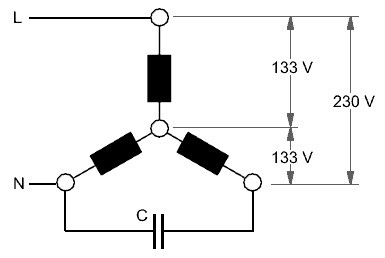
It is a capacitor-start circuit.
The capacitor creates an auxiliary phase. However, instead of a 120° phase shift, it only produces a phase shift of less than 90°. This results in an elliptical rotating field, which is sufficient to set the motor’s rotation direction and allow it to start on its own. However, this also causes the motor to have a pulsating torque, and depending on the load torque, humming noises occur at twice the power line frequency. The capacitor and the motor’s coil together form a series resonant circuit. During operation, the voltage across the capacitor is therefore higher than the supply voltage. To avoid damage, the capacitor should be rated for 400 to 450 V alternating voltage, as with capacitors used in capacitor motors. Due to the capacitor, the currents in the individual windings differ in magnitude. The motor’s starting current depends on the required torque and can be several times the nominal current. Because the operation of larger motors results in stronger single-phase loads on the power network, permission to operate motors with a capacitor-start circuit is often limited by some utilities to 1.5 kW.
N
Nanopixel13 Mar 2021 20:49Ah, thanks a lot for the detailed explanation!
I wasn’t familiar with this method before – after doing some research, it seems that the Steinmetz connection is used to run three-phase motors on a single-phase supply. In my case, this is probably the refrigerator’s compressor.
Now I have another question: What happens if I connect a different load (not a motor) in parallel at the points I labeled as 3 and 4 using junction terminals, which expects 230V?
I ask because my original plan was to connect a transformer here and then 12V PC fans that would run whenever the compressor is running.
I was a bit impatient and already tried it, and the result surprised me: Even though more than 270V is present at the transformer input, it still outputs exactly 12.0 V and the fan runs normally... why is that?
Kind regards,
N
I wasn’t familiar with this method before – after doing some research, it seems that the Steinmetz connection is used to run three-phase motors on a single-phase supply. In my case, this is probably the refrigerator’s compressor.
Now I have another question: What happens if I connect a different load (not a motor) in parallel at the points I labeled as 3 and 4 using junction terminals, which expects 230V?
I ask because my original plan was to connect a transformer here and then 12V PC fans that would run whenever the compressor is running.
I was a bit impatient and already tried it, and the result surprised me: Even though more than 270V is present at the transformer input, it still outputs exactly 12.0 V and the fan runs normally... why is that?
Kind regards,
N

Without thorough knowledge, I wouldn’t even attempt that in your position. Electricity can be fatal.
Only trained professionals should work on 230V electrical circuits, and for good reason. The Schuko plug was designed for use by non-experts, and that is where it ends. Everything beyond that must be handled by a qualified electrician.
Only trained professionals should work on 230V electrical circuits, and for good reason. The Schuko plug was designed for use by non-experts, and that is where it ends. Everything beyond that must be handled by a qualified electrician.
N
Nanopixel13 Mar 2021 21:23Who says I am a layperson.
Can I please get just one answer to my question.
Can I please get just one answer to my question.