
Hello everyone,
Our plot is located between a street at the front and a private driveway at the rear. The private driveway cannot be used for access or the driveway entrance. Access can only be made from the street.
Now the question is at what height we should position the house. Should we align it with the street level or with the private driveway?
If we align with the private driveway, we would need to add 80-100cm (31-39 inches) of fill, and the entrance to the house would likely require several steps. Also, the driveway to the parking area would probably be quite steep.
If we align with the street, the rear part of the plot would remain slightly below the level of the private driveway.
The street slopes upwards to the west. The neighbor to the west has adapted his house to the houses in the second row and his house is positioned quite high. His driveway is also very steep.
The neighbor to the north has leveled his plot completely and placed his house level with the street.
Our plot is in the middle. What would be the most sensible approach?
I have attached the elevation plan, hopefully it is clear.
Edit: The building project would be a single-family house without a basement!
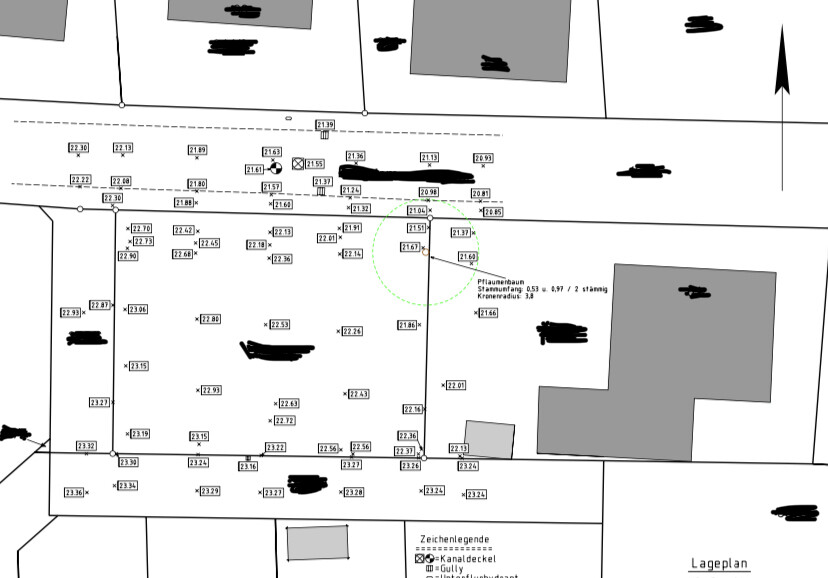
Our plot is located between a street at the front and a private driveway at the rear. The private driveway cannot be used for access or the driveway entrance. Access can only be made from the street.
Now the question is at what height we should position the house. Should we align it with the street level or with the private driveway?
If we align with the private driveway, we would need to add 80-100cm (31-39 inches) of fill, and the entrance to the house would likely require several steps. Also, the driveway to the parking area would probably be quite steep.
If we align with the street, the rear part of the plot would remain slightly below the level of the private driveway.
The street slopes upwards to the west. The neighbor to the west has adapted his house to the houses in the second row and his house is positioned quite high. His driveway is also very steep.
The neighbor to the north has leveled his plot completely and placed his house level with the street.
Our plot is in the middle. What would be the most sensible approach?
I have attached the elevation plan, hopefully it is clear.
Edit: The building project would be a single-family house without a basement!
11ant schrieb:
I understand that the original poster wants an effective driveway width of 3.50 m (11.5 feet) between the house and the fence, and the general contractor now plans to allocate 1.50 m (4.9 feet) of that width for terrain landscaping, meaning the planned width would be expanded to 5.00 m (16.4 feet) so that after subtracting the unexpected 1.50 m, the usable width remains 3.50 m. I agree with this interpretation. However, the property owner does not seem to want that.

icandoit schrieb:
You have quite a significant amount of earthworks to carry out. With my suggestion, the mass balance should nearly work out.
Once there is a height difference of 1 meter (3.3 feet) within the building plot, having a basement usually makes sense. We only have 10cm (4 inches) of topsoil, so the earthworks will probably not be as extensive as initially expected.
According to the person who prepared the soil report, we have perfect soil conditions.
It is the terrain modeling that makes it complicated.
11ant schrieb:
I understand it like this: The original poster wants an effective driveway width—meaning the width between the house and the fence—of 3.50 m (11.5 feet). The general contractor now wants to allocate 1.50 m (5 feet) width for terrain modeling work, which means the planned width has to be increased to 5.00 m (16.4 feet) so that after subtracting the 1.50 m (5 feet) needed for terrain modeling, 3.50 m (11.5 feet) usable width remains. Yes, that’s exactly how he explained it.
My question is: do you really have to allocate 1.50 m (5 feet) for that?
icandoit schrieb:
I see it that way, too. But the landowner does not seem to agree. We definitely want a functional driveway and, if possible, space for two cars on the property because there are already parking problems. To be honest, I’m not even sure whether it was a requirement to have two parking spaces.
But do I really have to sacrifice 1.50 m (5 feet) for the concrete curb blocks?
Yaso2.0 schrieb:
A basement living area/integrated garage should cost 70-100k, which was and still is well beyond our budget!You can’t really generalize like that.
It doesn’t just come as a simple additional cost.
Landscaping, retaining walls, paved driveway, no garage/carport, smaller footprint, etc. all affect the price.
I would reconsider the idea of the basement living area with the integrated garage and run the numbers more precisely.
If it ends up costing 15,000-20,000 more but in return you gain extra usable space, this could be a viable option.
Malunga schrieb:
You can’t generalize it like that.
It doesn’t simply add on top.
Landscaping, retaining walls, paved driveway, no garage/carport, smaller footprint, etc., all affect the price.
I would reconsider the idea of a basement living area and integrated garage with a detailed calculation.
If it ends up costing 15,000–20,000 more but you gain additional usable space, this could be a viable option. At the beginning, we considered three local general contractors. All three ultimately quoted an extra cost between 70,000 and 100,000 for the basement/garage situation.
If it had been only 15,000–20,000, we wouldn’t have said no either.
Yaso2.0 schrieb:
At the beginning, we had three local general contractors that seemed suitable for our project. All three quoted an additional cost between 70,000-100,000 for the basement/garage situation.
If it had been 15,000-20,000, we wouldn’t have said no.As mentioned, if the question is "How much does our planned house cost if we add a basement?" I understand the additional cost. However, when you compare living space to usable secondary space from the start on a sloped lot, this quickly puts things into perspective. A slab foundation on a slope isn’t much cheaper.This was basically meant just as a thought starter. The usual “It costs at least 100,000 euros more” cannot be applied so generally.
For example, in our case: 165 m² (1780 sq ft) living area, including 70 m² (750 sq ft) of usable secondary space – if we built with a basement, a lot of the secondary and gross floor area would be reduced. However, it’s actually not worthwhile for us because we would have to plan a waterproof basement, which disrupts the cost-benefit ratio again.
There was even a thread where the basement was only partially made of concrete, and the front living area was constructed with solid wood.
Malunga schrieb:
As I said, when the question naturally came up, "How much would our planned house cost if we wanted to add a basement?" It actually went more like this: at first, we discussed our ideas.
Then the question about a basement came up. And we said we wanted one (even though we actually didn’t, but it’s easier to leave it out later than to add it back in during planning).
After that, standard floor plans and approximate prices according to the scope of work were presented—once with a basement where the house was just under 130 sqm (1400 sqft), and once without a basement, with the house around 170 sqm (1830 sqft).
Then came the price differences and how much of that difference related to our land and our preferences.
So, for the least expensive general contractor, the price was about 72,000, and for the most expensive, around 97,000.
To be honest, I can’t even clearly remember now everything that was included. It was over 1.5 years ago.
I will call the managing director of the general contractor again on Monday; I also had the construction meeting with him.
Let’s see how he sees it—he also gave us very good advice during the construction meeting.
Similar topics