
ᐅ Mechanical ventilation with heat recovery + earth tube ventilation + exhaust hood ventilation and independent chimney
Created on: 11 Feb 2021 23:10
S
Stephan—Hello professionals,
I would like to gather some different opinions on the following project (see title). I have researched various forums and websites on the topics mentioned and here is the solution I am considering.
Mechanical ventilation with heat recovery (DIY installation of flexible ducts, devices, distributors, etc., excluding commissioning and balancing)
- Flexible round ducts, 75mm (3 inches) outer diameter with 61 or 63mm (2.4 or 2.5 inches) inner diameter
- For the ground floor on a raw concrete slab within insulation beneath the underfloor heating
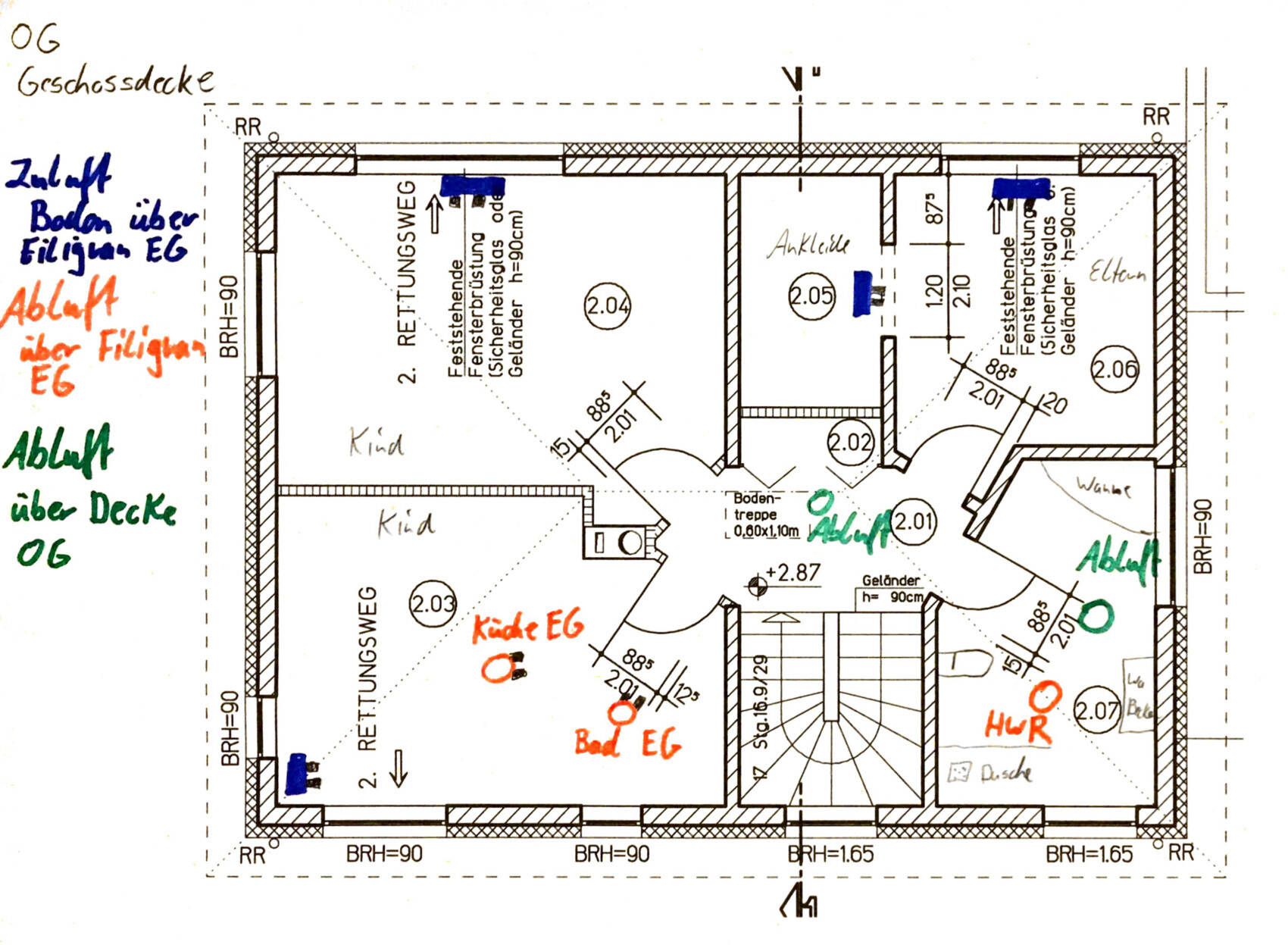
- For the upper floor above the precast ceiling, to be embedded in cast-in-place concrete (including valves) and approved by the structural engineer
- Exhaust air from bathroom and hallway on the upper floor routed through the attic (cold roof)
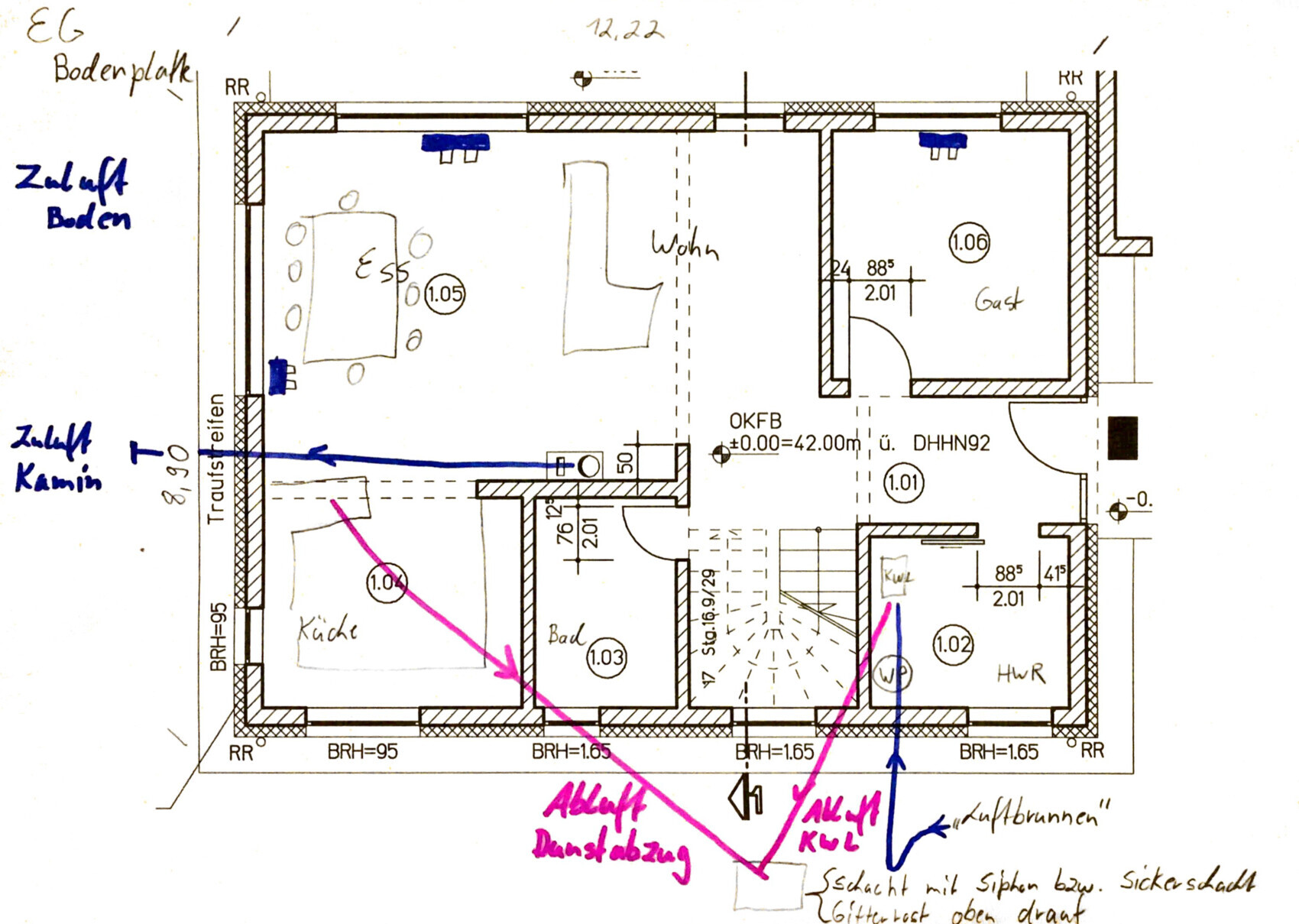
- All supply air valves via floor inlets (including 2 connections for flexible ducts)
- All exhaust air valves via ceiling vents 125mm (5 inches) (including 2 connections for flexible ducts)
Supply air for the mechanical ventilation with heat recovery through a 200mm (8 inches) duct passing through the foundation slab from outside via an earth air tunnel (just search online for inspiration)
Exhaust air 200mm (8 inches) duct through the foundation slab to the outside into a shaft (with slope for condensate drainage and permeable) and a ground-level grid cover
Provision for exhaust fumes below the foundation slab using a 150mm (6 inches) sewer pipe, also to be vented into the above-mentioned shaft
Chimney supplied with fresh air via a 200mm (8 inches) sewer pipe under the foundation slab, with a condensate drainage connected to the wastewater system
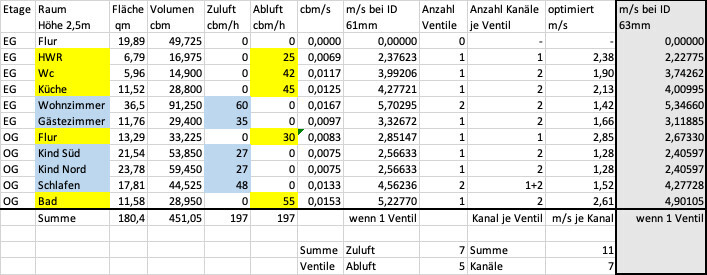
I have calculated the mechanical ventilation system using various tools (Helios, Wolf, Selfio (for calculation), Vallox, Maico) and come up with the following idea (pressure loss not taken into account):
Maximum air velocity in quiet rooms such as bedrooms about 2m/s (6.6 ft/s), in other rooms up to 3m/s (9.8 ft/s)
Motto: better to install one more duct than to have "noise problems" later
PS:
Proper supply air needs to be provided if mechanical ventilation is stopped when the exhaust hood is on.
I am considering installing a Maico system and saving energy with enthalpy and earth or brine heat exchangers via the earth air tunnel.
Looking forward to lively feedback, whether positive or negative.
Good idea or have I lost the plot?! 🙂
I would like to gather some different opinions on the following project (see title). I have researched various forums and websites on the topics mentioned and here is the solution I am considering.
Mechanical ventilation with heat recovery (DIY installation of flexible ducts, devices, distributors, etc., excluding commissioning and balancing)
- Flexible round ducts, 75mm (3 inches) outer diameter with 61 or 63mm (2.4 or 2.5 inches) inner diameter
- For the ground floor on a raw concrete slab within insulation beneath the underfloor heating
- For the upper floor above the precast ceiling, to be embedded in cast-in-place concrete (including valves) and approved by the structural engineer
- Exhaust air from bathroom and hallway on the upper floor routed through the attic (cold roof)
- All supply air valves via floor inlets (including 2 connections for flexible ducts)
- All exhaust air valves via ceiling vents 125mm (5 inches) (including 2 connections for flexible ducts)
Supply air for the mechanical ventilation with heat recovery through a 200mm (8 inches) duct passing through the foundation slab from outside via an earth air tunnel (just search online for inspiration)
Exhaust air 200mm (8 inches) duct through the foundation slab to the outside into a shaft (with slope for condensate drainage and permeable) and a ground-level grid cover
Provision for exhaust fumes below the foundation slab using a 150mm (6 inches) sewer pipe, also to be vented into the above-mentioned shaft
Chimney supplied with fresh air via a 200mm (8 inches) sewer pipe under the foundation slab, with a condensate drainage connected to the wastewater system
I have calculated the mechanical ventilation system using various tools (Helios, Wolf, Selfio (for calculation), Vallox, Maico) and come up with the following idea (pressure loss not taken into account):
Maximum air velocity in quiet rooms such as bedrooms about 2m/s (6.6 ft/s), in other rooms up to 3m/s (9.8 ft/s)
Motto: better to install one more duct than to have "noise problems" later
PS:
Proper supply air needs to be provided if mechanical ventilation is stopped when the exhaust hood is on.
I am considering installing a Maico system and saving energy with enthalpy and earth or brine heat exchangers via the earth air tunnel.
Looking forward to lively feedback, whether positive or negative.
Good idea or have I lost the plot?! 🙂
Stephan— schrieb:
I calculated the mechanical ventilation system using all available tools.What for?ypg schrieb:
Why?To be able to compare, all of them follow the DIN....-6 standard, but here and there they still produce slightly different results in the end. Even with consistent room dimensions.Stephan— schrieb:
To be able to compare,What is the purpose of that?ypg schrieb:
What is this supposed to be good for?I'm not a heating or ventilation expert, and I need some basis for sizing the pipework. Especially since it will be done as a DIY project.K
knalltüte12 Feb 2021 04:59I’m not an expert ;-) and can’t say much about the kitchen exhaust, chimney, or dimensioning, but:
Overall, great ideas and excellent planning. The topic of earth tubes (air wells) was just mentioned here in the forum 😉.
However, earth tubes require quite a lot of space in total (excavation pit for the earth tube). They also cause high initial costs, including excavation and gravel. I don’t know what the earth tube kit (piping) costs. But in operation, it seems to be the only good “air renewal system.” I considered it, but our plot didn’t (and still doesn’t) allow space in the optimal location – a pity. If you can do it: go for it!
- Flexible pipes (round) 75mm (3 inches) outer diameter with 61 or 63mm (2.4 or 2.5 inches) inner diameter
-> Great to install, very affordable (about 3€/m) and reliable. We will also use these.
- For the ground floor on a raw concrete slab with insulation under the underfloor heating
-> Provided the floor buildup height matches, this works. Crossing with wastewater pipes etc. is difficult due to minimum screed cover requirements. If all this is considered: excellent. It’s better to create a detailed installation plan for controlled ventilation and plumbing (wastewater) to avoid unpleasant surprises.
- For the upper floor above a precast concrete ceiling, to be cast into in-situ concrete (including valves) and approved by the structural engineer
-> OK.
- Exhaust air from bathroom and corridor on the upper floor via the attic (cold roof)
-> The exhaust air should remain within the thermal envelope of the house; otherwise, condensation problems may occur. Even if you collect or drain away the condensate, it still runs through the system. I’d be “afraid” of mold here and would clarify this point again (at a different “consultation center”).
- All supply air valves via floor-level inlets (including 2 connections for flexible pipes)
-> Floor inlets are expensive and may interfere with optimal furniture layout. Also, most have an awkward (trip) edge if they are not flush-mounted (which is even more expensive). We considered this and discarded it again. Try routing them up a wall instead and have the valves come out of the wall. For example, our valves only require about 14cm (5.5 inches) wall thickness for this.
- All exhaust air valves via ceiling valves, 125mm (5 inches) (including 2 connections for flexible pipes)
-> OK. (these also come in attractive designs ;-) )
Overall, great ideas and excellent planning. The topic of earth tubes (air wells) was just mentioned here in the forum 😉.
However, earth tubes require quite a lot of space in total (excavation pit for the earth tube). They also cause high initial costs, including excavation and gravel. I don’t know what the earth tube kit (piping) costs. But in operation, it seems to be the only good “air renewal system.” I considered it, but our plot didn’t (and still doesn’t) allow space in the optimal location – a pity. If you can do it: go for it!
- Flexible pipes (round) 75mm (3 inches) outer diameter with 61 or 63mm (2.4 or 2.5 inches) inner diameter
-> Great to install, very affordable (about 3€/m) and reliable. We will also use these.
- For the ground floor on a raw concrete slab with insulation under the underfloor heating
-> Provided the floor buildup height matches, this works. Crossing with wastewater pipes etc. is difficult due to minimum screed cover requirements. If all this is considered: excellent. It’s better to create a detailed installation plan for controlled ventilation and plumbing (wastewater) to avoid unpleasant surprises.
- For the upper floor above a precast concrete ceiling, to be cast into in-situ concrete (including valves) and approved by the structural engineer
-> OK.
- Exhaust air from bathroom and corridor on the upper floor via the attic (cold roof)
-> The exhaust air should remain within the thermal envelope of the house; otherwise, condensation problems may occur. Even if you collect or drain away the condensate, it still runs through the system. I’d be “afraid” of mold here and would clarify this point again (at a different “consultation center”).
- All supply air valves via floor-level inlets (including 2 connections for flexible pipes)
-> Floor inlets are expensive and may interfere with optimal furniture layout. Also, most have an awkward (trip) edge if they are not flush-mounted (which is even more expensive). We considered this and discarded it again. Try routing them up a wall instead and have the valves come out of the wall. For example, our valves only require about 14cm (5.5 inches) wall thickness for this.
- All exhaust air valves via ceiling valves, 125mm (5 inches) (including 2 connections for flexible pipes)
-> OK. (these also come in attractive designs ;-) )
Similar topics