
ᐅ Withholding Payments for Defects in the Shell Construction Phase
Created on: 9 Feb 2021 16:57
K
Kishihmen
Hello everyone,
The ceiling above the ground floor has just been concreted on our site. According to the payment schedule, a partial payment of approximately €30,000 is due.
However, our expert has identified several defects. These were formally reported to the general contractor (GC) with deadlines. The first deadline (2 weeks) passed without the defects being resolved; the second deadline is still running until Thursday (also 2 weeks).
So far, we have withheld about €17,000 of the €30,000. Our GC considers this amount far too high and insists on payment.
Since we are currently concerned about the potential insolvency of the GC (the structural builder, brick supplier, steel supplier, and light well supplier have not been paid), we want to keep the deduction as high as possible. However, since we are not construction professionals and want to avoid the risk that withholding too much for defects could backfire, I hope that some experts here can provide us with a rough cost estimate.
P.S. Our lawyer has been contacted, but the appointment is only scheduled for 17.02, and I fear we cannot hold off the GC until then.
Defect 1:
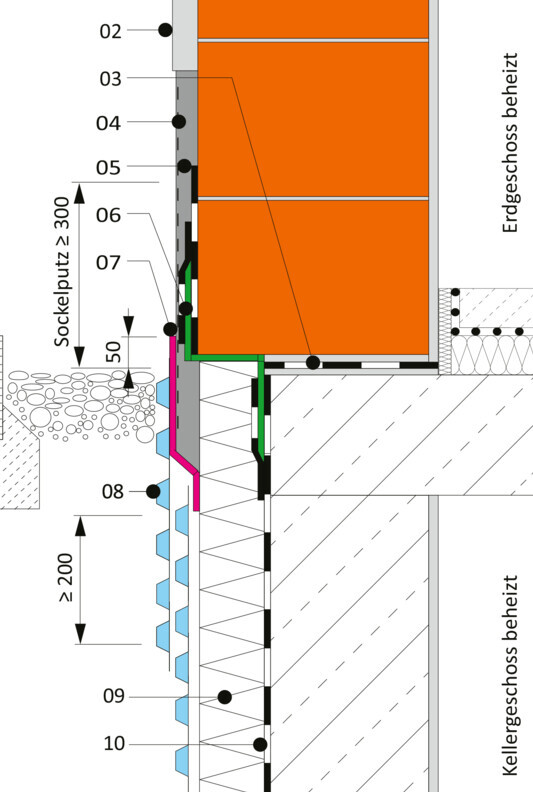
At the transition between the basement and the ground floor, no damp-proof course was installed at the base of the first course of blocks.
The basement is already fully lined with Styrodur insulation, and the excavation pit has been backfilled.
Defect 2:
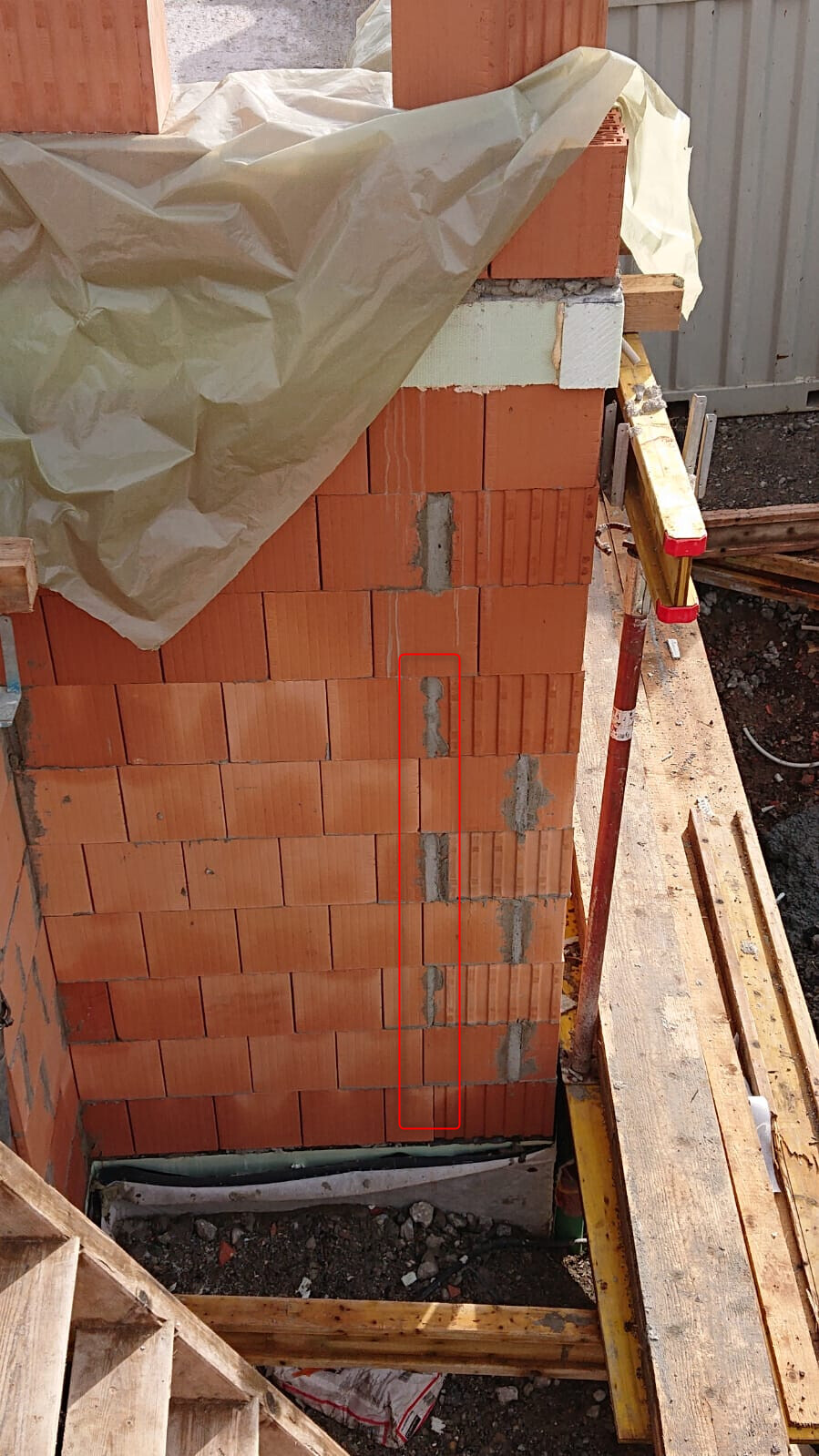
In some areas of the structural shell, the minimum offset of the bricks was not observed; in places, up to 7 courses of bricks were laid directly on top of each other.
Defect 3:
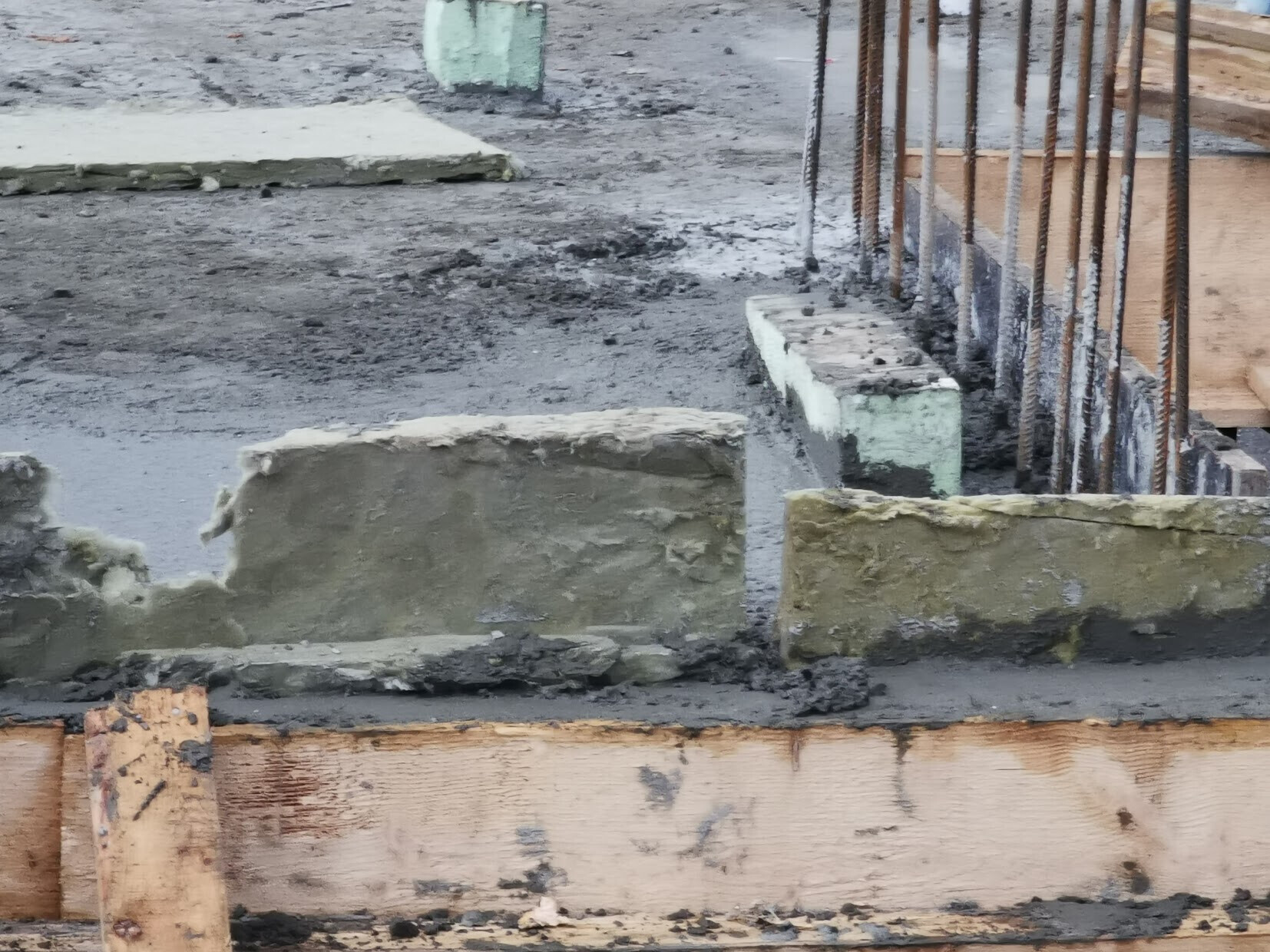
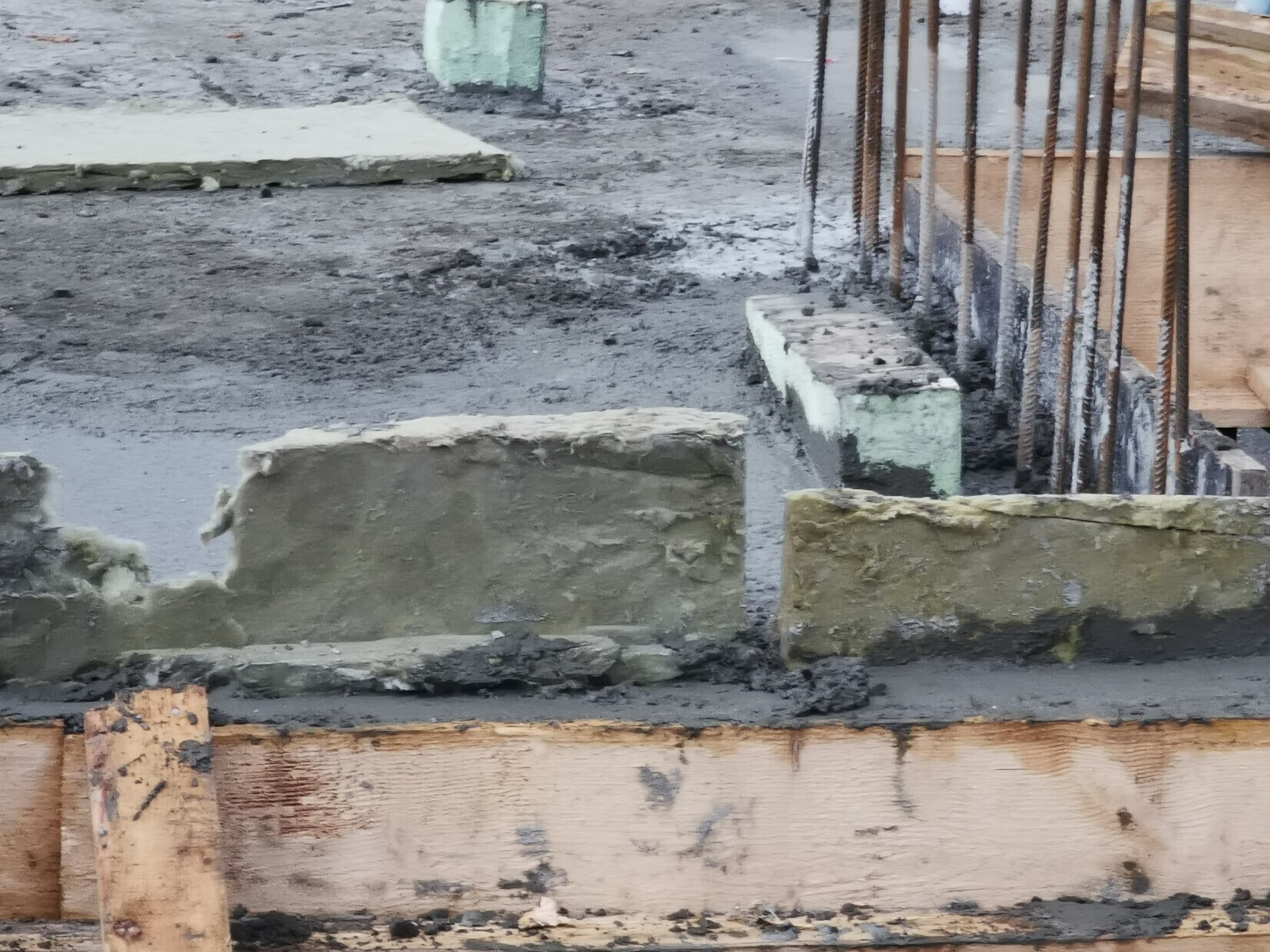
This is a row house. Mineral wool boards were installed between the buildings for sound insulation. At one externally visible spot, there is a gap of about 80cm (31.5 inches) depth and approximately 20cm (8 inches) height between the boards. After reporting the defect, the structural builder just “stuffed” mineral wool boards into the hole. According to our lawyer, this does not reliably ensure soundproofing.
Defect 4:
The area where the patio doors will later be installed was cast in concrete. Here, the reinforcing steel protrudes from the wall. According to the expert: This means that a proper bond between the reinforcing steel and concrete is not sufficiently ensured. It is assumed that adequate long-term corrosion protection of the reinforcement steel is not established. Furthermore, with insufficient concrete cover over the reinforcing steel, adequate fire protection is not guaranteed.
Defect 5:
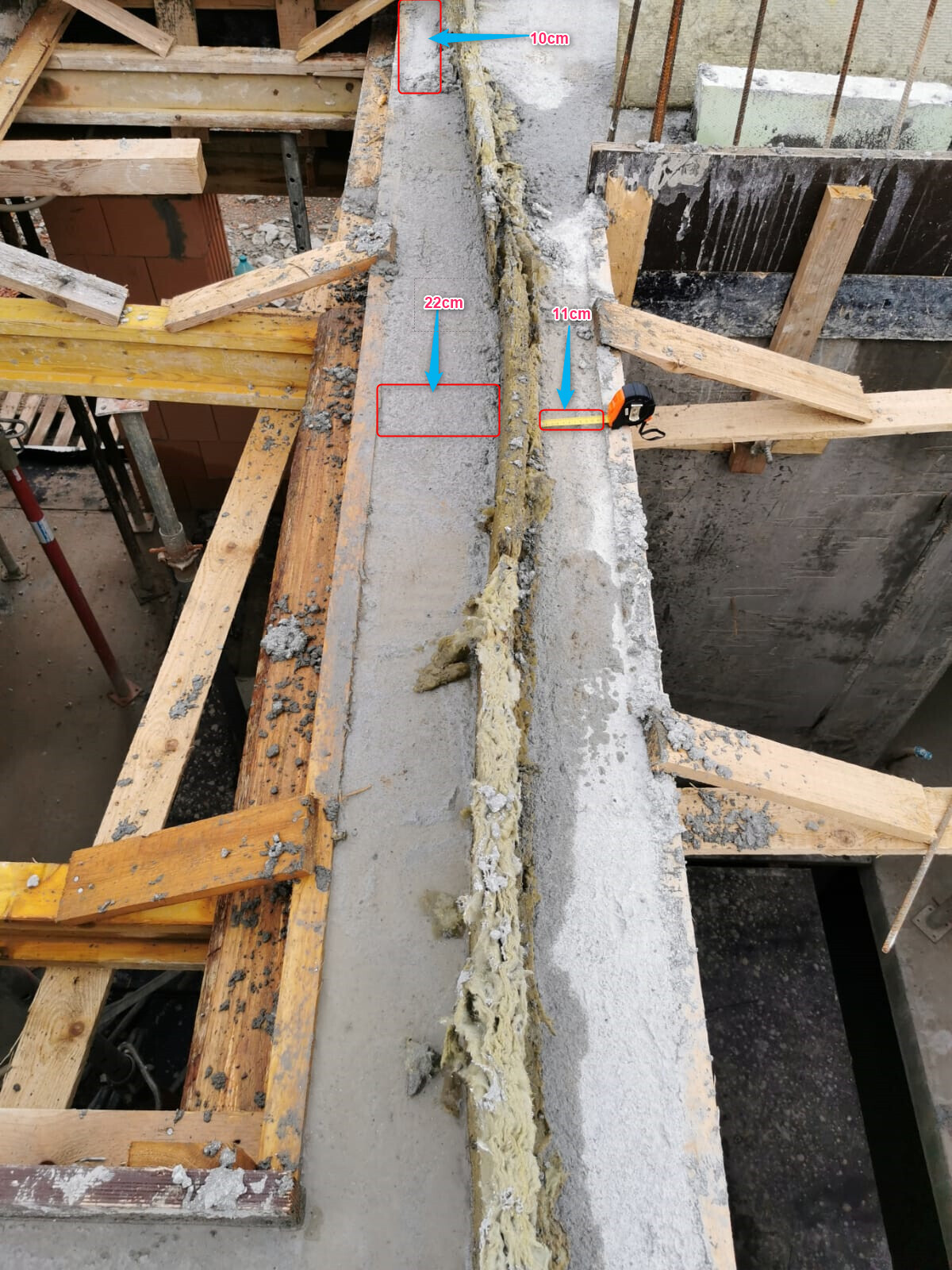
In the floor slab area, the mineral wool board was not properly secured. As a result, it is quite wavy. This is particularly problematic in the stairwell area, where in some places only 10cm (4 inches) of concrete remain above the mineral wool board. The partition wall bricks have a thickness of 17.5cm (7 inches), though.
Defect 6:
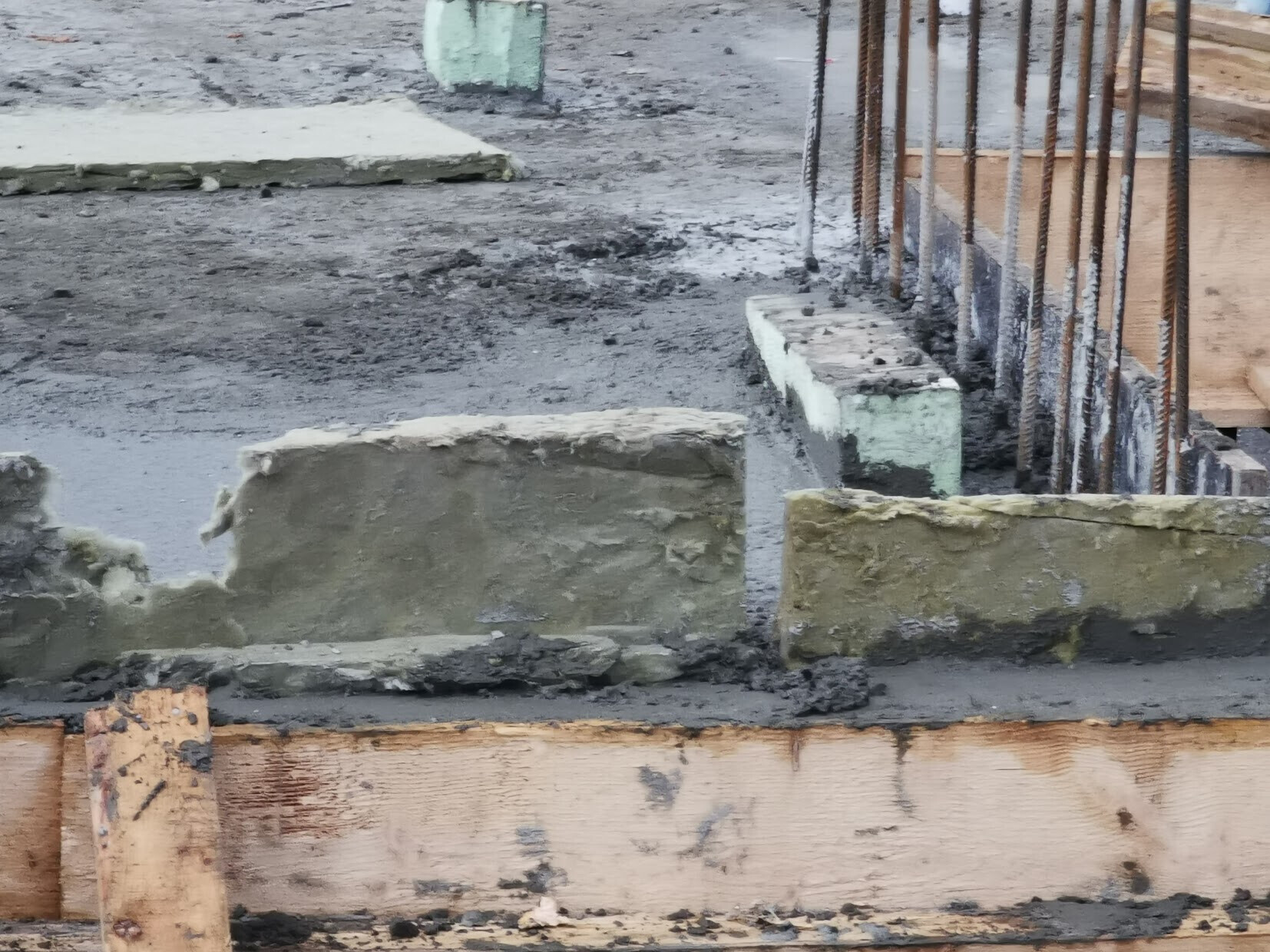
The mineral wool boards were not installed tightly enough in some areas, allowing concrete to seep between the boards and create a sound bridge.
These are the (known) defects so far. I would greatly appreciate it if anyone could roughly estimate the costs associated with these defects.
Thank you very much in advance.
The ceiling above the ground floor has just been concreted on our site. According to the payment schedule, a partial payment of approximately €30,000 is due.
However, our expert has identified several defects. These were formally reported to the general contractor (GC) with deadlines. The first deadline (2 weeks) passed without the defects being resolved; the second deadline is still running until Thursday (also 2 weeks).
So far, we have withheld about €17,000 of the €30,000. Our GC considers this amount far too high and insists on payment.
Since we are currently concerned about the potential insolvency of the GC (the structural builder, brick supplier, steel supplier, and light well supplier have not been paid), we want to keep the deduction as high as possible. However, since we are not construction professionals and want to avoid the risk that withholding too much for defects could backfire, I hope that some experts here can provide us with a rough cost estimate.
P.S. Our lawyer has been contacted, but the appointment is only scheduled for 17.02, and I fear we cannot hold off the GC until then.
Defect 1:
At the transition between the basement and the ground floor, no damp-proof course was installed at the base of the first course of blocks.
The basement is already fully lined with Styrodur insulation, and the excavation pit has been backfilled.
Defect 2:
In some areas of the structural shell, the minimum offset of the bricks was not observed; in places, up to 7 courses of bricks were laid directly on top of each other.
Defect 3:
This is a row house. Mineral wool boards were installed between the buildings for sound insulation. At one externally visible spot, there is a gap of about 80cm (31.5 inches) depth and approximately 20cm (8 inches) height between the boards. After reporting the defect, the structural builder just “stuffed” mineral wool boards into the hole. According to our lawyer, this does not reliably ensure soundproofing.
Defect 4:
The area where the patio doors will later be installed was cast in concrete. Here, the reinforcing steel protrudes from the wall. According to the expert: This means that a proper bond between the reinforcing steel and concrete is not sufficiently ensured. It is assumed that adequate long-term corrosion protection of the reinforcement steel is not established. Furthermore, with insufficient concrete cover over the reinforcing steel, adequate fire protection is not guaranteed.
Defect 5:
In the floor slab area, the mineral wool board was not properly secured. As a result, it is quite wavy. This is particularly problematic in the stairwell area, where in some places only 10cm (4 inches) of concrete remain above the mineral wool board. The partition wall bricks have a thickness of 17.5cm (7 inches), though.
Defect 6:
The mineral wool boards were not installed tightly enough in some areas, allowing concrete to seep between the boards and create a sound bridge.
These are the (known) defects so far. I would greatly appreciate it if anyone could roughly estimate the costs associated with these defects.
Thank you very much in advance.

Kishihmen schrieb:
It would be nice if this were a misdiagnosis. May I ask why? And yes, the overlap dimension was not followed in some places.I probably expressed myself too absolutely: I consider a misdiagnosis possible – at the mortar-“skimmed” areas, the actual joint is unclear in the photo. I attached where I see the incorrect spots.Kishihmen schrieb:
But at the moment, I don’t see a way around involving a lawyer.You should definitely involve one – but don’t get your hopes up too high.Kishihmen schrieb:
Honestly, I don’t really understand that sentence. From my perspectiveThat’s exactly the catch: if the defects were undisputed or established, withholding payment would be appropriate. But as it stands, this will certainly become a legal dispute. Also, a high retention does not guarantee your protection. See my explanations about the timing of insolvency and the risk of reclaiming withheld funds. If a trustee is appointed following an insolvency filing, they will challenge the legality of the retention, claim back the withheld amount, and at best return some of it proportionally (and only at the end of a lengthy process!) if your claims were filed correctly and on time.Kishihmen schrieb:
I have also researched the topic of insolvency. However, I don’t want to proceed without legal advice here.Yes, that’s why I recommended a lawyer. It’s better for your lawyer to communicate with the other creditors and also with the public prosecutor.Kishihmen schrieb:
I can’t just continue construction and consider the contract terminated.Most likely, @Snowy36 wanted to say something similar in different words, essentially in the same direction: that you should take Dante’s advice and abandon all hope. The old Fleischerhaus thread was titled “Construction company stops work despite overpayment.” And we probably see the same here: even if you think you have already paid too much based on construction progress—and especially based on “usable” progress—the general contractor will see it differently, won’t formally terminate the contract, but will default on performance—which effectively means zero construction (or ruins) progress.https://www.instagram.com/11antgmxde/
https://www.linkedin.com/company/bauen-jetzt/
K
knalltüte10 Feb 2021 07:38Kishihmen schrieb:
...
Defect 1:
At the junction between the basement and the ground floor, no base waterproofing was applied to the first row of bricks.
The basement is already fully glued with Styrodur, and the excavation pit has been backfilled.
...Considering the construction, I would also wonder why the excavation pit has already been backfilled. Isn’t that rather unusual at this stage of construction (due to scaffolding)?
Could this have been done to conceal errors or defects in the work? Depending on how the rest of the planned waterproofing was executed, this could lead to significant problems...
Overall, I sense a trend in the comments as if to say: It’s not possible to continue with this general contractor. The priority should be to exit the contract legally and properly, working with a SPECIALIST lawyer and an expert assessor. At the same time, start looking for alternatives (general contractor, or separate contractors, etc.) but avoid rushing into new contracts 😳
Also, be sure to roughly plan for major construction delays financially and logistically (moving, termination deadlines, follow-up trades, applications with utility providers), and so on.
11ant schrieb:
I may have stated it too absolutely: I consider a misdiagnosis possible – in the areas where mortar has been "smoothed over," the actual joint is unclear in the picture. I’ve attached where I see the incorrect spots.
You should definitely involve someone – but don’t get your hopes up too high.
That’s exactly where the problem lies: if the defects were undisputed or confirmed, withholding payment would be appropriate. But as it stands, this will most likely become a legal dispute. Even a high retention doesn’t guarantee your protection; see my explanations regarding the timing of insolvency and the risk of having funds reclaimed. If an insolvency administrator is appointed, they will challenge the legality of the retention, demand the withheld amount back, and with some luck (and after the end of a years-long process!) you might recover a portion proportionate to your claim, provided you filed it correctly and on time.
Yes, I did recommend a lawyer. It’s better if your lawyer contacts the other creditors and the public prosecutor rather than you doing it.
Presumably, @Snowy36 wanted to express the same thing differently than I did, essentially meaning you should follow Dante’s advice and abandon all hope. The old Fleischerhaus thread was titled “Construction company stops work despite overpayment.” And that’s probably what we’re looking at here as well: even if you think you’ve already paid too much based on construction progress – and even more so on "usable" construction progress – the general contractor will see it differently and won’t formally terminate the contract but will be in default of performance – which effectively means zero progress on the construction (a building site ruin).Exactly that’s what I wanted to say, or make clear to the original poster (as unfair as it is): you can’t wait until the dispute is resolved because this general contractor won’t continue for now … and because of insolvency and so on, you won’t see any money from them either … so here’s the sadly realistic assessment in advance (if the original poster eventually wants to move into a house): this is going nowhere, you have to look for a new contractor in parallel and get out of the contract with the old one …
K
Kishihmen10 Feb 2021 10:0711ant schrieb:
That’s exactly where the problem lies: if the defects were undisputed or already confirmed, withholding payment would be appropriate. But as it stands, this is sure to become a legal dispute. Also, a large retention doesn’t necessarily protect you—read my explanation about the timing of insolvency and the risk of repayment claims. If an administrator is appointed following a bankruptcy filing, they will challenge the legality of the retention, demand the withheld amount, and if you are lucky (and after years of proceedings!) you might recover a portion according to the distribution quota, provided you submitted your claims properly and on time. How can I make these defects become “undisputed”? Do I even have a chance?
superzapp schrieb:
Considering the construction progress, I would also ask why the excavation pit has already been backfilled. Isn’t that unusual at this stage of construction (because of scaffolding)? I need to explain a bit here. The basement was built by a different shell/concrete contractor. He did very clean work (also approved by the expert). The problem was that he was also very slow (almost 4 months)—the result was that he didn’t get paid either. According to the general contractor, this was due to the extreme delay and corresponding contractual penalties. Before leaving the site, the former shell contractor reported the situation to the construction site safety authority, which then ordered a work stop due to fall hazards until the excavation pit was backfilled or other safety measures were taken.
Snowy36 schrieb:
This won’t work anymore—you need to find a new contractor in parallel and get out of the contract with the old one.... Are there any experiences with this?
Does a new general contractor take over the plans from the previous one and continue construction? How is warranty handled in such a case? Or would hiring an architect be a better option?
Who was responsible for the site supervision? Site supervision is the client’s obligation.
The poor installation of the separation layer between the buildings should have been noticed before concreting. The missing waterproofing on the masonry wall as well.
These shoddy workmanship cases seem common. As [USER=32750]@11ant points out, they are criticized in about every second post.
Since the defects cannot be remedied without disproportionate effort, the general contractor will not fix them.
I would refuse partial acceptance, then you can negotiate payment with the contractor (insolvency administrator).
Prepare your counterclaims thoroughly. In my opinion, they exceed the entire progress payment.
Are you building both halves of the house?
The poor installation of the separation layer between the buildings should have been noticed before concreting. The missing waterproofing on the masonry wall as well.
These shoddy workmanship cases seem common. As [USER=32750]@11ant points out, they are criticized in about every second post.
Since the defects cannot be remedied without disproportionate effort, the general contractor will not fix them.
I would refuse partial acceptance, then you can negotiate payment with the contractor (insolvency administrator).
Prepare your counterclaims thoroughly. In my opinion, they exceed the entire progress payment.
Are you building both halves of the house?
Similar topics