
ᐅ Withholding Payments for Defects in the Shell Construction Phase
Created on: 9 Feb 2021 16:57
K
KishihmenK
Kishihmen9 Feb 2021 16:57Hello everyone,
The ceiling above the ground floor has just been concreted on our site. According to the payment schedule, a partial payment of approximately €30,000 is due.
However, our expert has identified several defects. These were formally reported to the general contractor (GC) with deadlines. The first deadline (2 weeks) passed without the defects being resolved; the second deadline is still running until Thursday (also 2 weeks).
So far, we have withheld about €17,000 of the €30,000. Our GC considers this amount far too high and insists on payment.
Since we are currently concerned about the potential insolvency of the GC (the structural builder, brick supplier, steel supplier, and light well supplier have not been paid), we want to keep the deduction as high as possible. However, since we are not construction professionals and want to avoid the risk that withholding too much for defects could backfire, I hope that some experts here can provide us with a rough cost estimate.
P.S. Our lawyer has been contacted, but the appointment is only scheduled for 17.02, and I fear we cannot hold off the GC until then.
Defect 1:
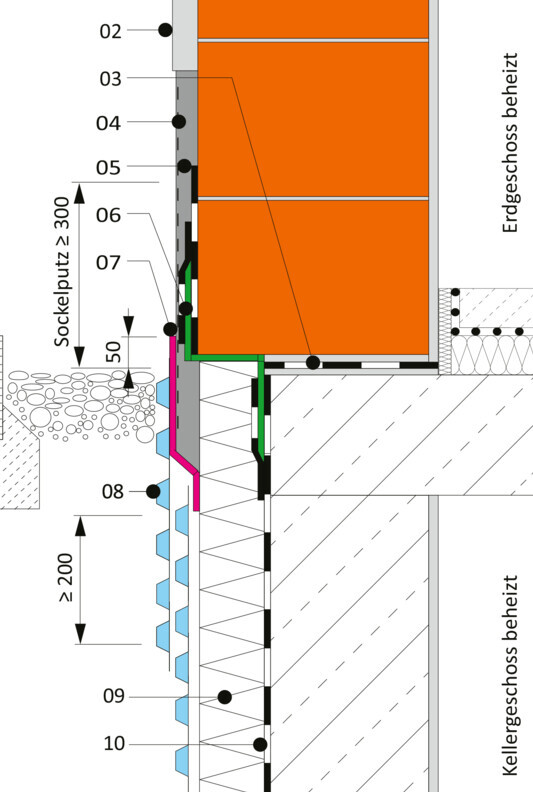
At the transition between the basement and the ground floor, no damp-proof course was installed at the base of the first course of blocks.
The basement is already fully lined with Styrodur insulation, and the excavation pit has been backfilled.
Defect 2:
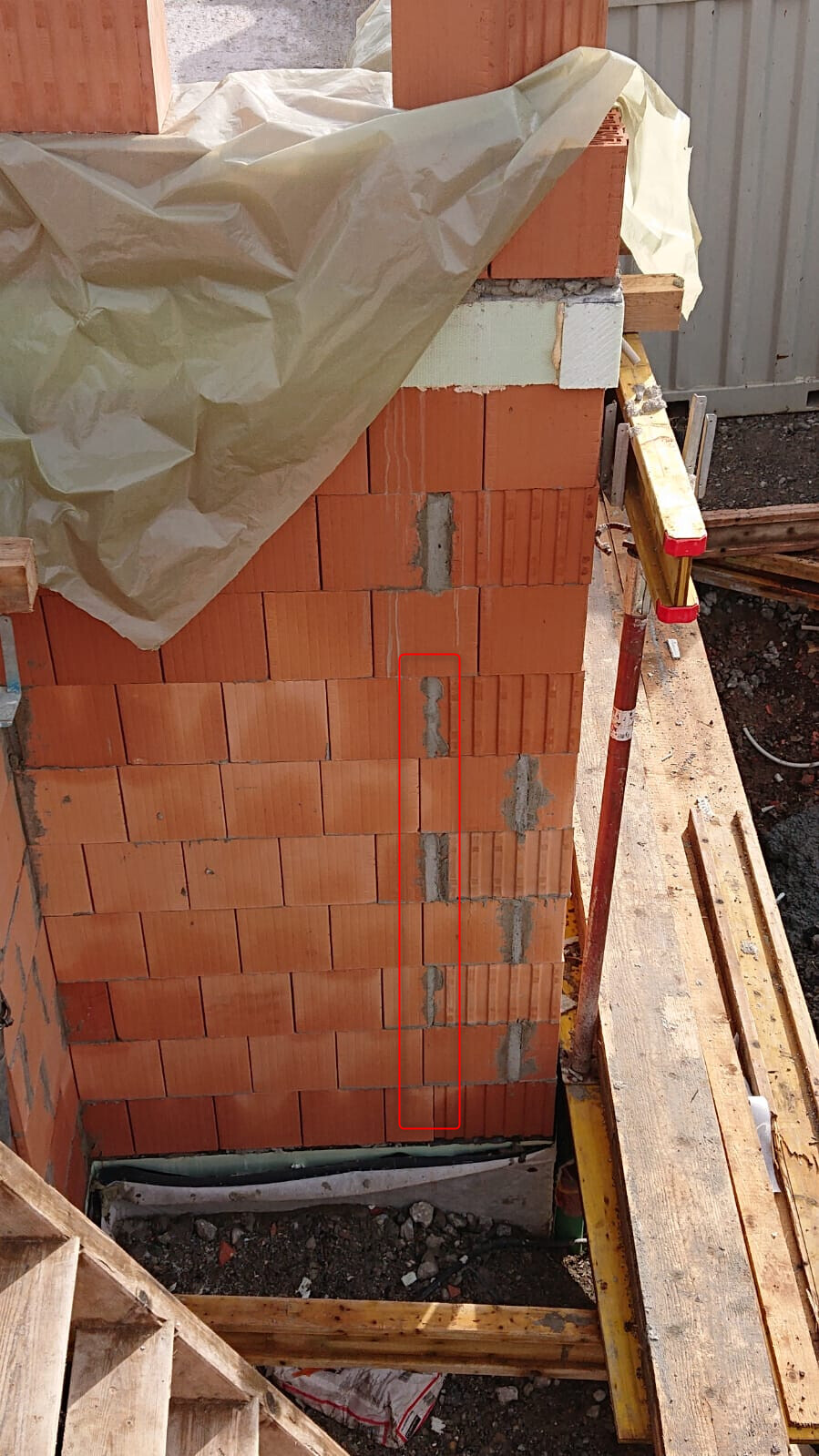
In some areas of the structural shell, the minimum offset of the bricks was not observed; in places, up to 7 courses of bricks were laid directly on top of each other.
Defect 3:
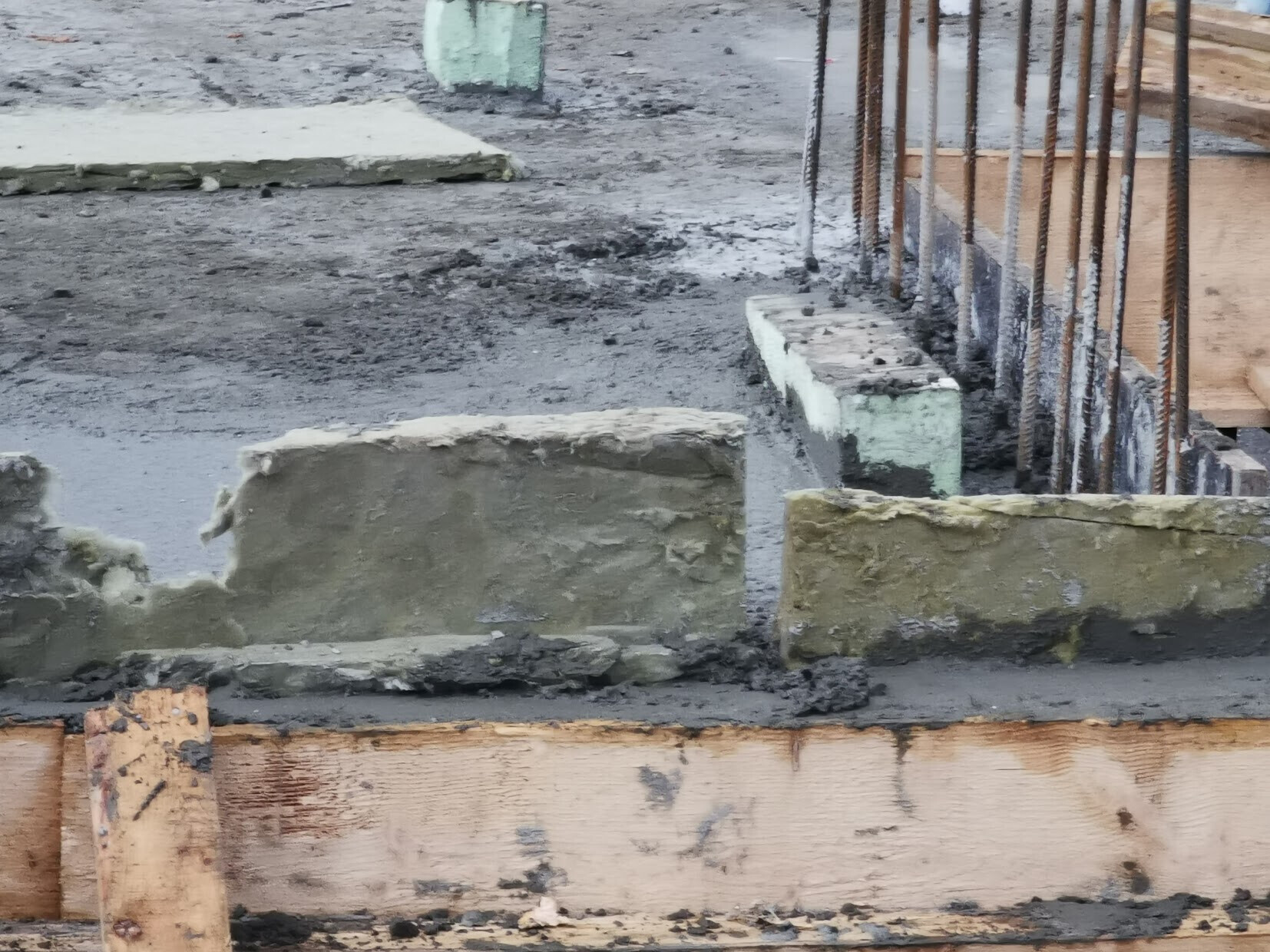
This is a row house. Mineral wool boards were installed between the buildings for sound insulation. At one externally visible spot, there is a gap of about 80cm (31.5 inches) depth and approximately 20cm (8 inches) height between the boards. After reporting the defect, the structural builder just “stuffed” mineral wool boards into the hole. According to our lawyer, this does not reliably ensure soundproofing.
Defect 4:
The area where the patio doors will later be installed was cast in concrete. Here, the reinforcing steel protrudes from the wall. According to the expert: This means that a proper bond between the reinforcing steel and concrete is not sufficiently ensured. It is assumed that adequate long-term corrosion protection of the reinforcement steel is not established. Furthermore, with insufficient concrete cover over the reinforcing steel, adequate fire protection is not guaranteed.
Defect 5:
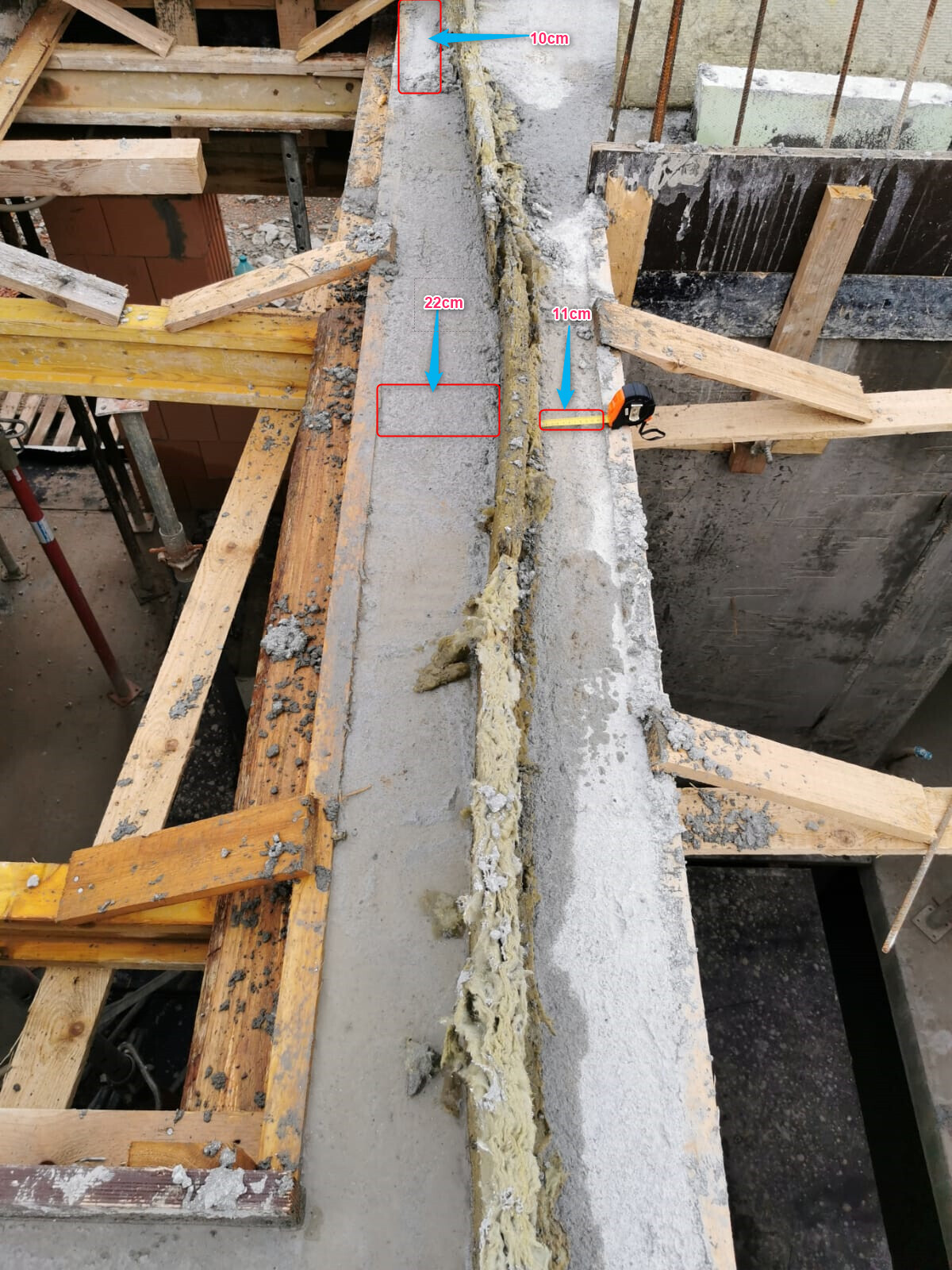
In the floor slab area, the mineral wool board was not properly secured. As a result, it is quite wavy. This is particularly problematic in the stairwell area, where in some places only 10cm (4 inches) of concrete remain above the mineral wool board. The partition wall bricks have a thickness of 17.5cm (7 inches), though.
Defect 6:
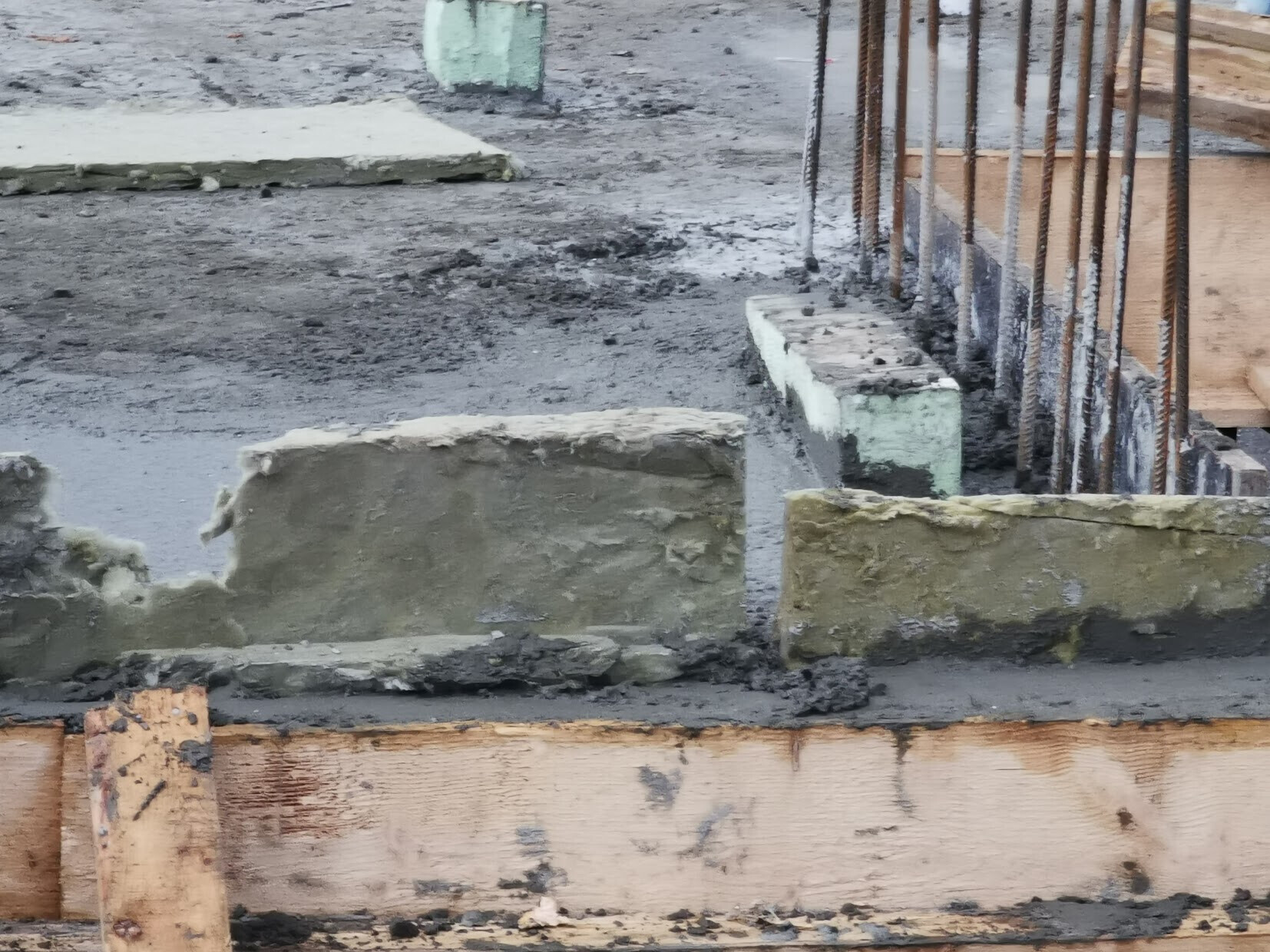
The mineral wool boards were not installed tightly enough in some areas, allowing concrete to seep between the boards and create a sound bridge.
These are the (known) defects so far. I would greatly appreciate it if anyone could roughly estimate the costs associated with these defects.
Thank you very much in advance.
The ceiling above the ground floor has just been concreted on our site. According to the payment schedule, a partial payment of approximately €30,000 is due.
However, our expert has identified several defects. These were formally reported to the general contractor (GC) with deadlines. The first deadline (2 weeks) passed without the defects being resolved; the second deadline is still running until Thursday (also 2 weeks).
So far, we have withheld about €17,000 of the €30,000. Our GC considers this amount far too high and insists on payment.
Since we are currently concerned about the potential insolvency of the GC (the structural builder, brick supplier, steel supplier, and light well supplier have not been paid), we want to keep the deduction as high as possible. However, since we are not construction professionals and want to avoid the risk that withholding too much for defects could backfire, I hope that some experts here can provide us with a rough cost estimate.
P.S. Our lawyer has been contacted, but the appointment is only scheduled for 17.02, and I fear we cannot hold off the GC until then.
Defect 1:
At the transition between the basement and the ground floor, no damp-proof course was installed at the base of the first course of blocks.
The basement is already fully lined with Styrodur insulation, and the excavation pit has been backfilled.
Defect 2:
In some areas of the structural shell, the minimum offset of the bricks was not observed; in places, up to 7 courses of bricks were laid directly on top of each other.
Defect 3:
This is a row house. Mineral wool boards were installed between the buildings for sound insulation. At one externally visible spot, there is a gap of about 80cm (31.5 inches) depth and approximately 20cm (8 inches) height between the boards. After reporting the defect, the structural builder just “stuffed” mineral wool boards into the hole. According to our lawyer, this does not reliably ensure soundproofing.
Defect 4:
The area where the patio doors will later be installed was cast in concrete. Here, the reinforcing steel protrudes from the wall. According to the expert: This means that a proper bond between the reinforcing steel and concrete is not sufficiently ensured. It is assumed that adequate long-term corrosion protection of the reinforcement steel is not established. Furthermore, with insufficient concrete cover over the reinforcing steel, adequate fire protection is not guaranteed.
Defect 5:
In the floor slab area, the mineral wool board was not properly secured. As a result, it is quite wavy. This is particularly problematic in the stairwell area, where in some places only 10cm (4 inches) of concrete remain above the mineral wool board. The partition wall bricks have a thickness of 17.5cm (7 inches), though.
Defect 6:
The mineral wool boards were not installed tightly enough in some areas, allowing concrete to seep between the boards and create a sound bridge.
These are the (known) defects so far. I would greatly appreciate it if anyone could roughly estimate the costs associated with these defects.
Thank you very much in advance.
K
knalltüte9 Feb 2021 17:06I have never seen a soft mineral fiber mat used loosely as sound insulation placed inside the formwork, and I neither consider this approach compliant with standards nor effective. It is obvious that at least in a few spots, a sound bridge will form. In my opinion, this cannot be fixed later (or only by dismantling) and would cause me considerable concern. Soundproofing between residential units or semi-detached houses is regularly a contentious issue.
Therefore, without wanting to preempt your lawyer, I think the amount is too low. The damage, as described above, can only (in my view) be remedied by dismantling. The remaining amount will not be sufficient for that…
Regarding the missing overlap, a structural engineer should give an opinion, but it certainly depends on the structural role of the wall in question.
P.S. It also looks sloppy in some other areas. However, more pictures would certainly be needed for that.
Therefore, without wanting to preempt your lawyer, I think the amount is too low. The damage, as described above, can only (in my view) be remedied by dismantling. The remaining amount will not be sufficient for that…
Regarding the missing overlap, a structural engineer should give an opinion, but it certainly depends on the structural role of the wall in question.
P.S. It also looks sloppy in some other areas. However, more pictures would certainly be needed for that.


Kishihmen schrieb:
In some areas of the shell construction, the minimum offset of the bricks was not observed; up to 7 rows of bricks were laid directly above each other in places. The circled spots seem more like a misdiagnosis to me; I see violations of the overlap dimension at three places not marked.
Kishihmen schrieb:
Defect 5: In the area of the floor slab, the mineral wool board was not secured. As a result, it is quite uneven. By "area of the floor slab," you probably mean the ring beam here. It seems the mats were used here—if at all, boards rather than mats would have been more suitable—as lost formwork. This is quite questionable.
How much hiring a lawyer helps, you can read about at the butcher’s house from @Hausbau2019 (@Hausbau0815)—there you can also verify the validity of your boomerang concern.
I see a big dilemma here: your retention amount is at the same time disproportionately high and inappropriately low—both significantly so.
Kishihmen schrieb:
Currently, we fear a possible insolvency of the general contractor (foundation builder not paid, brick supplier not paid, steel supplier not paid, light well supplier not paid), so we want to keep the deduction as high as possible. The points you mentioned strongly suggest a possible insolvency. However, what matters most is whether an insolvency actually exists. You should urgently discuss with your lawyer addressing the named creditors regarding the option of a “third-party insolvency petition” and also notify the public prosecutor about the suspicion of delayed insolvency filing.
Regarding suspected insolvency of general contractors, I frequently encounter two widespread misconceptions. I often read about the fear that the GC would file for insolvency (and the concern that this would worsen the position of the client as the project creditor). These are two misunderstandings: 1. An insolvency exists if it exists—not when the managing director bothers to notify the court. Reporting insolvency is not optional but a legal obligation of the managing director (self-application). For the legal effects of insolvency, it is essential that it actually exists—not when it becomes publicly known. Therefore, it is also a criminal offense for those obliged to report to conceal and thus delay it. A creditor therefore has no reason to hope that the general contractor will delay insolvency filing. 2a. It is often thought that one depends on the managing director of the general contractor fulfilling their duty to notify the court of a possible insolvency. The insolvency code explicitly provides creditors the option to have a justified suspicion of insolvency checked by filing a third-party petition. A creditor group that regularly uses this option is health insurance funds as collection agents for social contributions. 2b. It is believed that insolvency filing is a sword of Damocles hanging over creditors’ heads and that without this filing, the debtor can act more freely for the benefit of everyone involved: NEITHER is TRUE!!!
The insolvency itself—not its filing—is the sword of Damocles, and all transactions conducted after its occurrence are generally at risk of clawback. Creditors usually are the losers in delayed insolvency filing!
https://www.instagram.com/11antgmxde/
https://www.linkedin.com/company/bauen-jetzt/
An unpleasant forecast from me: you won’t pay the 17,000, you’ll have to have it demolished and find someone to rebuild it... that person will charge more than the previous one... you’ll be stuck with 30,000. He is insolvent and will start over somewhere else...
Continuing to build with this: NO way.
Because if you start arguing now and wait until you find a solution, so much time will pass that it will hurt financially again... and whoever puts something like that up: you can’t negotiate or talk normally with them.
Continuing to build with this: NO way.
Because if you start arguing now and wait until you find a solution, so much time will pass that it will hurt financially again... and whoever puts something like that up: you can’t negotiate or talk normally with them.
K
Kishihmen9 Feb 2021 23:27First of all, thank you for the responses. I will try to address them.
It would be nice if that were a misdiagnosis. May I ask why? And yes, the overlap length was not maintained in several places.
The photo shows the separation between two terraced houses – and yes, it is very questionable.
Yes, I have read through that thread a bit. But at this point, I don’t see a way around involving a lawyer.
Honestly, I don’t really understand this sentence. From my point of view, I can basically retain double the amount required to fix the defect. Unfortunately, what I lack is a concrete reference to quantify the necessary funds.
I have also read up on insolvency issues. However, I don’t want to proceed without legal advice.
Well, I think there is no avoiding a dispute. We have a contract that is valid independently of defects. I cannot simply continue construction and consider the contract terminated... 🙁
11ant schrieb:
The circled areas seem more like a misdiagnosis to me; I see violations of the overlap length at three places that are not circled.
It would be nice if that were a misdiagnosis. May I ask why? And yes, the overlap length was not maintained in several places.
11ant schrieb:
By "area of the floor slab" you probably mean ring beams here. The mats seem to have been used—as lost formwork, if at all more suitable would have been panels rather than mats. It all looks very questionable.
The photo shows the separation between two terraced houses – and yes, it is very questionable.
11ant schrieb:
You can see how much involving a lawyer helps in the Fleischerhaus case from @Hausbau2019 (@Hausbau0815) – there you can also convince yourself of the validity of your boomerang concern.
Yes, I have read through that thread a bit. But at this point, I don’t see a way around involving a lawyer.
11ant schrieb:
I see a big dilemma here: your retention is both disproportionately high and insufficiently low – both to a considerable extent.
Honestly, I don’t really understand this sentence. From my point of view, I can basically retain double the amount required to fix the defect. Unfortunately, what I lack is a concrete reference to quantify the necessary funds.
I have also read up on insolvency issues. However, I don’t want to proceed without legal advice.
Snowy36 schrieb:
Because if you start disputing now and wait until you find a solution, so much time will pass that it will hurt financially again... and whoever presents it like this: you cannot negotiate or talk with him normally.
Well, I think there is no avoiding a dispute. We have a contract that is valid independently of defects. I cannot simply continue construction and consider the contract terminated... 🙁
Similar topics