
Hello everyone,
By chance, we noticed yesterday that condensation is forming between the roofing underlay and the insulation batt in our new build.
The insulation setup is as follows: roofing underlay, 22cm (9 inches) insulation batt with a thermal conductivity of 0.035 W/(m·K), vapor barrier.
All overlaps of the vapor barrier are taped, wall connections have been sealed with membrane adhesive, and roof penetrations are also sealed with tape.
Plastering was done in November and a flowing screed was installed shortly before Christmas.
The underfloor heating has been running for almost two weeks now.
The moisture on the roofing underlay has already started to leave marks on the rafters behind it. How would you proceed from here? We are running three construction dryers alongside the heating, which are collecting a significant amount of moisture. Unfortunately, due to the current weather conditions, the condensation is not likely to disappear on its own anytime soon...
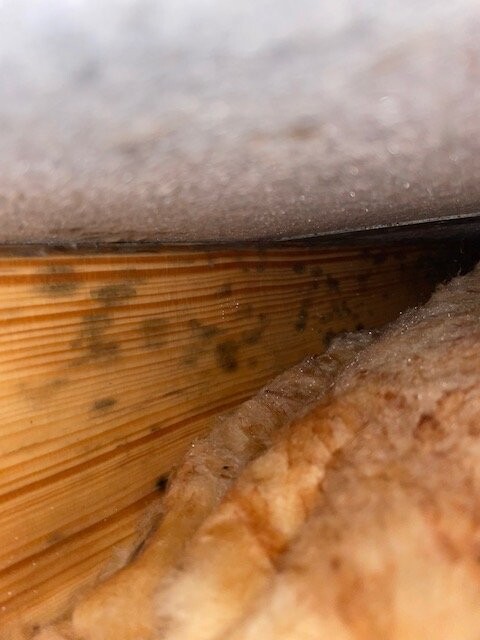
By chance, we noticed yesterday that condensation is forming between the roofing underlay and the insulation batt in our new build.
The insulation setup is as follows: roofing underlay, 22cm (9 inches) insulation batt with a thermal conductivity of 0.035 W/(m·K), vapor barrier.
All overlaps of the vapor barrier are taped, wall connections have been sealed with membrane adhesive, and roof penetrations are also sealed with tape.
Plastering was done in November and a flowing screed was installed shortly before Christmas.
The underfloor heating has been running for almost two weeks now.
The moisture on the roofing underlay has already started to leave marks on the rafters behind it. How would you proceed from here? We are running three construction dryers alongside the heating, which are collecting a significant amount of moisture. Unfortunately, due to the current weather conditions, the condensation is not likely to disappear on its own anytime soon...
B
borderpuschl4 Feb 2021 08:47How did you take the photo? Did you cut the vapor barrier again?

About 14 months ago, we experienced a similar issue with our new build – here’s how it ended:
Everything had to be completely removed. During winter, we dried everything thoroughly using over 30kW heating power. The beams were treated preventively with H2O2 (they already showed blue stain like yours; if it were only blue stain, it wouldn’t be a severe health risk, but who wants to take that chance in a new build?). Everything was then rebuilt with new insulation. Afterwards, a blower door test was performed. The general contractor and the drying company settled the costs, including construction power for heating and drying.
The mood among everyone involved wasn’t great at that time…
It doesn’t have to be as bad for you. But don’t let anyone brush it off, and make sure all areas of the roof are inspected, including wood moisture measurements. Is it possible for you to have targeted ventilation behind the rafters or insulation?
Edit: Your drywall ceiling is already finished, which obviously makes inspection much more difficult. And possibly the willingness of the tradespeople to inspect it thoroughly…
Extreme construction / residual moisture combined with cold outdoor temperatures leave no room for errors. In our case, it was due to suboptimal sealing at the overlap joints of the vapor retarder, a missing layer of insulation up to the ridge beam, combined with poorly sealed roof penetrations and empty conduits. Probably little would have happened in summer, but in winter, the entire insulation literally got soaked – and I mean that literally! In the end, there were real puddles between the vapor retarder and the insulation.
Everything had to be completely removed. During winter, we dried everything thoroughly using over 30kW heating power. The beams were treated preventively with H2O2 (they already showed blue stain like yours; if it were only blue stain, it wouldn’t be a severe health risk, but who wants to take that chance in a new build?). Everything was then rebuilt with new insulation. Afterwards, a blower door test was performed. The general contractor and the drying company settled the costs, including construction power for heating and drying.
The mood among everyone involved wasn’t great at that time…
It doesn’t have to be as bad for you. But don’t let anyone brush it off, and make sure all areas of the roof are inspected, including wood moisture measurements. Is it possible for you to have targeted ventilation behind the rafters or insulation?
Edit: Your drywall ceiling is already finished, which obviously makes inspection much more difficult. And possibly the willingness of the tradespeople to inspect it thoroughly…
Extreme construction / residual moisture combined with cold outdoor temperatures leave no room for errors. In our case, it was due to suboptimal sealing at the overlap joints of the vapor retarder, a missing layer of insulation up to the ridge beam, combined with poorly sealed roof penetrations and empty conduits. Probably little would have happened in summer, but in winter, the entire insulation literally got soaked – and I mean that literally! In the end, there were real puddles between the vapor retarder and the insulation.
Given the temperatures and construction status, some condensation between the roofing underlay and insulation is likely to occur (for example, due to residual moisture in the masonry/reinforced concrete ring beam in the area between the vapor retarder and the roofing underlay) and would probably dry out to some extent again during the summer.
The blue discoloration is, of course, not a good sign; how does the insulation feel? Is it only damp on the surface or already heavy/saturated?
The blue discoloration is, of course, not a good sign; how does the insulation feel? Is it only damp on the surface or already heavy/saturated?
borderpuschl schrieb:
How did you take that photo? Did you cut open the vapor barrier again? dab_dab schrieb:
Given the temperatures and the current stage of construction, some condensation between the underlay membrane and the insulation is probably normal (for example, due to residual moisture in the masonry or ring beam in the area between the vapor barrier and the underlay membrane) and would likely dry out again to some extent during the summer.
The blue discoloration is obviously not a good sign; how does the insulation feel? Just damp on the surface, or already heavy/saturated? I only discovered the issue by chance. Since condensation was being transported at the location of the roof rafter support via the antenna cables, I opened the vapor barrier at that spot. I noticed that the top layer (about 5-10% of the insulation) was wet. I was only able to take the photo in this area because I moved part of the insulation aside. Becoming concerned, I opened the vapor barrier in several places and found the same issue. Additionally, at some points, I detected moisture directly behind the vapor barrier, which is probably due to the fact that the respective clamp insulation pieces are not tightly fitted together there, allowing water to pass through a gap.
Similar topics