
Hello everyone,
We bought a house built in 1909 in the Greater Stuttgart area that needs renovation because we liked the location and the plot. The plan was to completely renovate it. Now we are quite torn about whether building a new house makes more sense. Of course, I don’t expect this forum to make the decision for us 🙂 I just hope to get some input, as we are currently about 50/50 on both options.
In summary: The house can be renovated well, and all the experts who have inspected it have given positive feedback. The renovation is estimated to cost around €250,000. The question, however, is more of an economic nature: Does it really make sense to invest that much money into an old house? The plot and the zoning plan allow for a house about twice the current size. So the other idea is to demolish, build bigger, and rent out 1-2 units. The financing with the bank is also arranged. However, the potential risks of new construction and renting are causing us some concern.
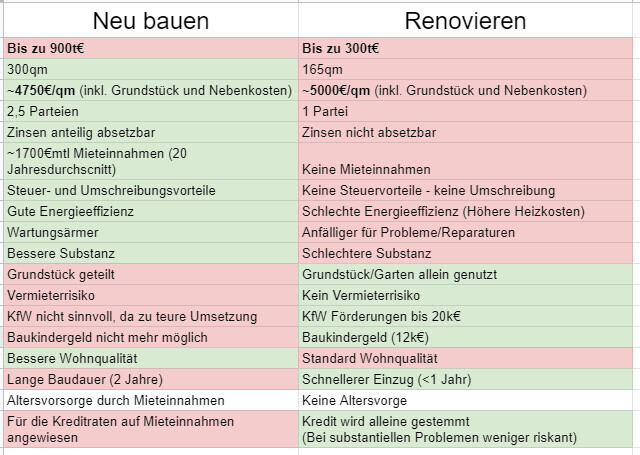
I don’t want to overwhelm you with lots of details. I have summarized everything in a pros and cons list. I look forward to your input or gut feelings.
We bought a house built in 1909 in the Greater Stuttgart area that needs renovation because we liked the location and the plot. The plan was to completely renovate it. Now we are quite torn about whether building a new house makes more sense. Of course, I don’t expect this forum to make the decision for us 🙂 I just hope to get some input, as we are currently about 50/50 on both options.
In summary: The house can be renovated well, and all the experts who have inspected it have given positive feedback. The renovation is estimated to cost around €250,000. The question, however, is more of an economic nature: Does it really make sense to invest that much money into an old house? The plot and the zoning plan allow for a house about twice the current size. So the other idea is to demolish, build bigger, and rent out 1-2 units. The financing with the bank is also arranged. However, the potential risks of new construction and renting are causing us some concern.
I don’t want to overwhelm you with lots of details. I have summarized everything in a pros and cons list. I look forward to your input or gut feelings.
solocan schrieb:
After 30 years, a newly built property will be larger and in like-new condition. It might also be worth it because it could be fully paid off by then.No, after 30 years every property will show signs of wear and deterioration unless you have carried out regular renovations and maintenance. The year the building was constructed does not indicate at all how well the occupants have taken care of it. And you cannot predict which colors, materials, and construction methods will be popular 30 years from now.As mentioned, with that budget you can practically achieve a house built to new construction standards.
H
hampshire3 Feb 2021 13:13First, approach this emotionally: Where would you prefer to live?
Then look at it from an economic perspective: Demolition and new construction require significantly more capital and are also more expensive in the long run. You can achieve the same rental income by purchasing apartments from the price difference (or even better, garages, as the rental risk is spread across multiple units, there are no utility cost settlements, fewer repairs—and depending on the area, even higher returns...).
And consider the risk aspect: Even after renovation, plan for a somewhat larger reserve for repairs and maintenance with the old house. Major issues can be insured. Simply include these costs and review the overall picture again.
There are also ongoing costs: During renovation, you will likely carry out energy efficiency measures (partially eligible for subsidies). Of course, there will still be a difference in operating costs. From an environmental perspective, preserving an existing building is more sensible when considering the overall picture.
Then look at it from an economic perspective: Demolition and new construction require significantly more capital and are also more expensive in the long run. You can achieve the same rental income by purchasing apartments from the price difference (or even better, garages, as the rental risk is spread across multiple units, there are no utility cost settlements, fewer repairs—and depending on the area, even higher returns...).
And consider the risk aspect: Even after renovation, plan for a somewhat larger reserve for repairs and maintenance with the old house. Major issues can be insured. Simply include these costs and review the overall picture again.
There are also ongoing costs: During renovation, you will likely carry out energy efficiency measures (partially eligible for subsidies). Of course, there will still be a difference in operating costs. From an environmental perspective, preserving an existing building is more sensible when considering the overall picture.
 Winniefred3 Feb 2021 13:38
solocan schrieb:
We don’t want to use the basement as living space either. The basement is mainly intended for storage. My main concern is that it can be very complicated to completely separate the basement climate from the living areas. In other words, if it ever becomes damp and musty in the basement, the smell will spread upstairs into the living spaces (which is a nightmare scenario for me). Since I have little experience with such old basements, it’s hard for me to assess this. Finding the original cause of moisture in the basement also seems difficult. The information is based solely on the neighbor’s memories. It could be the (now dried-out) rainwater storage in front of the basement, or the roof gutters, or simply leaking walls. Well, maybe that’s worth a new thread.
Before knocking off the plaster, the condition looked quite good. Nothing was crooked or anything like that. The house definitely has potential. Whether the defects found exceed what is reasonable, I’m not quite sure anymore. But so far, I haven’t heard many critical opinions here. That has encouraged me a bit.
I think I came across the wrong way. It’s not that we don’t know where to put the money, but for living alone we simply cannot afford any more expenses. The renovation budget was 150,000€ + 50,000€ backup. The above-mentioned issues already exceed the budget. If it comes down to building new, we WILL rely on rental income. Since we’re allowed to build bigger there, the idea is whether to build new and rent out part of it. Of course, it would be ideal to live on the property alone. We simply can’t afford that with a new build.
It’s about two units of approximately 100m² + 45m² (1076 sq ft + 484 sq ft). For these, the land would essentially be "free." Since here the land is very valuable and rents are high, we came up with this idea (currently about €12.5/m² average for existing properties). Tenant risk and expensive new construction costs also factor into this, which is why we are still undecided.You can insulate either the ground floor or the basement ceiling. Install a proper basement door, and that’s it. We notice no effect on our room climate from our damp basement (that’s actually what it’s called). It’s not musty or wet, just colder. If the basement is okay in the current damp and cold weather, then it will be fine in the future, and whatever problem there was has been fixed. If a basement is so damp that it smells musty and that odor spreads to living areas, then yes, that would be a problem. But you don’t have that problem.
I have a structural engineer in the family specialized in old buildings, who told me that depending on how much work you do yourself, a rough estimate for renovation is 700-1200€/m² (65-112 USD/sq ft). That would be around 198,000€ (218,000 USD) at the high end for your case, and of course costs can go higher. If you cannot afford the purchase price plus renovation, then you definitely can’t afford purchase plus demolition plus new build. Again, my questions: How old are the electrical systems, bathrooms, exterior plaster/render, interior plaster, roof, water pipes, heating, etc.? From the pictures, I don’t even think a full-scale renovation is necessary. But this is just a remote assessment, and it also depends on what you want. Besides “What do I want?” you have to honestly answer “What can I afford?” If you’re already nervous about replacing a few beams, then this project is probably too big for you, especially your plans for new build with renting out.
Ask yourselves these questions: What is the total budget we can realistically repay? What really needs to be done now, and what can wait? Which investments are truly worthwhile in the long run?
So far, we have spent about 500€/m² (46 USD/sq ft) on partial renovation. We updated 2 toilets, 1 bathroom, most windows, floors, interior doors, converted the attic, partially replastered and repaired walls, installed suspended ceilings, new radiators, new electrical wiring, and new sanitary rough-ins on 100m² (1076 sq ft). Heating, roof, and facade are still in good condition. Tiling, electrical work, and plumbing were done by professionals; the rest was done by us and remaining work will be done gradually as time and budget allow. Otherwise, we couldn’t have afforded this house.
Winniefred3 Feb 2021 13:40Tassimat schrieb:
No, after 30 years every property is worn out and shabby unless you have regularly renovated and refurbished it. The year it was built says absolutely nothing about how well the occupants have maintained it. And you can’t know yet which colors, materials, and construction methods will be popular in 30 years anyway.
As I said, with that budget you practically get a house up to new-build standard. Exactly. After 30 years, additional expenses will come up again and again. You are never really finished with a house. Not with maintenance and probably never with paying it off 😎
I would ask myself the following questions:
1. Do I want to rent out? If yes, will it be in my own house, or do I prefer "my home, my castle," and have the rest as condominiums, or add garages? Honestly, do you really want to live in a multi-family building where your garden becomes a tiny space after subtracting parking spots and a larger footprint?
2. What are the advantages of building a new single-family house?
3. What are the advantages of renovating an existing property?
4. Could you renovate in a way that fully meets your needs and expectations?
Renovating is pointless if the result doesn’t really suit you.
Basements in such old houses are not dry. They were never intended to be living space. They had to be storage rooms. Don’t ask how well potatoes and wine can be stored there.
Regarding water: Has a new housing development been built uphill in recent years or decades?
1. Do I want to rent out? If yes, will it be in my own house, or do I prefer "my home, my castle," and have the rest as condominiums, or add garages? Honestly, do you really want to live in a multi-family building where your garden becomes a tiny space after subtracting parking spots and a larger footprint?
2. What are the advantages of building a new single-family house?
3. What are the advantages of renovating an existing property?
4. Could you renovate in a way that fully meets your needs and expectations?
Renovating is pointless if the result doesn’t really suit you.
Basements in such old houses are not dry. They were never intended to be living space. They had to be storage rooms. Don’t ask how well potatoes and wine can be stored there.
Regarding water: Has a new housing development been built uphill in recent years or decades?
hampshire schrieb:
First, let's approach this emotionally: Where would you prefer to live? In Solitude Castle. But then we get worse loan conditions from the bank :p Just kidding. Of course, it’s nicer to have your own property and be alone. Sure. But I don’t imagine living in a multi-family house to be that bad. I’ve never experienced it any other way.
hampshire schrieb:
You can achieve the same rental income by buying apartments with the price difference. No, we really can’t. But okay. The difference isn’t huge, that’s true.
hampshire schrieb:
And regarding the risk assessment: For the old house, even with renovation, factor in a slightly larger reserve for repairs and maintenance. Major issues can be insured. Just account for these costs and look at the overall picture again. We actually tried to do that. That’s why the renovation in the table is calculated with €300,000 (not that we have that money saved up, but rather viewed over a few years what the renovated house would cost us).
Winniefred schrieb:
If a cellar is so damp that there is a musty smell that spreads into the living areas, yes, then that would be a problem. But that’s not an issue for you. Not at the moment. And those are exactly my main concerns.
Winniefred schrieb:
If you can’t afford the purchase price plus renovation, then you certainly can’t afford purchase plus demolition plus new build. I don’t understand. We have to manage the renovated single-family house ourselves. For the larger multi-family house, we need rental income. Our financial burden would remain the same.
Winniefred schrieb:
How old are the electrical system, bathrooms, external plaster/render, internal plaster, roof, water pipes, heating, etc.? From the pictures, I don’t even think a full renovation is necessary. Of course, this is just a remote assessment, and it depends on what you want. The building services (plumbing/electrical) need to be completely redone. External plastering is not necessary. The insulation does need to be redone anyway. Internal plastering also has to be almost entirely replaced. What’s true is that there’s no rush yet regarding the dormer windows and loft conversion.
Winniefred schrieb:
If you get nervous about replacing a few beams, then this project is too big for you, even more so your plans for new build with rental units. It’s not about getting nervous. I’ve already knocked out the entire infill; replacing beams would be the smaller problem. It’s just that I’m thinking whether a new build would be more economically sensible in the long term. Because once you invest in an old building, it’s invested. There’s no turning back. I’m the kind of person who “thinks things through before taking action.” So I’m just considering it carefully.
haydee schrieb:
4. Would you be able to renovate it in a way that covers your ideas and needs?
No use renovating if it actually doesn’t suit you. Certainly. The house would suit us. It was bought to renovate, not to demolish.
Similar topics