
Hello everyone,
We bought a house built in 1909 in the Greater Stuttgart area that needs renovation because we liked the location and the plot. The plan was to completely renovate it. Now we are quite torn about whether building a new house makes more sense. Of course, I don’t expect this forum to make the decision for us 🙂 I just hope to get some input, as we are currently about 50/50 on both options.
In summary: The house can be renovated well, and all the experts who have inspected it have given positive feedback. The renovation is estimated to cost around €250,000. The question, however, is more of an economic nature: Does it really make sense to invest that much money into an old house? The plot and the zoning plan allow for a house about twice the current size. So the other idea is to demolish, build bigger, and rent out 1-2 units. The financing with the bank is also arranged. However, the potential risks of new construction and renting are causing us some concern.
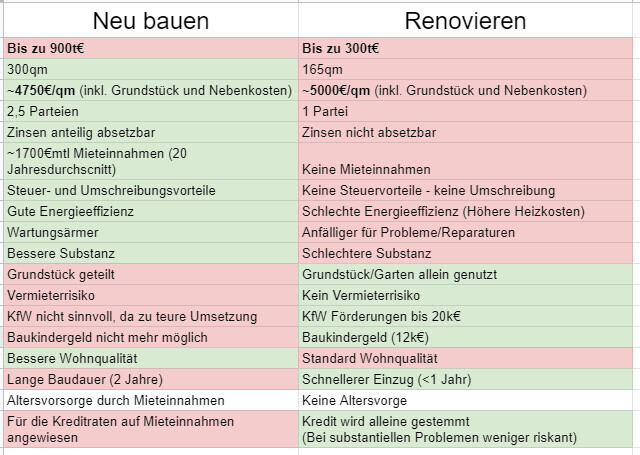
I don’t want to overwhelm you with lots of details. I have summarized everything in a pros and cons list. I look forward to your input or gut feelings.
We bought a house built in 1909 in the Greater Stuttgart area that needs renovation because we liked the location and the plot. The plan was to completely renovate it. Now we are quite torn about whether building a new house makes more sense. Of course, I don’t expect this forum to make the decision for us 🙂 I just hope to get some input, as we are currently about 50/50 on both options.
In summary: The house can be renovated well, and all the experts who have inspected it have given positive feedback. The renovation is estimated to cost around €250,000. The question, however, is more of an economic nature: Does it really make sense to invest that much money into an old house? The plot and the zoning plan allow for a house about twice the current size. So the other idea is to demolish, build bigger, and rent out 1-2 units. The financing with the bank is also arranged. However, the potential risks of new construction and renting are causing us some concern.
I don’t want to overwhelm you with lots of details. I have summarized everything in a pros and cons list. I look forward to your input or gut feelings.
Without going into too much detail, I would like to share my personal gut feeling.
1) The issues discovered after purchase are significant but manageable with craftsmen who have the right expertise in timber, historic, and especially half-timbered construction techniques, particularly considering that there appears to be a reasonable budget available.
2) Cellars of this age are considered dry if there is no visible flowing or standing water. Bringing a cellar of this construction period up to the living standards of a newly built cellar would require such a large investment that, in my personal opinion, it is not economically viable. If the cellar is dry according to the standards of its time, I would rather invest that money in a generous extension or renovation. Old cellars often require far fewer renovation expenses than initially expected, as long as their use is adapted to the original intended purpose (storage cellar for coal / vegetables / potatoes versus living space).
This brings me to my final point 3):
I personally prefer to live on my property, in my house and garden, by myself rather than with tenants of any kind. If there is a wish to rent out apartments as a form of retirement provision, I would not purchase in the same location where I live. If being a landlord is not a must, I would invest the money—rather than in a standard multi-family new build—in a really good architect who has experience with old buildings and innovative solutions, someone who can design a gem tailored to my needs from the existing house while incorporating the valuable original structure. Depending on the scale and type of such a project, energy costs after completion can be quite low. But with this approach, you enter the realm of old building enthusiasts, and first you would need to decide whether you want to belong to that group or not.
1) The issues discovered after purchase are significant but manageable with craftsmen who have the right expertise in timber, historic, and especially half-timbered construction techniques, particularly considering that there appears to be a reasonable budget available.
2) Cellars of this age are considered dry if there is no visible flowing or standing water. Bringing a cellar of this construction period up to the living standards of a newly built cellar would require such a large investment that, in my personal opinion, it is not economically viable. If the cellar is dry according to the standards of its time, I would rather invest that money in a generous extension or renovation. Old cellars often require far fewer renovation expenses than initially expected, as long as their use is adapted to the original intended purpose (storage cellar for coal / vegetables / potatoes versus living space).
This brings me to my final point 3):
I personally prefer to live on my property, in my house and garden, by myself rather than with tenants of any kind. If there is a wish to rent out apartments as a form of retirement provision, I would not purchase in the same location where I live. If being a landlord is not a must, I would invest the money—rather than in a standard multi-family new build—in a really good architect who has experience with old buildings and innovative solutions, someone who can design a gem tailored to my needs from the existing house while incorporating the valuable original structure. Depending on the scale and type of such a project, energy costs after completion can be quite low. But with this approach, you enter the realm of old building enthusiasts, and first you would need to decide whether you want to belong to that group or not.
W
WilderSueden1 Feb 2021 22:52I’ll stay out of the structural condition topic a bit, as others are more knowledgeable there. Here are some thoughts from my side:
- A 510 sqm (5,490 sq ft) plot is not particularly large for 300 sqm (3,230 sq ft) of living space
- Building on a slope generally makes a larger new construction more expensive
- If the building is planned as a boundary development, you should check carefully whether you will actually get approval for what is planned
- Do parking spaces have to be created on the property or elsewhere? That will reduce the usable plot size even more. With a larger new building, there will really be no garden left
- From the stairwell photo, it looks to me as if the house already has multiple residential units. Is that the case? If yes, that could open some possibilities, like living in one floor first and renovating the other. Later, you might even rent out the existing unit temporarily as a granny flat until you need it yourself (for children?). These questions can only be answered if it’s clear what your needs are
- You mentioned that you effectively have a shell in need of renovation. What price are you paying for the "shell" after deducting the land value?
- Some work does not necessarily have to be done immediately. For example, attic conversion is only necessary if you want to use it as living space. Some tasks can also be done in your own effort once you live in the house and don’t have to travel to the site
- A 510 sqm (5,490 sq ft) plot is not particularly large for 300 sqm (3,230 sq ft) of living space
- Building on a slope generally makes a larger new construction more expensive
- If the building is planned as a boundary development, you should check carefully whether you will actually get approval for what is planned
- Do parking spaces have to be created on the property or elsewhere? That will reduce the usable plot size even more. With a larger new building, there will really be no garden left
- From the stairwell photo, it looks to me as if the house already has multiple residential units. Is that the case? If yes, that could open some possibilities, like living in one floor first and renovating the other. Later, you might even rent out the existing unit temporarily as a granny flat until you need it yourself (for children?). These questions can only be answered if it’s clear what your needs are
- You mentioned that you effectively have a shell in need of renovation. What price are you paying for the "shell" after deducting the land value?
- Some work does not necessarily have to be done immediately. For example, attic conversion is only necessary if you want to use it as living space. Some tasks can also be done in your own effort once you live in the house and don’t have to travel to the site
 Winniefred2 Feb 2021 13:37
solocan schrieb:
Thanks for all the replies! The consensus really seems to be renovation.
The drawbacks of the new build option (tenant issues, shared garden, much more expensive) have all been correctly identified. However, I don’t think I’ve fully conveyed the downsides of the old building yet.
It’s a timber-framed house with cladding that really needs a complete overhaul. On top of that, some unpleasant surprises came to light after purchase, which have put our renovation plans into perspective:
- In the kitchen and bathroom area, some beams are rotten. The sill plates and supporting beams over at least an area of 3x3m (10x10 feet approx.) need to be completely replaced, and walls need to be rebuilt.
- An old owner from around the 1960s had the brilliant idea to install windows that are 10cm (4 inches) wider and to reduce the supporting beams on the left and right sides of the windows to half their original width so the windows would fit. Luckily, the house hasn’t collapsed yet, but we will definitely need to replace all these support beams.
- Probably the same previous owner combined two single windows into one large one by sawing off side beams and moving the lower beam to the center (see photos). So the structural framework and load-bearing stability need a complete overhaul.
- Currently, the vaulted cellar is quite dry (the surveyors didn’t find any issues), BUT: The neighbor recently mentioned that the vaulted cellar used to be partly flooded and that the house smelled musty back then. Why that was the case, why it isn’t anymore, and whether it could happen again in a few years, we don’t know. This likely requires a building forensics analysis. The fact is, these old cellars were not built to be waterproof, and I get the feeling we’re sitting on a ticking time bomb. If the cellar needs expensive waterproofing in three years’ time, that would definitely blow our budget. This is the biggest concern we have about the renovation.
Additionally, basically everything that is required after the shell stage of a new build needs to be done:
- Completely new electrical system
- Completely new plumbing (heating, hot and cold water, all bathrooms)
- Completely new windows
- New doors
- New insulation
- New exterior plaster/render
- New interior plaster
- Attic conversion
- Additional roof insulation
- New roof covering
- Dormer windows
- ...and everything else I might have forgotten.
Therefore, we have to invest at least €200,000-250,000 (about $220,000–275,000) which is €50,000 (about $55,000) more than we estimated before buying. And yet all we really have is a shell in need of repair, on top of a cellar that was once damp…
So we are increasingly torn between new build and renovation. Since we can’t manage this alone, we have to rent the house out partly. As rightly pointed out, this itself comes with many risks and is very costly.
Renovation is definitely possible. The house would certainly look great afterward. But if, after hundreds of thousands of dollars, the cellar gets wet again, the new beams rot, and the house needs to be rebuilt from scratch, that would be a disaster.
Here are some photos of the house and the issues. (Built on a party wall, footprint approximately 9x9m (30x30 feet approx.), ceiling height just under 2.6m (8.5 feet approx.), located on a 510m² (5,490 square feet approx.) sloped plot.)
First of all, the house actually looks quite well maintained, both inside and out. It’s just not new anymore. But there are still original floors and doors, which are quite valuable. For example, I wouldn’t replace those but restore them. Please pass the doors on to old house enthusiasts if you remove them. Timber framing is worth preserving, in my opinion. When done well, the house will look amazing afterward.
A cellar doesn’t have to be dry. That’s a myth nowadays. That standard should be reserved for new builds. Our cellar is not completely dry either and it never was meant to be. It’s perfect for storing potatoes and similar items. Nothing molds or rusts there, but it is no modern cellar, which is completely normal for its time. Of course, if you want to have a party room or rehearsal space in the cellar now, you have to invest a lot of money.
How old are the electrical and other systems?
The damage to the beams can be repaired. That kind of thing won’t make a house collapse—that would have happened a long time ago. But of course, it needs to be fixed, either by partial replacement or whatever is suitable. It depends on what you plan to do.
I would also add dormer windows if you’re planning to renovate the roof anyway. I agree with the need for new plumbing, windows, attic conversion, new roof covering plus dormers. How old are the interior and exterior plaster? Is the house freshly painted outside or is that why it still looks so good?
The rotten beams are obviously due to a water problem (you said it concerns kitchen and bathroom areas, so that makes sense). That can also be fixed.
I still believe: with your generous budget, this is all clearly manageable in my view. Many people would take on this project for half that budget.
Winniefred schrieb:
A basement doesn’t have to be dry. That’s a modern misconception. This expectation should only apply to new buildings. Our basement isn’t completely dry either, and it wasn’t supposed to be back then. It’s perfect for storing potatoes and similar items. Nothing molds or rusts there, but it’s not a newly built basement, which is normal for its time. Of course, if you want a party room or rehearsal space in the basement, you have to invest a lot of money. Asuni schrieb:
Bringing basements of this construction age up to the living standards of a new basement requires so much money that, in my personal opinion, it is not cost-effective. We don’t want to use the basement as living space either. It’s mainly intended for storage. My main concern is that it can be very challenging to completely separate the basement climate from the living space climate. That means if the basement ever gets damp and starts to smell musty, those conditions will spread upstairs into the living areas (which, to me, is a nightmare scenario). Since I have little experience with older basements like this, it’s hard for me to assess. Figuring out the original cause of moisture in the basement seems difficult. The information is mostly based on the neighbor’s memories. It could be the (now drained) rainwater cistern in front of the basement, or roof drainage pipes, or simply leaking walls... Maybe this deserves a separate thread.
Winniefred schrieb:
When done well, the house just looks amazing afterward. Before the plaster was knocked off, the condition actually made a pretty good impression. Nothing was crooked or anything like that. The house definitely has potential. Whether the defects found go beyond what’s reasonable… I’m not entirely sure anymore. But well, I didn’t hear any very critical opinions here so far, which encouraged me a bit.
Asuni schrieb:
If being a landlord is not a must, I would invest the money not in a standard multi-family new build but rather in a highly skilled, experienced architect who specializes in older buildings and innovative solutions. Winniefred schrieb:
With your generous budget, everything is easily doable. I think I gave the wrong impression. It’s not that we don’t know how to spend the money, but for living there alone, we definitely can’t afford additional costs. The renovation budget was 150,000 + 50,000 as backup. The problems mentioned above are already exceeding that budget. If it comes down to new construction, we WILL depend on rental income. Because we are allowed to build a larger property, we’re considering building new and renting part of it. Of course, it would be ideal to live on the property alone. But with a new build, we simply can’t afford that.
Ysop*** schrieb:
So far, I’ve always read that a granny flat supposedly paying off the mortgage is an unrealistic calculation. Why should it be any different here? It’s about two units of roughly 100m² + 45m² each. For these, the property would basically be “free.” Because land is quite valuable here and rents are high, we came to this idea. (Currently the average rent is €12.50/m² (about $1.30/ft²) for existing properties.) The tenant risk and expensive new build costs also temper this idea, which is why we’re still wavering back and forth.
Ysop*** schrieb:
So far, I’ve always read that the idea of a granny flat supposedly paying off the mortgage is an oversimplification. Why would it be any different in this case? It involves two units of approximately 100m² (1,076 sq ft) + 45m² (484 sq ft). For these, the land would essentially be “free.” Since land is very valuable here and rents are high, we came to this consideration. (Currently about €12.5/m² (approx. $1.40/sq ft) on average for existing properties.) The tenant risk and expensive new construction costs also complicate this calculation, which is why we are still undecided.
WilderSueden schrieb:
How long do you plan to wait until the additional costs of the demolition are recouped? By my rough calculation, with €1,700 (~$1,875) rent (~€20,000 (~$22,000) per year) and €600,000 (~$662,000) in rental costs, it takes 30 years. Interest and higher reserves for the larger house probably balance out roughly with rent increases. So, you have around 25 years before rental income actually benefits you in this case. That’s the line of thought. After 30 years, in the new build scenario, you have a larger, brand-new property. It may also be worth it later once it’s fully paid off.
Schelli schrieb:
I would personally consider buying a separate, small multi-family or two-family house sometime—it’s less stressful for your nerves. That’s an understandable concern with tenants in the same building. But where I live, there’s no new two-family house with 150m² (1,615 sq ft) for €600,000 (~$662,000). For that money, you only get the land.
Similar topics