
Hello everyone,
I more or less stumbled upon a plot of land after someone let their reservation expire.
The plot is about 606 square meters (6,521 square feet), according to my "measurement" approximately 18.10 meters by 33.50 meters (60 feet by 110 feet), not officially surveyed yet, and now I’m wondering exactly what I can do with it.
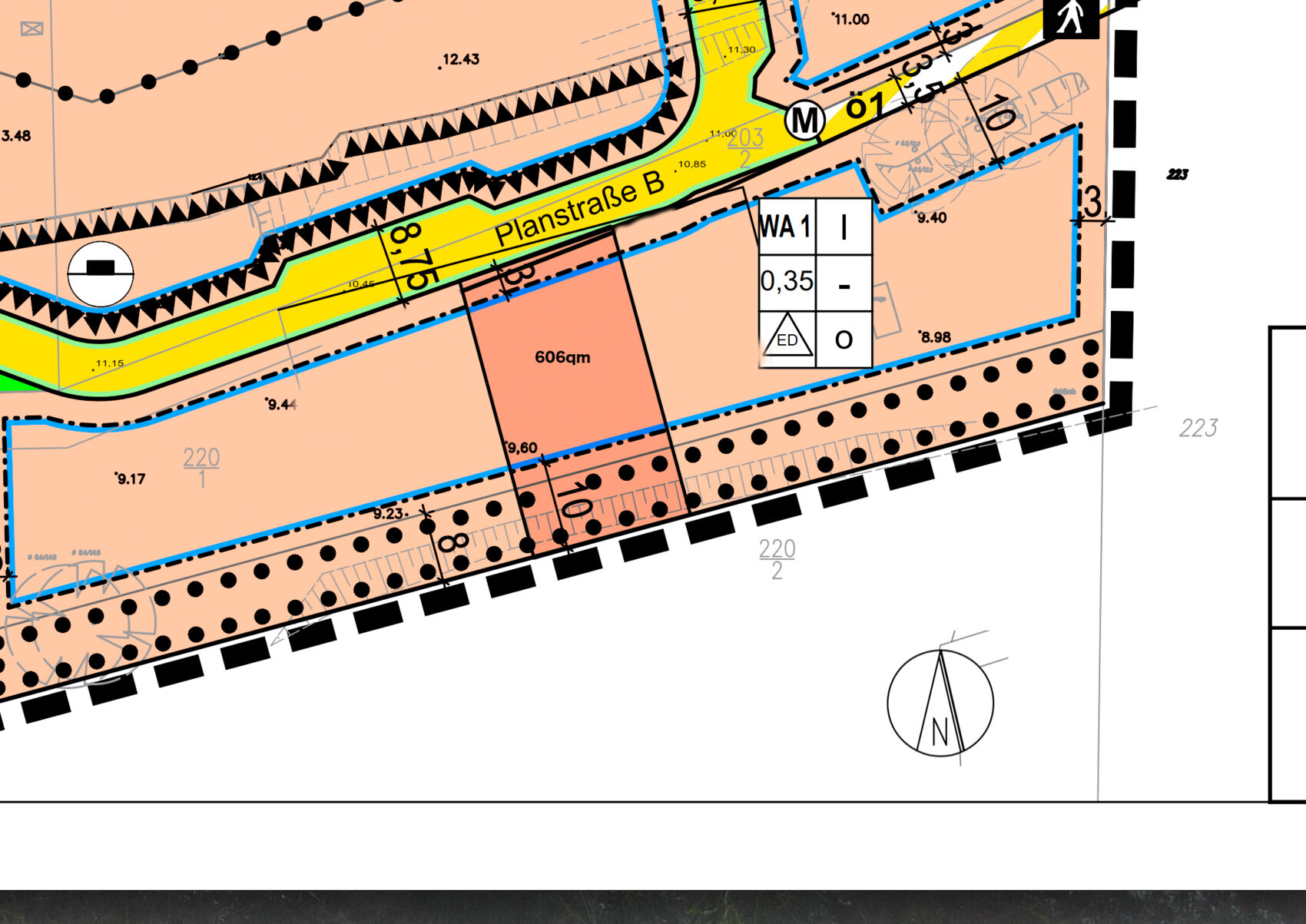
The development plan sets out the following for "my plot":
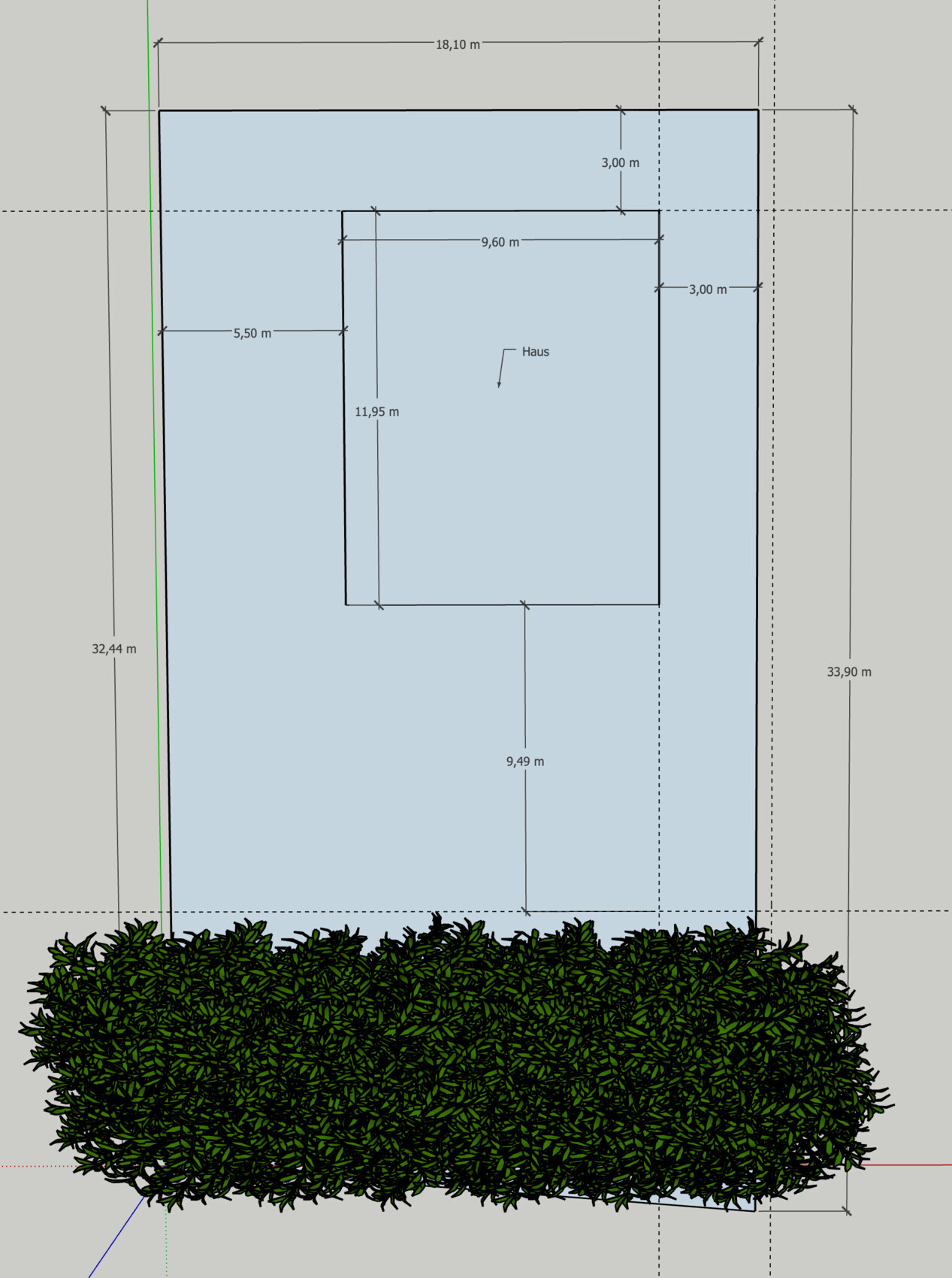
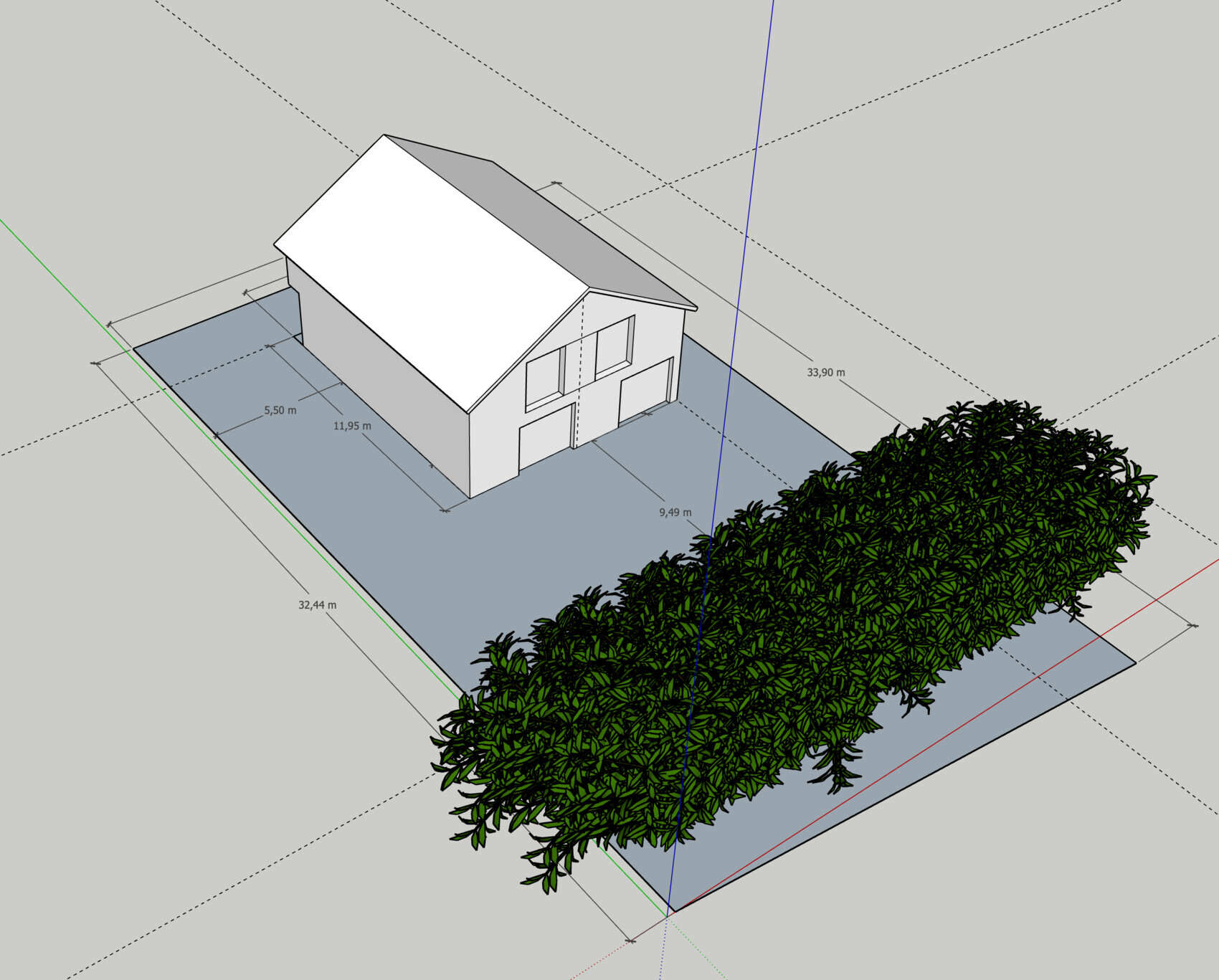
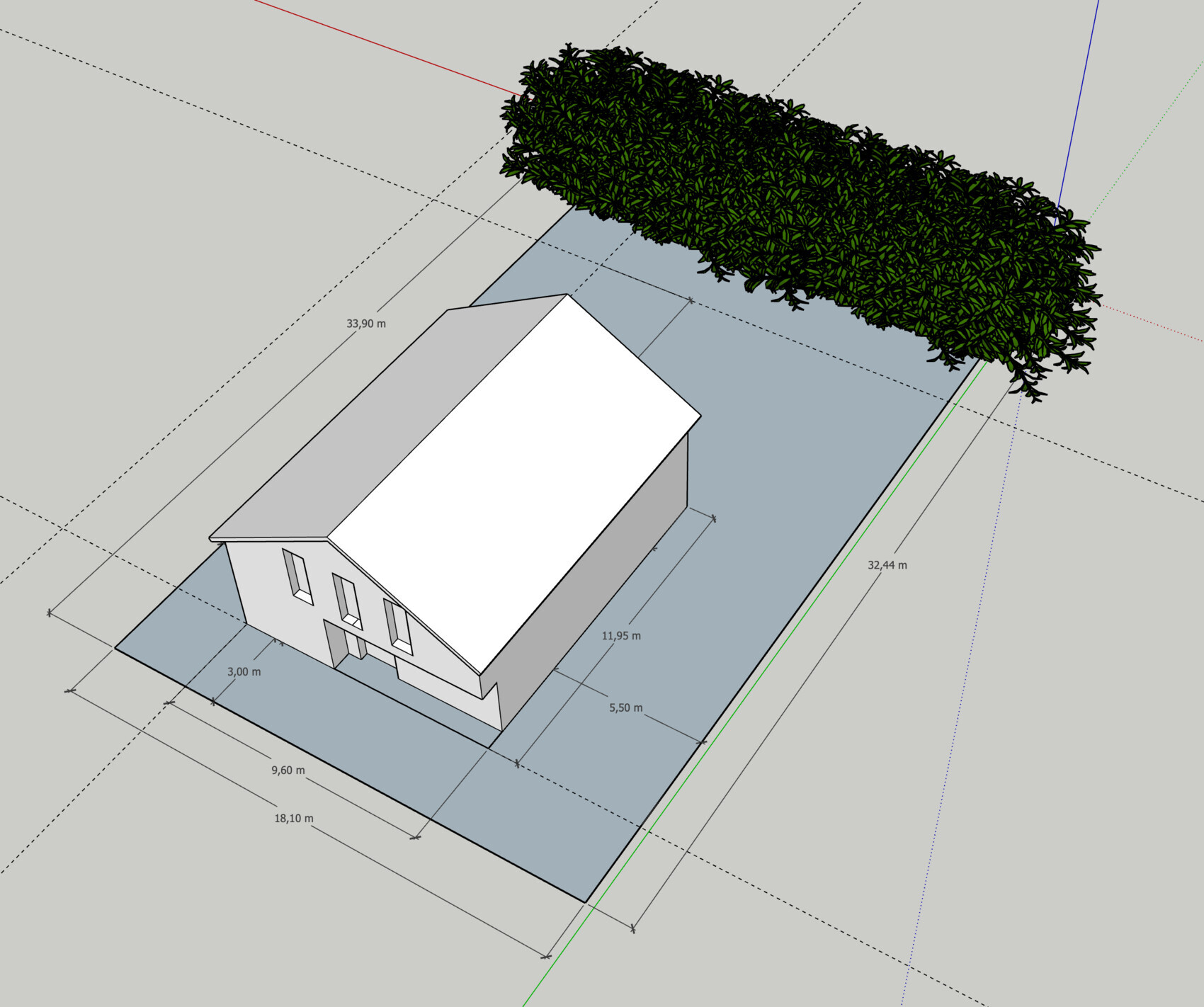
Here I have placed an example house measuring 9.60 meters by 11.95 meters (31.5 feet by 39 feet), which I like based on my initial review (Viebrockhaus Edition 600).
Next to the house, in the 5.50-meter (18 feet) wide space there would be a carport – is that enough space for two parking spots? I would prefer not to make the house narrower just to accommodate vehicles... but then there’s hardly any room left for fencing?!
The terrace and garden at the back are, of course, limited by the tall trees – but that’s a compromise I’ll have to accept.
I’ve never built a house in my life before... so this is my first time dealing with this topic in detail. What would you do in this situation? Make the house a bit smaller?
If you need more information, just ask – as I said, I’m a beginner and eager to learn 🙂
My wishes are:
- Starting from 160 square meters (1,722 square feet) upwards
- I’m currently thinking about a basement and budget around $100k extra for it
- I don’t like long corridors
Once the plot situation is reasonably clear, I’d like to hear your advice on floor plans – that will surely be a more extensive topic.
Best regards
I more or less stumbled upon a plot of land after someone let their reservation expire.
The plot is about 606 square meters (6,521 square feet), according to my "measurement" approximately 18.10 meters by 33.50 meters (60 feet by 110 feet), not officially surveyed yet, and now I’m wondering exactly what I can do with it.
The development plan sets out the following for "my plot":
- 0.35 floor area ratio
- Single-story buildings only
- Maximum building height 10 meters (33 feet)
- Eave height max 4.50 meters (15 feet)
- One driveway with max width of 4 meters (13 feet)
- Two parking spaces are mandatory
- Roof pitch between 15° and 51°
- Roofs of garages etc. may differ in shape
- Garages, carports, and ancillary buildings as defined by §14 (1) of the building use ordinance, which are buildings, must not exceed the street-side building boundaries of the access roads.
- Dormers and roof recesses: the total length of dormers or roof recesses per roof side may not exceed 50% of the total length of that roof side.
- Standard distance to property boundary is 3 meters (10 feet)
- In the southern area, there is an 8-meter (26 feet) deep strip across the full width of the plot (approx. 18 meters (60 feet)) where trees and shrubs must be preserved. This area is quite densely vegetated and reaches heights up to 10 meters (33 feet) – I’ve tried to visualize this below
- In the middle of this vegetation is a downward slope... the building boundary to this strip was reduced from the normal 3 meters to 2 meters (7 feet) so the plots aren’t too restricted.
Here I have placed an example house measuring 9.60 meters by 11.95 meters (31.5 feet by 39 feet), which I like based on my initial review (Viebrockhaus Edition 600).
Next to the house, in the 5.50-meter (18 feet) wide space there would be a carport – is that enough space for two parking spots? I would prefer not to make the house narrower just to accommodate vehicles... but then there’s hardly any room left for fencing?!
The terrace and garden at the back are, of course, limited by the tall trees – but that’s a compromise I’ll have to accept.
I’ve never built a house in my life before... so this is my first time dealing with this topic in detail. What would you do in this situation? Make the house a bit smaller?
If you need more information, just ask – as I said, I’m a beginner and eager to learn 🙂
My wishes are:
- Starting from 160 square meters (1,722 square feet) upwards
- I’m currently thinking about a basement and budget around $100k extra for it
- I don’t like long corridors
Once the plot situation is reasonably clear, I’d like to hear your advice on floor plans – that will surely be a more extensive topic.
Best regards

SaschaL schrieb:
I just need to figure out what criteria I can use to evaluate them. I can't give you a specific search term right now for which posts explain this. But if you look through my posts in the section "Experiences with Construction Company XYZ," you will find what you're looking for.
SaschaL schrieb:
Just because they don’t have a nice website doesn’t automatically mean they’re good. True, there’s no guarantee. But you will quickly notice the difference between sites that say, "I’m a mason, not a web designer," and those that simply don’t care at all, including about their website.
SaschaL schrieb:
Is it common to ask for references there and contact previous clients directly to ask about their experiences? Sort of. They obviously don’t have dedicated PR departments for managing references, and data protection regulations (such as GDPR) have caused uncertainty in many small businesses. You can see references with your own eyes if you walk around the new housing developments in the area where the construction company operates.
https://www.instagram.com/11antgmxde/
https://www.linkedin.com/company/bauen-jetzt/
Ask around within your circle of acquaintances, in new housing developments, at sports clubs, at the hairdresser, or at the dentist. Talk to everyone you know who has built a house in recent years. It is important to focus on those who had similar expectations. You might be satisfied, but your friend might say, “What kind of incompetent person did you recommend to me?”
What matters is that you know what you want and decide based on that. The company’s website and references are just parts of the process to finding the right building partner.
You can have a technically perfect house, with a smooth construction process, and still not be satisfied.
What matters is that you know what you want and decide based on that. The company’s website and references are just parts of the process to finding the right building partner.
You can have a technically perfect house, with a smooth construction process, and still not be satisfied.
It’s not the floor plan you need to worry about.
Do you want to open a catalog, point at a design, and move in, or do you want to make active decisions and be present on the construction site? Both options are possible even with a general contractor, but from a certain point onward, you will need an architect.
Do you want a specific energy standard, a particular wall construction, or a certain building material?
Are you the type who is fine with the same water coming from a basic hardware store faucet as from an expensive designer faucet, no matter the cost?
Every general contractor has a scope of work and a standard. The more the standard and its philosophy match your preferences, the better the value for money, and the more satisfied you will be with your home.
A standard—wherever that may be—is less prone to errors than exotic options for the craftsmen.
You need a room schedule. How many linear meters of closet space, how big is the bed, what minimum clearance is required, etc.
Do you want to open a catalog, point at a design, and move in, or do you want to make active decisions and be present on the construction site? Both options are possible even with a general contractor, but from a certain point onward, you will need an architect.
Do you want a specific energy standard, a particular wall construction, or a certain building material?
Are you the type who is fine with the same water coming from a basic hardware store faucet as from an expensive designer faucet, no matter the cost?
Every general contractor has a scope of work and a standard. The more the standard and its philosophy match your preferences, the better the value for money, and the more satisfied you will be with your home.
A standard—wherever that may be—is less prone to errors than exotic options for the craftsmen.
You need a room schedule. How many linear meters of closet space, how big is the bed, what minimum clearance is required, etc.

also consider whether you want a demonstration kitchen, like "I prepared something in the secondary kitchen," or an ergonomic functional kitchen that serves as the social center in the open-plan living area.
with the first option, everyone stays in the secondary kitchen to help and chat.
with the first option, everyone stays in the secondary kitchen to help and chat.
haydee schrieb:
Do you want a specific energy standard, a wall construction, a building material? I would prefer KFW40+ – simply because I think it makes sense in the long run. I don’t care much about wall construction or building materials, probably because I’m not clear on the differences. I need to do a lot more research. Can you recommend good literature for a future homeowner? I’m ready to study the subject thoroughly, but it doesn’t have to be at a university level.
haydee schrieb:
Are you the type who uses the hardware from the hardware store because it’s the same water as from the designer faucet, no matter the cost? I’m the type who wants something high-quality without it necessarily having to be designed by a well-known designer. Otherwise, it’s the motto: “buy cheap, buy twice” – it should be good quality, but without going overboard.
haydee schrieb:
Every general contractor has a scope of work and a standard. The closer the standard and its philosophy fit you, the better the value for money and the more satisfied you will be with your house. Understood.
haydee schrieb:
You need a room schedule. How many linear meters of wardrobe space, bed size, minimum clearances, etc. Ok, my partner and I will make a plan... The bed is the simplest part (waterbed 2.40 x 2.20 meters (8 ft x 7 ft 3 in)). As for wardrobe space, if it was up to her, 500 linear meters (1640 ft) 🙂 Since anything could happen between zero and two children, we will need to stay flexible there... and this decision regarding children should be deliberately left open.
Similar topics