
ᐅ Experiences with Energy Cloud Services versus Feed-in Tariffs?
Created on: 27 Aug 2020 13:00
M
Micha8589
Hello dear forum members,
Our house construction plans were significantly disrupted by the coronavirus pandemic, but you have to accept the trade-offs when pursuing something important. The good thing is we had enough time to calculate all the options and actually decided to give up our original plan of a gas boiler plus solar thermal system, as a heat pump combined with solar panels turns out to be more cost-effective over 20 years.
The current plan is:
Solid construction house, 148m2 (Kalksandstein – a type of calcium silicate brick – up to the roof ridge plus facing brick)
Air-source heat pump (Junkers Compress 7400)
Photovoltaic system plus battery storage (no provider chosen yet)
Our builder recently received an offer from Senec that includes a cloud tariff. It sounds great on paper, but both I and our builder are somewhat skeptical and are currently researching and calculating further. Unfortunately, I’ve also found contradictory information online.
Is the cloud system worthwhile, or is the classic system with feed-in tariff better?
What do you think? What are your experiences with electricity cloud systems?
Thanks in advance for your answers.
Our house construction plans were significantly disrupted by the coronavirus pandemic, but you have to accept the trade-offs when pursuing something important. The good thing is we had enough time to calculate all the options and actually decided to give up our original plan of a gas boiler plus solar thermal system, as a heat pump combined with solar panels turns out to be more cost-effective over 20 years.
The current plan is:
Solid construction house, 148m2 (Kalksandstein – a type of calcium silicate brick – up to the roof ridge plus facing brick)
Air-source heat pump (Junkers Compress 7400)
Photovoltaic system plus battery storage (no provider chosen yet)
Our builder recently received an offer from Senec that includes a cloud tariff. It sounds great on paper, but both I and our builder are somewhat skeptical and are currently researching and calculating further. Unfortunately, I’ve also found contradictory information online.
Is the cloud system worthwhile, or is the classic system with feed-in tariff better?
What do you think? What are your experiences with electricity cloud systems?
Thanks in advance for your answers.
The electricity consumption is then 4-5 times higher (yes, photovoltaic electricity, but that also has to be taxed, plus lost compensation). I would also question whether 2 hot water cycles per day are more harmful than 6 months of inactivity with all fluids standing still.
H
hampshire21 Dec 2020 12:10Micha8589 schrieb:
Preliminary price (including installation, photovoltaic system registration, commissioning support): €15,653 A smaller battery should definitely be included. Worth looking around again. In Bavaria, which is considered more expensive than Mecklenburg-Western Pomerania, a highly qualified installation company offered complete systems with 10 kWp, 8 kW storage installed for under €20,000 including VAT.
Fuchur schrieb:
The electricity consumption is then 4-5 times higher (yes, photovoltaic electricity, but it must also be taxed plus lost feed-in compensation). I would also question whether 2 domestic hot water heating cycles per day are more harmful than 6 months of stagnation with all the standing liquids. Again, this is a matter of belief. With a small system, the Renewable Energy Act surcharge is avoided (from January 1st, by the way, up to 30 kWp instead of the previous 9.99). Let's do a rough estimate: assume 1 kW from the photovoltaic system costs 8 ct and feed-in remuneration is 9 ct. Then the heating element would have to pay off from the 17 ct difference to the electricity tariff. If you want to consider the longer lifespan of the heat pump, add another 5-10% to the heat pump costs. To add some rough figures: assume the photovoltaic system heats the domestic hot water tank with 2 kWh/day of surplus energy on 150 days per year. That equals 300 kWh/year times 15 years = 4500 kWh times a 10 ct difference = €450, plus €500 as the heat pump share, and an investment cost of €700 for the heating element — initially, this doesn’t look great against €950. But as a bonus, you get a better and more environmentally friendly self-consumption rate. As always, altering the assumptions will make it better or worse. For me, this is not even worth debating — the heating element goes into the domestic hot water tank. Even if it doesn’t pay off financially (which I don’t believe), it has positive effects. I’ve invested money in worse ways.
R
RotorMotor21 Dec 2020 13:03hampshire schrieb:
The bonus is the good feeling of achieving a higher and more environmentally friendly self-consumption rate. As always, changing the assumptions can make it better or worse.
For me, it’s not worth overthinking – the immersion heater goes into the hot water tank. Even if it doesn’t pay off financially (which I don’t believe), it still has positive effects. I’ve invested money worse than that. What exactly is environmentally friendly about wasting electricity with an immersion heater instead of making it available to the neighborhood (or other useful purposes)? 🤨
Whether this really extends the lifespan of the heat pump and whether the immersion heater was produced carbon neutrally is also debatable...
Hello everyone,
I am also facing the decision between a cloud service or feed-in tariff.
Here are a few key details:
Photovoltaic system: 9.8 kWp
Storage: 10 kWh
Orientation: South, roof pitch 7°
Estimated annual yield: 8,880 kWh
Please, no discussions about storage, etc. ;-)
So, when I calculate based on these values and assume a self-consumption rate of 62%, the Senec Cloud is significantly cheaper. Am I making a mistake in my reasoning or calculations (see attachment)?
Best regards and thank you
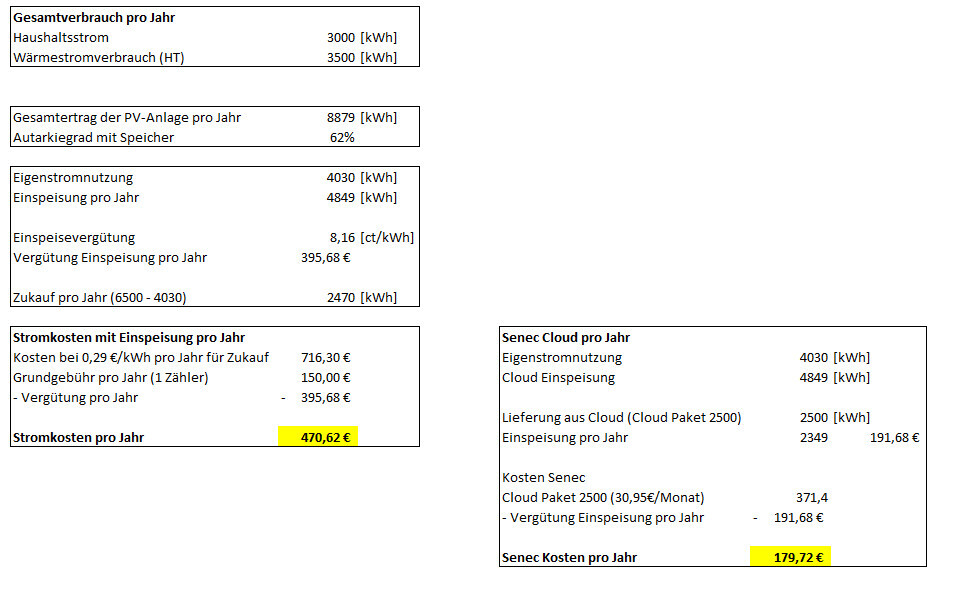
I am also facing the decision between a cloud service or feed-in tariff.
Here are a few key details:
Photovoltaic system: 9.8 kWp
Storage: 10 kWh
Orientation: South, roof pitch 7°
Estimated annual yield: 8,880 kWh
Please, no discussions about storage, etc. ;-)
So, when I calculate based on these values and assume a self-consumption rate of 62%, the Senec Cloud is significantly cheaper. Am I making a mistake in my reasoning or calculations (see attachment)?
Best regards and thank you
N
nordanney20 Jan 2021 16:08hippjoha schrieb:
So, if I calculate with the values given and assume a self-sufficiency rate of 62%, the Senec Cloud is clearly more cost-effective. Am I making a mistake in reasoning or calculation somewhere (see attachment)?At first glance, it sounds good.
Some questions that come to mind are:
- Is the battery capacity sufficient for your own electricity consumption?
- How does the calculation change if battery use or self-consumption differs?
- What is the cost of the Senec battery compared to a model purchased independently?
- Do you avoid the need for a separate electricity meter with the Cloud solution (saving about $150 per year)?
- Self-consumed electricity is not actually free (taxes!!!). These taxes would likely be higher with the Cloud due to increased self-consumption (I assume the Cloud’s electricity supply is taxed similarly to direct self-consumption—some form of taxation must apply). Please include this in your calculations.
I suspect your savings will shrink significantly in the end. Just the $150 for the meter alone is substantial. If the battery is $1,200 more expensive than a comparable independently purchased model, that leaves only about $41 per year in savings over 10 years. Then there’s the tax issue on top of that.
P
Piotr198120 Jan 2021 16:09I accepted a great offer last week. 40 modules with SolarEdge and power optimizers. 14 kWp. Price per kWp: 955 euros. Includes installation and more.
Similar topics