
Good morning everyone, and I hope you’re all having a nice Sunday. I’m new here and have quite a bit of text for you 🙄
The topic:
Due to family reasons, we want to move to a larger space and are looking for critical suggestions about which options are possible and make sense. I would appreciate it if you could also question options that we consider unrealistic, in case we are on the wrong track. One option is to buy a property from my father if we build a small new structure for him on the same plot. What possibilities do you think are reasonable?
About us:
We are a family of four: M33, F33, child 5, child 2, living in Hesse in Gelnhausen in the Main-Kinzig district, in a favorable location near the major city Frankfurt am Main, renting an apartment of 92m2 (990 sq ft) for 580€ (cold rent). My wife is a civil servant working full time, and I am permanently employed part-time (50%) in the public sector. In the future, as the kids get older, I plan to increase my hours a bit. Currently, our combined net income is 4500€. Our life philosophy is definitely to enjoy life without focusing too much on money. We travel a lot and don’t want to be financially restricted by a house or rent in the future. This also means we have relatively little savings of about 15000€, which we would prefer to keep as a reserve. Additionally, we have about 10000€ saved in a home savings contract but also a car loan of 250€/month for the next 5 years.
Even though we like our apartment very much (we’ve lived here for 5 years), we will need an additional children’s room. We considered adding a wall in the large living room here and already got landlord approval. However, we are not fully convinced by this solution because the apartment is quite noisy and we also prefer to have a garden for the kids. Staying here would be our last option if nothing else works out.
We regularly look for rental apartments, houses for rent, or houses for purchase. The market is very limited. Every two weeks there is a new listing, and the number of applicants is huge.
Rental apartments:
Some larger apartments of 100m2+ (1,075 sq ft) come up regularly, but they often do not have enough rooms and are listed for over 900€ (cold rent).
Rental houses:
The same applies for rental houses. If any are available, the price is about 1100€+ (cold rent).
Houses for purchase:
There are very few offers, starting at around 400,000€, often needing significant renovation. Since we have little to no equity, buying a house seems quite unrealistic. Agent fees, property transfer tax, and notary will add up to about 50,000€ in additional costs. That does not include any renovation, and our estimated monthly payment would be about 1600€+ for the next 30 years.
Buying my father’s house:
Our current favorite is buying my father’s semi-detached house in the same town. An independent appraisal values it at 200,000€ (100,000€ house, 90,000€ land, 10,000€ outbuildings). The catch/advantage is that my father would like to keep living on the property. We considered this because he lives alone and the house is too big for him. My mother passed away 8 years ago, and I already inherited 1/6 of the house (33,000€, 4/6 belong to my father and 1/6 to my sister). My father has an outstanding mortgage of about 30,000€, so our net equity is roughly 28,000€.
Current situation:
We would buy the entire house from my father and sister and then build a small house or extension on the same property for my father. We currently prefer this approach because we want to avoid paying out my sister after my father passes. He is just shy of 60 years old and will need a small place for the next 25 years.
We see this option as advantageous on several levels:
1. We get a house with a garden without needing much equity
2. My father can downsize
3. We can support each other with vacations, shopping, cooking, etc.
4. Grandpa can look after the grandchildren
5. We can care for him more easily in the future
We both prefer a clear separation. Whatever is built will be clearly separated, even though it belongs to us. If my father moves out later, we would rent the unit or use it for our children.
Is this financially feasible?
This was a lot of background to involve you and hopefully get help in case we are on the wrong track.
We imagine a small unit of about 50m2 (540 sq ft) for him, as inexpensive as possible. It feels strange to move into a house worth 100,000€ and then build a new one for him that costs twice that. We know 100,000€ is not enough, but maybe you have ideas.
We asked several banks about our maximum loan with a target monthly payment of 1000€, comparable to rent, so we can maintain our lifestyle. The bank would lend us 395,000€ under these conditions.
172,000€ for house and land including the inherited share
23,000€ renovation (new small bathroom, new carpet and wallpaper everywhere, possibly moving the stove, possibly breaking through a wall)
10,000€ demolition of the barn
170,000€ left for extension/foundation/expansion (50m2)
= 375,000€, which means a monthly payment of about 1300€ and leaves 20,000€ as reserve in case costs are higher. This fits our desired total monthly payment of 1400€.
450€ would be paid by my father as rent, 950€ by us, and 50€ into savings.
So far, so good. Please critically question the numbers if something looks off.
Extension or barn renovation?
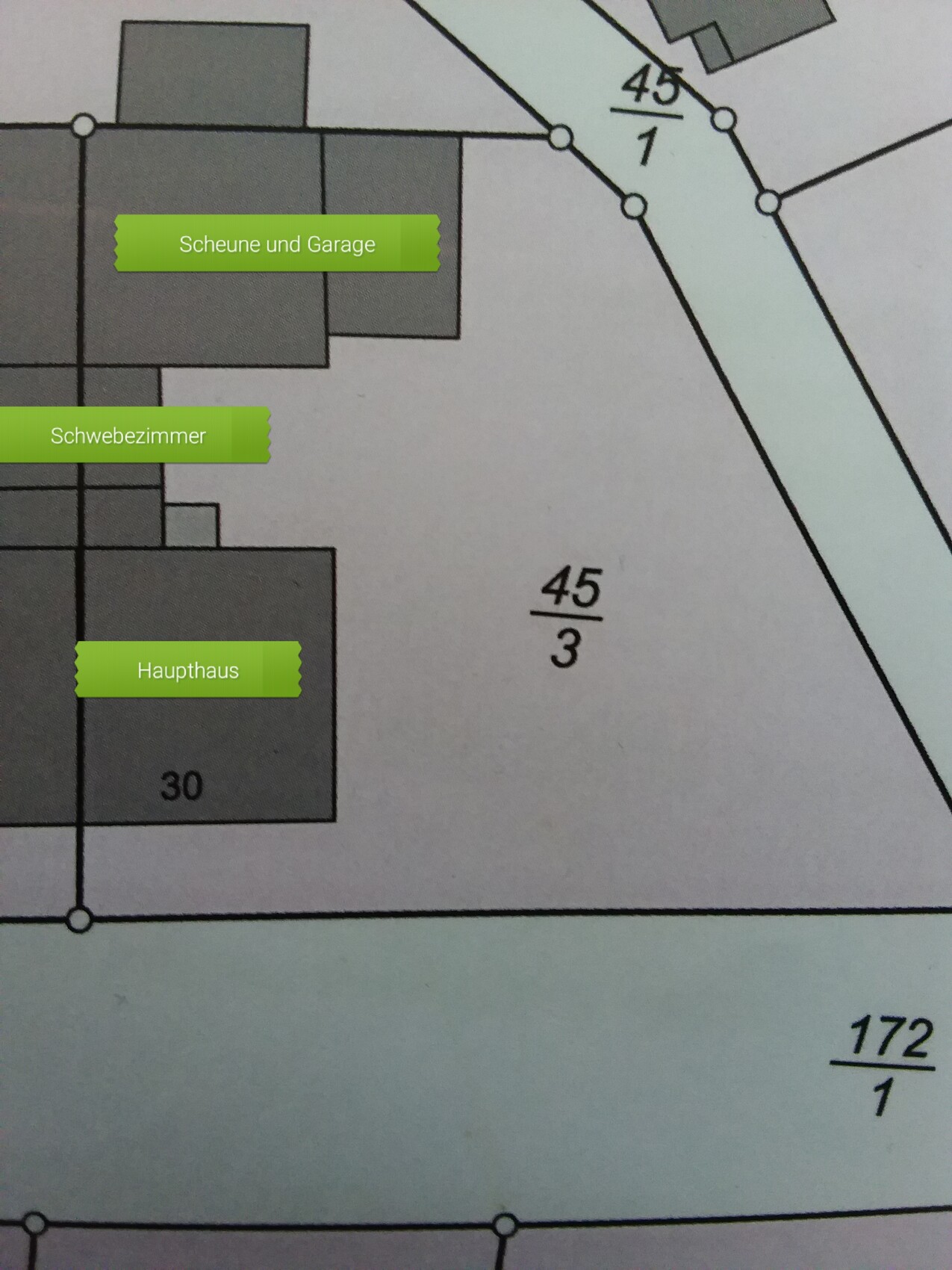
I am attaching a sketch so you can hopefully visualize it better. There are several approaches. At the moment, the barn is connected to the main house by a suspended room.
We want a house with lots of wood inside. It can also be a log cabin. It should have a stove and a small guest room for when my sister visits.
Here are all the ideas so far. In all cases, the garage will be demolished.
1. Renovate the barn
2. Build an extension onto the barn where the garage was
3. Demolish the barn; keep the suspended room and integrate it into the extension
4. Demolish barn and suspended room and build a new structure
5. Do you have alternative ideas?
1. Renovate the barn:
It’s not in the best condition. It’s quite damp. Waterproofing from below would have to be added later (a foundation slab after the fact?). The intermediate ceiling must be removed as there is just enough headroom on the ground floor. The roof probably needs to be replaced. Window openings must be altered and electrical and plumbing installed. A benefit is that the structure already sits on the plot boundaries and so no new negotiations with the building authority or neighbors would be needed.
2. Build an extension onto the barn at the garage site:
A benefit is additional storage space that both we and my father can continue to use. Wood and a workshop area can remain in the barn. A drawback is reduced garden space and the plots would not be clearly separated anymore, as garden and barn are shared.
3. Demolish the barn; keep suspended room integrated into new build:
The advantage is additional space from the suspended room and the covered area it creates. This is useful for hanging laundry or being outside in the rain. A challenge is integrating the suspended room into the new build, which might require custom solutions, increasing the cost. It would also result in a connected extension, as the suspended room links both buildings.
4. Demolish barn and suspended room and build a new structure:
The advantage could be a wider choice of design options for the new building. The question is whether this still counts as an extension. Water and electricity would be supplied via the main house but it would be physically separate.
5. Do you have alternative ideas?
Our current approach
Our first step was to contact an architect who visited the site. Several phone calls followed, during which I noticed we kept discussing things that should have been settled already. I found this very frustrating and exhausting. Now I wonder if going through an architect is the right way or if we can proceed more cheaply otherwise. As mentioned, our requirements are minimal. I do want to share a few points from him here: he said he would tear down the barn and suspended room right away. He considers an extension unproblematic as it is supplied through the main house. Separation would be more difficult.
Open questions
What is the right approach? (Discussing here on the forum what the most sensible option is and then making targeted inquiries, or is there someone who can tell us what is cheapest?)
Who should we contact (another architect, a construction company, a prefab house company)?
Who can answer our questions without focusing on their own profit?
What would you do?
When does an extension officially count as an extension?
Do you have any questions?
Conclusion
I want to thank everyone who started reading, and especially those who have made it this far. 🙂 This is a lot and probably worth 4-10 forum threads. I decided to write everything down in one go to also help myself get organized, which was helpful.
Thank you very much for your help, and it’s great that there is such a large and active forum.
Have a nice Sunday and stay healthy!
The topic:
Due to family reasons, we want to move to a larger space and are looking for critical suggestions about which options are possible and make sense. I would appreciate it if you could also question options that we consider unrealistic, in case we are on the wrong track. One option is to buy a property from my father if we build a small new structure for him on the same plot. What possibilities do you think are reasonable?
About us:
We are a family of four: M33, F33, child 5, child 2, living in Hesse in Gelnhausen in the Main-Kinzig district, in a favorable location near the major city Frankfurt am Main, renting an apartment of 92m2 (990 sq ft) for 580€ (cold rent). My wife is a civil servant working full time, and I am permanently employed part-time (50%) in the public sector. In the future, as the kids get older, I plan to increase my hours a bit. Currently, our combined net income is 4500€. Our life philosophy is definitely to enjoy life without focusing too much on money. We travel a lot and don’t want to be financially restricted by a house or rent in the future. This also means we have relatively little savings of about 15000€, which we would prefer to keep as a reserve. Additionally, we have about 10000€ saved in a home savings contract but also a car loan of 250€/month for the next 5 years.
Even though we like our apartment very much (we’ve lived here for 5 years), we will need an additional children’s room. We considered adding a wall in the large living room here and already got landlord approval. However, we are not fully convinced by this solution because the apartment is quite noisy and we also prefer to have a garden for the kids. Staying here would be our last option if nothing else works out.
We regularly look for rental apartments, houses for rent, or houses for purchase. The market is very limited. Every two weeks there is a new listing, and the number of applicants is huge.
Rental apartments:
Some larger apartments of 100m2+ (1,075 sq ft) come up regularly, but they often do not have enough rooms and are listed for over 900€ (cold rent).
Rental houses:
The same applies for rental houses. If any are available, the price is about 1100€+ (cold rent).
Houses for purchase:
There are very few offers, starting at around 400,000€, often needing significant renovation. Since we have little to no equity, buying a house seems quite unrealistic. Agent fees, property transfer tax, and notary will add up to about 50,000€ in additional costs. That does not include any renovation, and our estimated monthly payment would be about 1600€+ for the next 30 years.
Buying my father’s house:
Our current favorite is buying my father’s semi-detached house in the same town. An independent appraisal values it at 200,000€ (100,000€ house, 90,000€ land, 10,000€ outbuildings). The catch/advantage is that my father would like to keep living on the property. We considered this because he lives alone and the house is too big for him. My mother passed away 8 years ago, and I already inherited 1/6 of the house (33,000€, 4/6 belong to my father and 1/6 to my sister). My father has an outstanding mortgage of about 30,000€, so our net equity is roughly 28,000€.
Current situation:
We would buy the entire house from my father and sister and then build a small house or extension on the same property for my father. We currently prefer this approach because we want to avoid paying out my sister after my father passes. He is just shy of 60 years old and will need a small place for the next 25 years.
We see this option as advantageous on several levels:
1. We get a house with a garden without needing much equity
2. My father can downsize
3. We can support each other with vacations, shopping, cooking, etc.
4. Grandpa can look after the grandchildren
5. We can care for him more easily in the future
We both prefer a clear separation. Whatever is built will be clearly separated, even though it belongs to us. If my father moves out later, we would rent the unit or use it for our children.
Is this financially feasible?
This was a lot of background to involve you and hopefully get help in case we are on the wrong track.
We imagine a small unit of about 50m2 (540 sq ft) for him, as inexpensive as possible. It feels strange to move into a house worth 100,000€ and then build a new one for him that costs twice that. We know 100,000€ is not enough, but maybe you have ideas.
We asked several banks about our maximum loan with a target monthly payment of 1000€, comparable to rent, so we can maintain our lifestyle. The bank would lend us 395,000€ under these conditions.
172,000€ for house and land including the inherited share
23,000€ renovation (new small bathroom, new carpet and wallpaper everywhere, possibly moving the stove, possibly breaking through a wall)
10,000€ demolition of the barn
170,000€ left for extension/foundation/expansion (50m2)
= 375,000€, which means a monthly payment of about 1300€ and leaves 20,000€ as reserve in case costs are higher. This fits our desired total monthly payment of 1400€.
450€ would be paid by my father as rent, 950€ by us, and 50€ into savings.
So far, so good. Please critically question the numbers if something looks off.
Extension or barn renovation?
I am attaching a sketch so you can hopefully visualize it better. There are several approaches. At the moment, the barn is connected to the main house by a suspended room.
We want a house with lots of wood inside. It can also be a log cabin. It should have a stove and a small guest room for when my sister visits.
Here are all the ideas so far. In all cases, the garage will be demolished.
1. Renovate the barn
2. Build an extension onto the barn where the garage was
3. Demolish the barn; keep the suspended room and integrate it into the extension
4. Demolish barn and suspended room and build a new structure
5. Do you have alternative ideas?
1. Renovate the barn:
It’s not in the best condition. It’s quite damp. Waterproofing from below would have to be added later (a foundation slab after the fact?). The intermediate ceiling must be removed as there is just enough headroom on the ground floor. The roof probably needs to be replaced. Window openings must be altered and electrical and plumbing installed. A benefit is that the structure already sits on the plot boundaries and so no new negotiations with the building authority or neighbors would be needed.
2. Build an extension onto the barn at the garage site:
A benefit is additional storage space that both we and my father can continue to use. Wood and a workshop area can remain in the barn. A drawback is reduced garden space and the plots would not be clearly separated anymore, as garden and barn are shared.
3. Demolish the barn; keep suspended room integrated into new build:
The advantage is additional space from the suspended room and the covered area it creates. This is useful for hanging laundry or being outside in the rain. A challenge is integrating the suspended room into the new build, which might require custom solutions, increasing the cost. It would also result in a connected extension, as the suspended room links both buildings.
4. Demolish barn and suspended room and build a new structure:
The advantage could be a wider choice of design options for the new building. The question is whether this still counts as an extension. Water and electricity would be supplied via the main house but it would be physically separate.
5. Do you have alternative ideas?
Our current approach
Our first step was to contact an architect who visited the site. Several phone calls followed, during which I noticed we kept discussing things that should have been settled already. I found this very frustrating and exhausting. Now I wonder if going through an architect is the right way or if we can proceed more cheaply otherwise. As mentioned, our requirements are minimal. I do want to share a few points from him here: he said he would tear down the barn and suspended room right away. He considers an extension unproblematic as it is supplied through the main house. Separation would be more difficult.
Open questions
What is the right approach? (Discussing here on the forum what the most sensible option is and then making targeted inquiries, or is there someone who can tell us what is cheapest?)
Who should we contact (another architect, a construction company, a prefab house company)?
Who can answer our questions without focusing on their own profit?
What would you do?
When does an extension officially count as an extension?
Do you have any questions?
Conclusion
I want to thank everyone who started reading, and especially those who have made it this far. 🙂 This is a lot and probably worth 4-10 forum threads. I decided to write everything down in one go to also help myself get organized, which was helpful.
Thank you very much for your help, and it’s great that there is such a large and active forum.
Have a nice Sunday and stay healthy!
Howtnted schrieb:
In other words -> The architect wants to design the biggest, most expensive, and most elaborate extension possible, so that their creativity really matters, they don’t get bored, and ultimately they make the most profit. Howtnted schrieb:
Or -> The timber-frame builder says: Converting the barn doesn’t seem practical, too much effort, not profitable; he would rather build a great wooden house there. Howtnted schrieb:
Or -> The prefab home manufacturer says, it’s best to put a Flying Space there, since that is the easiest. However, these are not well-founded accusations or assumptions. I believe most service providers do not deserve that.
Howtnted schrieb:
I’m probably repeating myself, but it feels strange to move into a house worth 100,000 (approx. 110,000) when we are building a modern 1,700,000€ (approx. 1,860,000) structure with half the living space for my father. You are probably right, but that was your suggestion. A new build usually costs more than the current value of an older property. At least in most cases.
Therefore, you should find an architect and work with them to develop the best solution for everyone. You need to reflect on this yourselves.
For example, it might be an option to separate the existing ground floor for your father and build an extension behind it, connecting to the upper floor of the existing building. This requires expertise, and you will have to invest some money in an architect. You will need one anyway!
ypg schrieb:
This requires expertise, and sometimes you just have to invest money in an architect. You are going to need one anyway!So the process is 100% through an architect?
And I start with them as well?
J
JuliaMünchen20 Jan 2021 10:13@JulianMünchen: You suggest going to a construction company: Which one do you recommend? Who can tell me what would be the most affordable and suitable option for us? (Barn conversion/extension/extension to the barn/alternative)
I feel like I have to tell the company what I want—even though I don’t know yet what is even possible or what the advantages and disadvantages of each option are. Who can help me without making me feel like everyone advising me is just looking to maximize their own profit? For example -> An architect might want to design a large, expensive, complex extension so their expertise really matters, they don’t get bored, and they earn the most profit. Or -> The timber home builder could say that a barn conversion is pointless, too much work, not cost-effective, and would suggest building a great timber house instead. Or -> The prefab home manufacturer might say the best solution is to just put a flying space (modular add-on) up there, because that’s the simplest.
Even though I haven’t tested this yet, this is my concern. Maybe you can tell me how we should best approach this. I know I’m repeating myself, but it feels strange to move into a house worth 100,000 when we are building my father a modern, €1,700,000 (around $1,900,000) place with half the living space. He has lived comfortably in an old house for the past years. There doesn’t have to be a spectacular building. If the result is that €170,000 ($190,000) is the minimum investment for the minimum solution, we still have the option to say no. So far, we hope to find the most affordable (not cheapest) solution.
I’m afraid that truly neutral advice could only come from an architect or structural engineer friend who would not profit from your project. Whether extension, new build, or renovation, you will need both an architect (either freelance or employed by a construction company) and a builder anyway. Naturally, every builder will say they have the best concept and offer the cheapest price, so I would do what other home builders do: ask around in your area who has had good experiences with smaller local companies, visit a show home village and just talk to the prefab providers there—maybe the companies that focus on bungalows or accessory apartments can give you helpful tips. You already have a non-binding statement on what is allowed for the site; with this information and your housing preferences, I would visit the companies and listen to their different proposals. I’m pretty sure you will intuitively feel who you are comfortable with, who offers a creative solution, who asks the right questions, and with whom you feel trust.
As for the architect, here is a tip: Be very clear about your budget and your goals. If you want a functional extension for budget X, the architect should plan exactly that and cannot just charge more because of fee regulations. If you are working with a freelance architect, ask when was the last house they designed was built so you know they are aware of current building costs and not using the outdated prices from 2017 or 2018.
Regarding costs, I understand your reasoning. If a large investment is not possible, it might simply be that, given current construction prices, a truly functional extension or renovation is not feasible. What I don’t quite understand is why you phrase it as if you were building a modern, expensive house for your father. Although he would live there, after his death (hopefully many years from now), it will be YOUR house that you have invested in. As long as you all live there, the investment benefits all of you (think quality time together, childcare, owning your own land). The alternative would be your father staying in his place but you not being able to buy another property or house at the moment, and then, in the event of inheritance, having to pay your sister out while construction costs have increased many times over, right?
I feel like I have to tell the company what I want—even though I don’t know yet what is even possible or what the advantages and disadvantages of each option are. Who can help me without making me feel like everyone advising me is just looking to maximize their own profit? For example -> An architect might want to design a large, expensive, complex extension so their expertise really matters, they don’t get bored, and they earn the most profit. Or -> The timber home builder could say that a barn conversion is pointless, too much work, not cost-effective, and would suggest building a great timber house instead. Or -> The prefab home manufacturer might say the best solution is to just put a flying space (modular add-on) up there, because that’s the simplest.
Even though I haven’t tested this yet, this is my concern. Maybe you can tell me how we should best approach this. I know I’m repeating myself, but it feels strange to move into a house worth 100,000 when we are building my father a modern, €1,700,000 (around $1,900,000) place with half the living space. He has lived comfortably in an old house for the past years. There doesn’t have to be a spectacular building. If the result is that €170,000 ($190,000) is the minimum investment for the minimum solution, we still have the option to say no. So far, we hope to find the most affordable (not cheapest) solution.
I’m afraid that truly neutral advice could only come from an architect or structural engineer friend who would not profit from your project. Whether extension, new build, or renovation, you will need both an architect (either freelance or employed by a construction company) and a builder anyway. Naturally, every builder will say they have the best concept and offer the cheapest price, so I would do what other home builders do: ask around in your area who has had good experiences with smaller local companies, visit a show home village and just talk to the prefab providers there—maybe the companies that focus on bungalows or accessory apartments can give you helpful tips. You already have a non-binding statement on what is allowed for the site; with this information and your housing preferences, I would visit the companies and listen to their different proposals. I’m pretty sure you will intuitively feel who you are comfortable with, who offers a creative solution, who asks the right questions, and with whom you feel trust.
As for the architect, here is a tip: Be very clear about your budget and your goals. If you want a functional extension for budget X, the architect should plan exactly that and cannot just charge more because of fee regulations. If you are working with a freelance architect, ask when was the last house they designed was built so you know they are aware of current building costs and not using the outdated prices from 2017 or 2018.
Regarding costs, I understand your reasoning. If a large investment is not possible, it might simply be that, given current construction prices, a truly functional extension or renovation is not feasible. What I don’t quite understand is why you phrase it as if you were building a modern, expensive house for your father. Although he would live there, after his death (hopefully many years from now), it will be YOUR house that you have invested in. As long as you all live there, the investment benefits all of you (think quality time together, childcare, owning your own land). The alternative would be your father staying in his place but you not being able to buy another property or house at the moment, and then, in the event of inheritance, having to pay your sister out while construction costs have increased many times over, right?
JuliaMünchen schrieb:
I’m afraid the only truly neutral advice you could get here would be from an architect or structural engineer you know personally, who wouldn’t benefit from your project. Whether it’s an extension, new build, or renovation, you’ll need both an architect (whether independent or employed by a construction company) and a builder anyway. Naturally, every builder will claim to have the best concept and offer the lowest price, so I’d recommend doing what most home builders do: ask around locally who has had good experiences with smaller local builders, visit a model home park, and talk to the prefabricated home suppliers there. Maybe those who specialize in bungalows or accessory dwelling units can offer helpful advice. You already have an informal indication of what’s possible on the plot, so with this info and your living requirements, I’d approach the companies to listen to their proposals. I’m quite sure you’ll intuitively feel who gives you a good impression, proposes creative solutions, asks the right questions, and with whom you feel comfortable and build trust. Regarding the architect, my tip is: be clear and upfront about your budget and goals. If you want a functional extension with budget X, the architect should plan exactly that and, under the fee schedule, cannot simply charge more. If you plan to work with an independent architect, ask when their last house project was built, so you know if they are familiar with current construction costs and not relying on outdated fees from 2017/2018.
As for costs, I understand your way of thinking. If a major investment is not feasible, it may simply be that, with current building prices, a really functional extension or renovation is not possible. Thank you for your feedback. That sounds sobering at first and aligns with my preconceptions. It means no one will tell me what is best, but I, as a layperson, have to make the decision myself :-(
JuliaMünchen schrieb:
What I don’t fully understand is why you phrase it as if you are providing your father with a modern and expensive house? Although he would live on the property, after his death (hopefully far in the future), it would be YOUR house that you have invested in, and as long as you all live there, it’s an investment in all of you, with benefits for everyone (shared time, childcare, your own land). You are absolutely right. I have mentioned these advantages as well. In the long term, we won’t need an extension in 30 years. It’s hard at age 30 to decide what you might need in old age. We need a house now. We are building the extension for my dad so we can get the main house. For now, the extension is just a means to an end. We are constantly checking what’s possible in terms of extension/expansion, etc., but have barely put any thought into what we actually want in the main house. We are planning to invest almost €400,000 (about $435,000) and are currently planning “only” for my father. That’s probably why we are so frugal with money. We mistakenly see only half of it as an investment for us. Maybe that’s the source of my wording. But of course, it could be that someday our children move into the house and my wife and I move into the more modern extension.
JuliaMünchen schrieb:
The alternative would be that your father simply stays living there, but right now, you can’t buy another property or house, and then in the event of inheritance, you’d have to buy out your sister AND building costs have increased many times over, right? Yes, I see the risk with raising building costs, and in the long run, interest rates can only rise. But if we don’t take the house and inheritance happens, we don’t have to accept it; we could use the equity. Who knows.
Howtnted schrieb:
Thank you for your feedback. That sounds quite discouraging and matches my preconceptions. And it means that it’s not someone else telling me what’s best, but that I, as a layperson, have to make the decision :-( Sorry, but I completely disagree with @JuliaMünchen.
This is about extensions or conversions of an existing building – any experienced general contractor (GC) will point out that as a GC he might not be the right person for the job because such work is complex and not every GC is comfortable or skilled in that.
Of course, you need an architect who examines the existing structure, listens to what you need in a cost-effective way, communicates his expertise with the building authority and you, and creates something that satisfies you in the long term. If he has done his job well, there will be plans that a builder or tradesperson can use to construct or modify the building.
JuliaMünchen schrieb:
Whether it’s an extension, new build or conversion, you will need an architect (whether freelance or employed by a construction company) and a construction company anyway. What you don’t need is a GC who places a typical production house on your plot and a rubber-stamp official who approves a design. What you need are ideas and cost-optimized ways to implement them.
But if you’re here just to have your prejudices confirmed, I don’t know… then maybe you’ll have to hire your neighbor, the carpenter, and do some unofficial DIY work – whether it ends up livable is another matter.
ypg schrieb:
Sorry, but I completely disagree with @JuliaMünchen.
This is about extending or renovating an existing building – any experienced general contractor (GC) will tell you that they might not be the right fit if they don’t handle complex projects well.
Of course, you need an architect who examines the existing structure, listens to your needs for cost-effective solutions, understands what can be realistically achieved within your budget, communicates their knowledge to both the building department and you, and creates something that will satisfy you in the long term. When the architect has done their job, there will be plans that a builder or contractor can follow to construct or modify the building.
What you don’t need is a GC who just puts a standard production house on your lot and an official who rubber-stamps a design. You need ideas and implementation options that are as cost-optimized as possible.
If you’re just here to have your prejudices confirmed, I don’t know... then you might as well hire your neighbor or a carpenter unofficially to cobble something together – whether it will even be livable is another question. Thank you for your honest feedback. You’ve probably noticed from my earlier posts that I have little to no experience, which is why I’m here. I really appreciate your words. I definitely don’t want my prejudices confirmed but rather want to find out if they’re justified. It’s great that you’ve given me a clear roadmap.
So, instead of contacting building companies, I should approach architects?
And how do I best handle such a conversation tactically?
What should I say or ask? For example:
- I have €170,000 (around $185,000), what can I do with that?
- What is the most affordable option here?
- We want X, how much would that cost?
- ...
???
Best regards
Similar topics