
Hello everyone,
I had a chance to take a look at our heating plan on the construction site. The subcontractor’s subcontractor will be installing the underfloor heating next week.
Now to the question:
Do you see any major mistakes here, or just things that could be quickly clarified with the tradespeople on site?
Generally, I don’t have much say regarding the underfloor heating, so I wasn’t involved in the planning. However, I hope to work out one or two minor details directly with the workers on site.
So far, I’d only try to convince them to install the underfloor heating beneath the bathtub as well (acrylic on screed / showers are embedded in the screed). Or is making a last-minute adjustment a bad idea because it could mess everything up?
Any other tips? Should I try to negotiate anything about spacing?
Thanks a lot and best regards
KingJulien

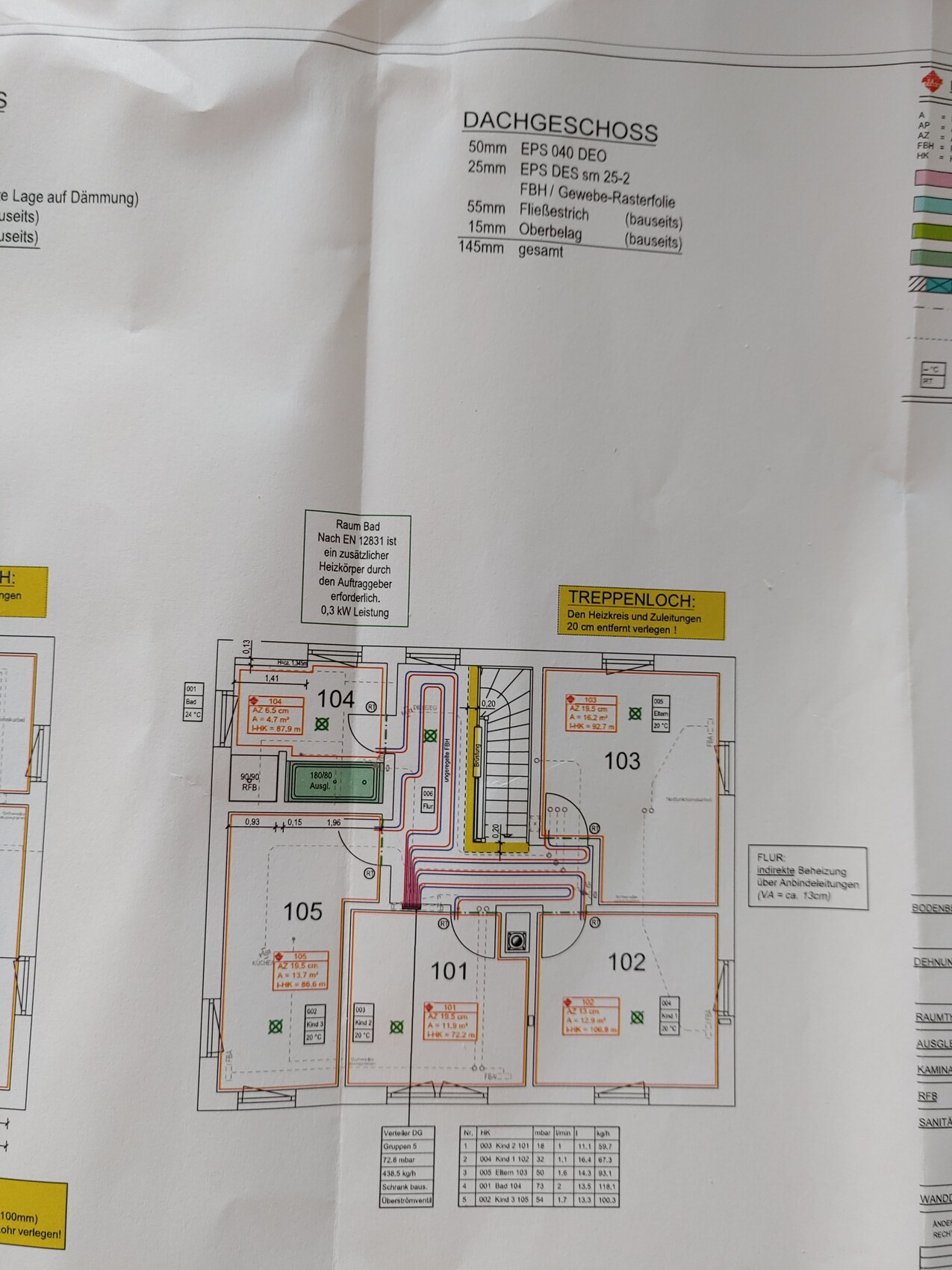
I had a chance to take a look at our heating plan on the construction site. The subcontractor’s subcontractor will be installing the underfloor heating next week.
Now to the question:
Do you see any major mistakes here, or just things that could be quickly clarified with the tradespeople on site?
Generally, I don’t have much say regarding the underfloor heating, so I wasn’t involved in the planning. However, I hope to work out one or two minor details directly with the workers on site.
So far, I’d only try to convince them to install the underfloor heating beneath the bathtub as well (acrylic on screed / showers are embedded in the screed). Or is making a last-minute adjustment a bad idea because it could mess everything up?
Any other tips? Should I try to negotiate anything about spacing?
Thanks a lot and best regards
KingJulien

I believe this can be done better, sorry.
The installation spacing is too wide, although I consider anything below 10cm (4 inches) critical because otherwise the heat flux density will eventually be exceeded.
But in the living room, for example, I think the spacing is due to the fact that with a smaller spacing they would exceed the maximum heating circuit length of 120m (394 feet) and would therefore need 2 circuits. This means a larger manifold and higher costs for the main contractor.
This doesn’t have much to do with energy-optimized planning. 😕
The installation spacing is too wide, although I consider anything below 10cm (4 inches) critical because otherwise the heat flux density will eventually be exceeded.
But in the living room, for example, I think the spacing is due to the fact that with a smaller spacing they would exceed the maximum heating circuit length of 120m (394 feet) and would therefore need 2 circuits. This means a larger manifold and higher costs for the main contractor.
This doesn’t have much to do with energy-optimized planning. 😕
T
T_im_Norden13 Jan 2021 17:01No design temperature is specified in the DIN standard.
Here, the DIN presumably refers to the heating load calculation and room temperature.
The question for you now is: how much time do you have available?
If the schedule is tight, there might not be much you can do.
I assume the underfloor heating is designed for a 35°C (95°F) supply temperature.
Actually, there should be something about the design specifications either in your scope of work or in your contract.
Here, the DIN presumably refers to the heating load calculation and room temperature.
The question for you now is: how much time do you have available?
If the schedule is tight, there might not be much you can do.
I assume the underfloor heating is designed for a 35°C (95°F) supply temperature.
Actually, there should be something about the design specifications either in your scope of work or in your contract.
T
T_im_Norden13 Jan 2021 17:03I’m just looking at the insulation values on the plan. Do you also have insulation beneath the concrete slab?
 bauenmk202013 Jan 2021 17:15
For us, the design temperature is also 20°C (68°F) for rooms and 24°C (75°F) for bathrooms. However, the pipe spacing is usually around 6.5cm (2.6 inches). I’m active in the "rosa" forum trying to "optimize" the heating system. In some cases, I even have two heating circuits per room.
It was similar for me: I took photos of the plans on site. I never heard anything about the design parameters from the general contractor’s heating subcontractor. The heat load calculation was only provided upon request. There’s a lot of secrecy around it! At first, the general contractor and others say: "The documents aren’t ready yet. Calculations still need to be done." Then they say: "Nothing can be changed anymore because the calculations are already complete!"
But in the other forum, it was also said that with a smaller pipe spacing, you can run at lower flow temperatures. The heating engineer can also help ensure the system is "optimally utilized," for example by not undersizing the supply pipes to the underfloor heating manifolds. This way, the heat generated by the heat pump can be properly delivered to the heating circuits ("taken up").
@matte1987
Why is under 10cm considered critical?
It was similar for me: I took photos of the plans on site. I never heard anything about the design parameters from the general contractor’s heating subcontractor. The heat load calculation was only provided upon request. There’s a lot of secrecy around it! At first, the general contractor and others say: "The documents aren’t ready yet. Calculations still need to be done." Then they say: "Nothing can be changed anymore because the calculations are already complete!"
But in the other forum, it was also said that with a smaller pipe spacing, you can run at lower flow temperatures. The heating engineer can also help ensure the system is "optimally utilized," for example by not undersizing the supply pipes to the underfloor heating manifolds. This way, the heat generated by the heat pump can be properly delivered to the heating circuits ("taken up").
@matte1987
Why is under 10cm considered critical?
As mentioned before, otherwise the limit for heat flux density can be exceeded.
With tile flooring, this leads to a warmer surface temperature, but with parquet flooring, it can potentially cause complete damage to the parquet, as it cannot withstand that temperature.
It doesn’t have to happen, but it has happened before.
Non-experts often assume that more is better, but it’s not that simple.
There is a good reason why this should be properly planned. This applies just as much in one direction as in the other... 😉
With tile flooring, this leads to a warmer surface temperature, but with parquet flooring, it can potentially cause complete damage to the parquet, as it cannot withstand that temperature.
It doesn’t have to happen, but it has happened before.
Non-experts often assume that more is better, but it’s not that simple.
There is a good reason why this should be properly planned. This applies just as much in one direction as in the other... 😉
Similar topics