
ᐅ Underfloor heating with an air-to-water heat pump. House gets too warm when the sun is shining.
Created on: 4 Dec 2019 14:18
C
chewbacca123
Hello everyone,
I have a general question.
We moved into our new build four months ago. The living area on the ground floor has three large floor-to-ceiling windows facing south. We have underfloor heating and an air-to-water heat pump.
It provides a really comfortable temperature inside the house, but we have a problem – whenever the sun is shining in winter, even if it’s -2°C (28°F) outside, the temperature suddenly rises to 24°C (75°F) in the living room. It gets uncomfortably warm in here, and the underfloor heating can’t be turned down quickly.
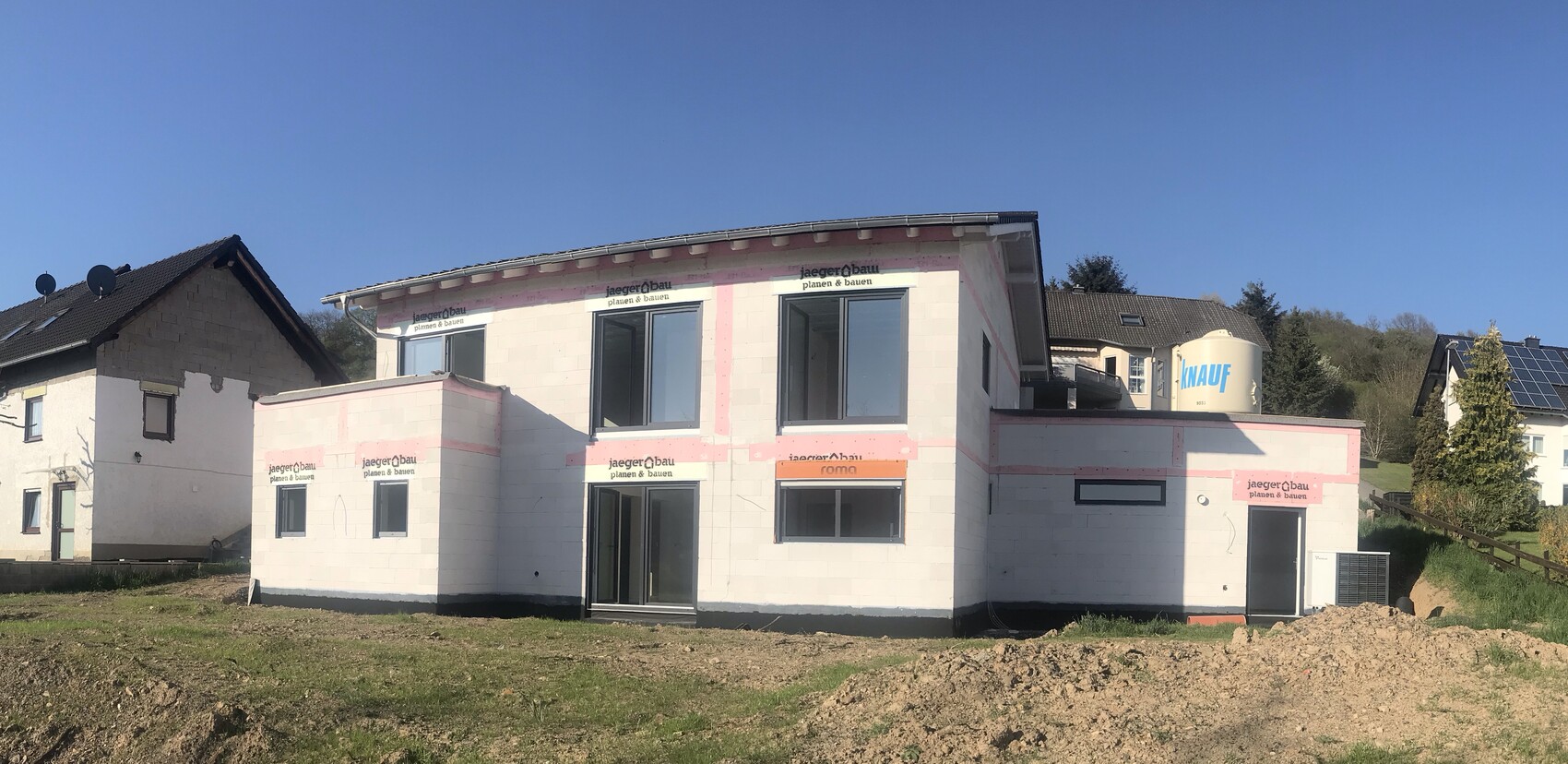
Should we assume that the large floor-to-ceiling windows are responsible for the heat gain? A photo of the south-facing side of the house is attached.
What would you do – always lower all the blinds as soon as sunlight is forecast? That seems quite annoying...
We have motorized blinds controlled by Somfy. Would you consider buying a sensor that automatically lowers the blinds at a certain temperature?
Thanks in advance for your replies.
I have a general question.
We moved into our new build four months ago. The living area on the ground floor has three large floor-to-ceiling windows facing south. We have underfloor heating and an air-to-water heat pump.
It provides a really comfortable temperature inside the house, but we have a problem – whenever the sun is shining in winter, even if it’s -2°C (28°F) outside, the temperature suddenly rises to 24°C (75°F) in the living room. It gets uncomfortably warm in here, and the underfloor heating can’t be turned down quickly.
Should we assume that the large floor-to-ceiling windows are responsible for the heat gain? A photo of the south-facing side of the house is attached.
What would you do – always lower all the blinds as soon as sunlight is forecast? That seems quite annoying...
We have motorized blinds controlled by Somfy. Would you consider buying a sensor that automatically lowers the blinds at a certain temperature?
Thanks in advance for your replies.
Deliverer schrieb:
How do these values come about? Or are we talking about liters per hour? With me, the pump usually decides that 35 l/min (9.2 gallons per minute) is enough. Below 26 l/min (6.9 gallons per minute), it complains because the defrosting doesn’t proceed quickly enough. I find it hard to imagine how you could get fifty times that through the pipes... I meant l/h (liters per hour). But your values are very high.
D
Daniel-Sp10 Jan 2021 12:30It also depends on the size of the house.
D
Deliverer10 Jan 2021 15:19Old building with 260 sqm (2800 sq ft) underfloor heating, temperature difference of 5°C (9°F).
A
AllThumbs10 Jan 2021 17:39I came across this thread by chance. If I understand correctly, poor hydraulic balancing causes two problems:
We are getting a Nibe F2120-8, which, according to my research, is supposed to be modulating. Is there a technical term I should look for to find out the minimum output capacity?
These questions are still theoretical at this point, as we are moving in next year.
- inefficient operation and therefore higher energy consumption
- shorter equipment lifespan due to increased compressor starts
We are getting a Nibe F2120-8, which, according to my research, is supposed to be modulating. Is there a technical term I should look for to find out the minimum output capacity?
These questions are still theoretical at this point, as we are moving in next year.
D
Daniel-Sp10 Jan 2021 20:16Modulating heat pumps can also be cycled. You can usually find the modulation range in the technical datasheet. Try searching for it online.

Similar topics