
Hello
After completing the screed, we are considering installing a so-called skim coat floor with a concrete look. Unfortunately, there are not many providers, and if there are, they tend to be extremely expensive. If anyone knows of alternatives, companies that offer a good price-performance ratio, or if it’s okay to do it “yourself” with guidance and instructions, I would be grateful for any advice. Rooms and a bathroom are to be done. Maybe someone here has taken on this task themselves. I understand that there are many things to consider.
After completing the screed, we are considering installing a so-called skim coat floor with a concrete look. Unfortunately, there are not many providers, and if there are, they tend to be extremely expensive. If anyone knows of alternatives, companies that offer a good price-performance ratio, or if it’s okay to do it “yourself” with guidance and instructions, I would be grateful for any advice. Rooms and a bathroom are to be done. Maybe someone here has taken on this task themselves. I understand that there are many things to consider.
pagoni2020 schrieb:
It probably depends on your expectations and whether you’re willing to accept some minor imperfections in the final result. With that in mind, I have often had work done by people whose quality I know well, and together we’ve been willing to “take the risk.” Yes, that’s exactly the question—whether we want to take that risk. I’m willing to accept flaws as long as the overall result looks good. It’s the same with flooring. If a friend lays the parquet as a favor, I have to be able to overlook some imperfections. After all, I saved a lot overall that way.
P
pagoni20209 Oct 2020 13:38Exactly...... maybe no risk - no fun!

Tolentino schrieb:
... but your remarks about wives and domestic peace come across as condescending and chauvinistic (actually even sexist).
.Thank you for pointing that out! I will of course avoid that in the future.
Best regards, KlaRa
Visually, I also found the seamless coatings really cool, but especially in bathrooms, you need to be aware that a waterproof membrane (on top) is required (with almost all manufacturers), typically a PU sealing.
That was the reason I decided against it. Concrete look with a plastic feel wasn’t for me. (By the way, it’s really frustrating if something breaks on it.)
If you decide to go for it: ask to see sample areas of the craftsmanship. The texture from the trowel can be very pronounced! We looked at various samples, ranging from “expressive” to almost completely uniform, so it’s important to find a tradesperson that matches your preference.
That was the reason I decided against it. Concrete look with a plastic feel wasn’t for me. (By the way, it’s really frustrating if something breaks on it.)
If you decide to go for it: ask to see sample areas of the craftsmanship. The texture from the trowel can be very pronounced! We looked at various samples, ranging from “expressive” to almost completely uniform, so it’s important to find a tradesperson that matches your preference.
Dear Forum,
I am following this topic with interest. I am new to this forum and hope I am posting my questions in the right thread (if not, I would appreciate suggestions on where it might be better placed).
The planning of our floor coverings has just become very relevant.
On the entire upper floor (except the bathroom), we want to install: Wineo 1500 Purline Bioboden Wood XL, Crafted Oak decor, glued installation with joints, size 1500 x 250 mm (59 x 10 inches), product thickness 2.5 mm (0.1 inches), usage class 23/34/43.
On the ground floor (hallway, living room, kitchen, guest room), we would like a seamless floor with a concrete look. There are various terms or systems for this (self-leveling screed, exposed screed, epoxy resin floor, etc.).
Our construction company is installing CT-C25-F4 screed over our underfloor heating.
We want to apply a concrete-look floor on top of this screed.
We have currently considered:
(1) Pandomo Floor (K3 self-leveling screed) by Ardex
Does anyone have experience with this supplier or system?
Visually, we like it due to its uniformity and calm appearance. However, we are concerned about the strength and hardness of the screed compound (it should not be much harder than good parquet, as it might be prone to scratches and wear over time).
What has been your experience regarding the durability of self-leveling screed floors, especially Pandomo?
(2) Industrial floor CT-C60 made of mineral dry mortar RHEOBOND 007; surface power troweled, Floorfinish 430, application OBTEGO R400
Has anyone had experience with this system?
(3) Self-leveling floor or epoxy resin floor from TopCiment
Does anyone happen to have experience with this?
We want a concrete-look floor that is not too busy or uneven and is also reasonably durable.
I am already grateful for your valuable advice, tips, and comments.
Best regards and wishing you all a good start to the new year.
I am following this topic with interest. I am new to this forum and hope I am posting my questions in the right thread (if not, I would appreciate suggestions on where it might be better placed).
The planning of our floor coverings has just become very relevant.
On the entire upper floor (except the bathroom), we want to install: Wineo 1500 Purline Bioboden Wood XL, Crafted Oak decor, glued installation with joints, size 1500 x 250 mm (59 x 10 inches), product thickness 2.5 mm (0.1 inches), usage class 23/34/43.
On the ground floor (hallway, living room, kitchen, guest room), we would like a seamless floor with a concrete look. There are various terms or systems for this (self-leveling screed, exposed screed, epoxy resin floor, etc.).
Our construction company is installing CT-C25-F4 screed over our underfloor heating.
We want to apply a concrete-look floor on top of this screed.
We have currently considered:
(1) Pandomo Floor (K3 self-leveling screed) by Ardex
Does anyone have experience with this supplier or system?
Visually, we like it due to its uniformity and calm appearance. However, we are concerned about the strength and hardness of the screed compound (it should not be much harder than good parquet, as it might be prone to scratches and wear over time).
What has been your experience regarding the durability of self-leveling screed floors, especially Pandomo?
(2) Industrial floor CT-C60 made of mineral dry mortar RHEOBOND 007; surface power troweled, Floorfinish 430, application OBTEGO R400
Has anyone had experience with this system?
(3) Self-leveling floor or epoxy resin floor from TopCiment
Does anyone happen to have experience with this?
We want a concrete-look floor that is not too busy or uneven and is also reasonably durable.
I am already grateful for your valuable advice, tips, and comments.
Best regards and wishing you all a good start to the new year.
Hello questioner.
Here are the answers to your questions:
If you want a visually uniform surface with so-called “concrete look,” you will not be fully satisfied with any of your suggestions!
And this is for understandable reasons.
The Pandomo system, as well as the “TopCiment” based on a cement dispersion, are mineral-bound systems that ultimately have different absorption rates after curing. Pandomo is usually treated with a so-called stone oil, which inevitably causes different penetration depths due to the varying absorbency of the cement surface.
This means that visually cloud-like, unevenly visible areas are created, which have nothing to do with “visual uniformity,” but are unavoidable from a craftsmanship perspective.
The Rheobond from Chemotechnik Abstatt is known to me from various large projects, most recently in Berlin.
Rheobond is a classic industrial floor covering used in halls as well as commercial buildings. A prerequisite for an appealing surface is machine troweling to achieve uniform compaction of the structure. This is not feasible in small rooms (residential buildings), where manual work is necessary around projecting corners, etc. Surfaces treated with an impregnation (here: OBTEGO) develop strong cloud-like shadows with varying intensity effects (see photo on the right).
On the left in the image, a grinder had to be used to smooth the surface before applying the impregnation. This is also visible.
For an industrial floor, these characteristics are irrelevant; in large projects, they lead to disputes but ultimately must be accepted. In private rooms, such a final appearance is unacceptable.
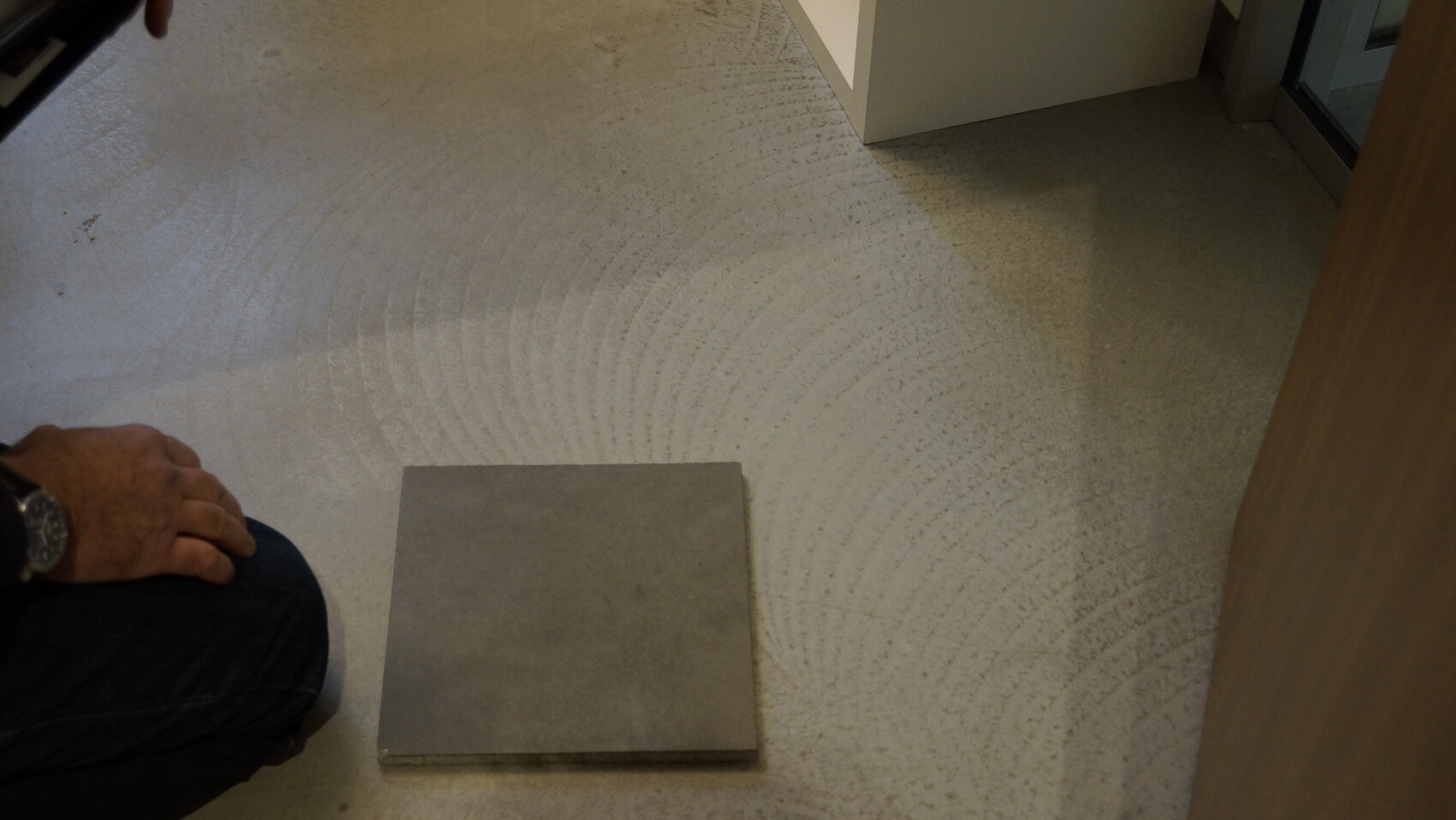
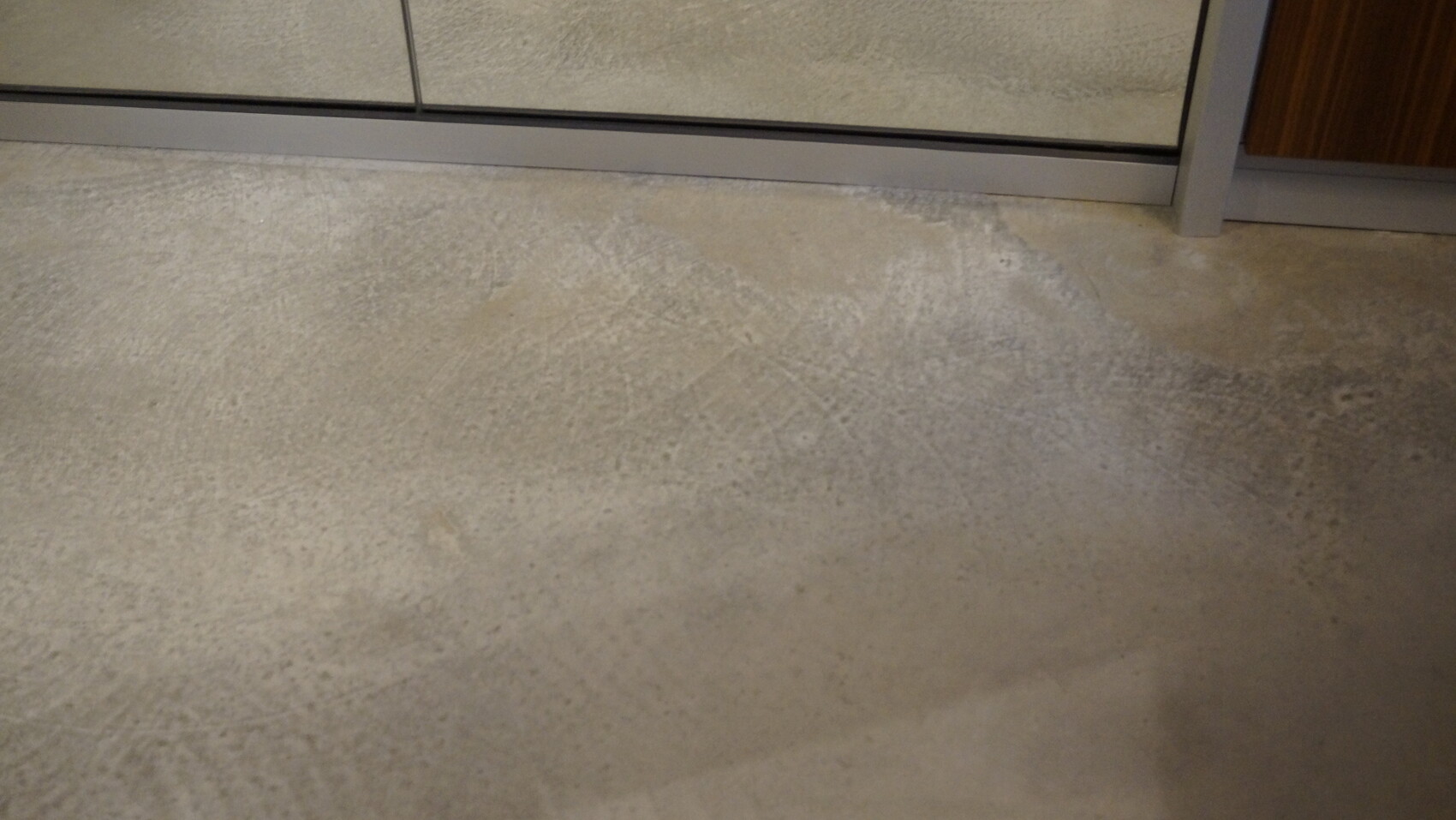
Scratching tendency cannot be ruled out for Pandomo as well as TopCiment.
If you want a visually flawless, meaning homogeneous appearance, you will have to use a pigmented sealant, for example in RAL 7046.
There are abrasion-resistant material systems available here that do not yellow and still serve well for many years.
You always have to be aware that such floor systems, as you have described, are so-called “unique floors.” How they will look afterwards depends on several factors.
DIN A4 sized sample areas do not help either (see photo 1) and are also unsuitable in a legal dispute as reliable evidence to prove visual unevenness.
We are not discussing suitability for underfloor heating or compressive strength of the systems, as all systems meet the necessary requirements.
The decision is now yours. As my last remark on this, the term “concrete look” is meaningless. A concrete look as I know it from professional practice and which is common will certainly not be what you want in a living area.
----------------------------
Regards: KlaRa
Here are the answers to your questions:
If you want a visually uniform surface with so-called “concrete look,” you will not be fully satisfied with any of your suggestions!
And this is for understandable reasons.
The Pandomo system, as well as the “TopCiment” based on a cement dispersion, are mineral-bound systems that ultimately have different absorption rates after curing. Pandomo is usually treated with a so-called stone oil, which inevitably causes different penetration depths due to the varying absorbency of the cement surface.
This means that visually cloud-like, unevenly visible areas are created, which have nothing to do with “visual uniformity,” but are unavoidable from a craftsmanship perspective.
The Rheobond from Chemotechnik Abstatt is known to me from various large projects, most recently in Berlin.
Rheobond is a classic industrial floor covering used in halls as well as commercial buildings. A prerequisite for an appealing surface is machine troweling to achieve uniform compaction of the structure. This is not feasible in small rooms (residential buildings), where manual work is necessary around projecting corners, etc. Surfaces treated with an impregnation (here: OBTEGO) develop strong cloud-like shadows with varying intensity effects (see photo on the right).
On the left in the image, a grinder had to be used to smooth the surface before applying the impregnation. This is also visible.
For an industrial floor, these characteristics are irrelevant; in large projects, they lead to disputes but ultimately must be accepted. In private rooms, such a final appearance is unacceptable.
Scratching tendency cannot be ruled out for Pandomo as well as TopCiment.
If you want a visually flawless, meaning homogeneous appearance, you will have to use a pigmented sealant, for example in RAL 7046.
There are abrasion-resistant material systems available here that do not yellow and still serve well for many years.
You always have to be aware that such floor systems, as you have described, are so-called “unique floors.” How they will look afterwards depends on several factors.
DIN A4 sized sample areas do not help either (see photo 1) and are also unsuitable in a legal dispute as reliable evidence to prove visual unevenness.
We are not discussing suitability for underfloor heating or compressive strength of the systems, as all systems meet the necessary requirements.
The decision is now yours. As my last remark on this, the term “concrete look” is meaningless. A concrete look as I know it from professional practice and which is common will certainly not be what you want in a living area.
----------------------------
Regards: KlaRa
Similar topics