
ᐅ Floor plan for a 180 m² urban villa with a basement, designed for a family with three children – what are your thoughts?
Created on: 27 Dec 2020 15:20
K
Kraj
Hello dear forum members,
after reading along for a long time, the time has finally come for us as well.
Since we are always open to criticism, different perspectives, and suggestions, we look forward to your opinions on our floor plan design.
Before entering the crucial phase, the two of us created a self-designed floor plan, and this is the one we want to move forward with.
Now, onto the details:
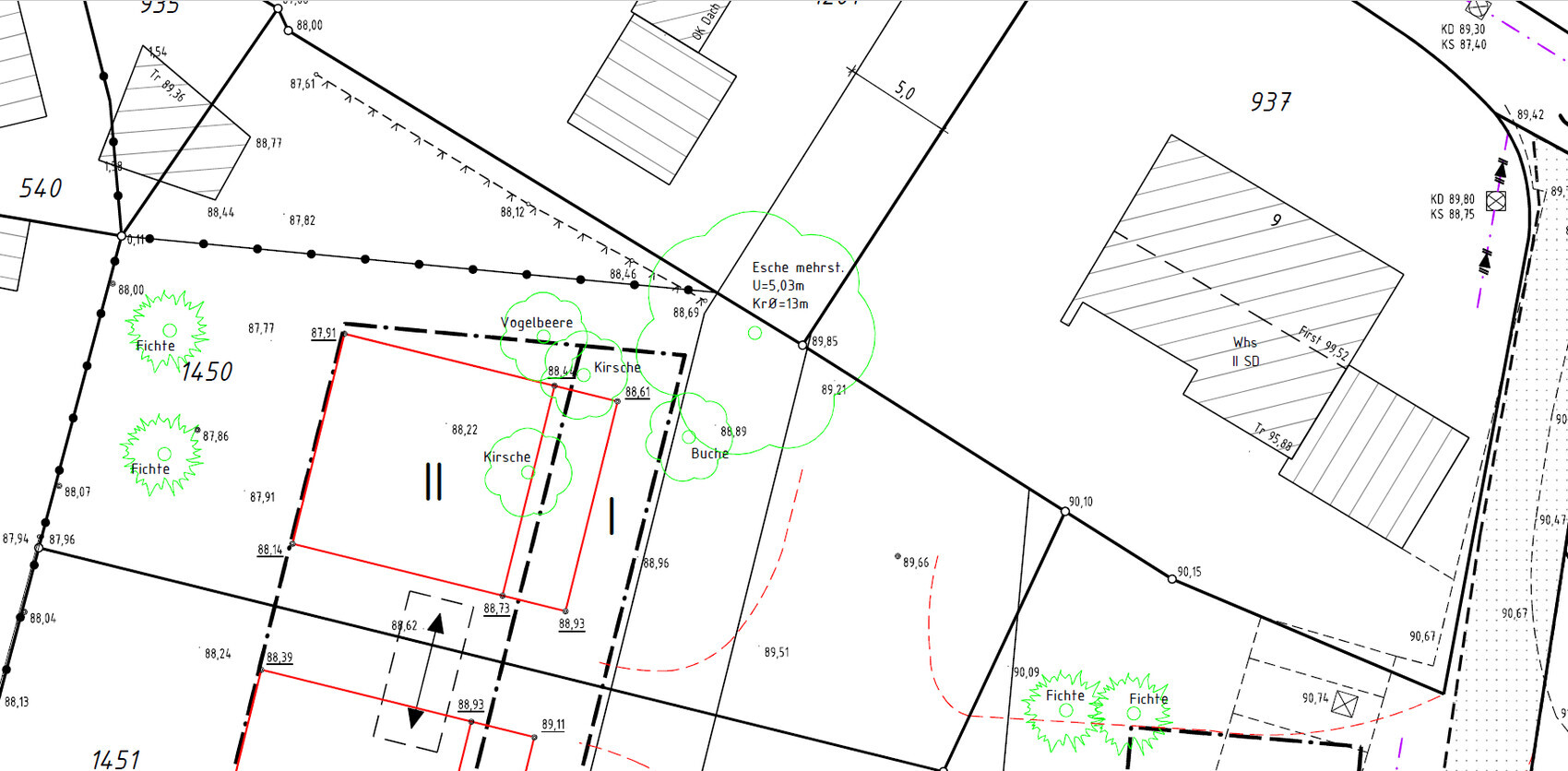
Development Plan/Restrictions
Plot size: 880m² (0.22 acres)
Slope: Approximately 2m (6.5 feet) between the east and west property boundaries but varying significantly—see surveying documents
Floor area ratio: 0.4
Gross floor area ratio: 0.8
Building envelope, building line and boundary: 13x10m (43x33 feet) for one full story and 10x10m (33x33 feet) for two full stories
Edge development: None
Number of parking spaces: No requirements
Number of stories: 2
Roof type: According to the development plan, pitched roofs are mandatory
Architectural style: Urban villa
Orientation: Main entrance on the east side, terrace and recreational garden on the west side, utility garden on east side
Maximum heights/limits: According to the development plan no specification other than two full stories
Other requirements: Rainwater must infiltrate the plot. According to the soil report, the ground is not optimally permeable. Additionally, some hydrostatic pressure from groundwater is expected. Therefore, we plan to install a cistern to use rainwater.
Client Requirements
Style, roof type, building type: Solid construction (Ytong), 35cm (14 inches) hip roof with 80cm (31 inches) knee wall
Basement, floors: Basement 10x10m (33x33 feet) precast waterproof concrete basement (white tank construction)
Number of occupants, age: Parents 36 and 33, children 3.5 and 1.5 years old, plus one due July 2021
Space requirements on ground floor and upper floor: Ground floor 80m² (860 sq ft), upper floor 80m² (860 sq ft), attic 15-20m² (160-215 sq ft), basement mainly utility but with a larger fitness room planned
Office: Family use or home office?: Home office only. Before COVID-19, working at home 2-3 days a week; in 2020 a total of 10 months working from home; after COVID-19 probably 3-4 days a week home office
Overnight guests per year: 5
Open or closed architecture: Open on the ground floor
Traditional or modern construction: Modern
Open kitchen, kitchen island: Open with large kitchen island, cooking happens daily, about once a month guests up to 8 people, pantry directly adjacent to kitchen
Number of dining seats: 6-8, expandable with an additional table
Fireplace: No
Music/stereo wall: No
Balcony, roof terrace: No
Garage, carport: Large garage plus possibly 1-2 guest parking spaces
Utility garden, greenhouse: Yes, large greenhouse (possibly earth-sheltered) planned on east side with south orientation
Other wishes/special features/daily routine, also reasoning why certain things should or should not be included: Very bright ground floor with many windows, where only the middle lift-and-slide door and the door near the kitchen can be opened, all other windows on the ground floor are fixed glazing. Photovoltaics and KNX home automation system are planned.
House Design
Who created the plan: DIY
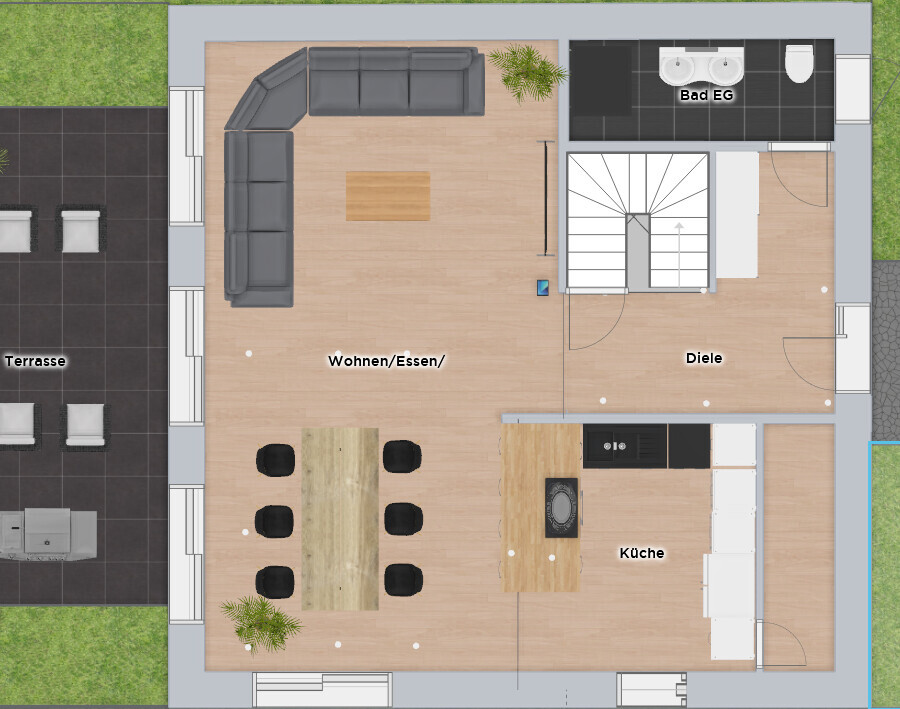
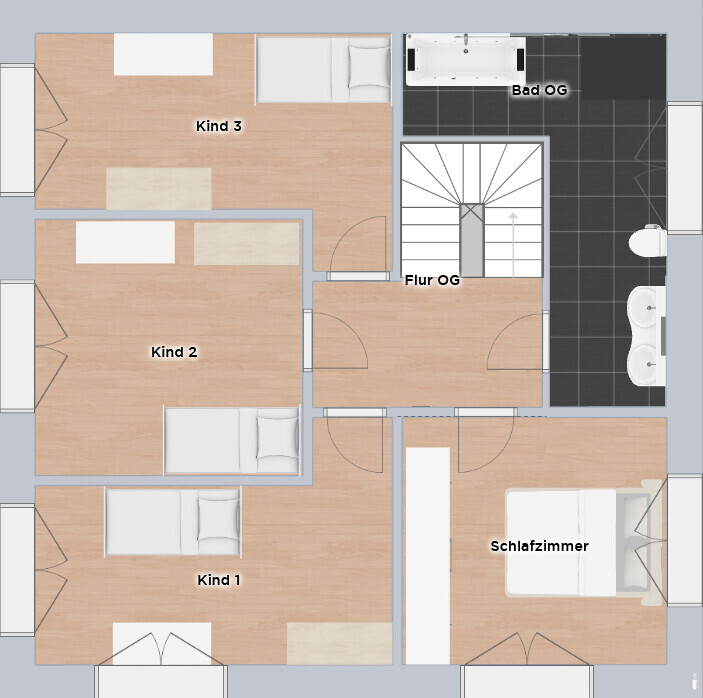
What do you especially like? Why?: Large living/dining area, open kitchen, pantry, three children’s rooms roughly equal in size facing the garden
What do you dislike? Why?: No walk-in closet in the master bedroom
Price estimate according to architect/planner: 400,000 without additional construction costs
Personal price limit for the house including equipment: 415,000
Preferred heating technology: Geothermal (either probe or trench collector) with underfloor heating
If you had to give up, which details/extensions
-could you do without: Walk-in closet in the bedroom
-could you not do without: Large living/dining area, open kitchen, pantry, three children’s rooms roughly equal in size facing the garden
Why is the design the way it is now?
This is the 12th or 13th version after long discussions and considerations. Whether it is more or less final also depends on your feedback.
What is the most important/basic question about the floor plan summarized in 130 characters?
Optimally use space and layout, avoid pitfalls.
after reading along for a long time, the time has finally come for us as well.
Since we are always open to criticism, different perspectives, and suggestions, we look forward to your opinions on our floor plan design.
Before entering the crucial phase, the two of us created a self-designed floor plan, and this is the one we want to move forward with.
Now, onto the details:
Development Plan/Restrictions
Plot size: 880m² (0.22 acres)
Slope: Approximately 2m (6.5 feet) between the east and west property boundaries but varying significantly—see surveying documents
Floor area ratio: 0.4
Gross floor area ratio: 0.8
Building envelope, building line and boundary: 13x10m (43x33 feet) for one full story and 10x10m (33x33 feet) for two full stories
Edge development: None
Number of parking spaces: No requirements
Number of stories: 2
Roof type: According to the development plan, pitched roofs are mandatory
Architectural style: Urban villa
Orientation: Main entrance on the east side, terrace and recreational garden on the west side, utility garden on east side
Maximum heights/limits: According to the development plan no specification other than two full stories
Other requirements: Rainwater must infiltrate the plot. According to the soil report, the ground is not optimally permeable. Additionally, some hydrostatic pressure from groundwater is expected. Therefore, we plan to install a cistern to use rainwater.
Client Requirements
Style, roof type, building type: Solid construction (Ytong), 35cm (14 inches) hip roof with 80cm (31 inches) knee wall
Basement, floors: Basement 10x10m (33x33 feet) precast waterproof concrete basement (white tank construction)
Number of occupants, age: Parents 36 and 33, children 3.5 and 1.5 years old, plus one due July 2021
Space requirements on ground floor and upper floor: Ground floor 80m² (860 sq ft), upper floor 80m² (860 sq ft), attic 15-20m² (160-215 sq ft), basement mainly utility but with a larger fitness room planned
Office: Family use or home office?: Home office only. Before COVID-19, working at home 2-3 days a week; in 2020 a total of 10 months working from home; after COVID-19 probably 3-4 days a week home office
Overnight guests per year: 5
Open or closed architecture: Open on the ground floor
Traditional or modern construction: Modern
Open kitchen, kitchen island: Open with large kitchen island, cooking happens daily, about once a month guests up to 8 people, pantry directly adjacent to kitchen
Number of dining seats: 6-8, expandable with an additional table
Fireplace: No
Music/stereo wall: No
Balcony, roof terrace: No
Garage, carport: Large garage plus possibly 1-2 guest parking spaces
Utility garden, greenhouse: Yes, large greenhouse (possibly earth-sheltered) planned on east side with south orientation
Other wishes/special features/daily routine, also reasoning why certain things should or should not be included: Very bright ground floor with many windows, where only the middle lift-and-slide door and the door near the kitchen can be opened, all other windows on the ground floor are fixed glazing. Photovoltaics and KNX home automation system are planned.
House Design
Who created the plan: DIY
What do you especially like? Why?: Large living/dining area, open kitchen, pantry, three children’s rooms roughly equal in size facing the garden
What do you dislike? Why?: No walk-in closet in the master bedroom
Price estimate according to architect/planner: 400,000 without additional construction costs
Personal price limit for the house including equipment: 415,000
Preferred heating technology: Geothermal (either probe or trench collector) with underfloor heating
If you had to give up, which details/extensions
-could you do without: Walk-in closet in the bedroom
-could you not do without: Large living/dining area, open kitchen, pantry, three children’s rooms roughly equal in size facing the garden
Why is the design the way it is now?
This is the 12th or 13th version after long discussions and considerations. Whether it is more or less final also depends on your feedback.
What is the most important/basic question about the floor plan summarized in 130 characters?
Optimally use space and layout, avoid pitfalls.
Kraj schrieb:
Slope: Approximately 2m (6.5 ft) between the east and west property boundaries, but varies significantly—see the survey document I don’t see that at all, I estimate around 120 cm (4 ft)... Where are the garage and parking spaces supposed to be? Some dimensions would really help the site plan, as I can’t currently identify the 880 sqm (9,450 sq ft). That would be about 20x40m (65x130 ft), but that doesn’t match the apparently marked 10x10m (33x33 ft) or 10x13m (33x43 ft). Or does that triangle to the north belong to it?
Kraj schrieb:
Building envelope, building line, and boundary: 13x10m (43x33 ft) for one full floor and 10x10m (33x33 ft) for two full floors What is this based on? Could a house possibly be one story in the part with zoning I, and then have two stories in the zone II area, effectively having a stepped floor?
Kraj schrieb:
At first glance, both the cloakroom and hallway can easily accommodate the staircase that is 30 cm (12 inches) wider, but the upper floor is less straightforward. So the staircase is still a ToDo. Kraj schrieb:
Apparently, our floor plan isn’t that bad after all, since the criticism seems to focus more on budget and DIY work 🙂
Or are we misunderstanding this? First, point 1 must be resolved—otherwise, as you yourself have noticed, there are serious issues upstairs, and I agree... significant ones 😉 So right now, any further discussion about the floor plan is pointless. I would detach from the square layout. For the attic, consider the remarks from @ypg, and maybe design the basement so that the northwest corner is somewhat elevated relative to the terrain, allowing the home office to be relocated there.
H
hampshire29 Dec 2020 10:05ypg schrieb:
But building extra large, covering the missing equity with a borrowed "muscle mortgage" that you depend on—I consider that unreasonable.If you use what is generally considered "reasonable" as a benchmark, I agree with you. Anyone taking on such a project must be able to improvise and persist firmly when facing setbacks. These setbacks will most likely occur but do not necessarily lead to ruin; instead, they result in challenging and exciting life situations that, once overcome, make one stronger. Reasonableness is just one of many guides.hampshire schrieb:
If you use what is generally considered "reasonable" as a benchmark, I agree with you. It’s unreasonable to finish an attic with over 100 sqm (1076 sq ft) of floor space for approximately €50,000 if the basement hasn’t even been fully utilized as living space.
As you can see here, you don’t notice the lower ground floor—not because it was forgotten, but because basement space is not considered important (hobbies, laundry, and heating can be managed somehow).
The slope of the site should—and rather can—be factored in here. If someone doesn’t use the 100 sqm (1076 sq ft) in the basement to optimize their cost calculation, then I don’t know.
I think a professional really needs to step in and advise the builders on their options—including budget considerations. This discussion here feels somewhat slow and unproductive like chewing gum.
I keep wondering whether the original poster has no need to communicate or no question. They show up but don’t post anything. After all, it’s their thread...

I have not commented on the submitted house design because I simply do not consider it ready for discussion yet: I cannot interpret the zoning plan myself, as I am not familiar with it as a source, and only certain details have been mentioned here, which seem at least strange to me in combination and partly suggest misinterpretations. The site plan lacks a legend and raises many questions; for example, the red lines appear to outline the planned buildings, but (to put it kindly) they are "not consistent" with the building envelope outlines. The plan section is also far too limited in scale—not even the site access can be reasonably inferred from it. This is not a basis for me to work on—the absence of my qualified comments is solely due to the fact that the design is by no means at an almost perfect maturity level!
https://www.instagram.com/11antgmxde/
https://www.linkedin.com/company/bauen-jetzt/
https://www.instagram.com/11antgmxde/
https://www.linkedin.com/company/bauen-jetzt/

hampshire schrieb:
Anyone taking on a project like this needs to be able to improvise and stay persistent when facing setbacks. That’s certainly true, but in this case, it seems like the project is being undertaken just to build resilience, which is unreasonable by any standard.
superzapp schrieb:
I would compare both options and calculate (or have calculated) as accurately as possible—from KfW55 to Passive House. If there is BAFA funding for both (35%), I would always choose a system controlled by a central unit (a requirement for the subsidy).
Also, include what you want anyway (e.g., photovoltaics?, controlled residential ventilation) in the calculations, and then see what the net cost is after the additional funding. But it might require an energy consultant for that...
I think it’s feasible when I consider how long other building projects have taken. But keep in mind that if you have to wait for ceilings to be finished or other trades, your timeline can get disrupted. Mixing outsourced services and self-work in a tight schedule requires a lot of discipline.
It’s definitely possible (with heavy equipment).
We’re doing the same, I think it fits. But flat duct is really expensive. Our 70mm (2.8 inches) round duct costs about €3/m (€3 per meter) 😉
I also consider that realistic. My brother-in-law did it for his son a few months ago, and I was there several times (not to help). It’s not that difficult if you have suitable plans and tools (unwinder, staple gun...)
That’s ambitious. I would schedule more time just to make sure all cables are labeled properly right away. Pulling cables into conduit takes time, and laying conduit itself is awkward.
I see you have a plan. But better build in some buffer here and there. Something always comes up 😀. Today I feel my “old bones” even though I was only on site for 6–7 hours doing light work (insulation and support battens). It’s different from office work—you shouldn’t underestimate the physical demands.We will probably use both the heat pump and the controlled residential ventilation system from Nibe since both can be subsidized together. Combining outsourced services and self-work never runs smoothly, but we will still try to plan with sufficient buffer time. Thanks for the tip about the round duct—do you have an idea how much floor height you sacrificed compared to flat duct? Labeling cables might really be an advantage, and I’d accept the extra effort for that.ypg schrieb:
The affordable townhouses have a hip roof, which falls under the hipped roof category. There is no knee wall, and due to the wooden structure, it can’t be converted into living space—at most, a crawl space for storage. What you are planning is one category more expensive: a) a timber frame that can be expanded and accessed, b) an additional knee wall, c) an extra staircase, d) a ceiling that must carry much more load than just storage, e) insulation that converts a cold roof into a warm roof, f) habitable finishing, g) some technical equipment like heating, h) a nice window instead of a roof hatch, i) higher scaffolding during construction, and k) exterior wall materials. And all that despite already planning a costly basement.
I looked at it: 2 users who don’t usually stand out in other floor plan discussions with counterexamples or alternative approaches.
1) Both children’s rooms lose 1 square meter (sq m) of living space each, and 2.60m (8.5 ft), not the 3.50m (11.5 ft) stated, is not something that can’t be improved.
2) The bathroom’s shape is like a storage room.
3) The pantry is wasted space.
These are obvious issues; no need to get into every detail. I could complain more, but besides that: the general contractor’s planner will copy this 1:1. They won’t advise or improve “what the customer wants is what they get.” The problem is: you see and plan this as laypeople, fascinated by the 3D button, and you no longer believe in the need for a professional architect because everything seems so simple. At least let the planner do their job and loosen the 10x10 grid that here only serves as an awkward corset, without being shown.
Does the active support also have the time on the days you need them? The support for the planned theoretical days must earn their own living... or are the people unemployed?
I totally get that. If my husband needs to work somewhere else on weekends, he is with me on the third weekend on a short trip :p. That might sound bad, but it’s reality—more than one weekend you cannot keep someone on the construction site. Free of charge, even less so. With good friends and family, maybe a week works. But nobody gives away their annual vacation. Therefore, I don’t see the €45,000 (now income) equity for the shell construction.Yes, you are right about the attic, and your arguments convinced us. So we are moving the office from the attic to the basement and will use the attic for storage. What should we do with the square meters in the children’s rooms? We haven’t understood that yet. We’re also not satisfied with the bathroom—is there a way to arrange it better? My wife really wants the pantry next to the kitchen, even if it’s only 1 meter (40 inches) wide. And of course, we don’t claim to do better than an architect—it’s just our initial drafts we want to start with. We expect that there will be objections (possibly due to statics) and adjustments.hampshire schrieb:
I have seen self-performance work work very well in 3 cases among friends in different constellations. Every weekend and many evenings were invested with a clear target and a lot of help from family and friends. That life sometimes comes to a halt is part of it, but in all cases, the partners managed very well together.I can confirm that since I have helped friends several times. It’s doable but leaves barely any free time.ypg schrieb:
Yes, it can work. But we have also often read here that it turned into a small disaster—with additional costs, because it was about painting work including filling... I don’t remember precisely. I personally witnessed a football team building a house with their craftsmen; it’s already many years ago... team dynamics make a lot possible. But building very large, filling missing equity with borrowed muscle power you depend on—that’s unreasonable. The good thing about the project is that the OP, meaning you @Kraj, can find out pretty early if it works. Then the helpers are still enthusiastic.
Still, you have to consider that helpers have their own jobs during the day. So as the builder, you often work mostly alone. Many people overlook this fact.There are not only 2 helpers. We help each other in our circle of friends, so 2 men are available one weekend, and 2 others the next weekend. It will never run exactly as planned anyway, since short-term changes are normal, but that’s all part of it.K1300S schrieb:
I’m afraid you do. If the overall project is calculated unrealistically, it’s not worth discussing the floor plan. To add my two cents: I like some parts (like the living/dining area), but others (such as the bathroom) are quite awful or unusable. And once you start cleaning up in one area, your (house of) cards collapses somewhere else. Not that 100m² (1,076 sq ft) of floor area is small, especially with basement and attic, but with this room program it’s rather tight. Things like storage space aren’t even considered.The floor plan cannot be directly translated 1:1 into costs, so I don’t agree. With the presented floor plan, I can easily contract trades for €80,000 or, with the same plan and a lot of self-work, save €80,000. The choice of heating system—for example, trench collector for €16,000 in self-performance or a regular ground source heat pump for nearly €50,000—is a huge difference and has nothing to do with room layout. Same for KNX, etc.haydee schrieb:
The pantry is too narrow. With a 15cm (6 inch) shelf, it’s extremely expensive storage space. Better add another cupboard to the kitchen. And what about the freezer? The cloakroom seems small for five people. Especially as you always have to go through the dirty zone and step over shoes to get to the toilet. The upstairs bathroom is an absolute no-go and will be buried with the modified staircase.
If the floor plan is oriented to north, swap parents’ and child 3’s rooms.The freezer is already in the kitchen, next to the pantry door. The bathroom is definitely unsatisfactory, but we currently have no idea how to improve it. We also noticed the shoe issue in the cloakroom, but the shoes have to go somewhere. Swapping parents with child 3? That will be difficult because of the bigger bed and the wardrobe from the bedroom.kbt09 schrieb:
I don’t see that at all, I see about 120cm (47 inches)... Where should the garage and parking spaces go? Some dimensions on the site plan would be helpful, currently I cannot identify the 880 m² (9,470 sq ft). It would be about 20x40m (66x131 ft), which don’t fit the roughly drawn 10x10 or 10x13m (33x33 or 33x43 ft). Does the triangle to the north belong?
What is this information based on? Could a house possibly be one-story in the I zone and two-story in the II zone, i.e., a stepped story?
First, point 1 must be correct, or you can already see problems in the upper floor, and so do I... serious ones 😉. So, at the moment, any further discussion about the floor plan is pointless. I would free myself from the square grid. For the attic, consider @ypg’s comments, and perhaps plan the basement so that the northwest corner can be raised slightly above ground level and the home office can be relocated there.I’m attaching a site plan. The west elevation is between 87.94 and 88.00m (288.3–288.6 ft), and the east is around 90m (295 ft), hence the 2-meter (6.6 feet) elevation difference. Yes, the triangle on top belongs to the plot. The garage and parking spaces will be placed on the east side; exact locations are not fixed. Either as suggested on the site plan or possibly closer to the house. What do you think? And yes, in zone I, the building can be one story, then two stories in zone II. But we were advised against this because of the basement.ypg schrieb:
It’s unreasonable to convert an attic over 100 m² (1,076 sq ft) for roughly €50,000 if the basement is not even fully used as living space. As you can see, nothing is visible from the basement—not because it was forgotten, but because basement space is not considered important (hobby room, laundry, and heating can be tucked in somehow). The slope should and can also be incorporated. If you don’t use the 100 m² (1,076 sq ft) in the basement optimally for your needs and calculation, I don’t know what else to say.
I think a professional needs to get involved to inform the builders about the options—also regarding the budget. This discussion feels drawn out and leads nowhere.
I keep wondering if the OP has any need to communicate or questions. He shows up but posts nothing. It’s his thread after all...You don’t see the basement because we only planned heating, laundry, fitness room, and guest room there, but the arguments here convinced us to move the office to the basement and drop the attic conversion. I do post, don’t I? I have responded to almost all feedback and am incorporating your input directly into our planning, see the attic change. 😉11ant schrieb:
I based my comments on the submitted house design and have not commented earlier because I don’t consider it ready for discussion: I cannot interpret the development plan myself since it is not provided and only partial details are discussed here, which seem odd in combination and suggest possible misunderstandings. The site plan lacks a legend and raises many questions; for example, red lines look like outline depictions of planned buildings but are not aligned with the building boundary lines. The plan excerpt is too small—it doesn’t even allow speculation about access. I cannot work like this—and not at all because of a supposed nearly perfect maturity of the design, which is the only reason I haven’t said more.Maybe the attached site plan with specific dimensions helps. The parking spaces and garages are not final and can still be moved. This site plan comes from a preliminary building inquiry and includes the condition for zones I (one full story) and II (two full stories).Similar topics