
ᐅ Floor plan for a 180 m² urban villa with a basement, designed for a family with three children – what are your thoughts?
Created on: 27 Dec 2020 15:20
K
Kraj
Hello dear forum members,
after reading along for a long time, the time has finally come for us as well.
Since we are always open to criticism, different perspectives, and suggestions, we look forward to your opinions on our floor plan design.
Before entering the crucial phase, the two of us created a self-designed floor plan, and this is the one we want to move forward with.
Now, onto the details:
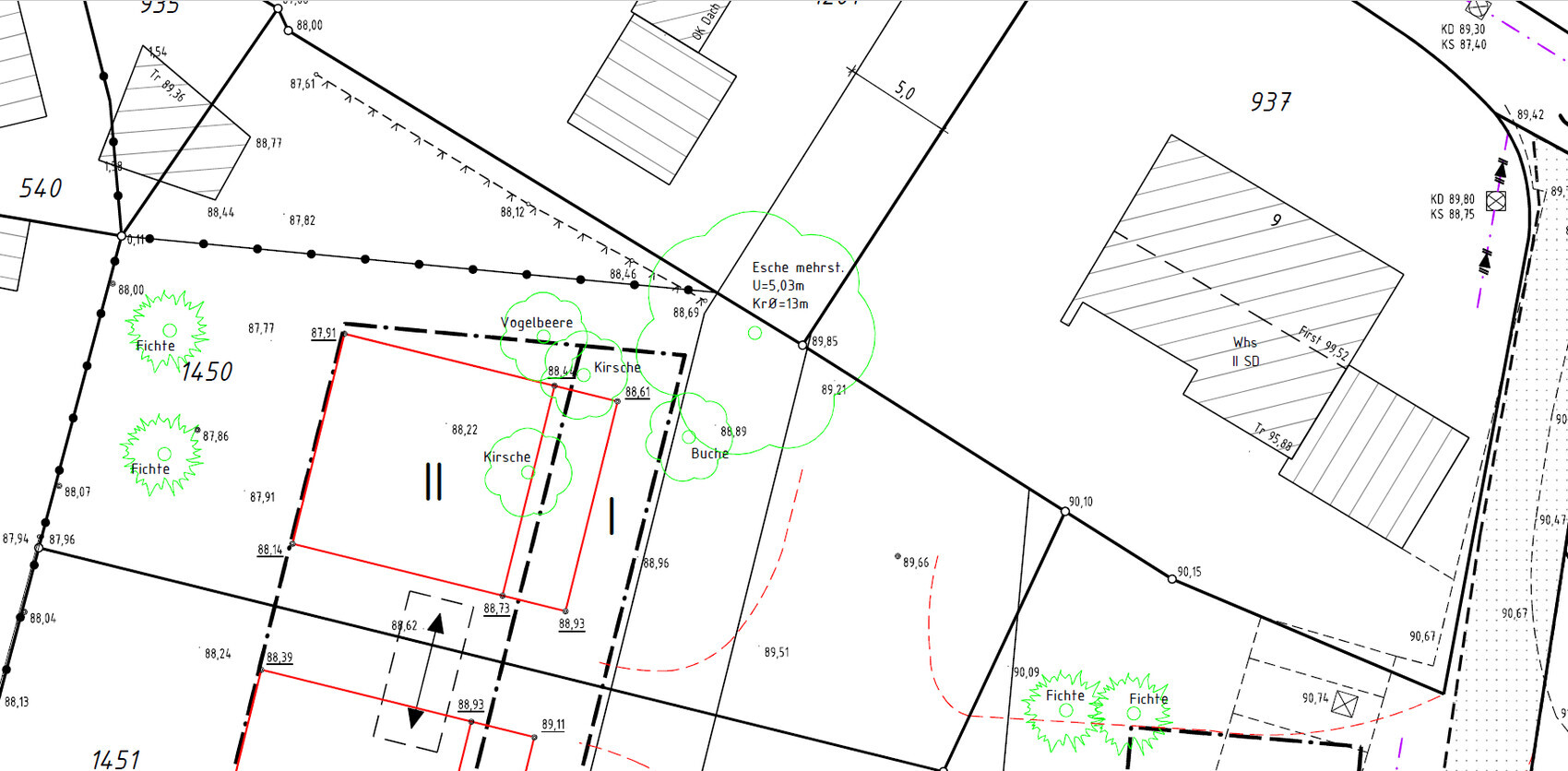
Development Plan/Restrictions
Plot size: 880m² (0.22 acres)
Slope: Approximately 2m (6.5 feet) between the east and west property boundaries but varying significantly—see surveying documents
Floor area ratio: 0.4
Gross floor area ratio: 0.8
Building envelope, building line and boundary: 13x10m (43x33 feet) for one full story and 10x10m (33x33 feet) for two full stories
Edge development: None
Number of parking spaces: No requirements
Number of stories: 2
Roof type: According to the development plan, pitched roofs are mandatory
Architectural style: Urban villa
Orientation: Main entrance on the east side, terrace and recreational garden on the west side, utility garden on east side
Maximum heights/limits: According to the development plan no specification other than two full stories
Other requirements: Rainwater must infiltrate the plot. According to the soil report, the ground is not optimally permeable. Additionally, some hydrostatic pressure from groundwater is expected. Therefore, we plan to install a cistern to use rainwater.
Client Requirements
Style, roof type, building type: Solid construction (Ytong), 35cm (14 inches) hip roof with 80cm (31 inches) knee wall
Basement, floors: Basement 10x10m (33x33 feet) precast waterproof concrete basement (white tank construction)
Number of occupants, age: Parents 36 and 33, children 3.5 and 1.5 years old, plus one due July 2021
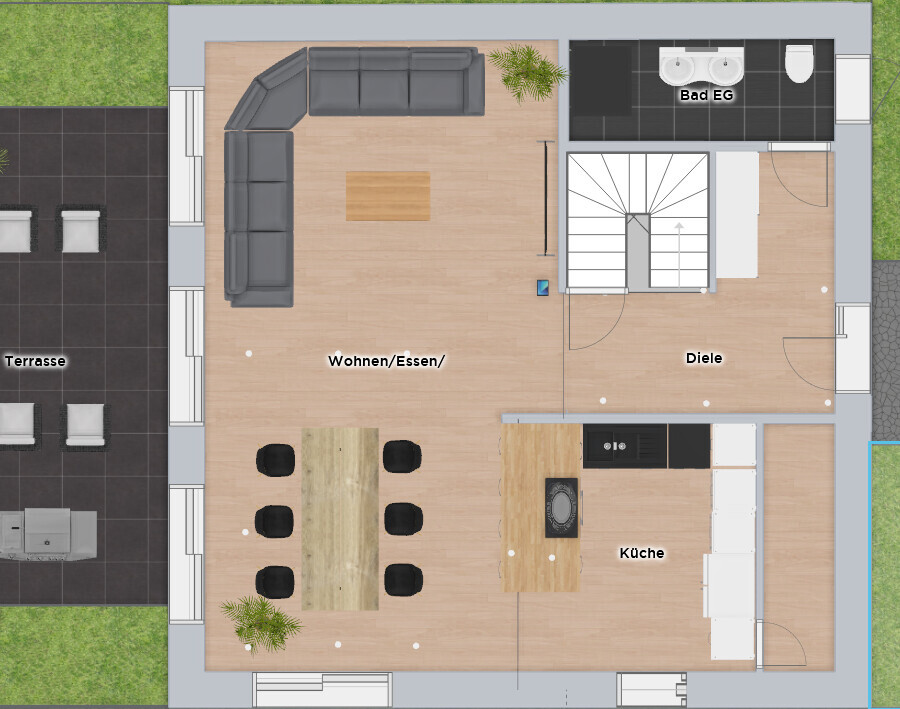
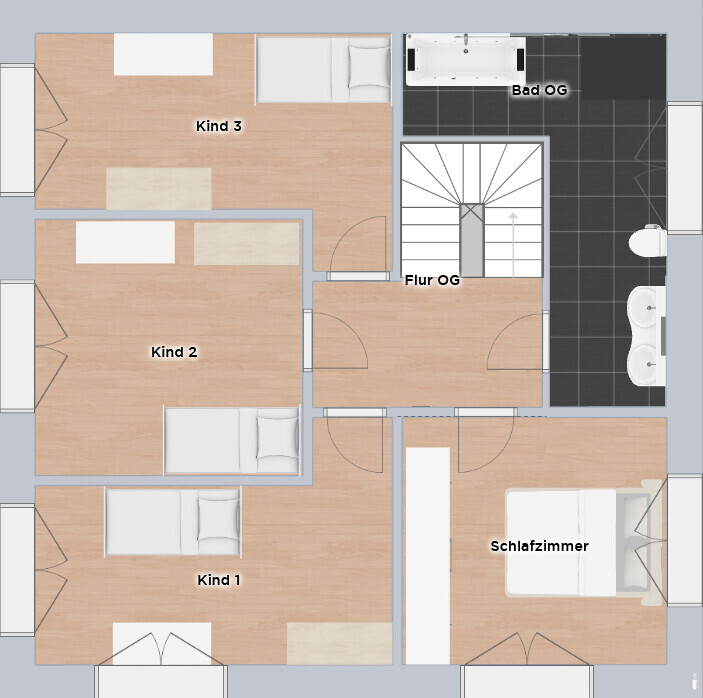
Space requirements on ground floor and upper floor: Ground floor 80m² (860 sq ft), upper floor 80m² (860 sq ft), attic 15-20m² (160-215 sq ft), basement mainly utility but with a larger fitness room planned
Office: Family use or home office?: Home office only. Before COVID-19, working at home 2-3 days a week; in 2020 a total of 10 months working from home; after COVID-19 probably 3-4 days a week home office
Overnight guests per year: 5
Open or closed architecture: Open on the ground floor
Traditional or modern construction: Modern
Open kitchen, kitchen island: Open with large kitchen island, cooking happens daily, about once a month guests up to 8 people, pantry directly adjacent to kitchen
Number of dining seats: 6-8, expandable with an additional table
Fireplace: No
Music/stereo wall: No
Balcony, roof terrace: No
Garage, carport: Large garage plus possibly 1-2 guest parking spaces
Utility garden, greenhouse: Yes, large greenhouse (possibly earth-sheltered) planned on east side with south orientation
Other wishes/special features/daily routine, also reasoning why certain things should or should not be included: Very bright ground floor with many windows, where only the middle lift-and-slide door and the door near the kitchen can be opened, all other windows on the ground floor are fixed glazing. Photovoltaics and KNX home automation system are planned.
House Design
Who created the plan: DIY
What do you especially like? Why?: Large living/dining area, open kitchen, pantry, three children’s rooms roughly equal in size facing the garden
What do you dislike? Why?: No walk-in closet in the master bedroom
Price estimate according to architect/planner: 400,000 without additional construction costs
Personal price limit for the house including equipment: 415,000
Preferred heating technology: Geothermal (either probe or trench collector) with underfloor heating
If you had to give up, which details/extensions
-could you do without: Walk-in closet in the bedroom
-could you not do without: Large living/dining area, open kitchen, pantry, three children’s rooms roughly equal in size facing the garden
Why is the design the way it is now?
This is the 12th or 13th version after long discussions and considerations. Whether it is more or less final also depends on your feedback.
What is the most important/basic question about the floor plan summarized in 130 characters?
Optimally use space and layout, avoid pitfalls.
after reading along for a long time, the time has finally come for us as well.
Since we are always open to criticism, different perspectives, and suggestions, we look forward to your opinions on our floor plan design.
Before entering the crucial phase, the two of us created a self-designed floor plan, and this is the one we want to move forward with.
Now, onto the details:
Development Plan/Restrictions
Plot size: 880m² (0.22 acres)
Slope: Approximately 2m (6.5 feet) between the east and west property boundaries but varying significantly—see surveying documents
Floor area ratio: 0.4
Gross floor area ratio: 0.8
Building envelope, building line and boundary: 13x10m (43x33 feet) for one full story and 10x10m (33x33 feet) for two full stories
Edge development: None
Number of parking spaces: No requirements
Number of stories: 2
Roof type: According to the development plan, pitched roofs are mandatory
Architectural style: Urban villa
Orientation: Main entrance on the east side, terrace and recreational garden on the west side, utility garden on east side
Maximum heights/limits: According to the development plan no specification other than two full stories
Other requirements: Rainwater must infiltrate the plot. According to the soil report, the ground is not optimally permeable. Additionally, some hydrostatic pressure from groundwater is expected. Therefore, we plan to install a cistern to use rainwater.
Client Requirements
Style, roof type, building type: Solid construction (Ytong), 35cm (14 inches) hip roof with 80cm (31 inches) knee wall
Basement, floors: Basement 10x10m (33x33 feet) precast waterproof concrete basement (white tank construction)
Number of occupants, age: Parents 36 and 33, children 3.5 and 1.5 years old, plus one due July 2021
Space requirements on ground floor and upper floor: Ground floor 80m² (860 sq ft), upper floor 80m² (860 sq ft), attic 15-20m² (160-215 sq ft), basement mainly utility but with a larger fitness room planned
Office: Family use or home office?: Home office only. Before COVID-19, working at home 2-3 days a week; in 2020 a total of 10 months working from home; after COVID-19 probably 3-4 days a week home office
Overnight guests per year: 5
Open or closed architecture: Open on the ground floor
Traditional or modern construction: Modern
Open kitchen, kitchen island: Open with large kitchen island, cooking happens daily, about once a month guests up to 8 people, pantry directly adjacent to kitchen
Number of dining seats: 6-8, expandable with an additional table
Fireplace: No
Music/stereo wall: No
Balcony, roof terrace: No
Garage, carport: Large garage plus possibly 1-2 guest parking spaces
Utility garden, greenhouse: Yes, large greenhouse (possibly earth-sheltered) planned on east side with south orientation
Other wishes/special features/daily routine, also reasoning why certain things should or should not be included: Very bright ground floor with many windows, where only the middle lift-and-slide door and the door near the kitchen can be opened, all other windows on the ground floor are fixed glazing. Photovoltaics and KNX home automation system are planned.
House Design
Who created the plan: DIY
What do you especially like? Why?: Large living/dining area, open kitchen, pantry, three children’s rooms roughly equal in size facing the garden
What do you dislike? Why?: No walk-in closet in the master bedroom
Price estimate according to architect/planner: 400,000 without additional construction costs
Personal price limit for the house including equipment: 415,000
Preferred heating technology: Geothermal (either probe or trench collector) with underfloor heating
If you had to give up, which details/extensions
-could you do without: Walk-in closet in the bedroom
-could you not do without: Large living/dining area, open kitchen, pantry, three children’s rooms roughly equal in size facing the garden
Why is the design the way it is now?
This is the 12th or 13th version after long discussions and considerations. Whether it is more or less final also depends on your feedback.
What is the most important/basic question about the floor plan summarized in 130 characters?
Optimally use space and layout, avoid pitfalls.
Kraj schrieb:
We will adjust to 230 width and 230 depth. Then the entire floor plan concept is pointless... a lot will change.
If you reduce the width to 2.30 meters (7.5 feet), also consider increasing the whole stairwell niche (with a ceiling height of 2.50 meters (8.2 feet)) to 2.50 meters (8.2 feet)... that’s better.
Kraj schrieb:
A single-sided shelf with a depth of 15cm (6 inches) is sufficient there. That room will be quite expensive: approximately 4 square meters (43 square feet) at 2000 €/sqm... 8000 €, and the shelves won’t even be able to hold a baking tray. Do you really want such a “hamster cage”?
Kraj schrieb:
The study is located in the attic. Wow, you are planning 4! floors… three of them heated.
If you also have to raise the basement and the attic gets 80cm (31.5 inches) of sand-lime brick, that will make for quite a tall house. A little tower.
Kraj schrieb:
We are building in NRW and doing a lot of the work ourselves, including the following:
- Masonry of all exterior and interior walls with 2 friends
- Installation of the ring trench collector
- Installation of the underfloor heating including insulation but without screed
- Installation of ventilation pipes for the ventilation system
- Chasing and installation of electrical and bus cables for KNX
- Installation of all floor coverings Respect—or madness.
I don’t think this will offset the budget shortfall. The build will drag on and you’ll have to pay standby interest.
You are currently planning an expensive utility basement and a more costly hipped roof than common city villa roofs, just so the attic can be used at all.
Since you have to redesign anyway, and you should keep in mind that narrow spaces shaped like hoses are neither attractive nor functional, and that towers are not really appealing nowadays, you should consider reshuffling the house layout and the rooms.
K
knalltüte27 Dec 2020 23:06That may sound unrealistic at first, but others also have ambitious goals (@hegi___ with his €1200/m² (about $112/sq ft) house).
Great that my assessment of the heat pump plus horizontal earth collector matches yours. The Nibe (under €10,000 (about $11,200) online, usually around €11,000-12,000 (about $12,300-$13,400) from the plumber) was our first choice, but on the recommendation of our energy consultant, we’re now going with an Alpha Innotec (same parent company). I assume you’re going for the smallest Nibe model at 7 kW?
By the way, Nibe says their controlled mechanical ventilation system works together with their heat pump, so both qualify for BAFA funding. Assuming BAFA funding for heat pumps is still available?
What energy standard are you planning to build to?
Are the costs before or after deducting subsidies?
How much of the work do you plan to do yourself? €100,000 (about $112,000) in personal labor is realistically very hard to achieve (but not impossible).
In our building area, a couple in a joint construction project built almost the entire duplex themselves—from the foundation, walls, and ceiling to laying electrical wiring. However, it took them quite a while (6 to 7 months?), and they were often, but not always, working full-time on it.
Do you and your friends have that much time available?
Great that my assessment of the heat pump plus horizontal earth collector matches yours. The Nibe (under €10,000 (about $11,200) online, usually around €11,000-12,000 (about $12,300-$13,400) from the plumber) was our first choice, but on the recommendation of our energy consultant, we’re now going with an Alpha Innotec (same parent company). I assume you’re going for the smallest Nibe model at 7 kW?
By the way, Nibe says their controlled mechanical ventilation system works together with their heat pump, so both qualify for BAFA funding. Assuming BAFA funding for heat pumps is still available?
What energy standard are you planning to build to?
Are the costs before or after deducting subsidies?
How much of the work do you plan to do yourself? €100,000 (about $112,000) in personal labor is realistically very hard to achieve (but not impossible).
In our building area, a couple in a joint construction project built almost the entire duplex themselves—from the foundation, walls, and ceiling to laying electrical wiring. However, it took them quite a while (6 to 7 months?), and they were often, but not always, working full-time on it.
Do you and your friends have that much time available?
K
knalltüte27 Dec 2020 23:14Hausbau0815 schrieb:
We would have needed about 600 meters (yards) of drilling (620 sqm (6670 sq ft) underfloor heating = semi-detached house with heated basement). Only 60 to a maximum of 70 meters (yards) drilling depth would have been approved. So 9 to 10 boreholes, and that would be very expensive. My two upcoming air source heat pumps with storage tanks and installation cost 52,000 €. Compared to that, the 16,000 € sounds very, very affordable. Crazy 🙄. I think people often go way overboard. What was the calculated heat demand of the house?
Our semi-detached house with about 300 sqm (3229 sq ft) of actual living space requires 5.3 kW with passive house standard! So the smallest heat pump under 7 kW would have been enough for the entire house. However, a separate (domestic hot water) storage tank would have been necessary. I consider the original poster’s configuration to be much more realistic.
 Hausbau081528 Dec 2020 06:25
This is a bit confusing to me. We are getting 2 air-to-water heat pumps, each with 14 kW, and 2 heat pump storage tanks of 360 liters (95 gallons) each. It’s not a low-energy or passive house, but a 36.5 Poroton wall without insulation.
Hausbau081528 Dec 2020 06:38Kraj schrieb:
Yes, you are probably right, with a general contractor (GC) these requirements definitely cannot be met within the budget.
We are building in NRW and doing a lot of the work ourselves, including the following:
- Building all external and internal walls with two friends
- Installing the horizontal ground heat exchanger
- Installing the underfloor heating including insulation but without screed
- Installing the ventilation ducts for the ventilation system
- Chasing and installing the electrical wiring and KNX bus cables
- Installing all floor coverings What are you and your friends’ professions? Are you from the construction industry? There is a reason why certain trades require certification, and my GC is a butcher by trade, which is no joke. I just recently found that out but now see the consequences. At the moment, we are demolishing all the drywall in two semi-detached houses because the vapor barrier was installed incorrectly.
That is 400 m² (4,306 sq ft) of drywall area, and it was double-layered.
The other aspect with such a large amount of planned self-performed work is that your wife will be very grateful if you are not only constantly on site but also leave her alone with the three small children all the time. Think carefully about this scope again. I consider it unrealistic.

So, let me summarize:
You want to build a 10 x 10 m² (33 x 33 ft) house with two full stories, a basement, and a converted attic, including a geothermal heat pump, KNX system, and probably several other "must-haves"? There is no way you can manage all that for 400K (or even 415K) including everything, regardless of how much work you do yourself. That’s my opinion. As @ivenh0 already pointed out: a six-figure amount is missing. Of course, if you budget another 200K for additional costs, the situation looks different again. 😉
You want to build a 10 x 10 m² (33 x 33 ft) house with two full stories, a basement, and a converted attic, including a geothermal heat pump, KNX system, and probably several other "must-haves"? There is no way you can manage all that for 400K (or even 415K) including everything, regardless of how much work you do yourself. That’s my opinion. As @ivenh0 already pointed out: a six-figure amount is missing. Of course, if you budget another 200K for additional costs, the situation looks different again. 😉