
ᐅ Floor Plan Design for a Single-Family Home without a Basement / 4-Person Household
Created on: 21 Dec 2020 20:23
M
Mr.Graves138
Hello dear forum,
what do the experts say about the following floor plan (especially regarding the questions described below)? Does anything stand out to you as something that should definitely be avoided?
Thank you in advance
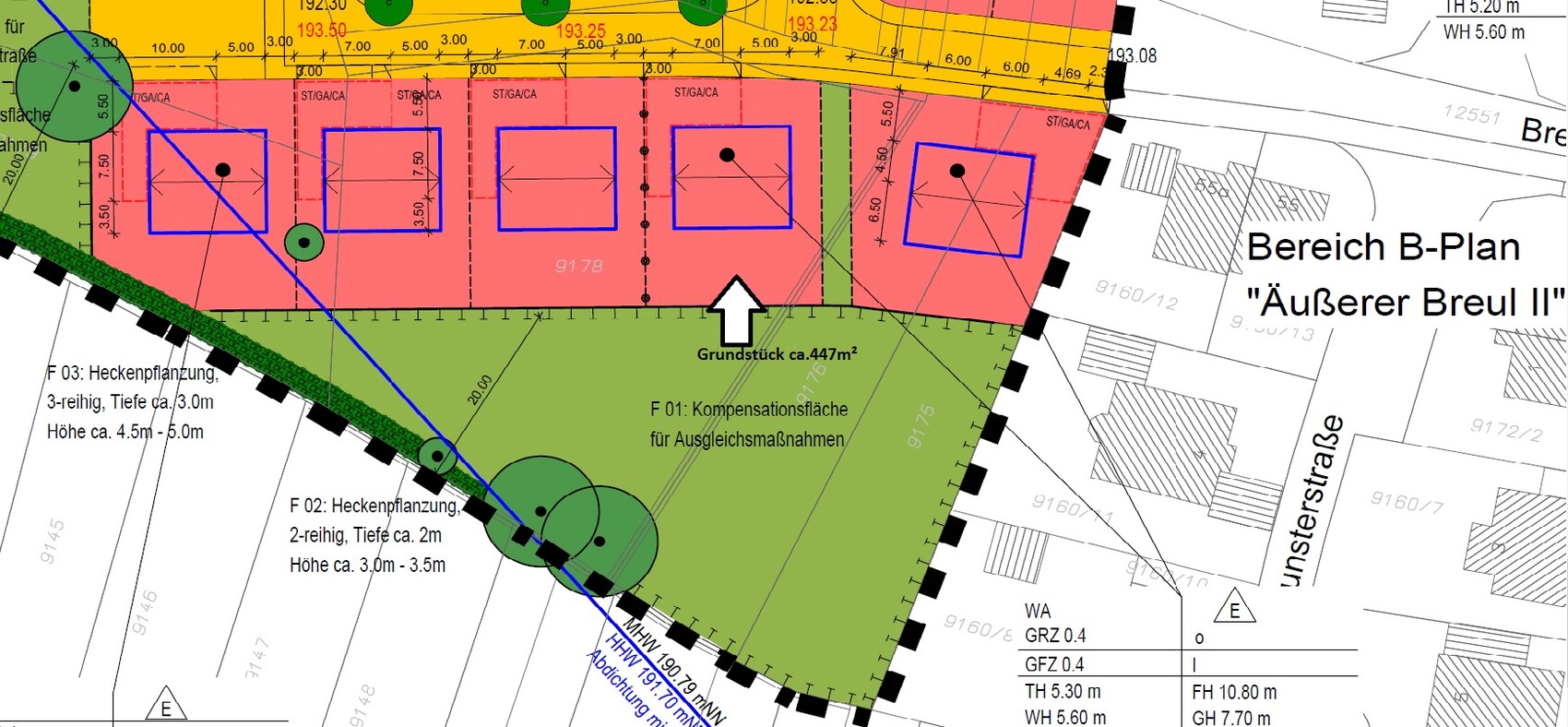
Development Plan / Restrictions
Plot size: 447m² (5400 sq ft)
Slope: no, but the plot slopes down about 80cm (31 inches) from the street and needs to be filled
Site coverage ratio 0.4
Floor area ratio 0.4
Building envelope, building line, building boundary
Border development: see attachment
Number of parking spaces: single garage + 2 outdoor parking spaces
Number of floors: 1.5 (only 1 full floor = ground floor)
Roof type: gable roof
Orientation: north/south
Maximum heights / limits: ridge height 5.30m (17 ft 5 in); wall height 5.60m (18 ft 5 in); full height 10.80m (35 ft 5 in); storey height 7.70m (25 ft 3 in)
Homeowners’ Requirements
Style, roof shape, building type: solid house, gable roof approx. 37° pitch, knee wall approx. 95cm (37 inches)
Basement, floors: no basement, 1.5 floors
Number of occupants, ages: 4 (parents 32 and 29, children 5 and 1)
Room requirements ground floor / upper floor: ground floor 90m² (970 sq ft), upper floor 80m² (860 sq ft)
Office: family use or home office? both
Guests per year: 6
Open or closed architecture: closed? see floor plan
Conservative or modern construction: modern
Open kitchen, cooking island: open, with seating (bar)
Number of dining seats: 6-8
Fireplace: no
Music / stereo wall: no
Balcony, roof terrace: no balcony, terrace on ground floor
Garage, carport: single garage, possibly carport for 2 spaces
Utility garden, greenhouse: no
Further wishes / special features: photovoltaic system, half-turned narrow-wing staircase with landing, alternatively solid stair
House Design
Planning by: general contractor and DIY
What do you especially like? Large living/dining area, open kitchen, many storage rooms, large walk-in shower
What do you not like? Why? A lot of space is lost through the hallway/corridor. Perhaps the rooms could be arranged more space-efficiently?
Price estimate according to architect/planner: 400,000 without ancillary construction costs
Personal price limit for the house, incl. equipment: 430,000 without ancillary construction costs
Preferred heating system: air-to-water heat pump with cooling function and underfloor heating
If you had to compromise, on which details / extra features
-can you do without: walk-in closet in the master bedroom, glass sliding door in living/dining room, possibly smaller utility room, cooling function of the air-to-water heat pump
-can’t do without: large living/dining room with open kitchen, spacious shower, storage rooms and attic storage
Why was the design developed like this?
The general contractor planned the house at 10.5m x 8.50m (34 ft 5 in x 28 ft) with basement (waterproof concrete). Because of the groundwater level, the house would be about 80cm (31 inches) higher than the street, knee wall 1.20m (47 inches), attic height only 1.20m (47 inches). A staircase to the house entrance would be necessary. Due to the small rooms and expensive basement, I designed a floor plan without a basement myself. I increased the living room width from 3.85m to 4.50m (from 12 ft 7 in to 14 ft 9 in).
What is the most important / fundamental question about the floor plan in 130 characters?
How can I make the room layout and arrangement more efficient? How and where can I save space? The hallway on the ground floor takes up a lot of square meters, even though it is only 1.25m (49 inches) wide. One reason is the large staircase, but also the long corridor consumes space and feels somewhat narrow. Is it possible to cleverly reduce the living space from currently about 170m² (1,830 sq ft) to 160m² (1,720 sq ft) or less? Different staircase? Move the entrance door? Is there an effective alternative to the cooling function of the underfloor heating? The goal is to save costs through optimization.
I appreciate every opinion, suggestion, and sketch!
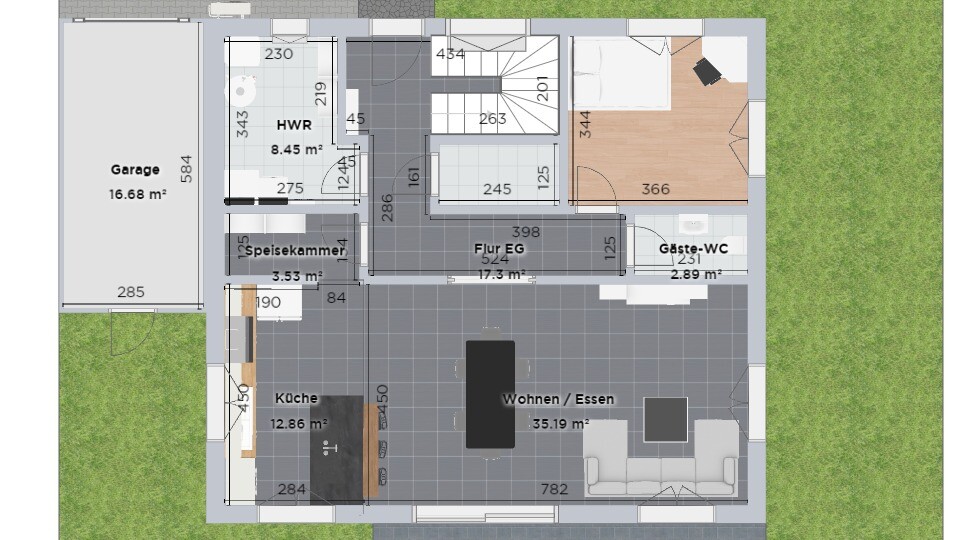
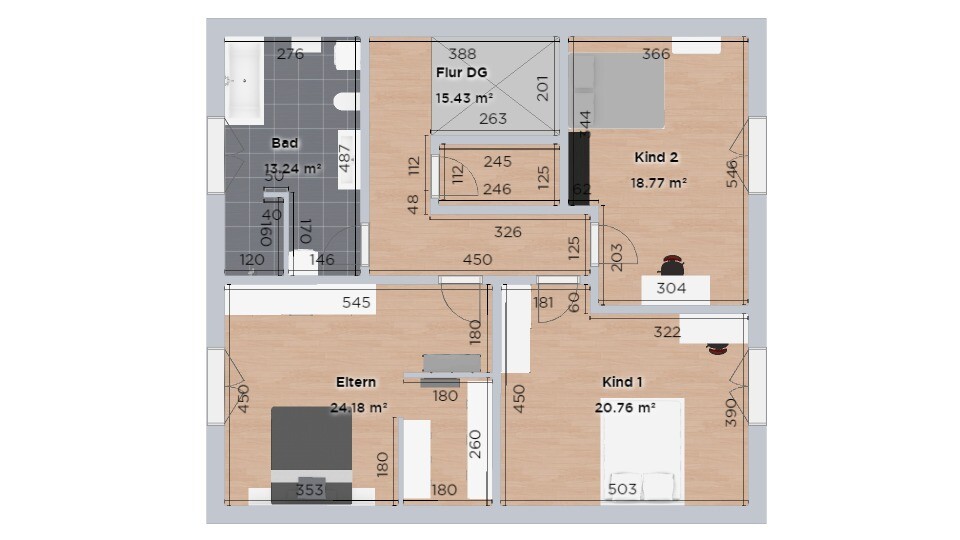
what do the experts say about the following floor plan (especially regarding the questions described below)? Does anything stand out to you as something that should definitely be avoided?
Thank you in advance
Development Plan / Restrictions
Plot size: 447m² (5400 sq ft)
Slope: no, but the plot slopes down about 80cm (31 inches) from the street and needs to be filled
Site coverage ratio 0.4
Floor area ratio 0.4
Building envelope, building line, building boundary
Border development: see attachment
Number of parking spaces: single garage + 2 outdoor parking spaces
Number of floors: 1.5 (only 1 full floor = ground floor)
Roof type: gable roof
Orientation: north/south
Maximum heights / limits: ridge height 5.30m (17 ft 5 in); wall height 5.60m (18 ft 5 in); full height 10.80m (35 ft 5 in); storey height 7.70m (25 ft 3 in)
Homeowners’ Requirements
Style, roof shape, building type: solid house, gable roof approx. 37° pitch, knee wall approx. 95cm (37 inches)
Basement, floors: no basement, 1.5 floors
Number of occupants, ages: 4 (parents 32 and 29, children 5 and 1)
Room requirements ground floor / upper floor: ground floor 90m² (970 sq ft), upper floor 80m² (860 sq ft)
Office: family use or home office? both
Guests per year: 6
Open or closed architecture: closed? see floor plan
Conservative or modern construction: modern
Open kitchen, cooking island: open, with seating (bar)
Number of dining seats: 6-8
Fireplace: no
Music / stereo wall: no
Balcony, roof terrace: no balcony, terrace on ground floor
Garage, carport: single garage, possibly carport for 2 spaces
Utility garden, greenhouse: no
Further wishes / special features: photovoltaic system, half-turned narrow-wing staircase with landing, alternatively solid stair
House Design
Planning by: general contractor and DIY
What do you especially like? Large living/dining area, open kitchen, many storage rooms, large walk-in shower
What do you not like? Why? A lot of space is lost through the hallway/corridor. Perhaps the rooms could be arranged more space-efficiently?
Price estimate according to architect/planner: 400,000 without ancillary construction costs
Personal price limit for the house, incl. equipment: 430,000 without ancillary construction costs
Preferred heating system: air-to-water heat pump with cooling function and underfloor heating
If you had to compromise, on which details / extra features
-can you do without: walk-in closet in the master bedroom, glass sliding door in living/dining room, possibly smaller utility room, cooling function of the air-to-water heat pump
-can’t do without: large living/dining room with open kitchen, spacious shower, storage rooms and attic storage
Why was the design developed like this?
The general contractor planned the house at 10.5m x 8.50m (34 ft 5 in x 28 ft) with basement (waterproof concrete). Because of the groundwater level, the house would be about 80cm (31 inches) higher than the street, knee wall 1.20m (47 inches), attic height only 1.20m (47 inches). A staircase to the house entrance would be necessary. Due to the small rooms and expensive basement, I designed a floor plan without a basement myself. I increased the living room width from 3.85m to 4.50m (from 12 ft 7 in to 14 ft 9 in).
What is the most important / fundamental question about the floor plan in 130 characters?
How can I make the room layout and arrangement more efficient? How and where can I save space? The hallway on the ground floor takes up a lot of square meters, even though it is only 1.25m (49 inches) wide. One reason is the large staircase, but also the long corridor consumes space and feels somewhat narrow. Is it possible to cleverly reduce the living space from currently about 170m² (1,830 sq ft) to 160m² (1,720 sq ft) or less? Different staircase? Move the entrance door? Is there an effective alternative to the cooling function of the underfloor heating? The goal is to save costs through optimization.
I appreciate every opinion, suggestion, and sketch!
M
Mr.Graves13823 Dec 2020 22:0811ant schrieb:
By the way, I don’t understand some things: 78.08 m² (840 ft²) of attic space represent 85.32% of 91.51 m² (985 ft²) on the ground floor — that would mathematically correspond to a full second floor. In the cross-section, the ridge height is nominally already slightly exceeded — so what reference height is being used? Then you mention the house is supposed to be 80 cm (31.5 inches) higher, which I cannot find in the cross-section, and that raises the question of how you want to avoid building a basement: that height would be almost ideal for a basement without major window well excavation, or else renouncing the basement would cost around 40% of the basement cost according to my calculation. So my impression definitely is not that the issues are simply unresolved details. It seems to me that the groundwork is still far from being done. To recap the process so far:
1. Originally, a single-family house with about 1.5 floors (approx. 130 m² (1400 ft²) living space), basement, and double garage was requested. Personal meetings were held with two general contractors (GU1 and GU2), and building regulations/planning permission were obtained. GU1 recommended building a gas condensing boiler with solar thermal system and no KFW 55 standard, but optionally offered an air-to-water heat pump with KFW 55 standard. GU2 advised against GU1’s suggestion and offered only an air-to-water heat pump with ventilation system (KFW 55). GU1’s offer was less expensive in terms of services compared to GU2. Floor plans (10.5 x 8.5 m (34.4 x 27.9 ft)) from GU1 and GU2 are attached.
2. Due to the average flood water height, a waterproof concrete basement (“white tub”) is necessary, and the house protrudes about 70-80 cm (27.5-31.5 inches) above street level. An entrance staircase is required, the terrace slopes downwards, the knee wall is 125 cm (49 inches), and in my opinion, all attic rooms are too small; the roof storage space is not usable (good that the basement has enough space).
My original thought: building the house without a basement would be cheaper — less excavation, larger rooms, no entrance stairs, more space in the roof storage, and a higher knee wall? No way! I sent my self-made beginner floor plans to GU1, and he implemented them 1:1 without optimization. The new offer from GU1 was just as expensive as with a basement. The reason given: the house is now “much” larger (12 x 9.8 m (39.4 x 32.1 ft)). “Details will be clarified during technical planning.” To my dissatisfaction, the knee wall suddenly became 90 cm (35 inches), which was justified using plot ratio / floor area ratio and the 75% rule.
3. I have now tried to take the floor plan design into my own hands. That’s how I found this forum, hoping to get valuable advice since many eyes see more than just two. You have already been very helpful, thank you for your valuable time! Maybe I should start over completely, look for a new contractor or architect, and reconsider having a basement.
@pagoni2020 The furniture dimensions I used come from this online tool. However, I only included the furniture as examples since I haven’t really thought about the future furnishing yet — I just used the dimensions of our current living room and kitchen as references. The large hallway on the ground floor still needs a lot of optimization, but I’m currently unsure how to rearrange the rooms. The narrow storage room on the ground floor (posting #10) measures 3.18 x 1.25 m (10.4 x 4.1 ft). The dressing room also gives me headaches. Should I redesign it or leave it out completely? My partner really wants a large walk-in shower. The sloping roof really makes this difficult for me.
@ypg The bikes will only be stored there in winter or against the wall in the garage, but a single garage without a storage room is too narrow. I will consider a single garage with storage room.
@Teilung A door in the niche unfortunately also takes up space. I find large kids’ rooms more important than a huge master bedroom. Since I only sleep upstairs, I am happy to sacrifice those square meters. I am still considering the issue with the shower and shifting the window in the guest room. Thanks!
@Nice-Nofret I included your suggestions about the pantry and spacing in the current plan (posting #10). Thanks!
Mr.Graves138 schrieb:
but I still don’t know how to rearrange the rooms.Let the general contractor handle that. Everyone understands if you want to build without a basement to reduce costs. I’ve said it before. Yes, it’s a short sentence, and there’s no need to say more than “let the general contractor do it first,” then we’ll see how it goes and optimize, for example, the shower.
M
Mr.Graves13820 Jan 2021 22:06Good evening everyone,
attached are the new floor plans from the general contractor (GC) and the cross-section from a friend who is an architect. The independent architect is offering her services at the minimum rate according to the HOAI calculator. She will only start detailed planning of the interior walls, etc., after signing the architectural contract. The architect's budget estimate is about €10,000 more expensive than the fixed price from the GC, although I don’t know what contingency she has included. My parents-in-law are currently building with the same architect in the same development area, which could bring some advantages, for example when requesting quotes for follow-up contracts with trades.
1. What do you think of the new floor plans from the GC? I am still not satisfied with the placement of the shower, but he suggested putting it on the 2m (6.5 ft) line, where the washbasin is currently located. Actually, I had planned the shower as shown in the drawing "Eigenentwurf_DG."
2. If you look at the cross-sections from the GC and the architect, you will see differences in room and ceiling heights. Has the GC made a planning mistake?
3. The GC offers me a central mechanical ventilation system with heat recovery for €14,500, but advises against it, saying it wouldn’t be necessary for a KfW 55 energy standard house. According to him, an exhaust fan in the bathroom and trickle vents in the windows in the other rooms would be sufficient. He has installed a central mechanical ventilation system in only 3 out of 100 new buildings. The architect says that due to the low ceiling heights, caused by the building regulations, a suspended ceiling is not advantageous and therefore suggests a decentralized mechanical ventilation system or window trickle vents instead. After my own research, I found out that a central mechanical ventilation system could also be integrated into the concrete ceiling or attic space. I still have to have another conversation with the architect. With the GC, I don’t feel well advised regarding the central mechanical ventilation system. What do you recommend?
4. Despite point 3, the GC is well regarded and highly rated in the region. Satisfied homeowners have confirmed this to me in personal conversations. The GC guarantees completion within 8 months from the start of construction, while the independent architect estimates 9 months. The final costs with the independent architect would of course be uncertain. Whether separate tenders for trades would ultimately be cheaper than the GC, who provides almost everything from one source, is unclear. I haven’t made a decision yet, as I am torn back and forth. Would you recommend the architect or the GC?
I appreciate any answers and suggestions very much! Then I can be more relaxed again. 🙂
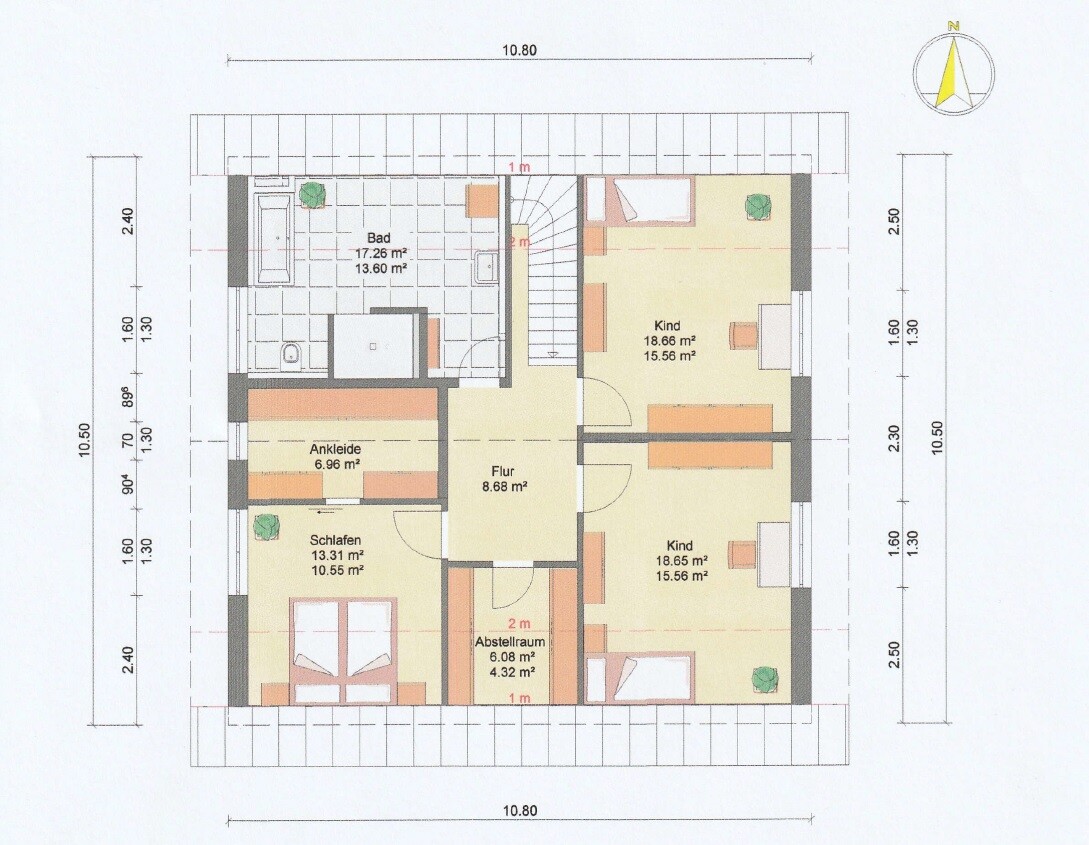
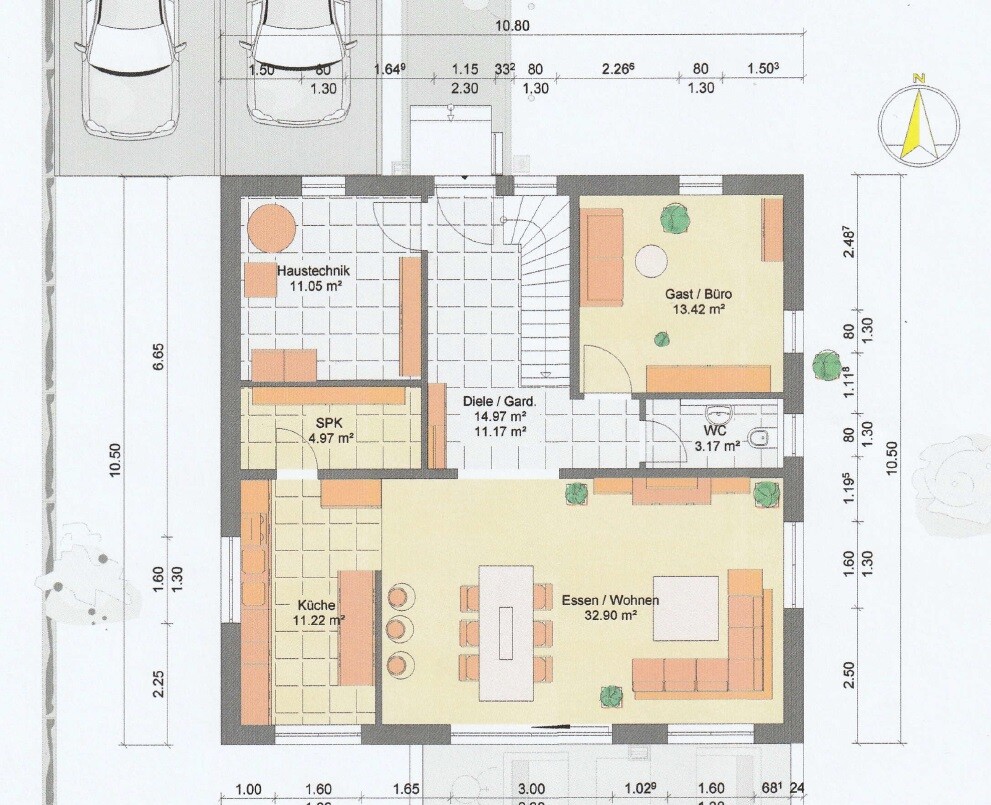
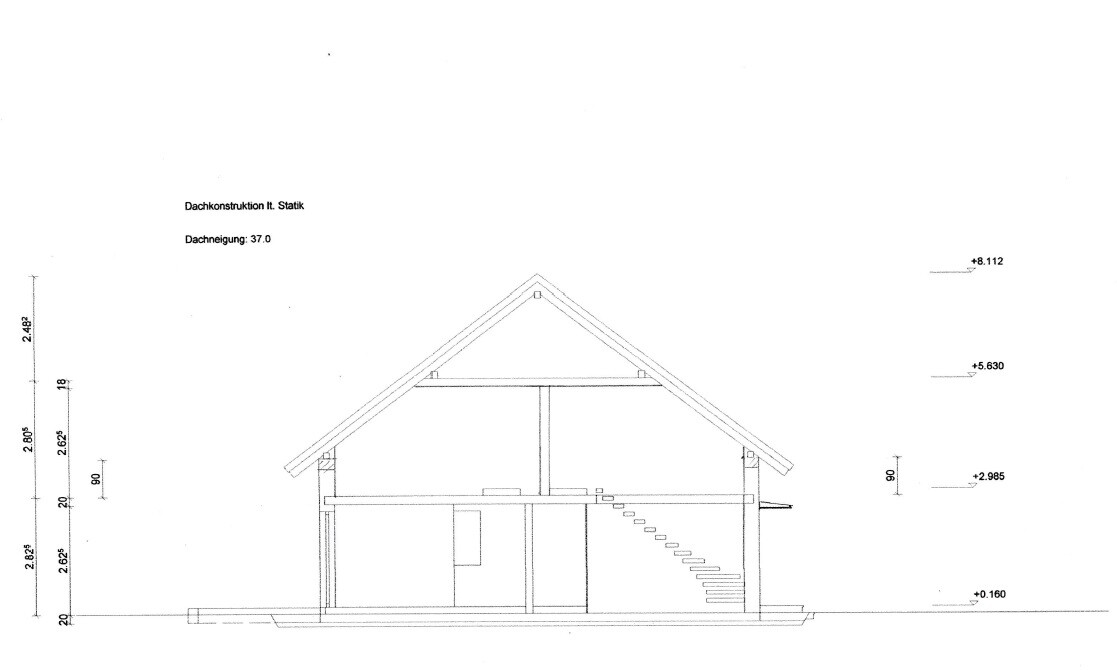
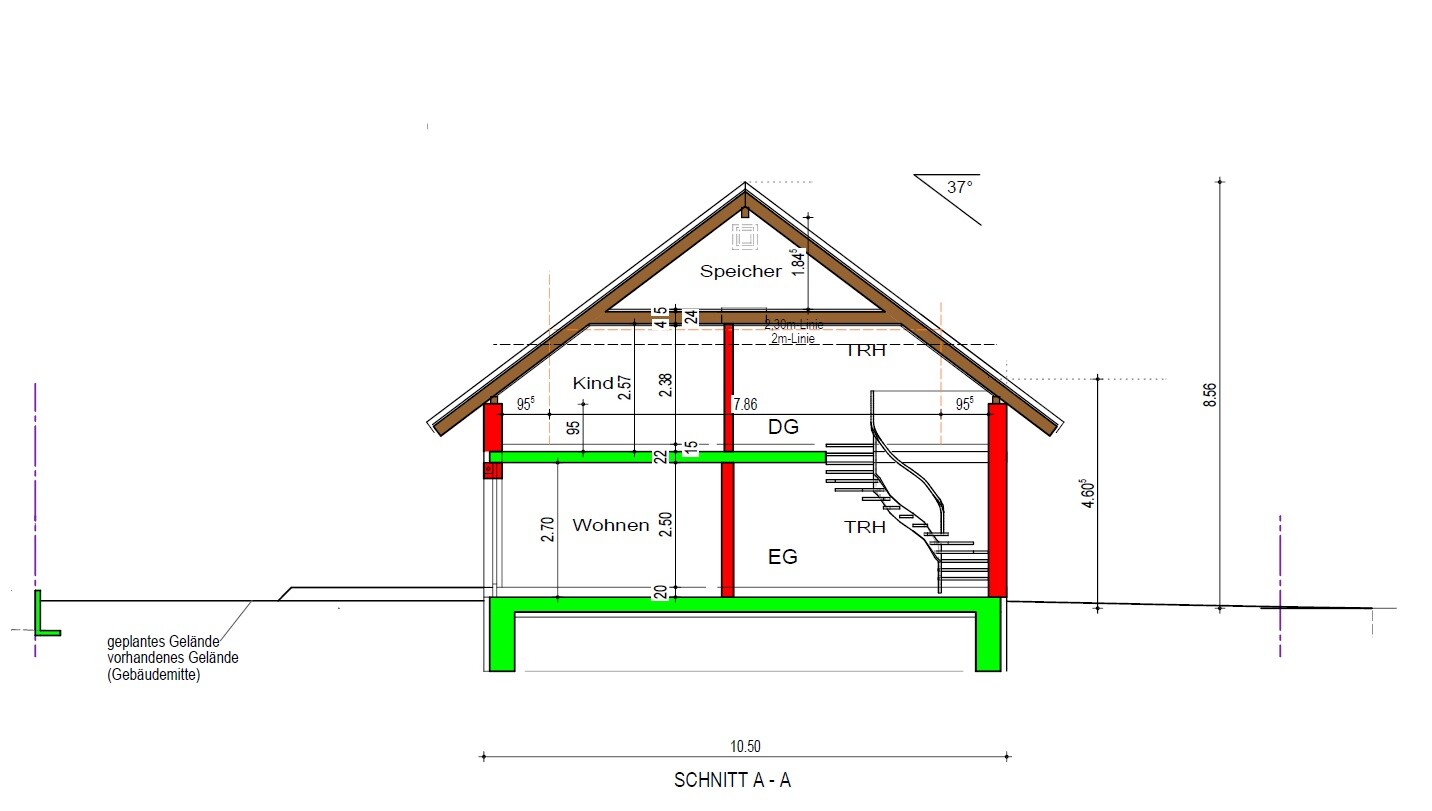
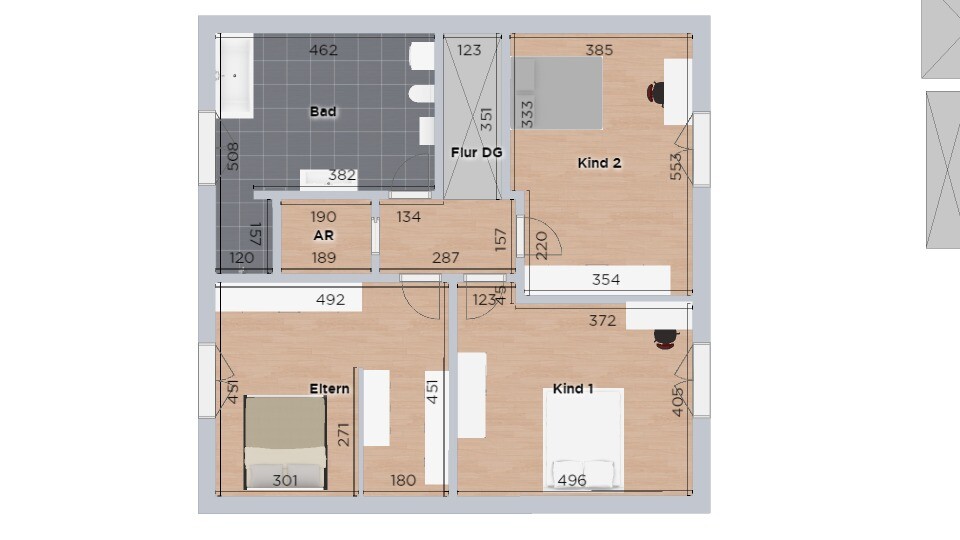
attached are the new floor plans from the general contractor (GC) and the cross-section from a friend who is an architect. The independent architect is offering her services at the minimum rate according to the HOAI calculator. She will only start detailed planning of the interior walls, etc., after signing the architectural contract. The architect's budget estimate is about €10,000 more expensive than the fixed price from the GC, although I don’t know what contingency she has included. My parents-in-law are currently building with the same architect in the same development area, which could bring some advantages, for example when requesting quotes for follow-up contracts with trades.
1. What do you think of the new floor plans from the GC? I am still not satisfied with the placement of the shower, but he suggested putting it on the 2m (6.5 ft) line, where the washbasin is currently located. Actually, I had planned the shower as shown in the drawing "Eigenentwurf_DG."
2. If you look at the cross-sections from the GC and the architect, you will see differences in room and ceiling heights. Has the GC made a planning mistake?
3. The GC offers me a central mechanical ventilation system with heat recovery for €14,500, but advises against it, saying it wouldn’t be necessary for a KfW 55 energy standard house. According to him, an exhaust fan in the bathroom and trickle vents in the windows in the other rooms would be sufficient. He has installed a central mechanical ventilation system in only 3 out of 100 new buildings. The architect says that due to the low ceiling heights, caused by the building regulations, a suspended ceiling is not advantageous and therefore suggests a decentralized mechanical ventilation system or window trickle vents instead. After my own research, I found out that a central mechanical ventilation system could also be integrated into the concrete ceiling or attic space. I still have to have another conversation with the architect. With the GC, I don’t feel well advised regarding the central mechanical ventilation system. What do you recommend?
4. Despite point 3, the GC is well regarded and highly rated in the region. Satisfied homeowners have confirmed this to me in personal conversations. The GC guarantees completion within 8 months from the start of construction, while the independent architect estimates 9 months. The final costs with the independent architect would of course be uncertain. Whether separate tenders for trades would ultimately be cheaper than the GC, who provides almost everything from one source, is unclear. I haven’t made a decision yet, as I am torn back and forth. Would you recommend the architect or the GC?
I appreciate any answers and suggestions very much! Then I can be more relaxed again. 🙂

When in doubt, I always prefer having my own architect. I can’t tell from the drawings whether their heights differ (?) – a cost estimate difference of only 10,000 EUR between the general contractor and the architect sounds good – for an estimate, that is practically a "zero deviation."
https://www.instagram.com/11antgmxde/
https://www.linkedin.com/company/bauen-jetzt/
https://www.instagram.com/11antgmxde/
https://www.linkedin.com/company/bauen-jetzt/
M
Mr.Graves13821 Jan 2021 21:28@11ant According to the contractor’s drawing, the house is 8.11 m (27 ft) tall, while the architect’s plan shows a height of 8.56 m (28 ft). At the moment, I am leaning more towards the independent architect because she also designs and specifies a photovoltaic system, carport, and terrace. The contractor does not do this or only offers it at outrageous prices, for example, a 6 kWp photovoltaic system for 14,000 EUR! 😀 However, I should mention that the contractor recommended I arrange the photovoltaic system independently since it’s not their main area of expertise. What surprised me, though, is that both the contractor and the architect consider the kitchen width of 2.50 m (8 ft) and the living/dining area width of about 7.50 m (25 ft) sufficient. Some forum members have suggested wider dimensions. Of course, bigger is always better but unfortunately also more expensive.
Similar topics