
Hello everyone,
My wife and I are currently planning to renovate our two bathrooms.
We bought a semi-detached house built in 2010, but unfortunately the bathrooms were poorly designed and are quite rundown.
I’m really glad there is a forum like this where plans can be critically reviewed, and I appreciate your support in advance.
A brief overview of our idea:
The upstairs bathroom has a bathtub.
The downstairs bathroom has a shower.
We want to completely redesign both bathrooms and swap the bathtub and shower locations. The reason: our parents and both girls (1 year & 2 years old) sleep upstairs and don’t want to walk downstairs just to shower.
For the downstairs bathroom, we are considering:
a) Bathtub only (Option 2) or
b) Bathtub with shower option (Option 1).
General considerations:
Bathtub only:
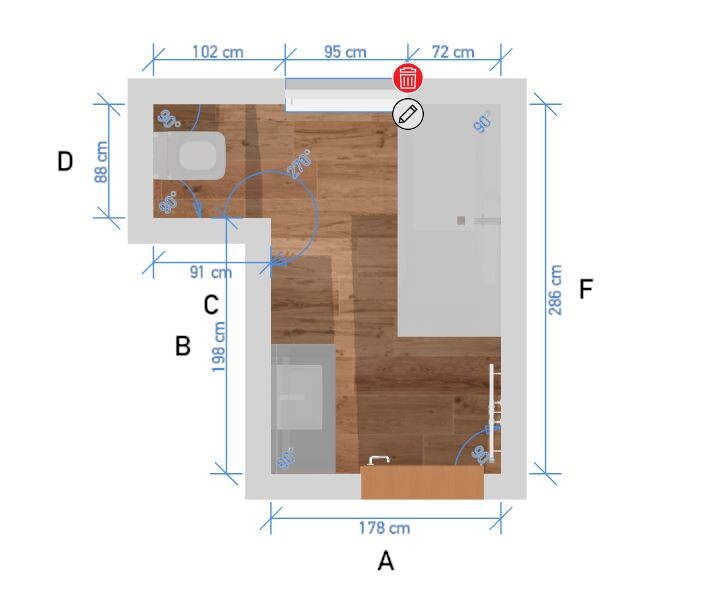
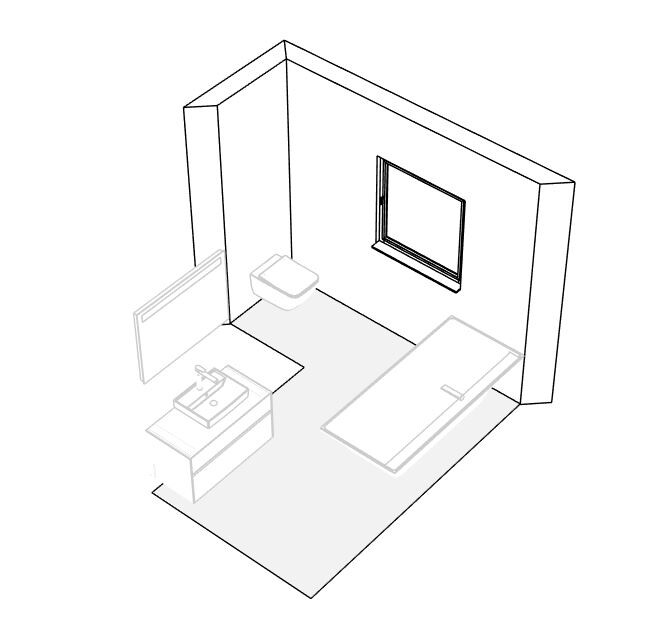
In this case, the bathtub can extend beyond the window without any issues. Using the sloped ceiling shape, we maximize the width and ensure the tub doesn’t block the space. We plan to add extra storage space within the wall.
Bathtub with shower option:
I (dad) assume that with three women in the house there will eventually be disputes about who gets to shower when. Also, guests should have a shower option. That’s why I want to keep the option open to shower downstairs as well. I imagine choosing a regular bathtub and installing a folding splash guard near the window.
Yes, the bathtub is 75cm (30 inches) wide and extends beyond the window. Since a bathtub usually has a rim about 6cm (2.5 inches) wide, I’m thinking of attaching the splash guard not at the tub’s rim but where the tub slopes downwards (sorry, I don’t know the exact term).
As for the sink, I’m trying to keep it as shallow as possible or move it as far left as I can to avoid narrowing the walkway too much. Room width: 178cm (70 inches) / 50cm (20 inches) sink + 75cm (30 inches) bathtub = 125cm (49 inches) --> 50cm (20 inches) clearance at the narrowest point.
Alternatively, I could imagine using a curved vanity that gets narrower toward the right. My only concern is that the “curved” design might not quite fit the overall aesthetic if everything else is very linear.
For the design, we planned black tiles, wood-look surfaces, and white fittings.
Looking forward to your feedback!
Best regards,
Arnold
My wife and I are currently planning to renovate our two bathrooms.
We bought a semi-detached house built in 2010, but unfortunately the bathrooms were poorly designed and are quite rundown.
I’m really glad there is a forum like this where plans can be critically reviewed, and I appreciate your support in advance.
A brief overview of our idea:
The upstairs bathroom has a bathtub.
The downstairs bathroom has a shower.
We want to completely redesign both bathrooms and swap the bathtub and shower locations. The reason: our parents and both girls (1 year & 2 years old) sleep upstairs and don’t want to walk downstairs just to shower.
For the downstairs bathroom, we are considering:
a) Bathtub only (Option 2) or
b) Bathtub with shower option (Option 1).
General considerations:
Bathtub only:
In this case, the bathtub can extend beyond the window without any issues. Using the sloped ceiling shape, we maximize the width and ensure the tub doesn’t block the space. We plan to add extra storage space within the wall.
Bathtub with shower option:
I (dad) assume that with three women in the house there will eventually be disputes about who gets to shower when. Also, guests should have a shower option. That’s why I want to keep the option open to shower downstairs as well. I imagine choosing a regular bathtub and installing a folding splash guard near the window.
Yes, the bathtub is 75cm (30 inches) wide and extends beyond the window. Since a bathtub usually has a rim about 6cm (2.5 inches) wide, I’m thinking of attaching the splash guard not at the tub’s rim but where the tub slopes downwards (sorry, I don’t know the exact term).
As for the sink, I’m trying to keep it as shallow as possible or move it as far left as I can to avoid narrowing the walkway too much. Room width: 178cm (70 inches) / 50cm (20 inches) sink + 75cm (30 inches) bathtub = 125cm (49 inches) --> 50cm (20 inches) clearance at the narrowest point.
Alternatively, I could imagine using a curved vanity that gets narrower toward the right. My only concern is that the “curved” design might not quite fit the overall aesthetic if everything else is very linear.
For the design, we planned black tiles, wood-look surfaces, and white fittings.
Looking forward to your feedback!
Best regards,
Arnold
A
ArniBanarni23 Dec 2020 14:58Placing the bathtub into the recess has the following disadvantages for us:
1) You can’t easily reach the back. (Cleaning + supervising children)
2) You can no longer access the window. (It opens to the left)
I also considered the idea of installing a foldable splash guard and using the recess as an alternative shower. Unfortunately, we discarded this idea due to the two points mentioned above.
Do you think a passage width of 50cm (20 inches) in my drawing above would be sufficient? We currently prefer this solution.
A double sink is not necessary since it’s basically just the “guest” bathroom.
Upstairs, a double sink is planned where the children can get ready at the same time.
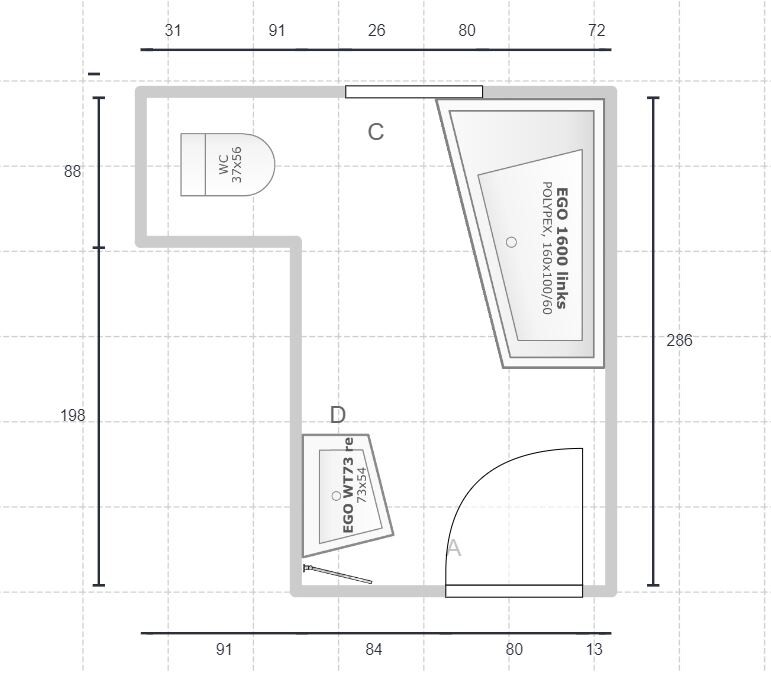
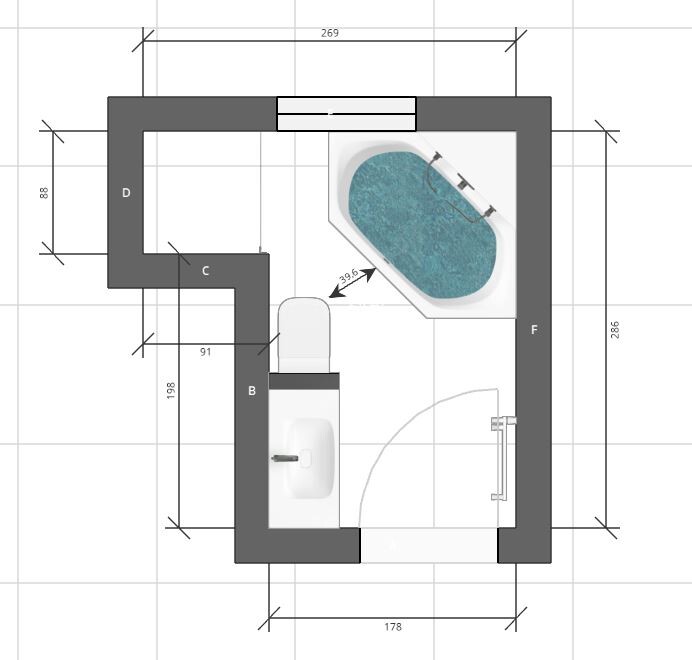
Our new idea:
Corner bathtub at the top right and the toilet on the right side, directly near the entrance.
I will calculate that quickly.
1) You can’t easily reach the back. (Cleaning + supervising children)
2) You can no longer access the window. (It opens to the left)
I also considered the idea of installing a foldable splash guard and using the recess as an alternative shower. Unfortunately, we discarded this idea due to the two points mentioned above.
Do you think a passage width of 50cm (20 inches) in my drawing above would be sufficient? We currently prefer this solution.
A double sink is not necessary since it’s basically just the “guest” bathroom.
Upstairs, a double sink is planned where the children can get ready at the same time.
Our new idea:
Corner bathtub at the top right and the toilet on the right side, directly near the entrance.
I will calculate that quickly.

H
hampshire23 Dec 2020 16:20Can’t the toilet be installed in the recess?
A
ArniBanarni23 Dec 2020 16:44Of course, the toilet can also be placed in the niche.
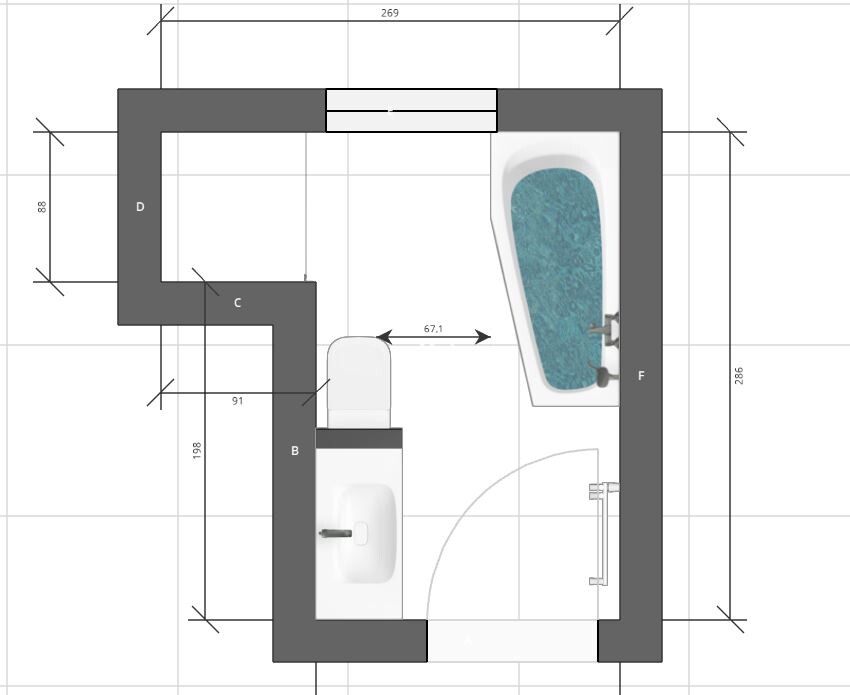
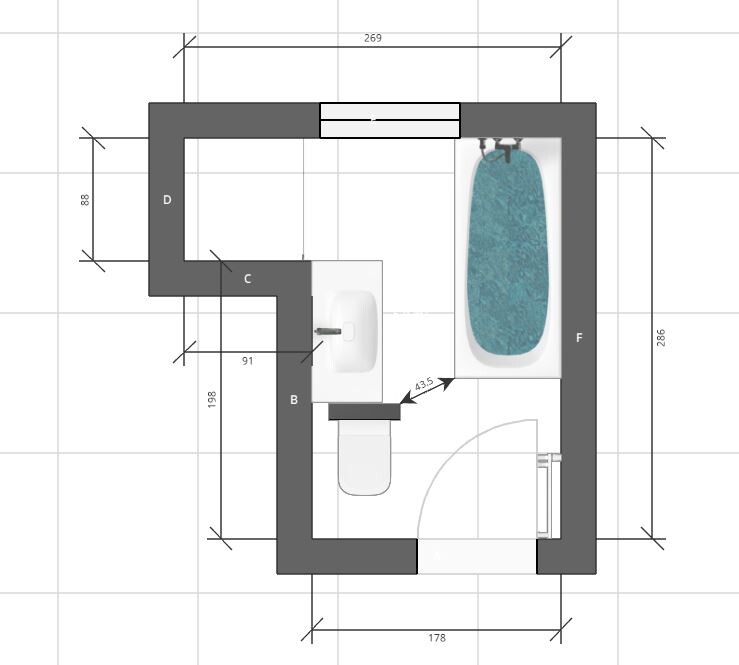
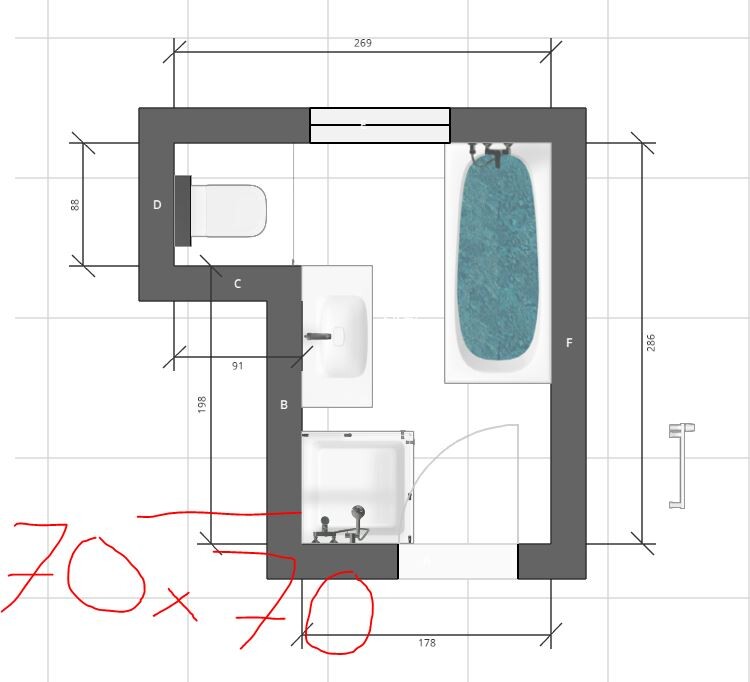
I have now sketched out all our possible solutions. They are basically prioritized from bottom to top.
My comments for each solution:
1. The bathtub looks like a sarcophagus.
2. Passage is quite narrow.
3. Most natural light and space. However, there is no shower. Planned alternative: a splash guard will be installed on the upper right side of the bathtub.
4. Not prioritized because the bathtub at the back is hard to access. → You can’t reach the children, cleaning is difficult, and you can’t reach the window.
5. You walk directly toward the toilet and the door hits it.
6. You walk directly toward the toilet and the passage is still narrow. Also, you face a wall directly.
7. A 70 x 70 cm (28 x 28 inch) shower is not shown in the planner. We have 69 cm (27 inches) of space on the wall but could probably gain that extra centimeter.
8. The passage is still too narrow.
Unfortunately, the passage measurements are quite rough, as the planning tool does not have a function to calculate exact distances from point A to point B.
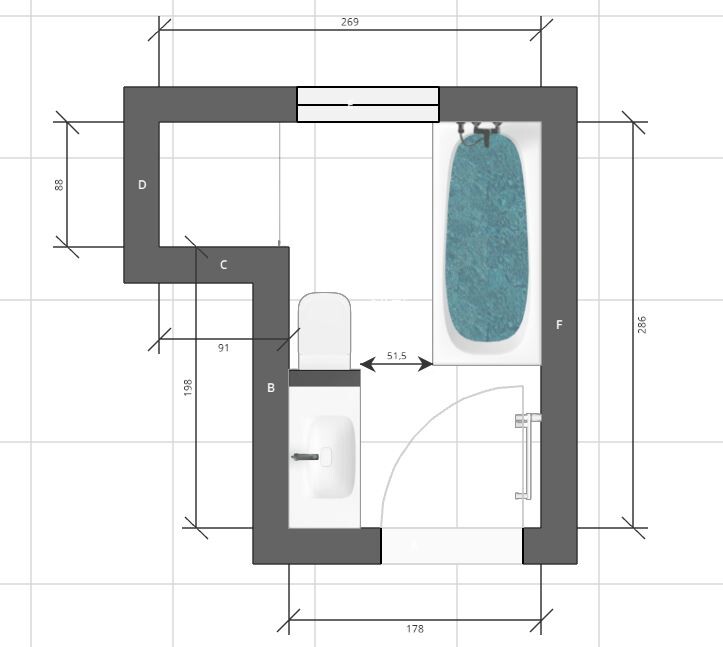
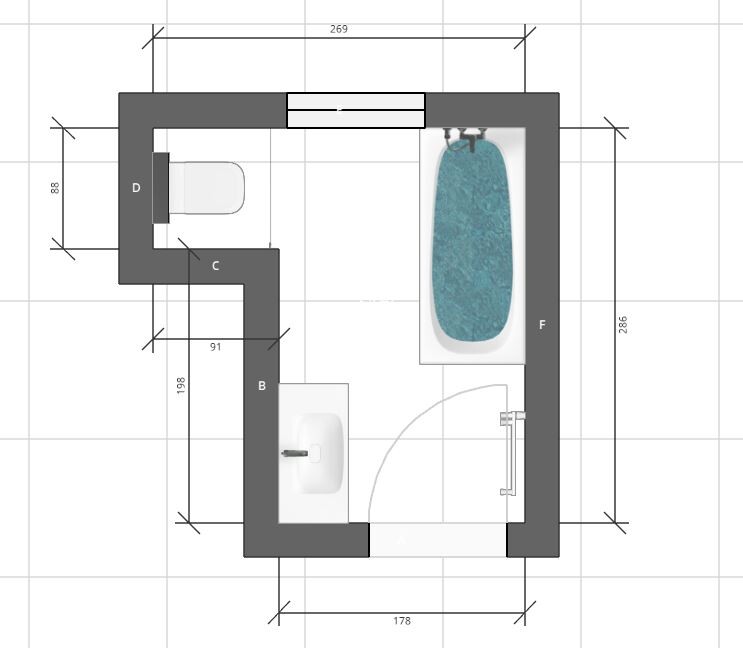
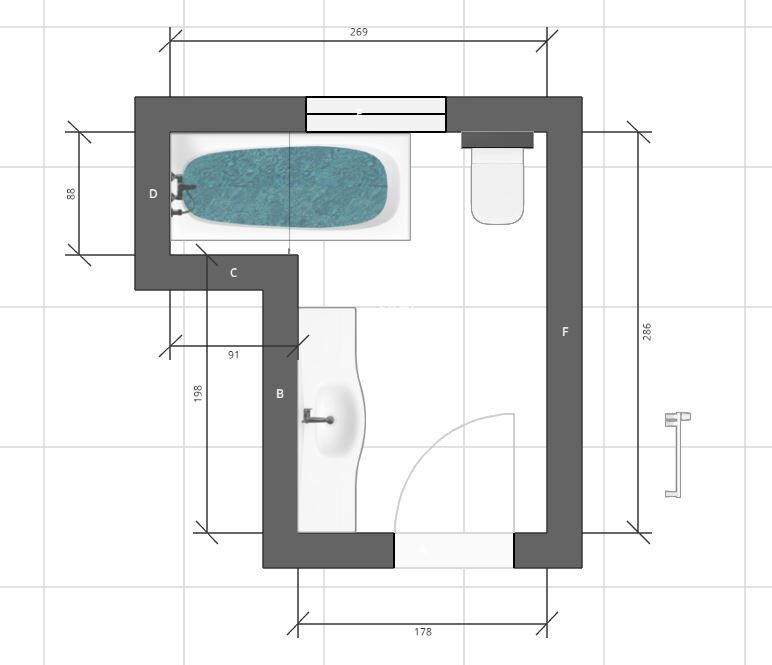
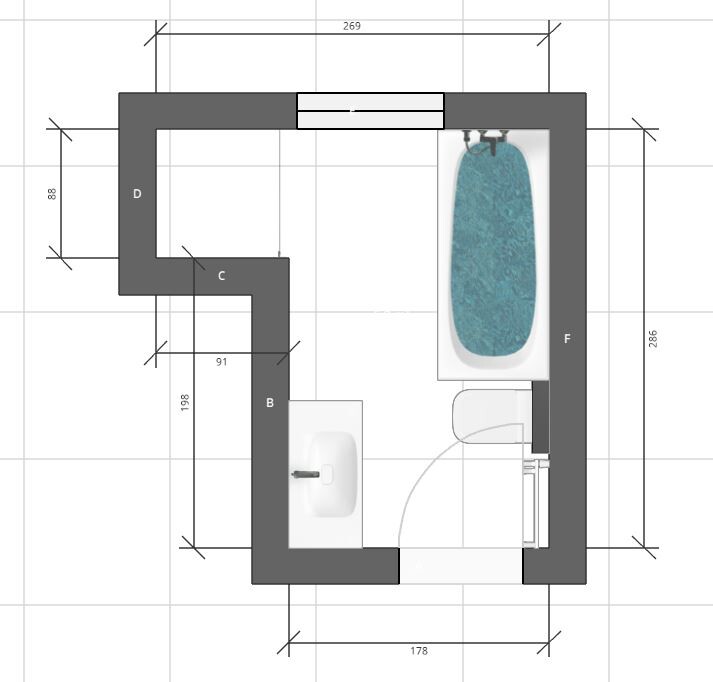
I have now sketched out all our possible solutions. They are basically prioritized from bottom to top.
My comments for each solution:
1. The bathtub looks like a sarcophagus.
2. Passage is quite narrow.
3. Most natural light and space. However, there is no shower. Planned alternative: a splash guard will be installed on the upper right side of the bathtub.
4. Not prioritized because the bathtub at the back is hard to access. → You can’t reach the children, cleaning is difficult, and you can’t reach the window.
5. You walk directly toward the toilet and the door hits it.
6. You walk directly toward the toilet and the passage is still narrow. Also, you face a wall directly.
7. A 70 x 70 cm (28 x 28 inch) shower is not shown in the planner. We have 69 cm (27 inches) of space on the wall but could probably gain that extra centimeter.
8. The passage is still too narrow.
Unfortunately, the passage measurements are quite rough, as the planning tool does not have a function to calculate exact distances from point A to point B.
A
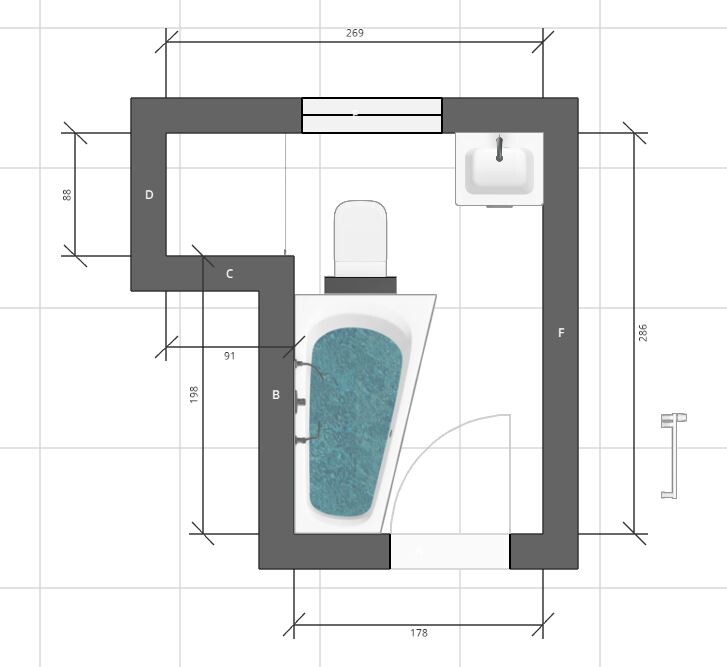
ArniBanarni23 Dec 2020 17:02And the last possible option :-D

Similar topics