
ᐅ Should You Install a Photovoltaic Battery Storage System or Not?
Created on: 2 Dec 2020 17:42
H
Heidi1965
Our new build is already quite advanced. Next week, 15 photovoltaic modules with a total output of 5.1 kWp will be installed. We are getting a heat pump with a capacity of 5.12 kWh. Initially, a battery storage system was not planned because we wanted to live in the house for at least one year to monitor our electricity consumption patterns, and then potentially add a battery or expand the photovoltaic system later. Now there is a new program that offers a 40% subsidy for battery storage—but only in connection with new builds. That sounds tempting. Should we go for it? What capacity should the battery have at a minimum? The condition is: "The ratio of system output to usable battery storage capacity must be at least 1.2 kWp to kWh of battery storage. Storage capacity exceeding this ratio is not eligible for funding." Have I understood correctly that only a battery with a capacity of 4.25 kWh would be eligible for funding?
Or is this all too small? Just “play equipment”?
Or is this all too small? Just “play equipment”?
hampshire schrieb:
Calculations involving the storage system are based on different assumptions. If you calculate only with sunshine hours, it looks like the left side of the illustration. If you also include cloudy days, it can look like the right side. This leads to an assumption about the cycles of the electricity storage. This assumption determines the calculated price per kWh from the battery. So, you can calculate it to look good or bad.
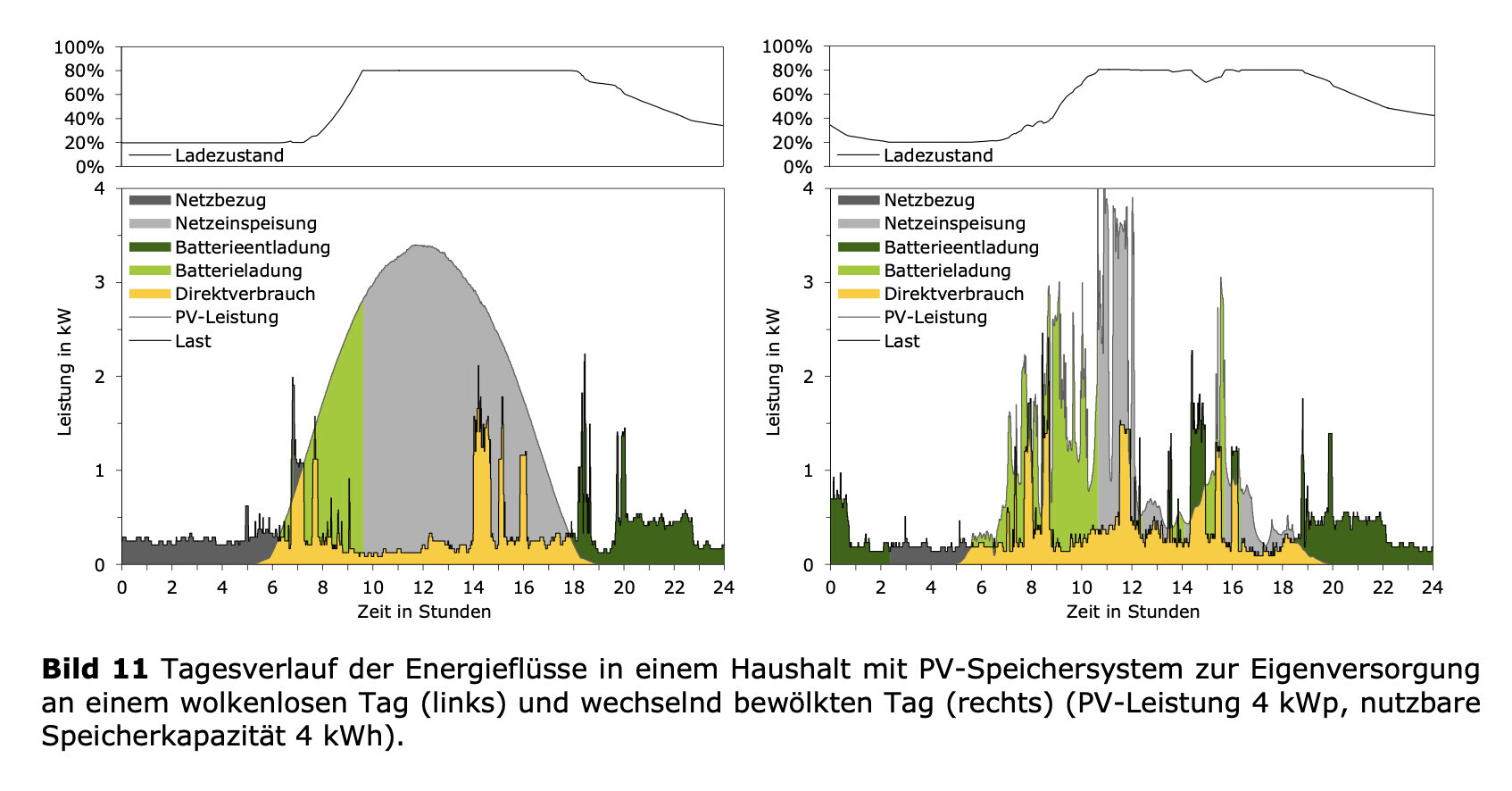
(Source: HTW Berlin) I don’t understand the illustration.
- What does cloud cover have to do with the profitability of a storage system? The weather can’t be influenced, with or without storage, so production is given.
- Why does the battery power last into the next morning after a cloudy day, but not after a sunny day? According to the image, less electricity is consumed on cloudy days (both batteries are at 80% in the evening).
- Why is there photovoltaic electricity available at 7:30 p.m. on a cloudy day, but not on a sunny day?
- Why is the battery charged only up to 80%?
- Why is feed-in limitation not taken into account?
- Modern systems operate with forecast algorithms for battery management—why is this not shown?
- What exactly is the “result” of the illustrations? In both cases, I see a full battery cycle during the day—so what?
Maybe you can provide an example calculation to show how you arrive at the price per kWh from the battery. Thanks.
We have our own storage system. Until the end of November, it was fully charged every day. However, thanks to the heat pump, even with the battery, we don’t get through the night without external power. But this is also due to the imbalance between photovoltaic generator and storage capacity (28.5kWp to 10.2kWh). Whether the storage system is worthwhile depends largely on its lifespan. You can really only calculate this at the end. Generally, it is said that profitability can be expected with a price under 450–500€/kWh.
H
hampshire13 Dec 2020 10:02The image shows that a storage system in variable weather conditions not only charges during the day but also discharges. This affects the assumptions regarding the number of cycles per year.
Simplified calculation method for the additional cost of battery electricity over its service life and cycle assumptions:
Usable storage capacity × charge cycles per year = battery electricity per year, e.g., 8 kWh × 200 cycles = 1600 kWh
Service life × annual production = total production, e.g., 10 × 1600 kWh = 16,000 kWh
Purchase price ÷ total production = cost per kWh, e.g., 4,000 € ÷ 16,000 kWh = 0.25 € per kWh
If someone assumes 15 years, the cost drops to 0.167 € per kWh.
Another assumes 10 years and only 150 cycles, suddenly the cost is 0.33 € per kWh.
Someone else uses the manufacturer’s specified cycles without considering service life, resulting in a different value.
Some assume a number of cycles equal only to the number of sunny days, leading to correspondingly higher costs.
Each example calculation can be dissected arbitrarily based on the basic assumptions—in any direction.
Simplified calculation method for the additional cost of battery electricity over its service life and cycle assumptions:
Usable storage capacity × charge cycles per year = battery electricity per year, e.g., 8 kWh × 200 cycles = 1600 kWh
Service life × annual production = total production, e.g., 10 × 1600 kWh = 16,000 kWh
Purchase price ÷ total production = cost per kWh, e.g., 4,000 € ÷ 16,000 kWh = 0.25 € per kWh
If someone assumes 15 years, the cost drops to 0.167 € per kWh.
Another assumes 10 years and only 150 cycles, suddenly the cost is 0.33 € per kWh.
Someone else uses the manufacturer’s specified cycles without considering service life, resulting in a different value.
Some assume a number of cycles equal only to the number of sunny days, leading to correspondingly higher costs.
Each example calculation can be dissected arbitrarily based on the basic assumptions—in any direction.
Okay, then we mean the same thing. With a "calculation" that contains mostly unknown variables that are freely estimated, you can end up with any result depending on desired outcomes.
Our battery storage system was commissioned on 7.10.2020. As of now, we have charged 577.82 kWh into the battery and discharged 505.15 kWh. This corresponds to around 100 euros saved on external electricity supply.
Our battery storage system was commissioned on 7.10.2020. As of now, we have charged 577.82 kWh into the battery and discharged 505.15 kWh. This corresponds to around 100 euros saved on external electricity supply.
We paid about €4350 for the battery storage (after deducting the subsidy). That should be sufficient. It comes with a 10-year warranty, so I expect it to have a longer lifespan. Even then, it rarely fails completely but usually just loses capacity.
Of course, it’s clear that this is neither a financial nor an ecological miracle in terms of return on investment. It’s simply nice to not need any external electricity from March to October, to somewhat decouple from electricity price developments and taxes, and to have a small influence on the energy mix. After all, we produce about three times as much electricity per year as we consume.
Of course, it’s clear that this is neither a financial nor an ecological miracle in terms of return on investment. It’s simply nice to not need any external electricity from March to October, to somewhat decouple from electricity price developments and taxes, and to have a small influence on the energy mix. After all, we produce about three times as much electricity per year as we consume.
K
knalltüte13 Dec 2020 13:45Fuchur schrieb:
... We have a battery storage system ourselves. Until the end of November, it was fully charged every day. However, despite having a heat pump and the battery, we still can’t get through the night without using external electricity. This is mainly due to the imbalance between the photovoltaic system and the storage capacity (28.5kWp to 10.2kWh). ...So you have about 8kWh in the battery, and for most batteries, the discharge limit is around 20%. That leaves you with approximately 6kWh of usable capacity. Is it really the case that your heat pump consumes around 6–7kWh overnight (until the sun provides power again)? Is that a realistic figure? It seems a bit high to me...Similar topics