
B
BananaJoe6 Dec 2020 16:00Hello everyone,
I’m currently unsure whether we need a backflow prevention device for our construction project or not. Our architect was only somewhat helpful and said that we “actually” don’t need one, but if we wanted to be on the safe side, we could of course have one installed.
Here are the key details:
The plot is connected to a separate sewer system.
We are building without a basement and have no shower on the ground floor, meaning the lowest wastewater outlet in the house should be the toilet on the ground floor.
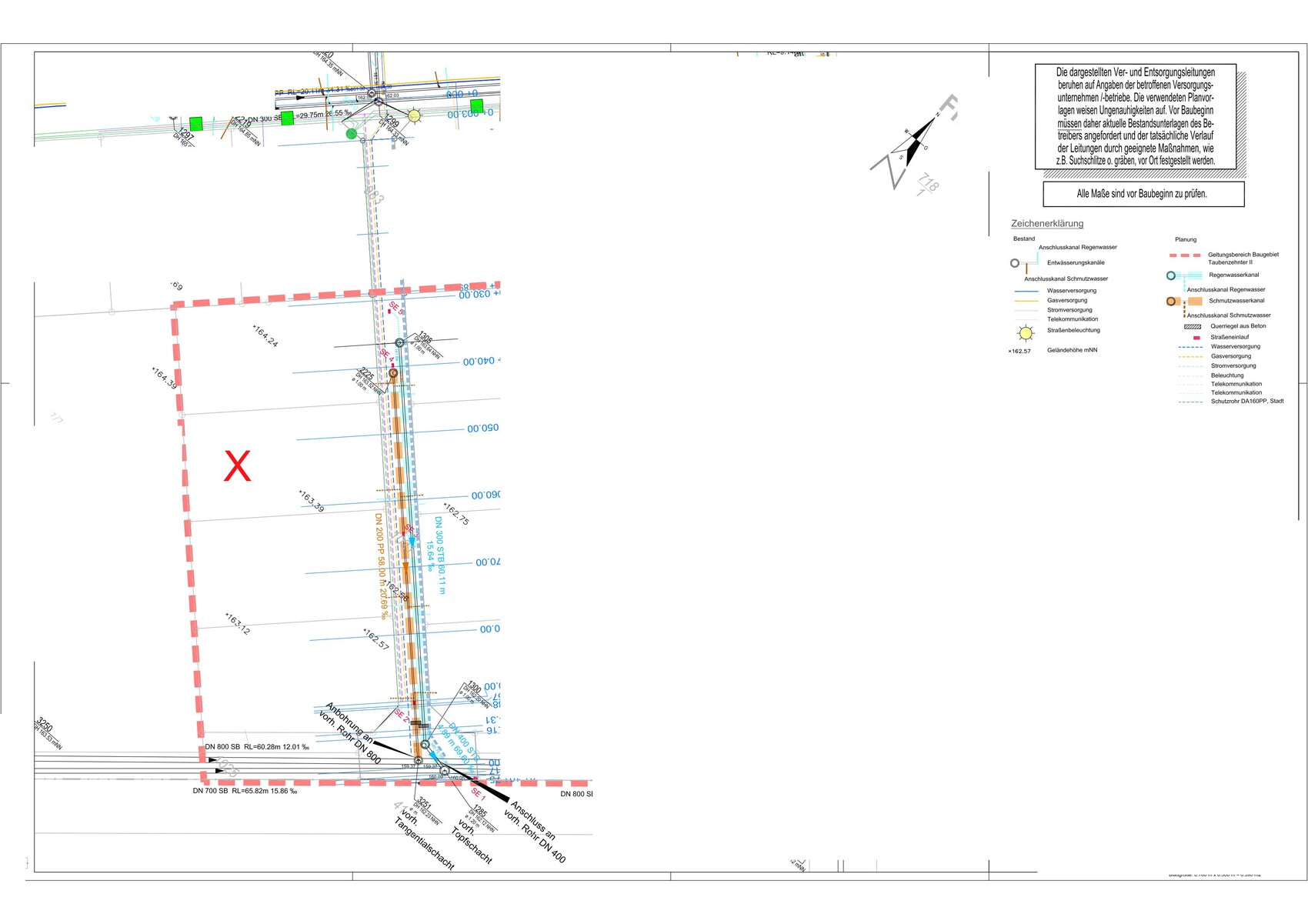
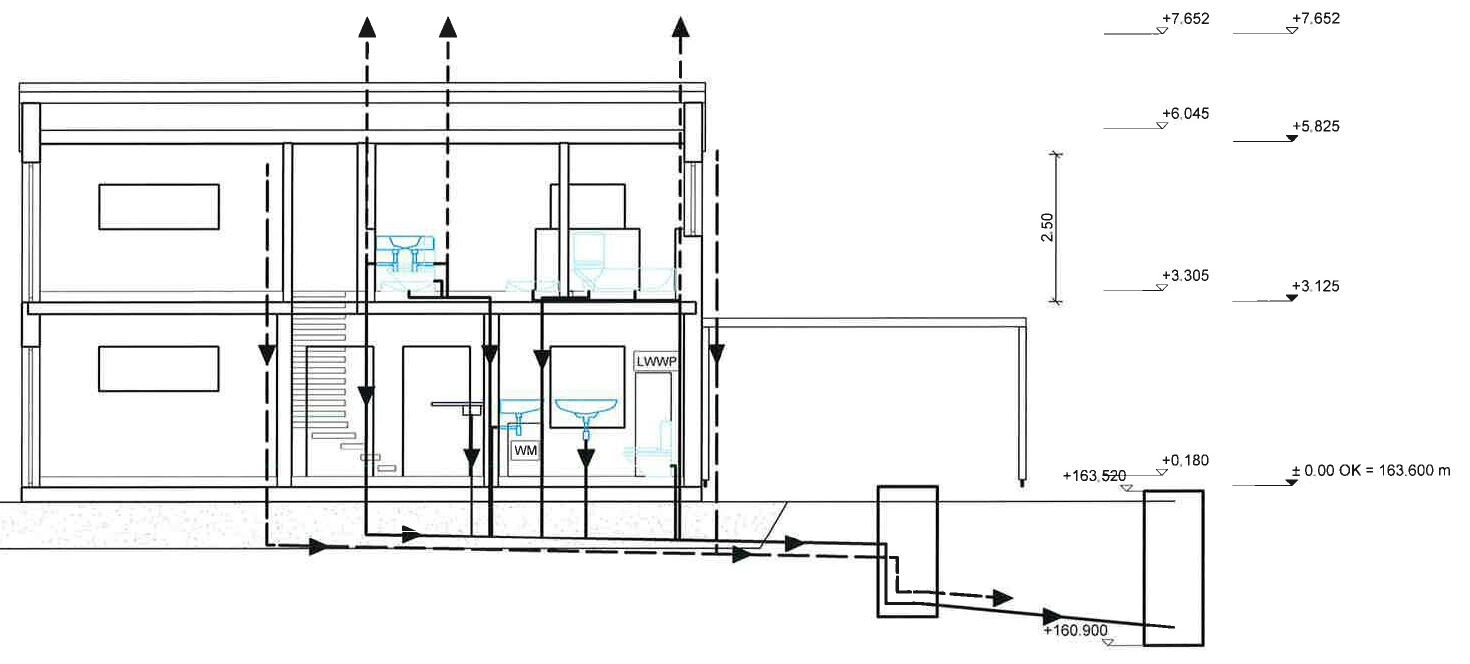
The plot is located on a slightly sloping street (downhill from top to bottom according to the plan). Attached are the city’s drainage plan and a cross-section of the planned house, both with elevation details.
The city’s drainage regulations contain no information regarding the backflow level, which I understand to mean that the street elevation corresponds to the backflow level (please correct me if this is wrong).
Based on this, I understand the situation as follows:
- The nearest manhole cover uphill from our plot is at 163.52m NHN (according to the plan provided by our surveyor for the building permit, it is at 163.48m NHN). The nearest manhole cover downhill is at 162.23m NHN.
- The top of the floor slab is at 163.30m NHN, plus 0.18m (7 inches) floor build-up, plus about 0.20m (8 inches) to the toilet outlet = 163.68m NHN.
As a non-expert, I would conclude that a backflow prevention device is not necessary since the lowest outlet is 16 (or rather 20) centimeters (6 or 8 inches) higher than the nearest uphill manhole cover. Is that correct?
However, I wonder why the architect said that I could “install a backflow prevention device to be on the safe side.” Of course, I could just ask him, but I wanted to inform myself here first to better understand his answer.
Thank you all in advance and have a nice second Advent!
I’m currently unsure whether we need a backflow prevention device for our construction project or not. Our architect was only somewhat helpful and said that we “actually” don’t need one, but if we wanted to be on the safe side, we could of course have one installed.
Here are the key details:
The plot is connected to a separate sewer system.
We are building without a basement and have no shower on the ground floor, meaning the lowest wastewater outlet in the house should be the toilet on the ground floor.
The plot is located on a slightly sloping street (downhill from top to bottom according to the plan). Attached are the city’s drainage plan and a cross-section of the planned house, both with elevation details.
The city’s drainage regulations contain no information regarding the backflow level, which I understand to mean that the street elevation corresponds to the backflow level (please correct me if this is wrong).
Based on this, I understand the situation as follows:
- The nearest manhole cover uphill from our plot is at 163.52m NHN (according to the plan provided by our surveyor for the building permit, it is at 163.48m NHN). The nearest manhole cover downhill is at 162.23m NHN.
- The top of the floor slab is at 163.30m NHN, plus 0.18m (7 inches) floor build-up, plus about 0.20m (8 inches) to the toilet outlet = 163.68m NHN.
As a non-expert, I would conclude that a backflow prevention device is not necessary since the lowest outlet is 16 (or rather 20) centimeters (6 or 8 inches) higher than the nearest uphill manhole cover. Is that correct?
However, I wonder why the architect said that I could “install a backflow prevention device to be on the safe side.” Of course, I could just ask him, but I wanted to inform myself here first to better understand his answer.
Thank you all in advance and have a nice second Advent!


BananaJoe schrieb:
I wonder why the architect said that, to be on the safe side, I could of course install a backflow prevention device.Well, let’s put it this way: I know someone who lives on a very steep street. Because of the slope, their entire basement on the street side is completely above ground level. The sewer pipe is buried deep down the middle of the road in front of the house. Due to the difference in elevation and the steep terrain, where everything normally drains away naturally, most people feel quite safe...... and then it still happened: A very heavy cloudburst brought so much water that a torrent flowed down the slope above ground, and underground the sewer was overloaded to the point that water pushed out everywhere—manhole covers, gully grates, and at this neighbor’s place water even shot up like a fountain from the floor drain in the basement. Even a height difference of more than 1 meter (3.3 feet) was no longer a protection. And nobody wants to have all that water flooding their basement...
... so: long story short: I would definitely install a backflow prevention device.
B
BananaJoe6 Dec 2020 19:33Nida35a schrieb:
Ask the neighbors if the street manhole covers have ever risen during heavy rain. Good point. Unfortunately, the entire area is a new development, so there isn’t much experience yet among the neighbors...
AxelH. schrieb:
[...] I know someone who lives on a very steeply sloped street. Due to the hill location, their entire basement wall on the street side is fully above ground level. The sewer line is buried deep in the center of the street in front of the house. [...] Isn’t the risk generally higher on a steep street rather than lower? Because on a steep street, the next manhole cover uphill (which is what matters) is typically at a higher elevation than the lowest shower or toilet—especially if you have a basement. Or am I missing something?
AxelH. schrieb:
[...] and underground, the sewer was so overloaded that it backed up everywhere—manhole covers, drain covers—and for that acquaintance, it even gushed like a fountain from the floor drain in the basement. At that point, even a height difference of more than 1 meter (3 feet) was no guarantee of safety. [...] What exactly does the 1 meter (3 feet) height difference refer to? Was the next higher manhole or drain cover really located 1 meter (3 feet) lower than the floor drain in the basement?
In our case, the street slopes only very slightly (according to the plan, about 1 meter (3 feet) over 30 meters (100 feet)).
BananaJoe schrieb:
What exactly does the 1 meter (3.3 feet) height difference refer to? Was the nearest higher-level sewer or manhole cover really 1 meter (3.3 feet) lower (!) than the floor drain in the basement?I can’t answer that without inspecting the site myself at some point. However, from my own experience, I know that a backwater valve doesn’t cost that much. Our house already has a sewer inspection chamber, and the backwater valve including installation cost just €268.50 before tax. Having water in the basement would definitely be more expensive...B
BananaJoe6 Dec 2020 20:06AxelH. schrieb:
I can’t really answer that without seeing the situation on site. But from my own experience, a backflow preventer doesn’t cost much at all. Our house already has a sewer inspection chamber, and the backwater valve with installation cost just €268.50 net. Water in the basement would definitely be much more expensive... Hmm… We don’t have a basement, but I thought that if the relevant wastewater contains fecal matter (which would be the case with a toilet in our house), you need a backflow valve type 3F – and my first search found those priced at over 1000 euros. Since that is still a lot less than the cost of a flooded ground floor, I’ll probably invest in it so I can sleep peacefully at night.
Similar topics