
ᐅ Floor plan optimization for a semi-detached house on a 380 sqm plot
Created on: 22 Nov 2020 23:11
Z
zeehdeehHello everyone,
In just under four weeks, we will be able to purchase a typical narrow lot suitable for building a semi-detached house. The future neighbor is someone we know personally, so we think it makes sense for both halves to be designed and built by the same general contractor. There is no formal zoning plan for the lot, but there is a village preservation statute that allows quite a bit of flexibility.
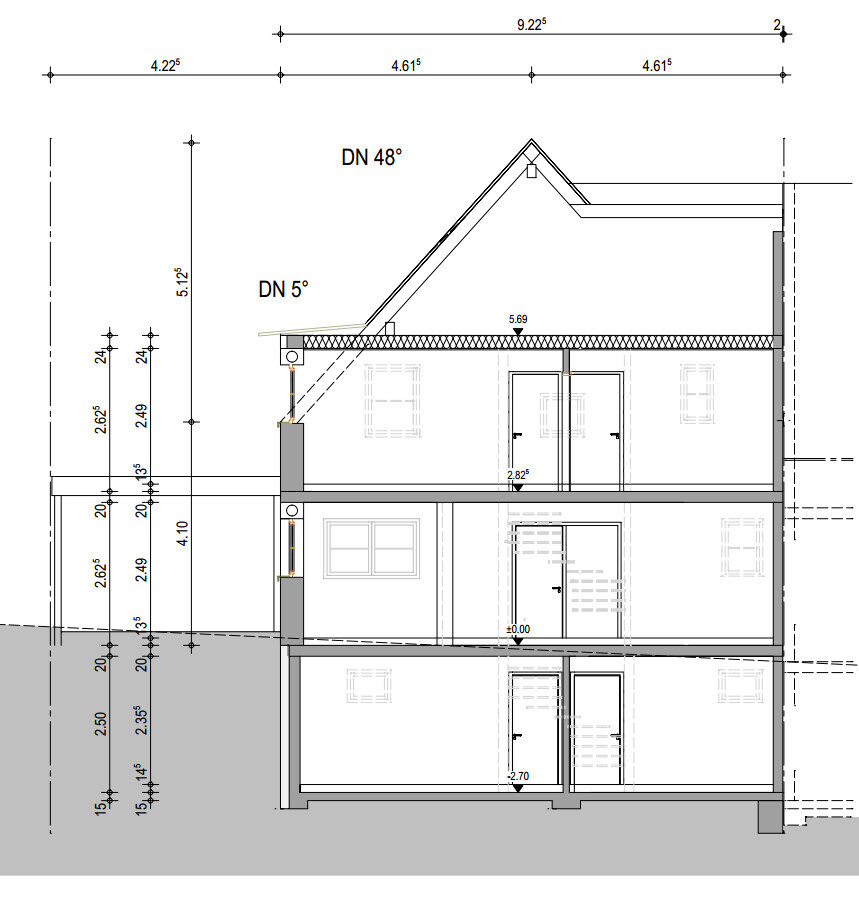
The neighbor’s half will have the eaves facing the street, while we are considering orienting our half with the gable end toward the street, continuing the neighbor’s ridge line. (I hope the cross-section makes this clear.) This would give two rooms more ceiling height and it wouldn’t look like a typical semi-detached house anymore.
The neighbor’s basement is fixed. Based on previous discussions, we were advised to build a basement as well because the cost savings would be limited considering the additional expenses for the foundation and the somewhat larger house overall. Can someone evaluate this?
Due to the roof shape, we would likely have enough storage space in the attic even without a basement.
Zoning / Restrictions
Lot size: 380m² (approx. 13.5m x 28m / 44 x 92 feet)
Slope: no
Bordering buildings: semi-detached house, otherwise setback according to State Building Code BaWü
Roof style: symmetrical gable roof, (min. 48°)
Architectural style: traditional, vertical window format
Owner Requirements
1.5 floors, knee wall 1.20m (4 feet), basement (at least relatively certain)
Number of residents, ages: 4 (38, 36, 6, 2)
Space requirements:
Ground floor: living/dining area, kitchen, guest bathroom with shower,
Upper floor: 2 children’s rooms, master bedroom, bathroom
Office: combined work/guest room in the basement, estimated 1-2 days home office per week
Guest stays per year: 2 people about 5 times/year
Open or closed layout: open, as much as possible
Conservative or modern construction: exterior conservative, interior modern preferred
Open kitchen, kitchen island: open
Number of dining seats: at least 4, preferably 6 (with option for 8)
Fireplace: no
Music/sound wall: no
Balcony, rooftop terrace: no
Garage, carport: carport
Utility garden, greenhouse: possibly a small utility garden, but low priority
House Design
Designer: planner from a construction company after the second revision
What do you especially like? Why?
- Layout of living and dining area
- Rooms for children are comparable in size
- Relatively little hallway space
What do you not like? Why?
- Uncertain if the cloakroom, kitchen, and bathroom have enough space
- Relatively much unused space in the attic
- Master bedroom has only one window
- Bathroom: layout and small window
Price estimate according to architect/planner: approx. $450,000 (estimated by volume, including earthworks and excavation)
Personal price limit for house including fittings: approx. $450,000
Preferred heating system: air-to-water heat pump with underfloor heating
If you had to give up something, which details/extras would you let go?
- Could give up: maybe the pantry
- Cannot give up: second toilet, guest/work room
Why did the design evolve this way?
Adjustments made to the first two drafts by the planner based on our requests (added shower to guest WC, removed originally planned tool shed behind the carport to make room for windows on the ground floor, swapped bathroom and bedroom)
What is the most important/basic question about the floor plan in 130 characters?
Can kitchen, bathroom, and cloakroom be given more space without significantly increasing (and costing) the house?
Thank you very much for your suggestions and opinions, including critical ones.

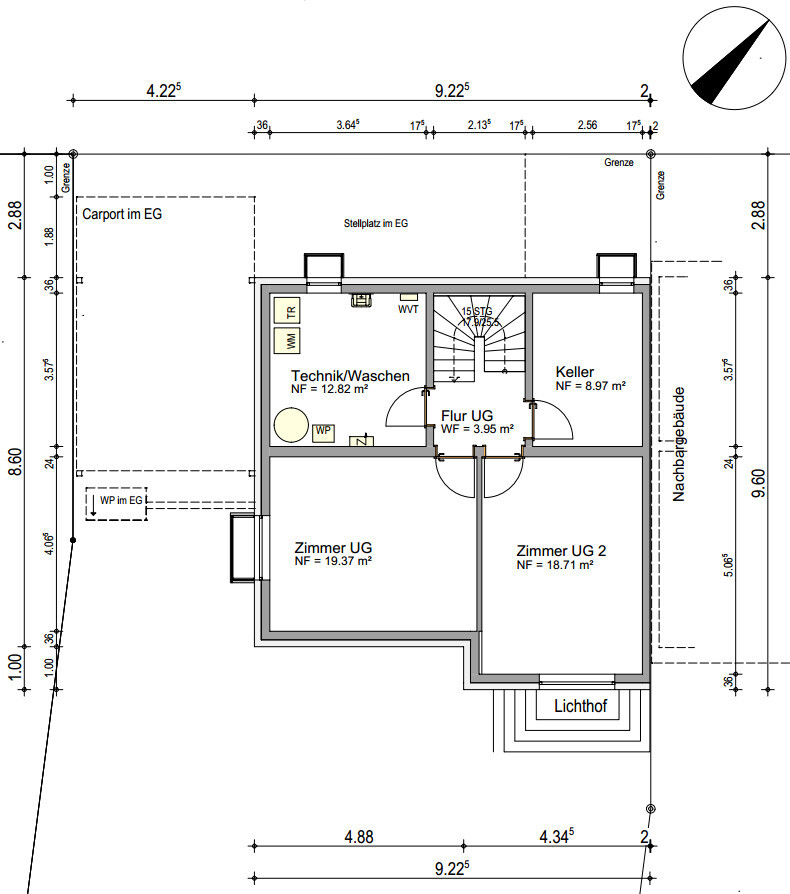
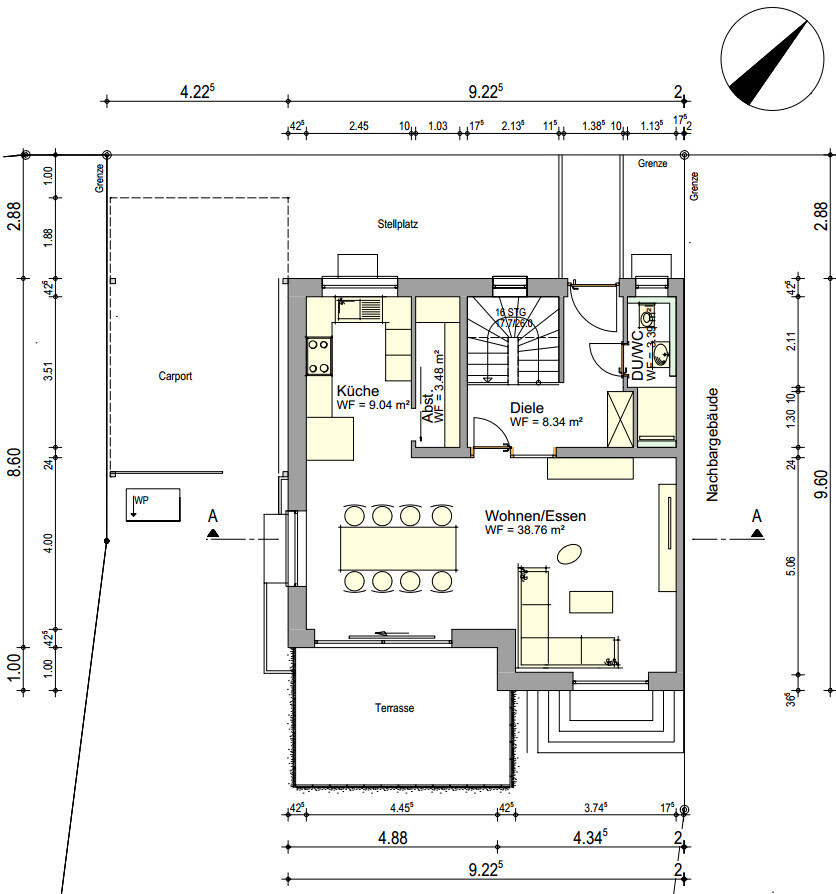
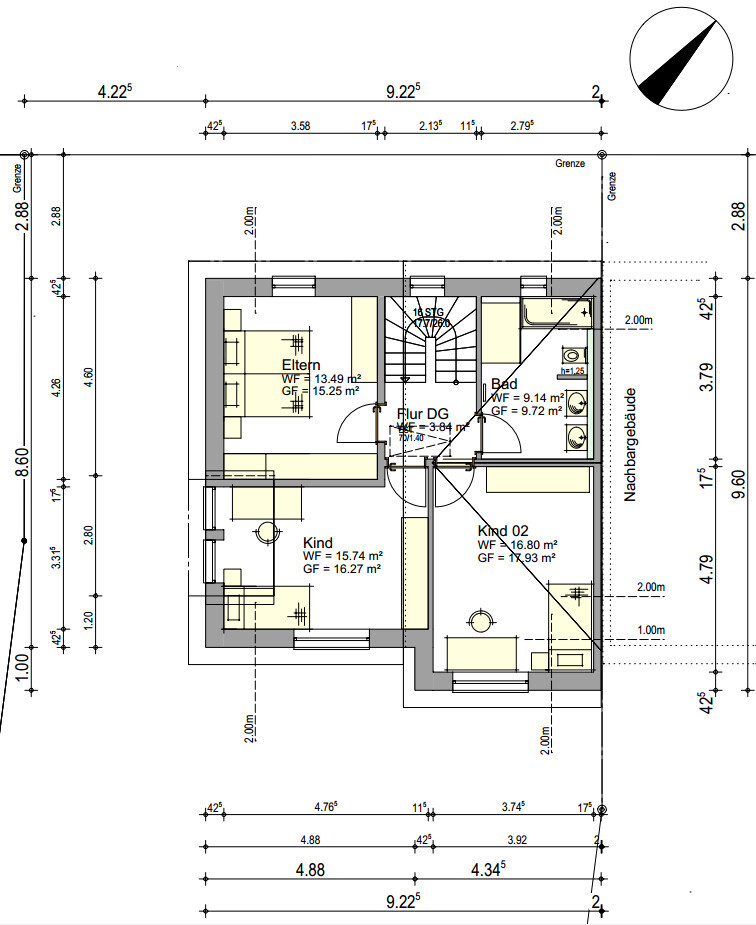
In just under four weeks, we will be able to purchase a typical narrow lot suitable for building a semi-detached house. The future neighbor is someone we know personally, so we think it makes sense for both halves to be designed and built by the same general contractor. There is no formal zoning plan for the lot, but there is a village preservation statute that allows quite a bit of flexibility.
The neighbor’s half will have the eaves facing the street, while we are considering orienting our half with the gable end toward the street, continuing the neighbor’s ridge line. (I hope the cross-section makes this clear.) This would give two rooms more ceiling height and it wouldn’t look like a typical semi-detached house anymore.
The neighbor’s basement is fixed. Based on previous discussions, we were advised to build a basement as well because the cost savings would be limited considering the additional expenses for the foundation and the somewhat larger house overall. Can someone evaluate this?
Due to the roof shape, we would likely have enough storage space in the attic even without a basement.
Zoning / Restrictions
Lot size: 380m² (approx. 13.5m x 28m / 44 x 92 feet)
Slope: no
Bordering buildings: semi-detached house, otherwise setback according to State Building Code BaWü
Roof style: symmetrical gable roof, (min. 48°)
Architectural style: traditional, vertical window format
Owner Requirements
1.5 floors, knee wall 1.20m (4 feet), basement (at least relatively certain)
Number of residents, ages: 4 (38, 36, 6, 2)
Space requirements:
Ground floor: living/dining area, kitchen, guest bathroom with shower,
Upper floor: 2 children’s rooms, master bedroom, bathroom
Office: combined work/guest room in the basement, estimated 1-2 days home office per week
Guest stays per year: 2 people about 5 times/year
Open or closed layout: open, as much as possible
Conservative or modern construction: exterior conservative, interior modern preferred
Open kitchen, kitchen island: open
Number of dining seats: at least 4, preferably 6 (with option for 8)
Fireplace: no
Music/sound wall: no
Balcony, rooftop terrace: no
Garage, carport: carport
Utility garden, greenhouse: possibly a small utility garden, but low priority
House Design
Designer: planner from a construction company after the second revision
What do you especially like? Why?
- Layout of living and dining area
- Rooms for children are comparable in size
- Relatively little hallway space
What do you not like? Why?
- Uncertain if the cloakroom, kitchen, and bathroom have enough space
- Relatively much unused space in the attic
- Master bedroom has only one window
- Bathroom: layout and small window
Price estimate according to architect/planner: approx. $450,000 (estimated by volume, including earthworks and excavation)
Personal price limit for house including fittings: approx. $450,000
Preferred heating system: air-to-water heat pump with underfloor heating
If you had to give up something, which details/extras would you let go?
- Could give up: maybe the pantry
- Cannot give up: second toilet, guest/work room
Why did the design evolve this way?
Adjustments made to the first two drafts by the planner based on our requests (added shower to guest WC, removed originally planned tool shed behind the carport to make room for windows on the ground floor, swapped bathroom and bedroom)
What is the most important/basic question about the floor plan in 130 characters?
Can kitchen, bathroom, and cloakroom be given more space without significantly increasing (and costing) the house?
Thank you very much for your suggestions and opinions, including critical ones.

zeehdeeh schrieb:
The neighboring house is from our circle of acquaintances, and we think it makes sense for both halves of the house to be planned and built by the same general contractor. Unfortunately, this wise approach has become rare.
zeehdeeh schrieb:
The neighbor’s basement is already fixed, and based on previous discussions, we were advised to build with a basement as well, since the savings would be limited due to the additional costs of the foundation and the inevitably slightly larger house. Can anyone assess this? With joint planning and coordination (the party building with a basement should not build after the one without a basement), this issue is significantly eased. Whether skipping a basement actually saves money depends largely on the plot itself. And finally, the rooms would have to be relocated elsewhere if they serve a specific purpose.
zeehdeeh schrieb:
The neighbor’s half will face the street at the eave side; we are considering orienting our half gable-side to the street and continuing the neighbor’s ridge line. [...] It wouldn’t look like a classic semi-detached house anymore. For this, I recommend the example from @MadameP – with more examples see https://www.hausbau-forum.de/threads/grundstuecksnutzung-fuer-doppelhaus-bzw-doppelhaushaelften.34427/page-2#post-392478
https://www.instagram.com/11antgmxde/
https://www.linkedin.com/company/bauen-jetzt/
Well, the pantry (although, as the shower toilet among other things shows, there is still some way to go before achieving a satisfactory floor plan) doesn’t really have space there anyway, since the "Frankfurt kitchen" cannot seriously be intended for four people. I also suspect the common mistake of designing "ground floor up" instead of "upper floor down."
https://www.instagram.com/11antgmxde/
https://www.linkedin.com/company/bauen-jetzt/
https://www.instagram.com/11antgmxde/
https://www.linkedin.com/company/bauen-jetzt/
zeehdeeh schrieb:
Bedroom has only one window
- Bathroom: layout and small window zeehdeeh schrieb:
You might be able to do without: possibly the pantry You can definitely live with something like that.
I would try, on the ground floor, to eliminate the pantry, move the interior wall about 80cm (31.5 inches) toward the bottom of the plan, then create a cloakroom next to the shower and a built-in wardrobe across from the stairs that spans the width of the staircase.
Personally, I would place double doors opposite the entrance door and then swap the living room and kitchen. This could possibly create a spot for a freezer as well 😉
Why swap? Because with the entrance leading to the open-plan area, it makes more sense for the active kitchen space to serve as a thoroughfare, while the living room with the sofa is located in the back.
Thank you for the feedback and apologies for the silence—I haven’t had a clear head these past two days....
I’ll start from the beginning:
If anyone has any more ideas... always happy to hear them.
I’ll start from the beginning:
11ant schrieb:The posts by a certain member with the yellow avatar probably didn’t go unnoticed in forming this opinion...;)
Unfortunately, this cleverness has become rare.
11ant schrieb:I find MadameP’s project interesting, but unfortunately it won’t work in our case. The neighboring plot is somewhat wider than ours, but less deep and missing a whole corner. With two gable-end houses, the neighbor would have even less garden left, so a side-on orientation (eaves side) to the street is fixed for them.
For this, I recommend the example by @MadameP – and more can be found here https://www.hausbau-forum.de/threads/grundstuecksnutzung-fuer-doppelhaus-bzw-doppelhaushaelften.34427/page-2#post-392478
11ant schrieb:I’m not sure whether the plan was developed “ground floor up” or “upper floor down,” though I quite like the upper floor except for the bathroom. I’m still not satisfied with the bathroom layout, and a bit more space wouldn’t hurt. I’ll sketch some more ideas—experienced input is always welcome! Could you give a hint on how the upper floor could be designed better to improve the ground floor? Or is that only possible with changes to the building’s overall dimensions? So far, the idea was to make the house wide enough to keep enough space on the side for a carport and a passage to the garden. Fundamentally, a narrower, more elongated shape is also possible. Then I’d just push a bit of wall up to the neighbor’s boundary, which he could admire from the terrace. 😎 I’m not attached to the almost square shape. We also had a design where the garage was integrated into the house to allow windows on the west side of the ground floor. At first glance (for us), it looked good, but upon closer inspection, fairly large rooms resulted upstairs and, of course, significantly higher costs.
I also suspect the common “mistake” of designing “ground floor up” instead of “upper floor down.”
ypg schrieb:To be honest, we were just happy that a pantry made it into the plan at all. Using it for a baking tray wasn’t really considered; it was more about having a more organized storage space than a 60 cm deep (24 inch) cabinet—kind of like an organized basement shelf on the ground floor. But the freezer is a valid point. It could be placed at the end of the pantry with the door opening into the “corridor,” but then only about 2 meters (6.5 feet) would remain where you could get stuck with the baking tray... 😎 So the pantry in this form will probably be discarded...
How is the pantry with one meter width and over 3 meters length supposed to be accessed and used? Imagine putting a freezer inside and carrying a full baking tray... the lack of an emergency exit worries me 😉
ypg schrieb:Of course, larger bedroom windows aren’t a matter of survival. I probably just lack a bit of imagination here; our current bedroom has 3-meter (10 feet) south-facing windows. It looks great, even if that isn’t really essential for the intended use of the room.
This is definitely manageable.
ypg schrieb:I like the idea of moving the wall for more coat storage, or general storage, and I’ll try to draw that. Without swapping kitchen and living room, though, the living room might end up a bit short. We had already considered switching kitchen and living room after the garage-in-the-house plan mentioned above. But my wife worries that the living room wouldn’t get enough light, and she finds it hard to imagine having the only living room window facing the street. (Again, an imagination issue: currently, almost 4 meters (13 feet) of windows face south toward the garden.) With the existing walls, the living room would probably feel a bit “corridor-like” because the opening to the dining area would be on the narrower side.
I would try removing the pantry on the ground floor, move the central wall about 80 cm (31.5 inches) down on the plan, then create a cloakroom next to the shower and, opposite the stairs, a built-in cupboard spanning the width of the stairs. Personally, I would place double doors opposite the entrance and then swap the living room and kitchen. Maybe then there would be a spot for the freezer as well 😉 Why swap? Because with the entrance to the open-plan area, the active kitchen area should serve primarily as the passage area, with the living room and sofa at the back.
If anyone has any more ideas... always happy to hear them.
Similar topics