
Hello everyone,
I’m new here and would like to introduce myself/us and share our current situation:
I am 44 and my partner is 46. We currently live with our 1.5-year-old son in my condominium (107 sqm (1150 sq ft); purchased before we met). Since my partner has a one-hour commute each way and we have both had a long-standing interest in owning a house with a garden, we decided to buy a house roughly midway between our workplaces.
Initially, we planned to buy an existing property, but after viewing several, we increasingly felt that for a bit more money, we could get significantly more value with a new build (although I’m starting to doubt our assessment now, but oh well). The high additional costs, some of which were hard to verify, were also off-putting.
So, in September 2019, we put our name on the waiting list for a new development and have now actually secured the plot we liked best from the available options. We signed the purchase contract about a month ago.
Months before, we had already talked to banks and home builders and visited show home villages to get a sense of current houses. The banks gave us the go-ahead for a rough budget, while the builders understandably said they couldn’t meaningfully start discussions until the plot was confirmed.
Now, we’ve presented our plot (which we have also had professionally surveyed). It is important for us to build with a local provider.
Currently, three builders are in the running (plus a larger prefab house builder as a possible fourth, potentially cheaper option). We have received floor plan proposals from all three; one produced a plan for a house in a similar location, while the other two created rough floor plans based on our ideas (which we also received).
Our big dilemma is that we can’t decide which builder to proceed with.
Two of the companies build solid/masonry houses, and one builds timber frame houses. Intuitively, we both feel masonry houses are of better quality (which might now just be a prejudice depending on the builder?), but the same gut feeling trusts the timber frame builder most. We naturally also asked around, and it was thanks to recommendations that we found these three/four options.
Each has its pros and cons for us:
Masonry 1: So far, we have mostly been in contact with a seemingly competent sales rep rather than those who will actually build with and for us (site manager, etc.). They did quite a bit of preliminary work—asking about our wishes and having the architect create a special floor plan—but without fully considering the site’s challenges. Unfortunately, we’ve heard from an acquaintance that they are having problems towards the end (crooked walls, many windows cracked during installation, subcontractors not as local as promised, etc.). Two acquaintances also report that costs significantly exceeded the contract price.
Masonry 2: Didn’t put much effort into planning or our wishes; the floor plan pulled from the drawer at the second meeting might actually be okay, but we spent the entire first meeting discussing a plan that had nothing to do with what we wanted. He simply didn’t listen to our ideas. Advantage: He knows the development very well as he has built several houses there. Everyone we spoke with had very positive things to say about the company. Our contact person is co-owner and also site manager, so we already know who we would be dealing with. Since we’ve only had evening appointments, he seemed exhausted and not particularly attentive—maybe just bad timing.
Timber 1: The whole team gives a sincere, open, and professionally sound impression. The company is seemingly located deep in the woods, where the wood is processed onsite. Their architect personally visited our plot. He also pointed out many structural and legal aspects. The design he presented some weeks later incorporated our wishes as much as possible and included some nice ideas. They also directed us to an ongoing site where they are building a single-family house on a slope, which we visited today to get an impression of the finished product.
Timber 2: Like Masonry 1, we have only talked to a sales rep here. It is a smaller prefab home company, but with a house in a show village where we also met for a discussion. The gentleman took almost three hours for us, and we learned a lot about general costs and other aspects. The company offers both pre-configured homes and custom designs. The main advantage here is likely a somewhat lower price while still building more solidly than much of the prefab competition. Acquaintances who searched for a year for a suitable builder, and were quite picky, chose this company and are happy so far.
Regarding how it feels to work with them, we would currently prefer Timber 1. But we are unsure if we can imagine building with wood. My main concerns are faster depreciation and potentially lower long-term value. Is that a misconception? Are there good and bad timber frame builders? Also, the house with this company wouldn’t be cheaper or ready to move into faster than with the masonry builders. The company always points to the excellent indoor climate in a timber house. But is that really noticeable?
This company works with separate offers: one for planning including submitting the building permit / planning permission, then a separate one for construction. So we could at least have them design the house, but does it make sense to take that plan to another builder afterward?
(In general, I have to say that I am somewhat puzzled about the offer prices—maybe I was a bit naive. Anyway, all three builders want approximately €500,000 to €550,000 net for a turnkey house with about 160 to 180 sqm (1700 to 1937 sq ft) of living space and a double garage (although one does not even include underground garage construction). That’s actually too much for our budget, and we need to see where we can save €50,000. But that’s not the topic of this post.)
Very long text—my questions:
- How do you assess the quality of such custom timber frame houses?
- How important is a good feeling about the builder to you? Would you weigh that more heavily than (possibly irrational) concerns about the building material?
Thank you very much for your thoughts! We really can’t make progress and appreciate any input.
I don’t know if it makes sense for this thread to fill in the data, but just in case, here are the details.
Development Plan / Restrictions
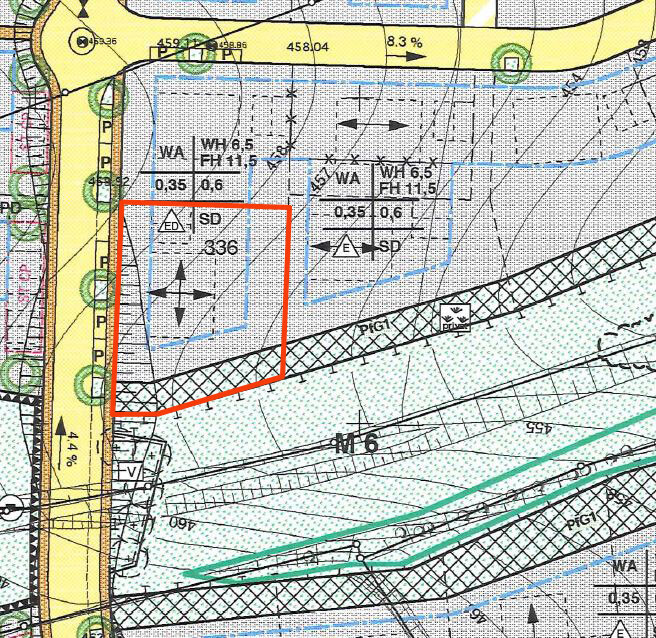
Plot size: 791 sqm (8509 sq ft)
Slope: yes
Site coverage ratio: 0.35
Floor area ratio: 0.6
Building envelope, building line & boundary: see attachment
Number of parking spaces: 2 (double garage planned)
Storeys: 2–2.5 (garden level/partial basement, ground floor, and possibly half attic as a gallery with an open space above the ground floor)
Roof style: gable roof (35–42° specified)
Orientation: open
Maximum heights/limits: ridge height: 6.5 m (21 ft 3 in); full height: 11.5 m (37 ft 9 in)
Other requirements: distance from house to street approx. 4.5 m (15 ft); (site slopes downward from street)
Homeowners’ Requirements
Style, roof shape, building type:
Unfortunately, we are restricted to a gable roof by the development plan; otherwise, I would have chosen a clear Bauhaus-style form.
Basement, storeys:
Garden level with 1/4 basement and 3/4 sleeping areas. Above, ground floor living spaces and possibly half an attic (gallery with open space and one room).
Number of occupants, ages:
3–4 persons: 44 and 46 years old; son 1.5 years and partner’s 12-year-old daughter (who either stays every other weekend or lives there full-time).
Room requirements on ground floor and upper floor:
Because the garage will likely require a basement due to the slope, we planned the basement (storage, possibly workshop) there with access from both the garden side and the house. The garden/basement level itself would contain the utility and laundry room, three bedrooms, and the main bathroom. On the ground floor (level with the street and also accessible from the garage), the living area with kitchen, open living and dining area, pantry/utility room, an office/guest room, and a guest bathroom are planned. An architect from one builder showed us the option of a half attic as a gallery with open ceiling over the living area plus a small room (guest room/office), which I really like.
Office: family use or home office?
Home office will definitely be used partly.
Overnight guests per year:
Hard to say, but a small guest room is planned.
Open or closed architecture:
Rather open in the living area, with an emphasis on views to the unobstructed, sloping greenery (southeast) through high ceilings (no intermediate ceiling there) and large windows.
Open kitchen, kitchen island:
Kitchen can be separated with a sliding door; kitchen island not necessary.
Number of dining seats:
6
Fireplace:
Preferred (or stove), but not mandatory.
Music/speaker wall:
Yes
Balcony, roof terrace:
Balcony on the ground floor facing southeast (preferably partially integrated into the house), south.
Garage, carport:
Garage preferred.
Utility garden, greenhouse:
Partly utility garden, partly space for digging and attractive landscaping, partly play space for our son.
Other wishes/special features/daily routine, including reasons for choices or exclusions:
We envision a KfW55-equivalent house with a (prepared) photovoltaic system.
I want the ground floor designed so that if mobility decreases later, we don’t have to move immediately and can live on one level. Therefore, an extra room on the ground floor is a must, currently for an office/guest room and later convertible to a bedroom. The guest bathroom should also have a shower for the same reason, and somewhere on the ground floor a washing machine connection should be considered.
I tend towards spaciousness and lots of living space with many rooms, but unfortunately, the budget limits that significantly. My partner is more minimalistic and wouldn’t mind if the house wasn’t too large.
I’m new here and would like to introduce myself/us and share our current situation:
I am 44 and my partner is 46. We currently live with our 1.5-year-old son in my condominium (107 sqm (1150 sq ft); purchased before we met). Since my partner has a one-hour commute each way and we have both had a long-standing interest in owning a house with a garden, we decided to buy a house roughly midway between our workplaces.
Initially, we planned to buy an existing property, but after viewing several, we increasingly felt that for a bit more money, we could get significantly more value with a new build (although I’m starting to doubt our assessment now, but oh well). The high additional costs, some of which were hard to verify, were also off-putting.
So, in September 2019, we put our name on the waiting list for a new development and have now actually secured the plot we liked best from the available options. We signed the purchase contract about a month ago.
Months before, we had already talked to banks and home builders and visited show home villages to get a sense of current houses. The banks gave us the go-ahead for a rough budget, while the builders understandably said they couldn’t meaningfully start discussions until the plot was confirmed.
Now, we’ve presented our plot (which we have also had professionally surveyed). It is important for us to build with a local provider.
Currently, three builders are in the running (plus a larger prefab house builder as a possible fourth, potentially cheaper option). We have received floor plan proposals from all three; one produced a plan for a house in a similar location, while the other two created rough floor plans based on our ideas (which we also received).
Our big dilemma is that we can’t decide which builder to proceed with.
Two of the companies build solid/masonry houses, and one builds timber frame houses. Intuitively, we both feel masonry houses are of better quality (which might now just be a prejudice depending on the builder?), but the same gut feeling trusts the timber frame builder most. We naturally also asked around, and it was thanks to recommendations that we found these three/four options.
Each has its pros and cons for us:
Masonry 1: So far, we have mostly been in contact with a seemingly competent sales rep rather than those who will actually build with and for us (site manager, etc.). They did quite a bit of preliminary work—asking about our wishes and having the architect create a special floor plan—but without fully considering the site’s challenges. Unfortunately, we’ve heard from an acquaintance that they are having problems towards the end (crooked walls, many windows cracked during installation, subcontractors not as local as promised, etc.). Two acquaintances also report that costs significantly exceeded the contract price.
Masonry 2: Didn’t put much effort into planning or our wishes; the floor plan pulled from the drawer at the second meeting might actually be okay, but we spent the entire first meeting discussing a plan that had nothing to do with what we wanted. He simply didn’t listen to our ideas. Advantage: He knows the development very well as he has built several houses there. Everyone we spoke with had very positive things to say about the company. Our contact person is co-owner and also site manager, so we already know who we would be dealing with. Since we’ve only had evening appointments, he seemed exhausted and not particularly attentive—maybe just bad timing.
Timber 1: The whole team gives a sincere, open, and professionally sound impression. The company is seemingly located deep in the woods, where the wood is processed onsite. Their architect personally visited our plot. He also pointed out many structural and legal aspects. The design he presented some weeks later incorporated our wishes as much as possible and included some nice ideas. They also directed us to an ongoing site where they are building a single-family house on a slope, which we visited today to get an impression of the finished product.
Timber 2: Like Masonry 1, we have only talked to a sales rep here. It is a smaller prefab home company, but with a house in a show village where we also met for a discussion. The gentleman took almost three hours for us, and we learned a lot about general costs and other aspects. The company offers both pre-configured homes and custom designs. The main advantage here is likely a somewhat lower price while still building more solidly than much of the prefab competition. Acquaintances who searched for a year for a suitable builder, and were quite picky, chose this company and are happy so far.
Regarding how it feels to work with them, we would currently prefer Timber 1. But we are unsure if we can imagine building with wood. My main concerns are faster depreciation and potentially lower long-term value. Is that a misconception? Are there good and bad timber frame builders? Also, the house with this company wouldn’t be cheaper or ready to move into faster than with the masonry builders. The company always points to the excellent indoor climate in a timber house. But is that really noticeable?
This company works with separate offers: one for planning including submitting the building permit / planning permission, then a separate one for construction. So we could at least have them design the house, but does it make sense to take that plan to another builder afterward?
(In general, I have to say that I am somewhat puzzled about the offer prices—maybe I was a bit naive. Anyway, all three builders want approximately €500,000 to €550,000 net for a turnkey house with about 160 to 180 sqm (1700 to 1937 sq ft) of living space and a double garage (although one does not even include underground garage construction). That’s actually too much for our budget, and we need to see where we can save €50,000. But that’s not the topic of this post.)
Very long text—my questions:
- How do you assess the quality of such custom timber frame houses?
- How important is a good feeling about the builder to you? Would you weigh that more heavily than (possibly irrational) concerns about the building material?
Thank you very much for your thoughts! We really can’t make progress and appreciate any input.
I don’t know if it makes sense for this thread to fill in the data, but just in case, here are the details.
Development Plan / Restrictions
Plot size: 791 sqm (8509 sq ft)
Slope: yes
Site coverage ratio: 0.35
Floor area ratio: 0.6
Building envelope, building line & boundary: see attachment
Number of parking spaces: 2 (double garage planned)
Storeys: 2–2.5 (garden level/partial basement, ground floor, and possibly half attic as a gallery with an open space above the ground floor)
Roof style: gable roof (35–42° specified)
Orientation: open
Maximum heights/limits: ridge height: 6.5 m (21 ft 3 in); full height: 11.5 m (37 ft 9 in)
Other requirements: distance from house to street approx. 4.5 m (15 ft); (site slopes downward from street)
Homeowners’ Requirements
Style, roof shape, building type:
Unfortunately, we are restricted to a gable roof by the development plan; otherwise, I would have chosen a clear Bauhaus-style form.
Basement, storeys:
Garden level with 1/4 basement and 3/4 sleeping areas. Above, ground floor living spaces and possibly half an attic (gallery with open space and one room).
Number of occupants, ages:
3–4 persons: 44 and 46 years old; son 1.5 years and partner’s 12-year-old daughter (who either stays every other weekend or lives there full-time).
Room requirements on ground floor and upper floor:
Because the garage will likely require a basement due to the slope, we planned the basement (storage, possibly workshop) there with access from both the garden side and the house. The garden/basement level itself would contain the utility and laundry room, three bedrooms, and the main bathroom. On the ground floor (level with the street and also accessible from the garage), the living area with kitchen, open living and dining area, pantry/utility room, an office/guest room, and a guest bathroom are planned. An architect from one builder showed us the option of a half attic as a gallery with open ceiling over the living area plus a small room (guest room/office), which I really like.
Office: family use or home office?
Home office will definitely be used partly.
Overnight guests per year:
Hard to say, but a small guest room is planned.
Open or closed architecture:
Rather open in the living area, with an emphasis on views to the unobstructed, sloping greenery (southeast) through high ceilings (no intermediate ceiling there) and large windows.
Open kitchen, kitchen island:
Kitchen can be separated with a sliding door; kitchen island not necessary.
Number of dining seats:
6
Fireplace:
Preferred (or stove), but not mandatory.
Music/speaker wall:
Yes
Balcony, roof terrace:
Balcony on the ground floor facing southeast (preferably partially integrated into the house), south.
Garage, carport:
Garage preferred.
Utility garden, greenhouse:
Partly utility garden, partly space for digging and attractive landscaping, partly play space for our son.
Other wishes/special features/daily routine, including reasons for choices or exclusions:
We envision a KfW55-equivalent house with a (prepared) photovoltaic system.
I want the ground floor designed so that if mobility decreases later, we don’t have to move immediately and can live on one level. Therefore, an extra room on the ground floor is a must, currently for an office/guest room and later convertible to a bedroom. The guest bathroom should also have a shower for the same reason, and somewhere on the ground floor a washing machine connection should be considered.
I tend towards spaciousness and lots of living space with many rooms, but unfortunately, the budget limits that significantly. My partner is more minimalistic and wouldn’t mind if the house wasn’t too large.
G
Gerddieter22 Nov 2020 10:38JayneCobb schrieb:
In any case, all three providers are asking for around 500,000 to 550,000 euros net for a turnkey house with approximately 160 to 180 square meters (1,725 to 1,940 square feet) of living space and a double garage—although for one of them, the garage basement isn’t even included.Hi, are you sure that’s NET price? That would be about 600,000 to 650,000 euros gross. That seems quite high to me—maybe it’s gross? Check that again, that could already be your first saving...Best regards, GD
H
hampshire22 Nov 2020 10:55Elokine schrieb:
I always find such a consideration questionable because no one knows what will happen in 30 years or who among you might become frail... Especially on a sloped site. I don’t find that questionable at all. It really depends on how you implement it. We have designed our house so that it can become accessible for seniors or people with disabilities with very few adjustments. Our house can adapt over the coming years to our life with or without children, with or without work, with or without physical limitations, and with or without higher income. If this is taken into account in the architecture from the start, it is possible to integrate these requirements without significant practical compromises—aside from some additional costs, of course. If you only consider the classic solutions, where accessible living is retrofitted later into a design, it’s easy to be skeptical.
saralina87 schrieb:
The build has to feel right, and for that, it’s really important to be confident in the general contractor. I completely agree!
Gerddieter schrieb:
Hi, are you sure that’s the NET amount?
Then gross would be 600–650 thousand...
That seems high—maybe it’s gross? With a net budget of 500–550 thousand euros (approximately 600–660 thousand USD), you don’t have to scrimp on every detail, but you also can’t indulge every wish.
Ã
Ötzi Ötztaler22 Nov 2020 11:08JayneCobb schrieb:
He knows the building area very well, as he has already constructed several houses there. Everyone we spoke to had very positive things to say about the company. Our contact person is the co-owner and also the site manager, so we already know who we will be dealing with. That would be a very strong reason to choose Solid2.
JayneCobb schrieb:
The architect working for them took the time to visit our plot. He also pointed out many structural and legal aspects to us. And that is a very strong reason to choose Wood1.
In the end, I would let your gut feeling decide. At that time, I was very fixed on solid construction and didn’t even seriously inquire with timber builders. But looking at my neighbor’s house now, I can see that a timber house can definitely be very high quality.
Ask yourself this question: With which company would you be most likely to find a constructive solution if a dispute arises during construction?
My gut feeling: Better to choose a solid house than a timber house from a low-cost provider, if there is no price difference. This protects against unpleasant surprises when reselling. But with mid-range to high-end offers using correspondingly high-quality materials, wood or solid construction is actually irrelevant and purely a matter of personal taste.
hampshire schrieb:
I don’t find this questionable at all. It really depends on how it is implemented. We designed our house so that it can be adapted for elderly or disabled needs with very few modifications. Our home can adjust over the coming years to our life with or without children, with or without work, with or without physical limitations, and with or without higher income. If these aspects are considered in the architecture from the start, it’s possible to integrate this requirement without any significant practical compromises—just some additional costs. If you only consider traditional solutions, where accessible living is retrofitted into a design afterwards, it’s easy to become skeptical. Of course, it’s good to think about this in advance. I just don’t understand why so many—often very young—home builders think that a great solution is to squeeze themselves into a tiny office space when they’re older, leaving the other one or two floors unused.
There are also other options, like stairlifts or, for hillside sites, ramps. Or moving later in life to a bungalow, a nice city apartment, etc.
A solid house no longer deserves that name nowadays. Due to energy efficiency, more air than stone is used in construction. Therefore, I consider wooden houses to be at least just as high-quality, perhaps even better. Nevertheless, we built with solid construction because it is more common in our region and the long-term value stability is significantly higher.

First of all, my compliments for the exemplary presentation :-)
Aside from the fact that we also like to compare four designs here: I wouldn’t compare four candidates based solely on four designs (keyword: comparing apples and oranges), but rather at least compare the two masonry builders and the two timber builders among themselves, and also cross-check each one by asking for the price of the other’s house.
That is absolutely correct—this is only a prejudice. Incidentally, the “smaller” timber builders often have fans (usually for biobased building reasons), which also positively influences the reputation of their products by word of mouth.
Do the two masonry builders and the two timber builders each build “similarly” to one another (i.e. not monolithic vs. insulated render systems or wood frame panel vs. solid timber)?
https://www.instagram.com/11antgmxde/
https://www.linkedin.com/company/bauen-jetzt/
Aside from the fact that we also like to compare four designs here: I wouldn’t compare four candidates based solely on four designs (keyword: comparing apples and oranges), but rather at least compare the two masonry builders and the two timber builders among themselves, and also cross-check each one by asking for the price of the other’s house.
JayneCobb schrieb:
Intuitively, we both think that solid-built houses are of higher quality (which, depending on the provider, is probably just a prejudice by now?),
That is absolutely correct—this is only a prejudice. Incidentally, the “smaller” timber builders often have fans (usually for biobased building reasons), which also positively influences the reputation of their products by word of mouth.
Do the two masonry builders and the two timber builders each build “similarly” to one another (i.e. not monolithic vs. insulated render systems or wood frame panel vs. solid timber)?
https://www.instagram.com/11antgmxde/
https://www.linkedin.com/company/bauen-jetzt/
Similar topics