
J
JayneCobb22 Nov 2020 03:59Hello everyone,
I’m new here and would like to introduce myself/us and share our current situation:
I am 44 and my partner is 46. We currently live with our 1.5-year-old son in my condominium (107 sqm (1150 sq ft); purchased before we met). Since my partner has a one-hour commute each way and we have both had a long-standing interest in owning a house with a garden, we decided to buy a house roughly midway between our workplaces.
Initially, we planned to buy an existing property, but after viewing several, we increasingly felt that for a bit more money, we could get significantly more value with a new build (although I’m starting to doubt our assessment now, but oh well). The high additional costs, some of which were hard to verify, were also off-putting.
So, in September 2019, we put our name on the waiting list for a new development and have now actually secured the plot we liked best from the available options. We signed the purchase contract about a month ago.
Months before, we had already talked to banks and home builders and visited show home villages to get a sense of current houses. The banks gave us the go-ahead for a rough budget, while the builders understandably said they couldn’t meaningfully start discussions until the plot was confirmed.
Now, we’ve presented our plot (which we have also had professionally surveyed). It is important for us to build with a local provider.
Currently, three builders are in the running (plus a larger prefab house builder as a possible fourth, potentially cheaper option). We have received floor plan proposals from all three; one produced a plan for a house in a similar location, while the other two created rough floor plans based on our ideas (which we also received).
Our big dilemma is that we can’t decide which builder to proceed with.
Two of the companies build solid/masonry houses, and one builds timber frame houses. Intuitively, we both feel masonry houses are of better quality (which might now just be a prejudice depending on the builder?), but the same gut feeling trusts the timber frame builder most. We naturally also asked around, and it was thanks to recommendations that we found these three/four options.
Each has its pros and cons for us:
Masonry 1: So far, we have mostly been in contact with a seemingly competent sales rep rather than those who will actually build with and for us (site manager, etc.). They did quite a bit of preliminary work—asking about our wishes and having the architect create a special floor plan—but without fully considering the site’s challenges. Unfortunately, we’ve heard from an acquaintance that they are having problems towards the end (crooked walls, many windows cracked during installation, subcontractors not as local as promised, etc.). Two acquaintances also report that costs significantly exceeded the contract price.
Masonry 2: Didn’t put much effort into planning or our wishes; the floor plan pulled from the drawer at the second meeting might actually be okay, but we spent the entire first meeting discussing a plan that had nothing to do with what we wanted. He simply didn’t listen to our ideas. Advantage: He knows the development very well as he has built several houses there. Everyone we spoke with had very positive things to say about the company. Our contact person is co-owner and also site manager, so we already know who we would be dealing with. Since we’ve only had evening appointments, he seemed exhausted and not particularly attentive—maybe just bad timing.
Timber 1: The whole team gives a sincere, open, and professionally sound impression. The company is seemingly located deep in the woods, where the wood is processed onsite. Their architect personally visited our plot. He also pointed out many structural and legal aspects. The design he presented some weeks later incorporated our wishes as much as possible and included some nice ideas. They also directed us to an ongoing site where they are building a single-family house on a slope, which we visited today to get an impression of the finished product.
Timber 2: Like Masonry 1, we have only talked to a sales rep here. It is a smaller prefab home company, but with a house in a show village where we also met for a discussion. The gentleman took almost three hours for us, and we learned a lot about general costs and other aspects. The company offers both pre-configured homes and custom designs. The main advantage here is likely a somewhat lower price while still building more solidly than much of the prefab competition. Acquaintances who searched for a year for a suitable builder, and were quite picky, chose this company and are happy so far.
Regarding how it feels to work with them, we would currently prefer Timber 1. But we are unsure if we can imagine building with wood. My main concerns are faster depreciation and potentially lower long-term value. Is that a misconception? Are there good and bad timber frame builders? Also, the house with this company wouldn’t be cheaper or ready to move into faster than with the masonry builders. The company always points to the excellent indoor climate in a timber house. But is that really noticeable?
This company works with separate offers: one for planning including submitting the building permit / planning permission, then a separate one for construction. So we could at least have them design the house, but does it make sense to take that plan to another builder afterward?
(In general, I have to say that I am somewhat puzzled about the offer prices—maybe I was a bit naive. Anyway, all three builders want approximately €500,000 to €550,000 net for a turnkey house with about 160 to 180 sqm (1700 to 1937 sq ft) of living space and a double garage (although one does not even include underground garage construction). That’s actually too much for our budget, and we need to see where we can save €50,000. But that’s not the topic of this post.)
Very long text—my questions:
- How do you assess the quality of such custom timber frame houses?
- How important is a good feeling about the builder to you? Would you weigh that more heavily than (possibly irrational) concerns about the building material?
Thank you very much for your thoughts! We really can’t make progress and appreciate any input.
I don’t know if it makes sense for this thread to fill in the data, but just in case, here are the details.
Development Plan / Restrictions
Plot size: 791 sqm (8509 sq ft)
Slope: yes
Site coverage ratio: 0.35
Floor area ratio: 0.6
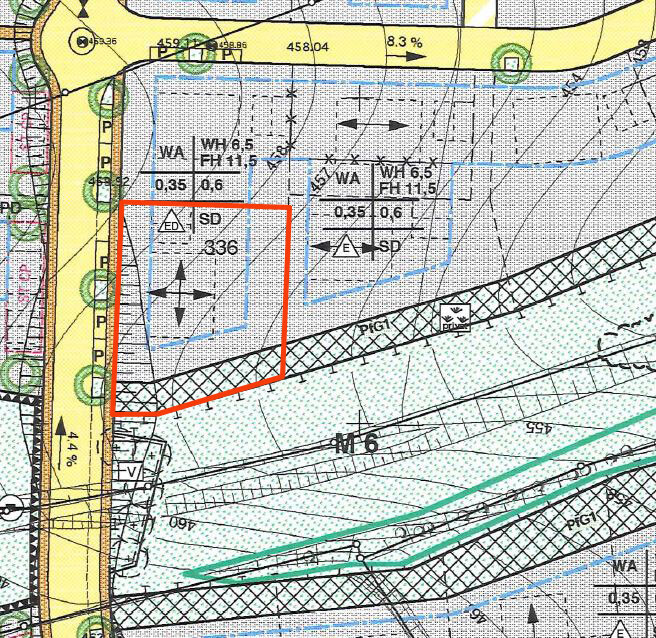
Building envelope, building line & boundary: see attachment
Number of parking spaces: 2 (double garage planned)
Storeys: 2–2.5 (garden level/partial basement, ground floor, and possibly half attic as a gallery with an open space above the ground floor)
Roof style: gable roof (35–42° specified)
Orientation: open
Maximum heights/limits: ridge height: 6.5 m (21 ft 3 in); full height: 11.5 m (37 ft 9 in)
Other requirements: distance from house to street approx. 4.5 m (15 ft); (site slopes downward from street)
Homeowners’ Requirements
Style, roof shape, building type:
Unfortunately, we are restricted to a gable roof by the development plan; otherwise, I would have chosen a clear Bauhaus-style form.
Basement, storeys:
Garden level with 1/4 basement and 3/4 sleeping areas. Above, ground floor living spaces and possibly half an attic (gallery with open space and one room).
Number of occupants, ages:
3–4 persons: 44 and 46 years old; son 1.5 years and partner’s 12-year-old daughter (who either stays every other weekend or lives there full-time).
Room requirements on ground floor and upper floor:
Because the garage will likely require a basement due to the slope, we planned the basement (storage, possibly workshop) there with access from both the garden side and the house. The garden/basement level itself would contain the utility and laundry room, three bedrooms, and the main bathroom. On the ground floor (level with the street and also accessible from the garage), the living area with kitchen, open living and dining area, pantry/utility room, an office/guest room, and a guest bathroom are planned. An architect from one builder showed us the option of a half attic as a gallery with open ceiling over the living area plus a small room (guest room/office), which I really like.
Office: family use or home office?
Home office will definitely be used partly.
Overnight guests per year:
Hard to say, but a small guest room is planned.
Open or closed architecture:
Rather open in the living area, with an emphasis on views to the unobstructed, sloping greenery (southeast) through high ceilings (no intermediate ceiling there) and large windows.
Open kitchen, kitchen island:
Kitchen can be separated with a sliding door; kitchen island not necessary.
Number of dining seats:
6
Fireplace:
Preferred (or stove), but not mandatory.
Music/speaker wall:
Yes
Balcony, roof terrace:
Balcony on the ground floor facing southeast (preferably partially integrated into the house), south.
Garage, carport:
Garage preferred.
Utility garden, greenhouse:
Partly utility garden, partly space for digging and attractive landscaping, partly play space for our son.
Other wishes/special features/daily routine, including reasons for choices or exclusions:
We envision a KfW55-equivalent house with a (prepared) photovoltaic system.
I want the ground floor designed so that if mobility decreases later, we don’t have to move immediately and can live on one level. Therefore, an extra room on the ground floor is a must, currently for an office/guest room and later convertible to a bedroom. The guest bathroom should also have a shower for the same reason, and somewhere on the ground floor a washing machine connection should be considered.
I tend towards spaciousness and lots of living space with many rooms, but unfortunately, the budget limits that significantly. My partner is more minimalistic and wouldn’t mind if the house wasn’t too large.
I’m new here and would like to introduce myself/us and share our current situation:
I am 44 and my partner is 46. We currently live with our 1.5-year-old son in my condominium (107 sqm (1150 sq ft); purchased before we met). Since my partner has a one-hour commute each way and we have both had a long-standing interest in owning a house with a garden, we decided to buy a house roughly midway between our workplaces.
Initially, we planned to buy an existing property, but after viewing several, we increasingly felt that for a bit more money, we could get significantly more value with a new build (although I’m starting to doubt our assessment now, but oh well). The high additional costs, some of which were hard to verify, were also off-putting.
So, in September 2019, we put our name on the waiting list for a new development and have now actually secured the plot we liked best from the available options. We signed the purchase contract about a month ago.
Months before, we had already talked to banks and home builders and visited show home villages to get a sense of current houses. The banks gave us the go-ahead for a rough budget, while the builders understandably said they couldn’t meaningfully start discussions until the plot was confirmed.
Now, we’ve presented our plot (which we have also had professionally surveyed). It is important for us to build with a local provider.
Currently, three builders are in the running (plus a larger prefab house builder as a possible fourth, potentially cheaper option). We have received floor plan proposals from all three; one produced a plan for a house in a similar location, while the other two created rough floor plans based on our ideas (which we also received).
Our big dilemma is that we can’t decide which builder to proceed with.
Two of the companies build solid/masonry houses, and one builds timber frame houses. Intuitively, we both feel masonry houses are of better quality (which might now just be a prejudice depending on the builder?), but the same gut feeling trusts the timber frame builder most. We naturally also asked around, and it was thanks to recommendations that we found these three/four options.
Each has its pros and cons for us:
Masonry 1: So far, we have mostly been in contact with a seemingly competent sales rep rather than those who will actually build with and for us (site manager, etc.). They did quite a bit of preliminary work—asking about our wishes and having the architect create a special floor plan—but without fully considering the site’s challenges. Unfortunately, we’ve heard from an acquaintance that they are having problems towards the end (crooked walls, many windows cracked during installation, subcontractors not as local as promised, etc.). Two acquaintances also report that costs significantly exceeded the contract price.
Masonry 2: Didn’t put much effort into planning or our wishes; the floor plan pulled from the drawer at the second meeting might actually be okay, but we spent the entire first meeting discussing a plan that had nothing to do with what we wanted. He simply didn’t listen to our ideas. Advantage: He knows the development very well as he has built several houses there. Everyone we spoke with had very positive things to say about the company. Our contact person is co-owner and also site manager, so we already know who we would be dealing with. Since we’ve only had evening appointments, he seemed exhausted and not particularly attentive—maybe just bad timing.
Timber 1: The whole team gives a sincere, open, and professionally sound impression. The company is seemingly located deep in the woods, where the wood is processed onsite. Their architect personally visited our plot. He also pointed out many structural and legal aspects. The design he presented some weeks later incorporated our wishes as much as possible and included some nice ideas. They also directed us to an ongoing site where they are building a single-family house on a slope, which we visited today to get an impression of the finished product.
Timber 2: Like Masonry 1, we have only talked to a sales rep here. It is a smaller prefab home company, but with a house in a show village where we also met for a discussion. The gentleman took almost three hours for us, and we learned a lot about general costs and other aspects. The company offers both pre-configured homes and custom designs. The main advantage here is likely a somewhat lower price while still building more solidly than much of the prefab competition. Acquaintances who searched for a year for a suitable builder, and were quite picky, chose this company and are happy so far.
Regarding how it feels to work with them, we would currently prefer Timber 1. But we are unsure if we can imagine building with wood. My main concerns are faster depreciation and potentially lower long-term value. Is that a misconception? Are there good and bad timber frame builders? Also, the house with this company wouldn’t be cheaper or ready to move into faster than with the masonry builders. The company always points to the excellent indoor climate in a timber house. But is that really noticeable?
This company works with separate offers: one for planning including submitting the building permit / planning permission, then a separate one for construction. So we could at least have them design the house, but does it make sense to take that plan to another builder afterward?
(In general, I have to say that I am somewhat puzzled about the offer prices—maybe I was a bit naive. Anyway, all three builders want approximately €500,000 to €550,000 net for a turnkey house with about 160 to 180 sqm (1700 to 1937 sq ft) of living space and a double garage (although one does not even include underground garage construction). That’s actually too much for our budget, and we need to see where we can save €50,000. But that’s not the topic of this post.)
Very long text—my questions:
- How do you assess the quality of such custom timber frame houses?
- How important is a good feeling about the builder to you? Would you weigh that more heavily than (possibly irrational) concerns about the building material?
Thank you very much for your thoughts! We really can’t make progress and appreciate any input.
I don’t know if it makes sense for this thread to fill in the data, but just in case, here are the details.
Development Plan / Restrictions
Plot size: 791 sqm (8509 sq ft)
Slope: yes
Site coverage ratio: 0.35
Floor area ratio: 0.6
Building envelope, building line & boundary: see attachment
Number of parking spaces: 2 (double garage planned)
Storeys: 2–2.5 (garden level/partial basement, ground floor, and possibly half attic as a gallery with an open space above the ground floor)
Roof style: gable roof (35–42° specified)
Orientation: open
Maximum heights/limits: ridge height: 6.5 m (21 ft 3 in); full height: 11.5 m (37 ft 9 in)
Other requirements: distance from house to street approx. 4.5 m (15 ft); (site slopes downward from street)
Homeowners’ Requirements
Style, roof shape, building type:
Unfortunately, we are restricted to a gable roof by the development plan; otherwise, I would have chosen a clear Bauhaus-style form.
Basement, storeys:
Garden level with 1/4 basement and 3/4 sleeping areas. Above, ground floor living spaces and possibly half an attic (gallery with open space and one room).
Number of occupants, ages:
3–4 persons: 44 and 46 years old; son 1.5 years and partner’s 12-year-old daughter (who either stays every other weekend or lives there full-time).
Room requirements on ground floor and upper floor:
Because the garage will likely require a basement due to the slope, we planned the basement (storage, possibly workshop) there with access from both the garden side and the house. The garden/basement level itself would contain the utility and laundry room, three bedrooms, and the main bathroom. On the ground floor (level with the street and also accessible from the garage), the living area with kitchen, open living and dining area, pantry/utility room, an office/guest room, and a guest bathroom are planned. An architect from one builder showed us the option of a half attic as a gallery with open ceiling over the living area plus a small room (guest room/office), which I really like.
Office: family use or home office?
Home office will definitely be used partly.
Overnight guests per year:
Hard to say, but a small guest room is planned.
Open or closed architecture:
Rather open in the living area, with an emphasis on views to the unobstructed, sloping greenery (southeast) through high ceilings (no intermediate ceiling there) and large windows.
Open kitchen, kitchen island:
Kitchen can be separated with a sliding door; kitchen island not necessary.
Number of dining seats:
6
Fireplace:
Preferred (or stove), but not mandatory.
Music/speaker wall:
Yes
Balcony, roof terrace:
Balcony on the ground floor facing southeast (preferably partially integrated into the house), south.
Garage, carport:
Garage preferred.
Utility garden, greenhouse:
Partly utility garden, partly space for digging and attractive landscaping, partly play space for our son.
Other wishes/special features/daily routine, including reasons for choices or exclusions:
We envision a KfW55-equivalent house with a (prepared) photovoltaic system.
I want the ground floor designed so that if mobility decreases later, we don’t have to move immediately and can live on one level. Therefore, an extra room on the ground floor is a must, currently for an office/guest room and later convertible to a bedroom. The guest bathroom should also have a shower for the same reason, and somewhere on the ground floor a washing machine connection should be considered.
I tend towards spaciousness and lots of living space with many rooms, but unfortunately, the budget limits that significantly. My partner is more minimalistic and wouldn’t mind if the house wasn’t too large.
I would swap the floors. Living areas should face the garden. Otherwise, you lose many advantages of the house. Once you’ve built, you can just open the door and your son will be in the garden.
Budget: take a look around the financing section here. A slope is expensive, and the landscaping costs extra. There are always ways to save. I wouldn’t use up your contingency fund just yet.
Post your floor plan and we’ll help you reduce its size. From what you say, the entire attic floor is only "would be nice" space. Use it only for what’s necessary and reduce the floor area.
Regarding the builder: based on what you wrote, definitely Holz1.
In my opinion, timber frame construction is not worse than solid construction. It depends on the workmanship.
Write down your room program, not just the rooms but what needs to go into them and what might make them unique to you.
Not just “bed,” but 2.00 m x 2.20 m (because of extra length, large frame), 5 meters (16 ft) of continuous wardrobe space.
Always make sure these items fit into your floor plan.
Think about what is important for the fixtures and finishes. Often, the provider with the building specification that most closely matches your wishes is the most cost-effective.
I would only choose a builder with whom I feel understood.
Budget: take a look around the financing section here. A slope is expensive, and the landscaping costs extra. There are always ways to save. I wouldn’t use up your contingency fund just yet.
Post your floor plan and we’ll help you reduce its size. From what you say, the entire attic floor is only "would be nice" space. Use it only for what’s necessary and reduce the floor area.
Regarding the builder: based on what you wrote, definitely Holz1.
In my opinion, timber frame construction is not worse than solid construction. It depends on the workmanship.
Write down your room program, not just the rooms but what needs to go into them and what might make them unique to you.
Not just “bed,” but 2.00 m x 2.20 m (because of extra length, large frame), 5 meters (16 ft) of continuous wardrobe space.
Always make sure these items fit into your floor plan.
Think about what is important for the fixtures and finishes. Often, the provider with the building specification that most closely matches your wishes is the most cost-effective.
I would only choose a builder with whom I feel understood.
H
hampshire22 Nov 2020 08:07JayneCobb schrieb:
My main concerns are about faster depreciation and potentially lower long-term value. Is that wrong? Are there both good and bad timber house builders? Also, would a house from this company not be cheaper or ready for occupancy faster than from a solid masonry house builder? The company always emphasizes the great indoor climate in a timber house. But is it really that noticeable? Your concerns are not technically justified. Construction quality is the key factor. Timber houses last just as long as stone houses across multiple generations. That should be enough. Appreciation or depreciation is not a material issue with good workmanship; location, market conditions, and trends matter more. There are excellent timber house builders. The effort required to build with timber is not less. Depending on the construction method, the assembly of prefabricated walls by timber builders is often an eye-opener.
Regarding indoor climate, there are hundreds of opinions. Some focus purely on measuring humidity and air temperature, others consider additional parameters. Timber houses vary in construction as much as stone houses do. Both types can be executed well or poorly.
We chose timber and contracted the trades individually. Schwirten & Klein Carpentry took the lead and coordinated the build. They also offer turnkey construction, which was evident in the overall professional process. All companies involved in the build were local. This approach proved successful.
JayneCobb schrieb:
How do you rate such a custom timber house in terms of quality?
- How important is having a good feeling about the developer; would you prioritize that over (perhaps irrational) material concerns? The quality of our custom house is undoubtedly very high.
Having a good feeling about the developer is a basic prerequisite. Genuine interest in the client (not just the money) suggests good communication throughout the building process. Enthusiasm for and identification with the work on site is a strong promise of quality.
Your entire description, including the plot, future house, and searching for companies, sounds just like our situation. Crazy. I wouldn’t be surprised if Holz1’s headquarters were in Großrinderfeld.
In the end, we chose solid construction. However, this was not due to any doubts about the quality of timber construction. Nor was it because of the price, as all bids were very close. With such a good reputation among the compared providers, ultimately our gut feeling made the difference because we felt even more on the same wavelength with one of them...
You say that budget shouldn’t really matter here, but I still want to share a few thoughts with you.
It will be very difficult to fulfill all your wishes with 500k. The basemented double garage alone will cost you 50,000 euros. We had an offer for a basemented single garage for 30,000 euros and eventually decided against it. Instead, we now have a shed next to the garage for garden tools and bicycles.
I always find such considerations questionable because no one knows what will happen in 30 years or who might become frail... Especially on a sloped site! How do you plan to properly maintain and manage the house if you can’t even manage one staircase to bed? Besides, stairlifts are an option.
Just as @haydee wrote, it’s better to use the attic space! Office/guest room on one side, and the other can still be a gallery or open space. Or you could design a cool personal space under the roof for your 12-year-old right away.
For comparison: our footprint is just under 9 by 11 meters (30 by 36 feet), and we are paying 500,000 euros just for the house—without garage, balcony, or landscaping.
In the end, we chose solid construction. However, this was not due to any doubts about the quality of timber construction. Nor was it because of the price, as all bids were very close. With such a good reputation among the compared providers, ultimately our gut feeling made the difference because we felt even more on the same wavelength with one of them...
JayneCobb schrieb:
In general, I have to say that I’m a bit confused about the offer prices; maybe I was a bit too naive.
In any case, all three providers want around 500,000 to 550,000 euros net for a turnkey house with about 160 to 180 sqm (1,722 to 1,938 sq ft) of living space and a double garage (yet one of them doesn’t even include the basement under the garage). That’s really too much for our budget, and we’ll need to see if, where, and how we can save 50,000 euros. But that’s not the topic of this post.)
You say that budget shouldn’t really matter here, but I still want to share a few thoughts with you.
It will be very difficult to fulfill all your wishes with 500k. The basemented double garage alone will cost you 50,000 euros. We had an offer for a basemented single garage for 30,000 euros and eventually decided against it. Instead, we now have a shed next to the garage for garden tools and bicycles.
JayneCobb schrieb:
I want to design the ground floor so that later, if mobility becomes difficult, we don’t have to move immediately but can live on one level. Therefore, an extra room on the ground floor is a must, currently used as an office/guest room and potentially convertible into a bedroom later.
I always find such considerations questionable because no one knows what will happen in 30 years or who might become frail... Especially on a sloped site! How do you plan to properly maintain and manage the house if you can’t even manage one staircase to bed? Besides, stairlifts are an option.
Just as @haydee wrote, it’s better to use the attic space! Office/guest room on one side, and the other can still be a gallery or open space. Or you could design a cool personal space under the roof for your 12-year-old right away.
For comparison: our footprint is just under 9 by 11 meters (30 by 36 feet), and we are paying 500,000 euros just for the house—without garage, balcony, or landscaping.
A
allstar8322 Nov 2020 10:22You already have quite clear ideas. You should get a quote from, for example, your three favorites. Ideally, include all the conditions so that the offers are reasonably comparable. I think many builders can construct houses. In the end, it will also be crucial who you work best with. At least, that was the deciding factor for us.
S
saralina8722 Nov 2020 10:36We are currently building a timber house (not timber frame construction but solid wood) – it’s not cheaper than brick. We were quite open regarding the material and in the end, we went with our gut feeling. We have never really worried about durability or quality, but it seems that many people feel that wooden houses are less "stable" (perhaps a leftover from the story of the three little pigs?). Don’t let that influence you. The build has to feel right, and for that it’s extremely important to be confident in your general contractor.
Similar topics